
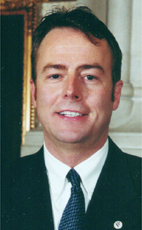
House of Commons photo

Crucial Fact

  • His favourite word was quebec.

Last in Parliament May 2004, as Bloc MP for Berthier—Montcalm (Québec)

Won his last election, in 2000, with 57% of the vote.

Statements in the House

Supply May 18th, 1995

Madam Speaker, it is a great pleasure to rise at this stage in the debate, especially after a speech by the Reform Party on a very important motion tabled by the Bloc Quebecois.

I think that we should put the cards on the table and look at what is really happening. The motion is very clear. It is aimed at denouncing the federal government's delay in paying the money it owes Quebec. This government owes Quebec $79 million as a result of the Oka crisis, $135 million under the 1991-92 stabilization program, and $119 million for problems related to

the education of young aboriginal people in northern Quebec. The Minister of Indian Affairs and the federal government know that these amounts are owed, but they are not doing anything about it.

It is normal for the Bloc Quebecois, for Quebec MPs elected by Quebecers to defend Quebec's interests in Ottawa, to table such a motion on an opposition day, because it is in the news. This week, a Quebec official met with her federal counterpart to claim the tidy sum of $333 million. You expect us to remain silent while this is going on? No way. We have been sent here with a clear mandate, which we intend to fulfil, and we will fight for this money because it is owed to Quebec. We will work to get it.

Again, this issue gives us the opportunity to show clearly that Quebecers made a very definite choice in the last federal election because, as you know, Madam Speaker, this issue has been dragging on for years. Let me take a minute to give you some background information. We did not make anything up. The Bloc Quebecois and the big bad separatists in Quebec had nothing to do with this. Once upon a time, there was a federalist government called the Bourassa government in Quebec; it was a Liberal government. In the last Liberal budget tabled in the Province of Quebec, the Bourassa government indicated that the federal government owed $300 million to Quebec.

Is this something that big bad separatists made up? No, Madam Speaker. If the allies of our friends opposite, those who will share their platform in the Quebec referendum scheduled for this year, if the Liberals mentioned this $300 million in their budget-and we know that they are pals with our friends opposite-it is because this amount is really owed. It remains to be paid.

I had a prepared speech but I think that I will set it aside and speak from the heart instead, because this is much too important an issue. I think you can push, but only so far. Our motion refers to three demands of the highest importance. Let us look at them one at a time.

First, there is the Oka crisis. What was this crisis? Well, Oka is in Quebec. Certain Indians claimed a strip of land in that area in the 1990s, and the Quebec provincial police, as well as the Canadian Armed Forces, had to be called in. The Minister of Intergovernmental Affairs said so himself. He reported having spent $122 million on these measures. And we are supposed to believe that these were not emergency measures related to a disaster, that, to use his own words, public order and public good are slightly different?

If it were strictly a matter of public good, what was the army doing there? Why did the government spend $122 million? Can you tell me, Madam Speaker? Because there was an element of public order involved, which is directly covered by federal-provincial agreement in the definition of disaster. This may sound like a strange term, disaster, but that is what the agreement says, and letters were even exchanged by the two levels of government, in which the federal government recognized the events in Oka were a disaster under the terms of the agreement.

Correspondence exchanged between the provincial Liberal government and the federal Conservative government at the time provides that the Oka crisis is covered by that agreement. An amount of $139 million was spent on that in Quebec. How did the federal government pay its debt? It gave $5.3 million. Then, it said: "The federal government is acting in good faith. It would pay the total bill, but the issue relates to public good, not public order". Such an interpretation can only be made in bad faith. When $122 million was spent because of the existence of a threat to the public, either the federal government pays the full amount or, if it does not want to respect its own agreements or thinks that it will not be able to fulfil its commitment, it should not sign such agreements with the provinces. This is what is deplorable.

Governments, whether they are Conservative or Liberal, are all the same. In fact, whether we are talking about the Conservatives, the Liberals or the Reform Party, it is all the same when it comes to looking after Quebec's interests. They are all opposed to these interests. This is the case and we have a very good example of that here, where Reform, Liberal, and Conservative members are working hand in hand. They belong to different parties, but they all react in the same manner regarding this issue. They are all opposed to Quebec's interests.

They put Quebec in its place. That is what federalists want to do, put Quebec in its place, and that is what they have been doing for 30 years. And then, they wonder why there is a sovereignist movement in Quebec.

There is a very precise order to the events in the Oka crisis. All the ministers who dealt with that issue have that correspondence. They know that the $139.7 million Quebec spent on that issue was not money spent for a futile purpose; it was spent to maintain public order. There was a major crisis going on. Those events involved the death of one person, and there was the need to intervene. That is why that money was spent, through the Quebec provincial police force.

It must be remembered that there is a provincial police force in Quebec. The province provides its own police services. What would have happened, say, if such a crisis had taken place in Manitoba, a province without a provincial police force? The events would have been monitored by the RCMP. Who would have paid? The federal government. Would the federal government have passed the $139.7 million bill on to the province of Manitoba? I doubt it.

Let us look at what is going on now with federal-provincial agreements on law enforcement services between that province and the federal government. The federal government provides police officers, and pays them, but it cannot even pass on the bill to get full payment for the services it provides to that province. Some might think that the member for Berthier-Montcalm is putting forward figures without knowing what he is talking about, but those are not my figures. The Solicitor General of Canada is the one who pointed them out. The solicitor general has been saying year in and year out: "You cannot even recover all the costs of the RCMP services you are providing, and you should".

And then, we are told that in a case like the Oka crisis that could have happened anywhere in Canada, the whole bill should be passed on to the province. Madam Speaker, this could only happen here. It could only happen in Quebec. It is the only province that has to argue to have the federal government pay its bills. We should not forget the Charlottetown referendum. How many times did we have to raise the issue in this House in order to get the federal government to pay the $35 million it owed? Quebec paid twice for that referendum that was forced upon it. The federal government imposed that referendum, and we had to pay for it twice.

It is only when the government opposite examined the issue, set aside its political interests and partisan considerations that it handed a $35 million cheque to Quebec, because that claim was indeed justified.

The situation is exactly the same with the Oka crisis. Quebec is owed $79 million. Now, who is going to pay?

I would now like to say a few words about the second claim concerning the education of young aboriginals. I am particularly pleased to do so when the minister is here. He will certainly confirm what I have to say.

Is it not strange that, here again, we had agreements between both levels of government on the education of aboriginals? One point should be clear. Aboriginal affairs are a federal jurisdiction. When the federal government steps outside its jurisdiction, we take it to task. What we have here is exclusively under federal jurisdiction. Let the government abide by that nice Canadian constitution it so eagerly defends in the House. Let it honour its signature. Here again, we have a federal-provincial agreement under which the federal government is supposed to pay 75 per cent of costs and Quebec 25 per cent. The minister gave an excellent explanation earlier. A few young whites live on the reserve, and their education is a provincial jurisdiction. Therefore, Quebec should pay for their education.

The federal government should also pay for the natives living on that reserve and on all the reserves in northern Quebec. Following the James Bay agreement, both levels of government reached an excellent agreement under which the federal government and the province of Quebec split some of the costs.

Between 1978 and 1987, this approach worked very well. The federal always paid as soon as it received the bill sent by the Quebec government. In 1987, the federal government stopped paying. Why? Because it argued that the bill was too high and that the expenses had increased too much. Why had these expenses increased? Simply because the birth rate has increased on the reserve as well as the number of young natives, and more natives had gone back to school. The Quebec government was providing more education services and more classes to the natives. So, the federal government said: "Oh no, the expenses have gotten out of hand; we will no longer pay".

Today, the minister had the nerve to say: "Look, we are acting in good faith. We paid $450 million". Yes, but they stopped paying in 1987. Is that what he calls acting in good faith? Is that what flexible federalism is all about? Is this the kind of federalism in front of which we should grovel like the members opposite? Without Canadian federalism, there is no salvation? I do not think so.

In cases like this one, we will still be blamed for defending Quebec's interests, even if the federal government obviously owes us some money. And we are not talking about petty cash here, but rather $119 million. We should give up $119 million without saying anything. This is horrible. It is unacceptable.

What is even more unacceptable is for some members representing Quebec ridings to rise and to criticize us because we are defending Quebec's interests and asking for the money owed to us. We want what is ours. This money is owed to us.

These Quebec members will still rise to try to sweeten things up, to hide the truth and to tell us why they do not have to pay. However, all the documentation we have clearly shows that some agreements were reached and some promises were made by the various levels of government concerned.

This only goes to prove that the system in which we live is awful and cannot work. There are two nations in this country; there are two countries in this country. We are totally unalike. How do you think we can agree when they cannot even respect contracts which they signed? Moreover, they invite us to settle our disagreements in court. "We do not agree, so let us go to court".

We can do that with the United States. A great Canadian like the Minister of Intergovernmental Affairs can say to his neighbours who do business with Canada: "Listen, if we cannot reach an agreement, you can always go to court; that is what courts are

for". But, to my knowledge, as long as Quebec does not say yes to sovereignty, as long as Quebec is not a separate country, we are still part of the system.

This is what the so-called flexible federalism is. Is this what the blind advocate of flexible federalism is going to offer us? It is scandalous. I think there is no better way to describe it than to say it is scandalous.

The third claim, and not the least, is an amount of $135 million for the 1991-92 stabilization program. If my memory does not fail me, it was not the big bad separatists who were in power then, it was the Liberals.

Indeed, the Premier of Quebec was the ineffable Robert Bourassa, a federalist well known by our friends opposite, and this man claimed $135 million. That tells you something. If a man like Mr. Bourassa put down in his books that the federal government owed Quebec the sum of $135 million, you need not look any further, it is a minimum. No matter how you calculate it, he was so afraid of displeasing his great federal friends, he so often groveled before the federal government, that if he submitted a claim for $135 million, you can be sure the federal government owed this money to Quebec. There is no need to look any further. We can make all kinds of complicated computations, we can make a balance sheet say what we want, I think everybody here agrees with that.

The fact remains that, if federalists like Robert Bourassa and his cabinet, of which the present Minister of Labour was a member, claimed such an amount, then that was probably the amount due. I would like to hear from the Minister of Labour, who was elected to protect Quebec's interests, since she is very familiar with all the details of the claim. I would like to know what she says to the Minister of Intergovernmental Affairs.

Does she say that that is the correct amount as she used to claim when she was a member of the Bourassa government? Does she say that Quebec's claims like the one for the Oka crisis, which she certainly knew all about as a member of the Bourassa cabinet, are well founded? Does she say to the intergovernmental affairs minister that the money owed for northern Quebec natives' education should be paid? She was once the Quebec Minister of Education. Does she say it should be paid? Will she rise in the House? I am anxious to see how she will vote tonight on the motion and to see if she defends Quebec's interests as we do because it was for that reason that we were elected. I am anxious to see her on her feet.

The federal government made written and oral commitments to Quebec. It is accountable to the people of Quebec. Moreover, it is the source of some of the problems we are faced with today. The federal government should pay right away what it owes Quebecers. Do the honourable thing and pay what you owe.

Supply May 18th, 1995

Madam Speaker, I find it rather deplorable that some people will say almost anything to score political points in the House. I understand that the hon. member might be very interested in forming the official opposition, but an election will be held only after the Bloc Quebecois is gone.

I would like to say to the hon. member that it is in Quebec that the Oka crisis happened. It is Quebec that has problems with the federal government with respect to payments for aboriginal education. It is Quebec that has problems regarding stabilization. That is why we are here, to defend Quebec's interests.

Aboriginal Affairs May 11th, 1995

Mr. Speaker, with respect to the claim relating to the education of aboriginal peoples in northern Quebec, how can the Minister of Intergovernmental Affairs wriggle out of his responsibilities under the James Bay Agreement and argue that the matter is progressing normally, when the first claims in this matter were submitted in 1986-87? Is a ten year delay normal?

Aboriginal Affairs May 11th, 1995

Mr. Speaker, my question is for the Minister of Intergovernmental Affairs.

In a letter to his Quebec counterpart, the minister rejected rather casually the $333 million in claims submitted by Quebec to the federal government. These claims include reimbursement of the costs incurred during the Oka crisis, the federal contribution to the education of aboriginal peoples in northern Quebec, and stabilization payments.

Can the Minister of Intergovernmental Affairs assure us that, when he meets with his Quebec counterpart next Monday, he will be more open to Quebec's claims than he was in the letter he made public yesterday?

Supply May 11th, 1995

Mr. Speaker, I think that this was more a comment than a question. The hon. member stated facts of which I had no knowledge. I am therefore unable to reply to his comment.

Supply May 11th, 1995

Mr. Speaker, virtue is undeniably a great thing. I agree with my hon. colleague to some extent. I agree that the government should listen more carefully to the representations made by members of this House on major issues, such as the ones the secretary of state listed as part of the so-called positive record of the government for the first 18 or 19 months of its mandate.

We agreed in principle with certain bills introduced by the Liberals. It is just that we wanted to improve them. It is most unfortunate that the government did not listen more closely to the representations and remarks made by the hon. member.

Supply May 11th, 1995

Mr. Speaker, first off, I would like to say to my colleague that we are members of the Bloc Quebecois, not the Parti Quebecois as he incorrectly said. There is a difference. Second, just because other parties make mistakes does not mean that the government should repeat

them. I think that goes without saying. We must improve the situation, and sometimes that requires drawing up a balance sheet.

I do not want to compare one government to another. I am a member of the Bloc Quebecois, a federal party, and my role is to criticize what the federal government, the Liberal government does. I can understand, however, certain points made by the Liberal member. It is true that promises can be made in the heat of an election campaign which a government will realize, once it gets into office, that it cannot fulfil because certain things have changed in the meanwhile.

Therefore, why not simply say, in all honesty: "We are sorry, we cannot attain the goal we set regarding parliamentary reform, for x number of reasons"? And not do what the Liberals are currently doing: Clinging desperately to the goal they set in the red book, inventing a story to give people the impression that they have done something. This lacks integrity and perpetuates the lack of transparency in this House.

As I was saying earlier, the Liberals reign supreme in the art of making it look like they are doing something, while, in reality, they are doing absolutely nothing. I have said it once and will say it again, there is room for improvement in the area of transparency and also in the area of listening to the opposition, because we are right on several issues.

Supply May 11th, 1995

Mr. Speaker, I am certain that my colleagues opposite are very happy to see me rise to speak on this motion. But, to understand the turn of events today, I think that we have to clearly define what we mean by all this, so I am going to refer to the motion of the third party in this House.

The motion is the following:

That this House condemn the government for its failure to keep its Red Book promise to make the government more open and permitting Members of Parliament to be more accountable to their constituents.

So, there are two parts to this motion. The second is to permit Members of Parliament to be more accountable to their constituents. I will now say a few words on the subject.

Accountability depends on each Member of Parliament. We have enough means these days to write to our constituents, to let them know the government's positions and to transmit information. We all have the necessary tools. I think that, as the representatives of a riding, we could do a better job of informing our electorate of the work we are doing.

I can say, for my part anyway, that I write to my constituents regularly to keep them up to date on the decisions made by the Bloc Quebecois or to comment on, among other things, decisions made by the government. We already have the means to do this. There is no need, regarding this point, to heap more blame on the government.

However, regarding the first point, which condemns the government for not having kept its famous red book promise to make the administration more transparent, we would like to say the following: The Liberals are crafty. They saw, during their nine years in opposition, that integrity struck a chord with the public. Therefore, they brought certain campaign promises contained in the red book to the public's attention. Fortunately they are written down, because words fade away but written statements endure-we can still read them today.

Indeed, the famous red book did contain a nice, little chapter, entitled "Governing with Integrity". I would like to say that I am fortunate to be speaking after the secretary of state. I can see what he thinks was done to restore integrity in government, because, otherwise, I would not have known what to say on that topic in my speech. What the government just said is incomplete, almost exaggerated. They did not tell the whole truth.

As I was saying, they greatly stressed integrity during the election campaign. I think that they put their finger on the problem, they saw that people want their parliamentarians to be more accountable, that they want Parliament to be more transparent, so that they can know what is going on here.

After 19 months-because they have already been in office that long-I would like to summarize their administration's actions. And you will see that there is a clear difference between what they think they have achieved and what we think they have achieved. It is funny how outlooks change, depending on whether one is seated to the left or the right of the Chair. That is the truth, sad, but true.

The secretary of state for parliamentary affairs stressed one point because, it would seem that it is a revelation of the government, the discovery of the century: the famous ethics counsellor. That is just peachy. How much more open can you get? An ethics counsellor appointed by the Prime Minister, an ethics counsellor who will investigate matters involving ministers behind closed doors, which directly contradicts what the red book said about ensuring openness. An ethics counsellor who will only comment on the conclusions of his investigation. This is openness? This is how this government plans to restore confidence and ensure openness? What a crock!

They also wanted people to think more highly of the role of MPs. As I commented on this earlier, I will not spend any more time on this but the fact remains that it is an utter failure. Nothing has changed. The minister is still the boss, telling Liberal committee chairs what to do. The more things change, the more they stay the same.

They also say that there will eventually be a code of conduct for MPs, ministers, senior officials, etc. If one can tell the future by looking at the past, we can expect more of the same. We will continue to hear nice promises, wishful thinking and rose-coloured rhetoric. In the end, the objective of openness will not be achieved.

Another even more subtle approach of this government is to table bills in which the powers are increasingly centralized at the minister's level. More and more, the minister must be the absolute master in his department. More and more-but quietly so that the public is kept in the dark-, they are changing the rules of the game through complicated laws and regulations, but it is the minister who will have the final say. It is the minister who will make the appointments and allocate the funds. What openness! In my opinion, this opens the door to patronage, to political appointments.

Speaking of political appointments, what has this Liberal government done in the last 18 months to change the situation that existed under the Tories? Absolutely nothing.

I remember that, in 1984, the Tories defeated the Liberals because of a rash of appointments. During the famous leaders' debate, John Turner looked rather foolish indeed. Yet, the Tories did exactly the same thing for nine years. Today, after the 1993 election, what are the Liberals doing? Exactly the same thing as the Tories did and the Liberals had done before them. The more things change, the more they stay the same. "Partisan appointments, partisan appointments, partisan appointments" has replaced "jobs, jobs, jobs". This contradicts the red book but do the Liberals care?

As we have seen, the news is full of similar situations in which members of the Liberal "family" have received preferential treatment. That is Liberal openness for you. Let me give you a few examples of political appointments. I am not saying that none of these people is qualified, but when we see that everyone appointed by this openness-seeking government is a Liberal, we may well ask ourselves if only Liberals are considered as qualified. Perhaps according to the hon. members across the way, but I do not think so.

Here are a few examples: Jean-Robert Gauthier, a former Liberal MP, was appointed to the Senate; John Bryden was also appointed to the Senate, and what did this gentleman use to do? He was one of Mr. Chrétien's campaign organizers in the leadership race, another good Liberal. Robert Nixon, Liberal Party president also on the Chrétien campaign team. He was appointed to a department. Here is another one: Michel Robert, past president of the Liberal Party of Canada. We know he was acting president of the SIRC, dealing with the Canadian Security Intelligence Service. As we all know, as a sideline he was involved in negotiations with aboriginal people. He has apparently billed the government approximately $300,000 for his services so far and, today, we learn that he was appointed appellate judge. He is no doubt qualified, but

he has one quality in common with the others: he is a Liberal. Another well-known Liberal according to the press, Pierre Dalphond, was also appointed judge.

There is a whole list of individuals who ran in the 1993 campaign who were appointed to various positions. Is that the way to ensure transparency? Is that it, when, every time we dig somewhere, we find party ties? When a government claims to seek openness and to enhance politicians' credibility, should its ultimate goal be to appoint "chums"?

Just in case we do not get reelected, we better treat our friends now, while we are riding the gravy train. Is that the way to restore the confidence of Canadian and Quebec taxpayers? I think not. We are aware of very recent cases. Liberals, Conservatives, it is all the same damn thing. Oops, my apologies, that word is unparliamentary. It is all one and the same. The Liberals are doing the exact same thing as the Conservatives did.

Take the Pearson deal. I can understand that the Liberals who are listening would be embarrassed. In the Pearson deal, as we found out, there were as many Liberal lobbyists as Conservative lobbyists. No wonder that the Liberals do not want to raise too much dust around this issue. Then there was the Dupuy matter. It had several stages, but I will focus on the first two. The first one was the minister's interference in CRTC business, and the second, his little trip on the sly to Los Angeles. Upon looking into it more closely, one realizes that this may be a family thing, that the Prime Minister's son-in-law may be involved, that subsidiaries were involved, and so on.

In the Power Direct TV deal, direct ties can be made to the Liberal clique. One could even say the Liberal "famiglia" in this case, where an order was made specifically to benefit a company run by the Prime Minister's son-in-law. It takes some doing. Billions of dollars are involved. Is that what this government means by openness?

Here is another example: the bovine somatotropin issue. The Minister of Health is implicated in this and she never knows what is going on in her own department. Mr. Ritter, an official of this department took a leave of absence to lobby his colleagues and have the BST approved.

This does not strike the minister as odd. She sees nothing wrong with this. This must be what Liberals call openness. She must be right, so there is no problem. No problem.

We can never get the facts about the tainted blood scandal. We have been asking questions for months regarding this issue. Canadians and Quebecers are dying because blood supplies were not properly handled. These are very important issues. We ask questions, but we do not get answers. We are told: "Do not worry; a commissioner will make a decision and then we will take action". In the meantime, people are dying. Is this what we call transparency, Mr. Speaker? Is that what this government had to offer to Canadians and Quebecers? I do not think so.

Earlier, the secretary of state alluded to the CN strike. We spent a whole weekend saying that the minister was using strong-arm tactics on workers to eventually be able to privatize CN. We were told: "No, no. You are wrong. The government is not trying to break the union". Fine. But then, what do we learn a few weeks later? We learn that the government wants to privatize CN. We learn that it wants to sell part of Canada's heritage, because CN is truly a part of our heritage. Yet, we were told that we were mistaken. This is probably what the government calls transparency.

I will give one last example, but there are many more. The Charles R. Bronfman Foundation. We just learned, thanks to the Access to Information Act, that this great foundation, which extols the virtues of Canada by promoting Canadian heritage in its "heritage minutes" on TV, and which received a $200,000 government subsidy for the year 1992-93, will get $2 million this year. If you look a little more closely, you discover that one party involved is a person by the name of Tom Axworthy. That person must be a good lobbyist to get a tenfold, or 1,000 per cent, increase in the government subsidy. This is either a good lobbyist, or else the brother of the Minister of Human Resources Development. We checked and discovered that it is the latter.

When people look at all this, they realize that things have not changed. This is why we want transparency. We want to improve the credibility of MPs and their work. All the parties should set aside their political differences and work together to come up with a good bill. This is what the Bloc tried to do on several occasions. However, the amendments we proposed were always rejected by the government. Are we always in the wrong? I think not. We too hear from our constituents. Then, why is that happening? Simply because this government is no better than the previous one. It is only somewhat more discreet. It uses a thicker smoke screen than the Conservatives did. However, if you dig a little, you see exactly the same things.

I will close by saying that I think the Liberal Party should take a hard look at the transparency of its administration. It should really reread its elections promises and its famous red book and look at what it has actually done. I think it will draw useful conclusions that will enable it to take better aim, because it needs to take better aim.

In conclusion, therefore, if I had to decide or vote on this motion, I would be for the first part and against the second.

Finally, with a message for government perhaps as well-I almost forgot this point-I wanted to say that we in the Bloc Quebecois, the official opposition, wanted to introduce a bill here to increase transparency with regard to the funding of political parties, and it would have been given the same unanimous support across Canada it is now being given in Quebec. I think Parliament must acquire such a tool to provide for transparency in its administration. You know, each year, when we look at the list of individuals contributing to one or other political party, we realize that there are

individuals and companies-at the federal level, companies may make contributions-making contributions of $15,000 or $25,000. Immediately, the question comes to mind: "What do they want in return?"

I think that, if we had legislation governing party funding, a law on the public funding of parties, we would avoid governments having their hands and feet tied once they are elected. We would thus limit contributions, as in Quebec, to $5,000 and we would limit contributions only to voters, constituents. We would avoid having companies taking power and control, as is the case currently with the Liberal Party, whose head office is Power Corporation. We just have to look at the legislation being passed here to see that everything is done in terms of this company. This would really prevent the kind of business currently going on.

This is what we introduced. The government often tells us that the opposition is always criticizing, but never comes up with anything. We presented a bill from the Bloc Quebecois, from the member for Richelieu. What did the Liberals do? They voted against it-go figure-even though it was directly related to a very large part of the red book on the subject of integrity. We were giving them the opportunity to achieve something they were not achieving, something they were sidestepping. But, no, they voted against it.

All this is to say that nothing has changed since the Conservatives left. The same thing is going on. I think the secretary of state is deceiving us when he says that voters' confidence has increased. Quite sincerely, I think that the Liberal Party and each of its members here in this House have broken a large number of their election promises. Quite sincerely, I think that these Liberals have betrayed the confidence of this House in this regard and I find it most regrettable.

Supply May 11th, 1995

Mr. Speaker, the issue that was raised is a very serious one, but I will expand on it later on. However, the Secretary of State for Parliamentary Affairs mentioned a number of things the government is supposed to have done.

I think you really have to be as bold as brass to make certain statements. I will not consider each and everyone because I would not have enough time, but I must say I was struck by a reference to the so-called new procedure for expanding the role played by members in this House and in committee, and my comments will be based on my own experience.

You referred to Bill C-43, to amend the Lobbyists Registration Act. I was a diligent representative of the Bloc on this committee, so I think I can speak from experience.

It is all very well to introduce new procedures in the House, give the impression that the government is more open and refer the bill, after first reading, to committee so that it can be amended on the basis of information obtained by members in committee, but in practice it does not work out that way. In practice, the minister responsible for this question or the bill comes and tell the committee what to do. In this committee on Bill C-43, the opposition presented 20 amendments to provide more transparency. All 20 were rejected. So what is the difference? The difference is that the minister told us what to do before the hearings began.

Is that the new procedure? Is that what the Liberals are bragging about? I think it takes a lot of nerve to come and say that this morning, and what is worse, say it with a straight face.

I think that if the hon. member bothered to look at what is really happening he would realize that basically nothing has changed. And that is why people are so upset. He said

something very significant to the Reform Party. He said that you cannot change people's impressions with window dressing. And as member of the Bloc Quebecois, I am certainly not the one to tell the hon. member for Saint-Léonard and Secretary of State how to do this. They are past masters at the art of giving the impression they are doing something.

That was only about this particular question, but I could repeat all the examples he gave and prove that he was not talking about the real situation. I wish that in other cases he would reconcile what was done with what they promised in the red book, which said that as part of parliamentary reform, they would expand the role of members in developing legislation, through-

Yes, that is what they did, that is what they gave the impression of doing, but basically, nothing has changed. The minister controls government members in committee, although the membership keeps changing, but in any case, this is an insult to the public's intelligence. I would appreciate the hon. member's comments.

Points Of Order May 8th, 1995

Mr. Speaker, my point of order relates to remarks made by the Minister of Transport about a question I asked in this House on Friday, May 5, 1995.

The Minister of Transport said I had betrayed a confidence of this House and questioned my integrity because I was quizzing him about a current issue. I did not rise on a point of order on the spot because I could not believe what I had just heard, given the seriousness of the accusations.

Unfortunately, on checking Hansard , I found that what I had heard was indeed what the Minister of Transport had said.

My question is this: How can I have betrayed the confidence of the House by asking the Minister of Transport a legitimate question on an issue featured on the front page of such leading newspapers as La Presse and The Globe and Mail with regard to the government's decision to privatize CN?

The figures quoted in my questions did not come any lock-up but were taken from the comments-