I hope not.

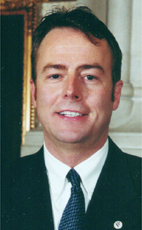 House of Commons photo
Won his last election, in 2000, with 57% of the vote.
Lobbyists Registration Act April 28th, 1995
I hope not.
Lobbyists Registration Act April 28th, 1995
It was an election promise. Today, their other small red book called "Rebuilding Trust" has nothing to do with that and would have been better named "Breach of Trust". It does not even go one tenth of the way, and that is disgraceful. I would be embarrassed if I were him.
I would like him to explain to me why the contents of Bill C-43 do not jive with the Holtmann report. Let him explain, if he has the courage to and if he even knows, because he has hardly been to two or three meetings in the last six months. And today, he thinks he can teach me something. No, there is definitely something wrong with this picture.
Lobbyists Registration Act April 28th, 1995
Mr. Speaker, I am really disappointed to see the member for Glengarry-Prescott-Russell laughing about such an important issue as Bill C-43, an Act to amend the Lobbyists Registration Act, confusing everything and saying almost nothing about the bill itself.
The member talked about sovereignty, about all kinds of issues, about the leaders of the sovereignist forces in Quebec, about almost everything except for the real issue, the one concerning lobbyists. As for sovereignty, during the referendum period, in Quebec, the member will come and talk about the great policies of the stuffed beavers over there. He will come in Quebec and talk about that. However, today's debate is on Bill C-43.
Bill C-43 is a most important bill, and I find it strange that the member has nothing to say about it. I will ask him a few questions but first, I want to make a comment. He underestimated the work done by the committee. He said that the members claimed they alone knew the truth because they had heard witnesses during six months. That is not true, Mr. Speaker. I am not alone in knowing the truth. I only report to the House what I have heard during the hearings of the committee.
I report to the House what witnesses, taxpayers and voters said to the committee about what they would like to see in Bill C-43. I think that the member underestimates the work that has been done, and that is most regrettable.
There are two very important points in this bill. There are many others, but what is important is not what is in the bill. There are, in particular, a couple of points concerning the ethics code and the appointment of the ethics counsellor.
I will read two clauses to the member opposite who suggested that this bill is a model of openness and absolutely the best legislation of its type anywhere in the world, that they are the smartest, the most clever and the boldest in their proposal. Why, then, does the bill clearly state that the counsellor's investigations should remain secret, hidden behind the closed doors of the federal government? We are not allowed to know what is going on behind those closed doors. Why does the bill specify that the code of ethics is not a statutory instrument for the purposes of the statutory instruments act? Are they afraid that the public will initiate legal proceedings to have the code enforced?
Are they afraid of civil suits? How do you explain section 10.5 of the bill, which says that "the Ethics Counsellor shall prepare a report of the investigation, including the findings, conclusions and reasons for the Ethics Counsellor's conclusions"? We insist on having a reasoned report. The ethics counsellor would never tell us how he came to these conclusions.
It is the same with a judge's decision. It is by reading the decision that you know if the judge's findings are right or wrong. We will not have this information because the legislation is made especially for the friends of the government, those who contribute to the Liberal Party's election fund. They do not want us to know how the ethics counsellor came to his conclusions. They do not want us to know how the ethics counsellor really judges a minister, senior official or anyone else working for the
government machine. No, instead they introduce a bill that makes no sense.
I would say to the hon. member that he should have been embarrassed to speak today about Bill C-43. I would have been, knowing that I had signed the Holtmann report, which recommended taking measures that are 10 times stronger and more comprehensive than those in the bill before us.
He was a member of the Holtmann committee, he signed the report regarding the tier system for lobbyists and disclosure, and we are not even doing one-tenth of what the Holtmann report recommended. I would be embarrassed to flaunt that today. I would also be embarrassed to hold up a book, claiming that it is still red. Those small red books may all have come out of the same press, but not two are identical. At least in the version of the book they used during the election campaign they were committed to implementing the recommendations of the Holtmann report.
Lobbyists Registration Act April 28th, 1995
This is too much!
Lobbyists Registration Act April 28th, 1995
Mr. Speaker, you will certainly agree with me that the hon. member for Hochelaga-Maisonneuve really understands the problem. This man has exceptional assessment skills. He made extremely fair comments on this debate and on certain qualities of the men and women in this House.
That said, what struck me in the hon. member's speech-and I think his speech is justified-is that he highlighted the differences between what government members said when they were in opposition and what is in Bill C-43 on lobbyists currently being considered at third reading. Moreover, the Liberals even tabled in this House the so-called Zed report, entitled "Rebuilding Trust".
Given what I hear from the Liberals, I think the title should be "Imposing Trust", because that is what the government is doing, forcing Canadians and Quebecers to trust this document. What they have said since taking office 18 months ago is quite different from what they used to say in opposition.
In closing, I would like to ask the hon. member a question, which he will surely be happy to answer. How can he explain, as seriously as possible, the Liberals' shift in policy? What is the most obvious explanation for this change of heart by, among others, the hon. member for Glengarry-Prescott-Russell, who, when he sat on the opposition side, used to tear his shirt over this, when there is no trace of these elements in Bill C-43? How can the hon. member for Hochelaga-Maisonneuve explain this extraordinary about-face, because the whole issue of government integrity is an extremely important and serious matter? How can the hon. member explain this?
Lobbyists Registration Act April 28th, 1995
Mr. Speaker, before question period, I started pointing out the flaws in Bill C-43. I mentioned the staging of the ethics counsellor's appointment and the authority he was supposed to have. I highlighted the discrepancies in the Liberal position and their about face regarding several points, including the different categories of lobbyists.
One will recall that the Liberals, when they were in the opposition, wanted to have only one category for lobbying because, in their opinion, lobbying was lobbying.
But once they came to power, their friends, probably the ones who fund their electoral campaigns, told them: "No, no, no! We would rather it stay the same, with three different categories". So, the Liberals reviewed their position and now, Bill C-43 meets the lobbyists' demands, maintaining three categories.
Before question period, I was dealing with the third flaw I found in Bill C-43. In total, there are eight major flaws which were deliberately introduced with a view not to reach the stated goal of Bill C-43, which is transparency. The third flaw I found has to do with the compulsory filing of a return. As I mentioned earlier, the scandal regarding Pearson airport, in Toronto, is ample proof of how lax the present rules are in this area.
One will recall that the privatization contract was signed at the height of the federal electoral campaign, in 1993, and that subsequently an inquiry looked into that deal. The Nixon report, issued on November 29, 1993, revealed several instances of misconduct on the part of lobbyists, officials and political aids to the ministers concerned. The report raised several other questions which have remained unanswered to this day. For example, who are the lobbyists who contravened the most elementary rules of ethics? When did these events occur? How did they act illegally or unlawfully? Who are the officials and political staff members who went too far in this matter?
The Liberal government did not answer those questions. They chose to close their eyes to such stratagems which undermine the credibility of our democratic institutions. Most unfortunately, Bill C-43 offers nothing new. We remain totally in the dark. The clique exercising such undue influence will continue to have its way, and that is terrible. While they were in the opposition, members of government had promised they would bring transparency into this issue.
If the Liberals were serious about transparency for all government undertakings, why do they now refuse to force lobbyists to indicate which contracts they are trying to influence the federal administration on? Furthermore, why do they refuse to disclose which contracts are attributed in a discretionary fashion, without any call for tenders? I regret that the Liberals absolutely refuse to shed any kind of light on this issue.
If the Liberal government were really serious when it talks about integrity and transparency, would it not demand that lobbyists also disclose their fees? I learned, through the Minister of Industry, that in Ottawa, some lobbyists charge up to $5,000 a day to negotiate small arrangements with government.
In such a case, people have the right to know who is paying this kind of money, who has an interest great enough to pay up to $5,000 a day to have a minister or the government change its position or decision. But no, Bill C-43 says nothing about that.
When they were on this side of the House, the Liberals were in favour of such disclosure. They thought, quite appropriately, that lobbyists should disclose their fees. I will give you specific examples of Liberal members who have changed their tune since they took office.
The member for Glengarry-Prescott-Russell, and government whip, said on February 2, 1993: "In other words, the public has the right to know who does what and for whom, and at what cost". When in opposition, that is what they were asking the government. Put even more eloquently, on February 16, 1993, the current Parliamentary Secretary to the Minister of Industry said, about the disclosure of lobbyists' fees: "One of the reasons I stand firm on the issue of disclosure is that your organization does not work only in the area of politics. You now have a polling department and a media relations unit. Your organization"-he was answering someone in committee and knew what he was talking about-"has a strong influence not only on consumers but also on government and the media. In a town like ours you only have to be a few days in the press centre to have almost any idea accepted. One of the reasons I believe your fees must be disclosed is that it sometimes happens-Take the referendum for instance: millions of dollars have been put in the system by lobbying firms advocating a position while we knew almost nothing about them".
The parliamentary secretary to the minister said only a few months ago that lobbyists fees had to be disclosed. Today in Bill C-43, the minister says that fees will not be disclosed. What did members say? What did the parliamentary secretary to the minister mention? I will not answer that question. I will not answer it because I find it deplorable that a member did not raise to express his concerns and or defend the ideas he had when he was in the opposition. Power corrupts and gives Alzheimer's to Liberals.
I would now like to refer to another issue over which the Liberals ranted and raved when they were in the opposition, and that is the contacts initiated by lobbyists with ministers and officials. They seem less concerned about that issue today, although the problem remains unsolved.
Suppose that Bill C-43 had been in force during transactions which led to the contract to privatize Pearson airport. I often choose that example because it was a scandal known to all Canadians and to the Liberal themselves. The new registry would have told us on what contract a consultant lobbyist had worked, and that this lobbyist contacted the relevant department, in this case the Department of Transport. So what? Such are the changes brought about by Bill C-43. That is the information we would have.
This new obligation to disclose is being presented as a bold move by the government and the Liberal majority in the committee. It goes without saying that, for the Bloc Quebecois, it is essentially pointless. It is obvious that a lobbyist trying to influence the government on an issue relating to the privatization of an airport would contact the Minister of Transport. That is obvious, we do not need a bill to know that; one does not have to be a rocket scientist to guess that.
To really have transparency in its dealings, the government should have agreed to lobbyists revealing their meetings with a minister and the names of the senior officials involved. Bill C-43 should have required lobbyists to say they had contacted a given minister or a given senior official at a given time, that they had discussed a given issue, that they wanted the government to make a decision on a given subject. Bill C-43 does not say anything about that; it does not give us what we wanted.
Such transparency would have helped to restore the integrity of institutions in people's minds. Once again, the government missed the boat. Once again, we proposed some amendments to this end, but the government said no to the transparency and the integrity proposed by the Bloc Quebecois.
Also, why not require lobbyists to reveal their political ties? It would be interesting to know that a given lobbyist is employed by a given political party. It might be interesting to know that a given lobbyist had once been a candidate for a political party. It might be interesting to know that a given lobbyist is the president of an association or was a minister's chief campaign organizer. It might be interesting to know also that a given lobbyist gave $1,000, $2,000 or $3,000 to the Liberal Party's fundraising campaign. It would be interesting to know that.
But no. When the Liberals had trouble collecting a nickel, that was required from the government, the lobbyists had to reveal that. But now that they are in office, now that they have cocktails and luncheons at $1,000 and $2,000 a plate, they do not want this information. They have changed their tune.
Since time flies, I will not deal at length with the contingent fees some lobbyists ask from those who hire them. They say: I will charge you $5,000 an hour-as in the example given by the minister-to make representations to the government, and if you win your case, you will pay me $250,000 on top of my fees. I am using large figures to put my point across more clearly, but that is what is meant by contingent fees.
The Bloc Quebecois thinks Bill C-43 should prohibit contingent fees. Of course, as you have seen, Mr. Speaker, the Liberals rejected that amendment. However, witnesses who appeared before the committee said that contingent fees lead to scandals and influence peddling. The higher the contingent fees, the more forceful lobbyists will be in their representations to the minister and the more they will use all kinds of tactics. Today, the Liberals find that quite acceptable. It is not. Those are the kind of things they criticized when they were the opposition, but now that they are in power they are too busy at the trough and feel everything is fine. Such smoothies.
I repeat that I could keep talking for hours on this important issue. As a matter of fact, it is so important that the committee heard about 80 witnesses. We received brilliant briefs. This was the third time a group of parliamentarians reviewed this issue. We have had the Cooper Report, we have had the Holtmann Report and now you have before you today the Zed Report.
Three times, parliamentarians have said: "We have to give teeth to the Lobbyists Registration Act". And what do we have before us? A toothless bill, a spineless bill, that will not reach the goal of openness that had been set. There is nothing new in this bill, and scandals will occur again.
Talking about scandals, about current events also, as you could see during question period, all kinds of revelations are being made. These issues have been raised for weeks now. We are not the only ones saying that there is something strange going on in the government machinery, something that is going wrong. Except of course for The Gazette . But nobody wonders why The Gazette is supporting the government.
What all these elements are showing us I think is that there has never been such an urgent need for a bill to closely regulate the lobbyists. That is what current events show us, with the saga of patronage by the Liberal government in its policy on direct to home satellite broadcasting.
Here is what Jean-Robert Sansfaçon wrote in today's Le Devoir : ``Seldom has the federal government been more obviously under remote control than with this decision to suspend the rules set out by the CRTC. This is an action whose only purpose is to allow onto the scene a certain player, none other than the company run by the Prime Minister's son-in-law, André Desmarais. Once more, the Minister of Canadian Heritage, Michel Dupuy, looks like a puppet, unable to apply either the letter or the spirit of the Canadian Broadcasting Act''.
All that has been done through lobbying, meetings and visits with the minister. And all that is the doing of the powerful PowerCorp lobby.
We now have Bill C-43 before us. It could not have come at a more appropriate juncture. We have the proof we need to say that with Bill C-43 as enacted, as drafted, nothing will change and scandals as those we have witnessed this week will occur again, and our questions will never get answered. We will never really know what guided the minister in his decisions, his visits, his meetings, etc. That is a true scandal.
Seagram April 28th, 1995
Mr. Speaker, how surprising that The Gazette should support the Liberals. Very surprising indeed.
After seeing the way his minister proceeded in the Ginn Publishing affair, the disturbing letters he wrote to CRTC, his betrayal of his commitments to the CBC and his abdication of his mandate in the case of Power DirecTv, would the acting Prime Minister, leader in this House and defender of his government's integrity, agree that the Minister of Canadian
Heritage is no longer capable of performing his duties and that consequently, he will have to ask for his resignation?
Seagram April 28th, 1995
Mr. Speaker, I do not suppose it was a cultural exchange between Mickey Mouse and a representative of the federal government, when the Minister of Canadian Heritage, unbeknownst to the taxpayers, went to Los Angeles two weeks ago. That just does not make sense.
My question is directed to the Acting Prime Minister. Considering the conflict of interest guidelines that apply to members of this government and considering that the case of Power DirecTV has shown there is a very close relationship between this government and influential Liberals in the business community, including Mr. Paul Desmarais, father of the Prime Minister's son-in-law and member of the board of directors of Seagram, does the acting Prime Minister realize that the conduct of the Minister of Canadian Heritage raises questions about the integrity of the Liberal government?
Lobbyists Registration Act April 28th, 1995
What they said when they were in the opposition is not what they are saying now, and I find this very disturbing.
In fact, they all voted against the amendment I proposed to eliminate all distinctions between lobbyists. I do not understand the Liberal's retreat from their own position and the promises they made during the election campaign. What was not acceptable two years ago is still unacceptable today. Witnesses made this clear to the members of the committee that examined Bill C-43. A lobbyist is a lobbyist, whether they belong to the first, second or third tier. That is why Bill C-43 should provide for only one tier for all lobbyists in Canada.
I imagine this position was not palatable to the lobbyists and the financial backers of the Liberal Party. That is probably the only explanation we have for the current flexible conscience we note among government members.
Another flaw in this bill is its disclosure provisions. Here again, I proposed amending the bill to oblige lobbyists to disclose their real business, the real facts we could then investigate, so that we could see what is going on in this government.
The scandal surrounding Toronto's Pearson airport has amply demonstrated the lax nature of the current disclosure rules. The privatization contract, it will be remembered, was signed in the middle of the 1993 federal election campaign and an inquiry was instituted to shed light on the transaction. The Nixon report was submitted to government on November 29, 1993 and revealed misconduct on the part of the lobbyists, public servants and political assistants. However, the report raised a number of other questions to which we have not obtained answers: Who were the lobbyists who failed to comply with the most elementary rules of ethics? When did these events occur? In what way were their actions either illegal or improper? Bill C-43 will still not give us the answer to these questions.
I see that my time will be interrupted for question period.
Lobbyists Registration Act April 28th, 1995
Mr. Speaker, when the government announced its intention to amend the Lobbyists Registration Act, we thought that it was sincere. We thought that those who, for almost ten years, took the Conservatives to task about their integrity, their way of doing things and their decision-making processes, would table a bill that would shed some light on what goes on behind the scene in this Parliament.
Yet, on June 16, 1994, when Bill C-43, an Act to amend the Lobbyists Registration Act and to make related amendments to other Acts, was tabled, we were forced to change our thinking. The Liberal government, that is those same Liberal members who, in opposition, denounced the cosy deals being hatched in the inner circles of the Conservative regime, now seemed prepared to condone such practices by tabling legislation which contains nothing but good intentions.
We figure that, once the Liberals gained access to the pork barrel, they forgot what they were saying during their days in opposition. This bill has neither teeth nor substance; it is exactly the opposite of what we expected. The credibility of our democratic institutions is currently being questioned by the public. Never, in the short history of our democracy, have public officials been looked upon with such cynicism by voters. Everyone agrees that a climate of confidence must be restored between the governments and the public.
During the last federal election campaign, the Liberal Party of Canada pledged to reform our institutions and make their operations more transparent. In fact, the Liberals' red book, which we hear so much about, contains the following on page 94: "The integrity of government is put into question when there is a perception that the public agenda is set by lobbyists exercising undue influence away from public view".
Unfortunately, once it took office, the Liberal Party considerably watered down its commitments. Such an about face makes the population wonder, and rightly so, how committed the Liberal government really is to bringing in legislation to control influence peddling. When we compare the campaign promises and how they translate into legislation, we can only conclude that the lobbyists undoubtedly determined the final version of Bill C-43 and the resulting reversal of the Liberals' position.
I believe that the first thing a government has to do to restore the integrity of our democratic institutions is to stop buying votes with empty promises. It must also make the administration of the state's affairs more transparent, above all so that we can clear up all grey areas and reassure the population that public policy decisions are made in the public interest and not in the interest of powerful lobbies.
Everybody recognizes the need to restore the public's confidence in our institutions. Unfortunately, after only 18 months in power, the Chrétien government's track record on transparency is dismal. For example, on September 26, 1994, the Canadian press reported that documents obtained under the Access to Information Act showed that, in the months preceding the introduction of Bill C-43, there was a marked increase in the number of meetings with lobbyists and that some of them had threatened to take the government to court if the new legislation forced them to disclose their political ties.
As has often been the case, the lack of transparency in the process kept the public in the dark regarding the scope and the nature of the lobbyists' workings on Bill C-43 until the news hit the press. The daily newspaper La Presse eloquently summed up the situation in its headline on the issue: ``Ottawa's plans to shackle lobbies foiled''. Bizarre situation-lobbyists influencing the very legislation that was supposed to reduce their influence. Given this situation, the need for transparency has never been greater.
One cannot treat the public like a doormat, Mr. Speaker. The public remembers quite clearly the promises made by the Liberals in the red book and elsewhere. Duff Conacher, co-ordinator of the organization Démocratie en surveillance, appeared before the committee to refresh the Liberals' memory regarding their statements on this issue. I know that the members opposite do not like being reminded of some of the things they have said, especially when they are being hypocritical on such an important issue, but I will nevertheless subject them to a quote from this person, who has studied the issue in depth and monitored the government. Mr. Conacher said: "We would like to remind you of those promises and the requirement. We hope you will not
only take the opportunity but also keep those promises and fulfil that requirement in your deliberations on Bill C-43."
There is also a legislative history to be acknowledged. The Cooper committee and the Holtmann committee have preceded you. Both proposed measures that go beyond the provisions in Bill C-43. And now the Liberals are going to brag that they went further than anyone else.
Nevertheless, Bill C-43 does make certain improvements to the system for providing a framework for lobbyists. Of course it was not that difficult to improve the present legislation, since it was so permissive, smart lobbyists could easily get around it.
Government members, however, will have to admit that the commitments of the red book have been vastly watered down and that Bill C-43, in its present form, will be unlikely to prevent such troubling events as those surrounding the privatization of Pearson airport or the "Dupuy affair", both the first and the latest version. We will not be able to find out more with Bill C-43 than we can under the current legislation.
What is worse, Mitchell Sharp-Who is this guy? The senior advisor to the Prime Minister on ethical issues-admitted before the committee that, even if the statute arising from Bill C-43 had been in effect at the time of the negotiations for the privatization of Pearson airport's terminals I and 2, the public would have learned nothing more.
So what use will Bill C-43 be? What use is the statute arising from this bill if we cannot even find out about the administrative irregularities and the scandals around all this? The government drafted Bill C-43 because of certain events, including the Pearson affair. It has drafted a bill that will not give us any additional information. What are they doing? Why do they bother?
What the public has a right to know, legislators and members of this House are unable to tell them because of the government's attitude and the attitude of the Minister of Industry.
The public has the right to know, for instance, who influences the government, who in government is being influenced, why, and especially, for how much. The Liberals are denying the people's, the taxpayers' legitimate and democratic right to know.
The official opposition has been diligent. We were on the alert. The opposition was quick to condemn the Liberals' lack of courage in their proposals for providing a framework for lobbyists' activities and for ensuring the greatest possible openness in the administration of government affairs. I imagine the Liberals are upset because we were on the alert and did our job as the official opposition.
To try and change the object of this bill, I personally proposed more than 24 amendments in committee, amendments that were motivated only by a concern for transparency. The Minister of Industry ordered his second string to defeat all the amendments moved by the official opposition. I use the term "second string" because the Liberals who were present on Tuesday, March 14 voted against my amendments without being able to explain why.
We reached the height of absurdity when these same Liberals were unable to explain their own cosmetic amendments. It was department officials who explained the Liberals' amendments. Does that not take the cake. I used to know the House jester, I know the Prime Minister's ministerial puppets, now today I get to meet some of the pawns of the Minister of Industry. Nothing in this situation enhances the role of the members of the government.
On Tuesday, April 25, the opposition, again at the report stage, presented over 30 reworded motions in amendment in an effort once again to improve the bill. We were trying once more to give the government the opportunity to amend the bill in order to achieve the objectives that had been set.
All of the amendments were once again defeated by the Liberal government. We have presented over 60 amendments to this bill. They have all been rejected. Sixty amendments have been systematically rejected by the government. The Liberals have therefore said "no" 60 times to transparency. They have said "no" 60 times to government integrity. They have said "no" 60 times to shedding light on the activities of influence peddlers. I will let you draw your own conclusions.
The attitude of the government is incomprehensible, since the aim of the Bloc Quebecois' amendments was, in the end, simply to enable the government to fulfill its own campaign commitments. The Prime Minister in fact reiterated them last June saying that Bill C-43 would give the federal administration unprecedented transparency. Unfortunately, I have to assume that we have had the wool pulled over our eyes. I am not alone in thinking this. Both the francophone and the anglophone press is making this point.
Gilles Lesage, editorial writer for Le Devoir made the following comment a few months ago. I will read it for you: ``The Bloc Quebecois is right in believing that Mr. Manley's bill is watering down hugely the commitments made by the Liberals in their famous red book. Now that they are in power, they must do everything possible to keep their promises. As the opposition is
pointing out, the lobbyists' activities must be better regulated to ensure greater transparency in government decision-making and to ensure that the more fortunate do not have undue access to decision-makers through the actions of the influence peddlers".
In his editorial, Mr. Lesage accurately identified the issue of the bill currently before us. From the time the bill was tabled to when it reached third reading, the government added nothing to give more teeth to the legislation this bill will become.
It simply fussed about, adding cosmetic amendments here and there throughout the bill, without substantially altering the bill in any way.
After it studied the bill, the Bloc Quebecois identified eight major flaws in it and proposed legislative solutions to them. As you know, the government often accuses the official opposition of criticizing without making any constructive suggestions. Yet, as I said earlier, we proposed 60 amendments aimed at improving this bill. These improvements had a very specific goal: to correct the eight flaws in this bill that we had identified very quickly.
I will start by listing these eight flaws, before outlining them in more detail later. The first, very important flaw concerns the ethics counsellor. The other flaws have to do with the types of lobbyists, the requirement to disclose contracts, lobbyists' fees, the contacting of ministers and senior officials, the lobbyists' political ties, coalitions, contingency fees, and tax deductions for lobbyists' fees.
This bill has no avoidance rule or code of conduct for public officials. Finally, this great code of ethics will be practically unenforceable, as I will explain in my last point.
There are eight major shortcomings in Bill C-43, either because it does not go far enough or because it does not even mention the problem.
I could go on for hours about this bill, mostly about the expectations and concerns of taxpayers, because I followed committee proceedings closely, because my mind was not made up before I heard the people's concerns, because my only goal was to answer the questions raised by English Canada and especially by the Quebec people, instead of trying to please the lucky few who can afford to send lobbyists to Parliament Hill by exempting them.
Within the time allocated to me, I will try to explain clearly each of the flaws I identified in this bill. As I said earlier, the first flaw concerns the ethics counsellor. Need I remind the House of the Minister of Canadian Heritage's troubling interference in CRTC business or the Ritter affair involving a senior official at the Department of Health who, while still on the department's payroll, was lobbying his coworkers, trying to sell them on the merits of bovine somatotropin?
Also, when we look at Pearson International Airport, the helicopter acquisition contract, the Augusta affair as well as the recent damning positions taken by the Prime Minister and his cabinet ministers to benefit Power Corporation and, at the same time, the Prime Minister's own son-in-law, when we look at all that and at the government's attitude regarding the heritage minister's quiet trip to Los Angeles to visit Edgar Bronfman, owner of the Seagram Company, one can only wonder and be concerned.
Especially when the Prime Minister does not even consult his ethics counsellor or when he does but systematically refuses to tell us what advice he was given, when he will not tell the elected representatives sitting in this House what his ethics counsellor has recommended.
This deplorable window dressing clearly shows that the ethics counsellor is not independent enough to assume as crucial and fundamental a role as that of transparency watchdog in the federal administration. The Prime Minister probably just wanted to have an extra advisor on his staff. Smoke screens only hide the truth.
This appointment is therefore nothing but a sham to fool the public into believing that the government is actually doing something, taking concrete action to restore integrity in Canadian institutions. In actual fact, the counsellor conducts only secret investigations and accounts only to the Prime Minister. What does that give us, the elected represeantatives? And what does it give the people of Canada? Absolutely nothing.
So, we, in the Bloc Quebecois, believe that ethics, transparency and public confidence in democratic institutions and government management are not matters to be left in the hands of a political party, a government or a Prime Minister, but rather to be decided on by democratic institutions, the House of Commons and the elected representatives of the people.
In that regard, one of the government's star witnesses, Simon Reisman, the president of Ranger Oil Limited, supported the Bloc's views on the subject. Let me quote him because what he told the chair of the committee, who was a Liberal and had to submit a report to the minister, was extremely important. He said: "If we get into the business of a code of ethics to govern the behaviour of the members of this industry, it ought to be kept out of partisan politics as far as you possibly can. I think one good way of doing that is to make the appointment an appointment by Parliament, rather than by the government of the day. You are more likely to get someone more objective. If he is appointed by Parliament, I think he should report to Parliament-which is the recommendation in any event".
And he added: "There is another reason I think he should be reporting to Parliament and should be subject to accountability to Parliament. Members of Parliament, who are elected under a democratic process, have the mandate to legislate and they have the right to review legislation. In our democratic society, they are in the best position to prevent any abuse of power. The ethics counsellor will undoubtedly be a very powerful official". That statement was made by a government star witness, who testified at the committee's request. Yet, nothing in Bill C-43 reflects the recommendations made by that witness.
Do you really think that the ethics counsellor, who will work for the government and look after its interests, will be very powerful? I do not think that this is what taxpayers were hoping for when they heard the Liberals' election promises. An ethics counsellor, sure, but one who has some investigative powers and who is not under the Prime Minister's thumb. This is what the public wanted. What we need is a totally independent ethics counsellor who is accountable to Parliament. This means that he can hold public inquiries and report on his work, on his findings and on the reasons supporting his conclusions to the House of Commons.
I am also very concerned by the fact that Bill C-43 does not delegate any enforcement powers to the ethics counsellor. I fear that the counsellor will end up being like a traffic cop with no authority to give tickets. If you listen to the Liberals these days, you get the impression that they simply want to set up a system which will be administered behind closed doors, so that patronage can still go on without anyone really knowing what is happening. In my mind, that is what is going on right now. Is it not strange that the tabling of Bill C-43 would coincide with such a scandal?
A second flaw, equally significant, shows how the Liberals reversed their position on the tier system for lobbyists. In June 1993, after examining the Lobbyists Registration Act, a committee of the House of Commons recommended eliminating the distinction between first tier and second tier lobbyists. In fact, this was the first recommendation in the Holtmann report. The members who signed this report, including the hon. member for Glengarry-Prescott-Russell, the hon. member for St. Boniface, the hon. member for Kingston and the Islands and the hon. member for Broadview-Greenwood, who were all in the opposition at the time, agreed with the principle of eliminating the tier system. I assume they are not going to deny that. You are not going to deny you signed the Holtmann report. You signed it, and you agreed with its recommendations. Today, those very same members who are now government whip, Parliamentary Secretary to the Minister of National Revenue, Deputy Leader of the Government and lastly, Parliamentary Secretary to the Minister of Industry, are no longer on side.