It is a good thing they only have two hands.

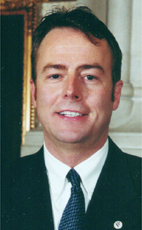 House of Commons photo
Won his last election, in 2000, with 57% of the vote.
Lobbyists Registration Act April 25th, 1995
It is a good thing they only have two hands.
Lobbyists Registration Act April 25th, 1995
Mr. Speaker, I believe the group of motions we are currently considering is the most important, because it focusses on the essence of the problem and of the goal of transparency. The amendments, the motions presented by the opposition relate directly to this.
This is why I am extremely happy to see all the Liberal members and ministers listening very attentively to what I have to say. Let them take notes and they will realize that the objective of the motions put forward by the Bloc Quebecois, Motions Nos. 22, 28 and 29, is indeed in line with the purpose of Bill C-43 with respect to transparency.
I believe that, if we are really to convince Canadians and Quebecers that Bill C-43 does indeed increase transparency and is not some dubious undertaking, it will be with the help of Motions Nos. 22, 28 and 29.
Motion No. 22 concerns the appointment of the ethics counsellor. I do not want to go over this whole issue, but I think and I believe everyone across from me will agree that the elected representatives are the people who sit here. If someone is to report to somebody or account for something to somebody, anywhere in the entire system, it is to the duly elected representatives.
But they still have to be able to choose this person-the ethics counsellor. Bill C-43 gives a lot of power to the ethics counsellor. Some witnesses even told us that the ethics counsellor should be someone extremely powerful. Powerful for whom or for what, if we, the elected representatives have no say in the choice or in the appointment of this individual and, more importantly, if he or she is not required to report to the House and is not accountable to the elected representatives?
We are now being told that his job is to watch over parliamentarians' chastity. I would like to have a say on the kind of work to be done by this ethics counsellor. I would like to have a say on his appointment and his reports to the House.
As it now stands-and I think that most critics will agree on this-, Bill C-43 has no teeth. One of the reasons why this bill does not achieve the objectives set in terms of transparency is that the ethics counsellor will have to report only to the Prime Minister.
I see hon. members opposite shaking their heads in disagreement and indicating to me that Bill C-43 still provides for some safeguards. The ethics counsellor will release his findings. That is not enough. Not only do we have no say in his appointment, but the ethics counsellor will only justify his findings. That is the purpose of Bloc Quebecois Motions Nos. 28 and 29, which provide that the ethics counsellor must conduct his investigations publicly.
We must keep in mind that the ethics counsellor will act in matters involving public money. I would not say anything if the ethics counsellor could look at contracts involving two private individuals or companies. I do not need to know the circumstances, how much they paid for a given piece of land, or why the contract was signed. However, when one of the parties is the government, when one of the parties spends taxpayers' money and makes laws or regulations that will have an indirect impact on the population as a whole, I think it is a different matter.
When I sat on the committee, people told me that, even though I am a lawyer, I asked for things that even the Bar Association could not ask for. I reminded these people that, whenever the Quebec Bar Association investigates a lawyer, it is no longer a public but a private matter.
The ethics counsellor is responsible for reviewing an issue like the Pearson Airport deal, which everyone in this House is familiar with. This is not a matter between two private parties. The ethics counsellor will have to look go over the telephone calls, the letters, the contacts, the meetings. We could have had information. The people could have received information they do not have at this time.
I think that the Canadian people have a right to know what is being done with their tax money. We are paying enough taxes. I think we should know what our money is being used for. The only way to get to the bottom of this whole matter of lobbying would be through public inquiries. This way we would know which ministers and members of Parliament were involved and who contacted a particular civil servant. We need to know. It is not enough to go by findings on which the ethics councillor will base his conclusions.
Let me give you a very simple example. If the only part of court judgments to be released were the conclusions, whether at the Superior Court, the Quebec Court or another court, few people would be able to find grounds for an appeal. Basically, disagreement would be expressed regarding the conclusions. But why did the judge come to these conclusions? How does one know what the judge's decision is based on? To appeal a
decision, one needs to know who testified in the case, what they said, what evidence was introduced, what the charges were and so on. And where is all this information found? In the judgment.
Why the judgment? Because most of the time, perhaps 99.9 per cent of the time, trials are public. While private parties are involved, 99.9 per cent of trials are public and we get to know on what basis the judge made his decision.
This is plainly a public matter involving public funds, and the government, which claims to be transparent and which came up with Bill C-43 to show its hands were clean and it was fulfilling an election promise, introduced a bill whereby we will have no say in the selection of the ethics councillor and, moreover, we will never know a thing about his activities.
That is what this government is about, a Liberal government that cannot even manage to fulfil the simplest of promises made in its red book concerning transparency and lobbyists, when it had promised to implement to the letter the recommendations of the Holtmann report on greater transparency. I can see that what we are saying here is painful to them because it is the truth. This government is good at hiding problems without ever solving them. It is hiding something. Bill C-43 is further evidence of this.
You will understand therefore why these motions are so important and why the government is reacting this way to my comments. The fact is that we have put our finger on the real problem and the problem is over there.
Lobbyists Registration Act April 25th, 1995
moved:
Motion No. 28
That Bill C-43, in Clause 5, be amended by replacing lines 45 and 46, on page 14, with the following:
"(3) The investigation shall be conducted publicly."
Motion No. 29
That Bill C-43, in Clause 5, be amended by deleting lines 13 to 30, on page 15.
Lobbyists Registration Act April 25th, 1995
moved:
Motion No. 22
That Bill C-43, in Clause 5, be amended by replacing lines 27 to 29, on page 13, with the following:
"10.1(1) There shall be an Ethics Counsellor who shall be appointed by commission under the Great Seal after approval of the appointment by resolution of the House of Commons.
(2) Subject to this section, the Ethics Counsellor holds office during good behaviour for a term of seven years, but may be removed by the Governor in Council at any time on address of the House of Commons.
(3) The Ethics Counsellor, on the expiration of a first or any subsequent term of office, is eligible to be re- appointed for a further term not exceeding seven years."
Lobbyists Registration Act April 25th, 1995
Mr. Speaker, I was not going to repeat what I said at the beginning, in my introductory remarks on Motion No. 1, when I took a few minutes to explain why the Bloc Quebecois had taken the stand it took at the committee stage of this bill and describe the general attitude of the hon. members who sat on this committee. But in the light of the comments made by the hon. member for
Fundy-Royal, who also chaired the sub-committee on this bill, I will focus on the causes for my disappointment, since he is here to hear what I have to say, as will the minister opposite.
I repeat, I am disappointed with this new consultation process. The main reason for referring the bill to committee before second reading was to allow members to play a more prominent role and promote dialogue between the government and opposition parties to enhance the contribution of members to the development of legislation. The idea was to give opposition members the chance to express their views on the bill now before us.
Look at the changes to Bill C-43 as a result of this process and watch what will happen, at the end of the day, to the proposals made by opposition parties this afternoon. You will see that nothing changes. It comes to the same thing. So much so that when the minister appeared before the committee as our first witness, he told us that we had a free hand, that we were the best lobbyists there was to have the act amended, but he also gave us directions. While all his directions made it to Bill C-43, amendment proposals made at committee stage by the opposition, and the official opposition in particular, including twenty or so of my own fostering greater transparency, were all rejected. That is why I want to tone down this whole thing. I think we could revert to the old process, since this one is not much different anyway and comes to the same thing.
Regarding Motion No. 19, I must tell the sponsor of this amendment straight off that I agree in principle with his amendment. I think that Motion No. 19 serves the purpose of fostering greater transparency. This is a commendable goal and we, Bloc members, will work toward and support this goal. However, what stands in the way of this motion being adopted is much more a technical consideration. Let me explain.
Motion No. 19 seeks to amend section 8 of the existing legislation, the Lobbyists Registration Act. That act is in Chapter L-12.4 of the Revised Statutes of Canada. Section 8, which is under the heading "Registry of lobbyists", reads as follows: "The Registrar General of Canada may designate any person employed in the office of the Registrar General of Canada as the registrar for the purposes of this Act". Therefore, the section 8 currently in effect deals with the designation of the registrar. What does the registrar do? His role is to keep the registry of lobbyists. This is what the existing act provides. Based on its wording, section 8 designates the registrar.
Motion No. 19 reads as follows: "8. The Governor in Council may designate any person as the registrar for the purposes of this Act." The motion therefore refers to the Registrar General of Canada. The amended section in Motion No. 19 designates the Registrar General of Canada. But who will designate the registrar? As I said earlier, the underlying principle is good. Things would be clearer if the Governor in Council were the one designating the Registrar General of Canada.
This would ensure greater transparency. However, the amendment proposed by the member does not specify who will designate the registrar. Yet, this is extremely important, since the registrar is the one who maintains the registry of lobbyists. I believe the amendment proposed in Motion No. 19 is incomplete and thus we cannot support it, since it would create a vacuum regarding the implementation of the Lobbyists Registration Act.
There is a legal principle which says that the legislator does not intervene uselessly. The legislator does not make a law for no reason. This is even more true in this case, where the legislator is represented by all of us here. Parliament does not make legislation to poke holes in its implementation. I sincerely believe that, if we support Motion No. 19, we will poke a hole in the legislation regarding who will designate the registrars. If we are going to create problems by amending the current legislation, we should stick with the existing section 8 of the Lobbyists Registration Act.
As I said, the official opposition, the Bloc Quebecois, will oppose this motion, not because of its underlying principle, which we support and which has to do with ensuring greater fairness and transparency, but because it creates a vacuum in the bill. Consequently, we will vote against Motion No. 19.
Lobbyists Registration Act April 25th, 1995
The official opposition is against Motion No. 9, but I thought that it had been voted on at the same time as Motion No. 7. I now understand that you are dealing with every motion separately. I would ask for the unanimous consent of the House to go back to this vote because we wish to say that we are against this motion, so that the vote can be deferred until the end of the day.
Lobbyists Registration Act April 25th, 1995
Mr. Speaker, I thought we were supposed to vote on a group of motions. I notice that you are presenting the motions one by one. If we are voting on the version of Motion No. 9 that I have before me, I will vote against this motion. I thought this had already been settled by grouping the motions. Are we dealing with each motion separately and deferring the division until the end of the day?
Lobbyists Registration Act April 25th, 1995
Mr. Speaker, I believe the hon. member said that you would find unanimous consent. The Bloc Quebecois is not giving its consent to the two proposed amendments to motions, which deal more or less with the same matter. We are not giving our consent.
Lobbyists Registration Act April 25th, 1995
Mr. Speaker, I rise on a point of order. I listened attentively to the hon. member who was chairman of the committee. However, I think that he should save his speech for third reading and I would ask him to deal more directly with the group of motions before us.
I am sure that he has interesting things to say, but I think that his speech today is totally out of context.
Lobbyists Registration Act April 25th, 1995
Ce n'est pas cela.