
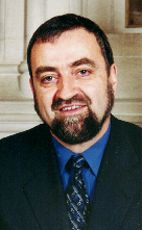
House of Commons photo

Crucial Fact

  • His favourite word was federal.

Last in Parliament May 2004, as Bloc MP for Lévis-Et-Chutes-De-La-Chaudière (Québec)

Lost his last election, in 2015, with 12% of the vote.

Statements in the House

Shipbuilding Act, 1999 March 28th, 2000

Mr. Speaker, I thank the hon. members for having given unanimous consent to allow me to respond and to conclude this debate.

First of all, I would like to thank all members who spoke to this bill, not just today, but also in the first two hours of debate. I am truly grateful. That goes for Liberal members as well. We live in a democracy, and they expressed their views, which I believe is important.

I was very pleased to see that the leaders of the New Democratic and Progressive Conservative parties took the time to speak during the debate today. Seeing the opposition party leaders speak during a debate on a private member's bill is a great honour for me.

I also wish to thank the 100 members who signed my bill last spring so that it could be given priority. Had they not done so, I would still be waiting for the luck of the draw and there would be no debate today. I therefore thank these 100 members, 40 of them in the Bloc Quebecois, because not everyone could be present, all members of the Progressive Conservative and New Democratic parties, and 20 members of the Reform Party, now called the Canadian Alliance.

I wish to pay tribute to the member for Elk Island, who came to support me at public meetings. The former Canadian Alliance critic attended a press conference, as did the leader of the New Democratic Party, the leader of the Bloc Quebecois, and a representative of the Progressive Conservative House leader. Canadian Alliance members had supported the idea of this bill last year. They wanted a debate to be held.

I appeal to the Liberal members. Because of the size of the majority, several have told me individually that they were sensitive to this issue. I checked with the whip, and the position of the Liberal party is that there should be a free vote on a private member's bill.

I am well aware that some members represented the Minister of Industry's view in the House. In recent months, when the Minister of Industry began visiting people in the Atlantic region or elsewhere, we saw that he was becoming more sensitive to their problems.

I also noticed that the Minister of Labour was concerned as well, as a member representing a riding in the Atlantic region. Unfortunately, I did not hear many members from the Vancouver region.

To say no to this bill is to say no to 150,000 people who sent a postcard to the Prime Minister telling him that they support this bill. To say no to this bill is also to say no to all the provincial premiers. Twice during federal-provincial conferences, once in 1997 and again in 1999, in Quebec City, they urged the Liberal government to support a shipbuilding policy.

To say no to this bill is to say no to the Liberal grassroots who, at the Liberal convention, two years ago, passed a resolution in favour of such a policy.

To say no to this bill is to say no to a joint request from Canada's shipyard owners, the largest shipyards, and it is also to say no to all the workers who, through a labour coalition, reached a consensus and decided to support their employers and make the same request. Why? Because, in 1993, there were 12,000 workers in Canada's shipyards. There are barely 3,000 now. Two great shipyards are facing closure.

When the Minister of Industry says there is an overcapacity worldwide, I suggest he read the London Journal of Commerce , which says that demand has revived and that, at present, Canadian shipyards, like the English shipyards, are capable of entering this field.

I address my remarks to the members of the Canadian Alliance, who think there are grants where there are none. There are no grants, but tax measures and a program of loans with automatic pay back like the one they have had in the U.S. since 1938. The American government has not lost one cent in a similar program.

As for the tax measures, they come after construction. When people are put to work, revenues, taxes and the GST enable the federal government and the provincial governments to recover their costs. All those who wanted to create “jobs, jobs, jobs” have their chance now. We know that second reading deals with the principles of a bill, and the purpose of this bill is to help shipbuilding.

I close by saying that a vote against this bill is a blow to the shipbuilding industry.

Shipbuilding Act, 1999 March 28th, 2000

I rise on a point of order, Mr. Speaker. I understand that members may be excited to speak on this issue. I find it difficult to object, in fact I am pleased, but we have the same time limit. I think each party should be allowed at least one speaker. It would be important that each party be able to express its views on the matter.

Shipbuilding Act, 1999 March 28th, 2000

Mr. Speaker, I rise on a point of order. As the member sponsoring this bill, I agree to this proposal. However, I would just like to make sure at the same time, with the unanimous consent of the House, of having the right to respond for the three to five minutes usually given all members sponsoring a bill.

Shipbuilding March 27th, 2000

Mr. Speaker, in January, after months of representations by employers and workers at Canada's main ship yards, the Minister of Industry admitted that new measures were needed and that he intended to set up a consultative committee to look into ways of helping the shipbuilding industry. Two months later, there is still no action.

Given the importance of this issue, will the Minister of Industry finally get going and deliver on his promises, before other ship yards close down and workers are laid off?

Supply March 21st, 2000

The member is asking me whether or not I believe Mr. Bouchard is creating a slush fund. We in the Bloc Quebecois have always asked for cash transfers to finance active employment measures. Speaking of the transitional jobs fund, we went along with it and we still support it in principle because of the impact of the drastic cuts on individuals. Where there have been quotas, in some cases they even went back five years and required workers to reimburse so-called EI overpayments.

They have bled the unemployed dry in order to doll out grants for electioneering purposes. This is a vicious, undemocratic attack. I thought those days were long gone. Unfortunately the Liberal Party came out of the same mould as the parties that came before it under previous regimes. It wants to use public money for partisan purposes, which is unacceptable.

Supply March 21st, 2000

It is a fact. We noticed how focussed it all was.

In the Quebec City and Chaudière-Appalaches region, there are ten ridings, none of which got any money from this fund because they were considered impossible to win over by the Liberal Party. Those where the Liberal Party had no hope of winning did not get any grant but those where it might win did.

Supply March 21st, 2000

Madam Speaker, the fact that more money went to ridings held by opposition members before 1997 is part of our argument. For instance, the Anjou riding was held by a Bloc Quebecois MP. The Liberal Party wanted to win it over.

Supply March 21st, 2000

Madam Speaker, I am pleased to take part in this debate as a former member of the human resources development committee.

First, I would like to read the text of the motion brought forward by the member for Kamouraska—Rivière-du-Loup—Témiscouata—Les Basques. The motion reads as follows:

That this House condemn the government for the poor management seen at the Department of Human Resources Development, particularly in the award and use of grants for partisan purposes, and that it recommend the creation of an independent public commission of inquiry, whose members will be appointed by the House, and whose mandate will be to inquire into all practices of that Department and to report to the House by September 19, 2000.

There is also an amendment, which reads as follows:

That the motion be amended by adding after the word “condemn” the following:

“vehemently”

As I was saying, after the 1993 election I was a member of the human resources development committee. That committee toured major cities in all the provinces, including Quebec. My colleague opposite was on that tour. If he could talk he would certainly tell us that every place we went the majority of witnesses who came before the committee were against cuts in social programs. They were against cuts in the unemployment insurance program, as it was then called.

There were several protests. I do not encourage protests but it happened several times during that tour. My colleague is nodding in agreement. He remembers. He may be a Liberal but he witnessed those protests.

I remember our visit to Montreal, where people turned over tables to protest against the government's intention to cut employment insurance.

A subcommittee had been set up and on the last day we went to Bathurst. I wondered why we were going to that riding, the riding of the former minister of human resources development. Why were we going there at the very end, as a subcommittee, without the TV cameras? That was Doug Young's riding. Protesters were particularly vocal there. People told us that the situation in Acadia was similar to that in the Gaspé Peninsula. The Liberal majority had rejected the idea of going to the Gaspé region or the Magdalen Islands.

Nor did we go to the Abitibi or the Saguenay—Lac-Saint-Jean region, where seasonal unemployment is extremely high. Still, even if the subcommittee's destinations had been carefully selected, we had to go to the minister's riding. But the minister did not come on that day.

It was quite a surprise for me to see that the protest was even better organized there than elsewhere. This was because there were real problems. The wives of fishers came to testify. They told us that switching from a number of weeks to a number of hours of work would have a major impact in their area.

We remember that Doug Young, the former minister, was ousted, as had been the Conservative minister before him, Bernard Valcourt, who, at the time, had wanted to proceed with an unemployment insurance reform. I remember—that is Quebec's motto—that at the time the current Prime Minister had criticized the idea in a debate against then Prime Minister Kim Campbell, saying “You intend to cut social programs and the UI program. This is unacceptable”. The Prime Minister has left a trail. He even wrote a letter, using the same arguments ans stating that social programs and unemployment insurance should not be tampered with. These programs were necessary in the so-called seasonal unemployment regions.

But Ms. Campbell would not promise not to follow through on her plans, or the plans of Human Resources Development Canada officials. So the plans went ahead and the minister made the cuts in question, but it will be remembered that there was a marvellous transitional fund with up to $300 million for Quebec.

The reaction was “Fine, they are making changes but, with the transitional fund, people will be able to adapt”. But the problem was the way in which this transitional fund was managed, when it was realized that it would be limited to regions where unemployment was higher than 12%.

Unemployment in my riding, and in most ridings in the Quebec City and Chaudières-Appalaches region, was less than 12%. They therefore did not qualify for this program but, in the riding of the present minister, where unemployment stood at 6%, businesses and organizations did. Why? Because, she said, there were pockets of poverty.

All members in the House are capable of showing that there are pockets of poverty everywhere. There are pockets of poverty in my riding. I go to the Lauzon and, when the shipyard lays people off, it is not long before there is a pocket of poverty. There is still one right now.

But, oddly enough, we in the Bloc Quebecois and members of all the opposition parties were not informed of this directive. Only the Liberal members heard about it. Luck was on their side.

It hits even closer to home is when one realizes that 54.3% of the sums allocated over three years through this transitional job fund were during the six months before and the two months after the election. Promises had been made and there had not been time for the grants to be authorized. After the fact, when questions were raised, it became obvious that the money was sometimes six months or a year in coming. This is unbelievable.

The hon. member has said that there were partisan attacks from the opposition. Why are there such attacks which he calls partisan? Simply because the facts point very clearly to there having been partisan action in Liberal ridings or in ridings with opposition MPs on which the Liberals had designs.

The facts are even more worrisome. I will not spend much time on the Prime Minister's riding, but it is clear that, particularly in the riding of Saint-Maurice, there was a sort of flood of grants. Sometimes grants that had been awarded to another riding, such as Rosemont, got added to the ones already promised. In the Prime Minister's election literature, he was not shy about mentioning that this was the result of his interventions. He even included a quote from the business owner in question.

I also recall another instance, during the first mandate, involving phone-in centres for the unemployed and other people with problems. There were a number of these centres, more or less everywhere, but they were reduced to two. In the Quebec City region, there was one in the riding of my colleague for Louis-Hébert. It was not a face-to-face service. Everything was done over the phone. They did not receive any clients.

All of a sudden, when there was not even an office, and it was not one of the centres concerned, the number dropped from 10 to 2. There was not even one in the riding of Saint-Maurice and, all of a sudden, they were cut to two, and one was opened in the riding of Saint-Maurice. The one in Montreal they left there.

The one in the riding of Saint-Maurice was to serve eastern Quebec. I can tell you that the Prime Minister's riding is a long way from eastern Quebec. This is an example of decision making.

The member for Trois-Rivières pointed out what happened when the employment office in Trois-Rivières had to be moved. They streamlined, and where did the office go? Once again, to the riding of the Prime Minister, the riding of Saint-Maurice.

We reveal all these facts, plus those mentioned by my colleagues before me, and the Liberal member opposite looks offended. It seems to him that the members of the Bloc Quebecois are making partisan interventions. These facts are never contradicted. In 19 instances, the RCMP, as the Prime Minister said repeatedly, is investigating.

For me, the evidence is very clear. There was political influence in the awarding of grants in the transitional jobs fund. Since I find that scandalous, I add my voice to those who are protesting.

Supply March 21st, 2000

They had not been translated into French. It is absolutely incredible. Last week, a senior official, whom we have seen on several occasions on TV since the scandal broke out, told us it was unfortunate they had not been translated.

In the year 2000, in this new millenium, in a democratic and bilingual country, it is not unfortunate, it is unacceptable.

An Act To Give Effect To The Requirement For Clarity As Set Out In The Opinion Of The Supreme Court Of Canada In The Quebec Secession Reference March 13th, 2000

moved:

Motion No. 395

That Bill C-20 be amended by adding after line 28 on page 5 the following new clause:

“4. This Act shall come into force on November 1, 2010.”