
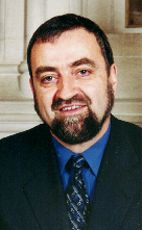
House of Commons photo

Crucial Fact

  • His favourite word was federal.

Last in Parliament May 2004, as Bloc MP for Lévis-Et-Chutes-De-La-Chaudière (Québec)

Lost his last election, in 2015, with 12% of the vote.

Statements in the House

Civil International Space Station Agreement Implementation Act November 19th, 1999

Mr. Speaker, I do not think I am going to use the 32 minutes I am allowed since we are in favour of this bill.

However, as I mentioned in my remarks before question period, I would like to reiterate our disappointment in the fact that we are called upon now to discuss this bill to ratify an international agreement reached nearly two years ago, when the deadline for the ratification of the agreement is January 29, 2000. Since the House does not sit in January, parliamentarians are really called upon to express their views on this bill at the very last minute.

Perhaps I should address one particular aspect of this bill. It seems to have become a habit, as I noticed myself last year with Bill C-54, to include the substance of the bill in the schedule. While the bill per se is only six pages long, the schedule contains 26 pages.

There is a provision in the bill that says that, once the bill passed, after nearly two years, the minister will only need an order in council to amend the agreement through changes to the schedule. It is as simple as that.

Here we are, two years later, and this is the first time we hear about that in the House. It might well be the last, even if the agreement can be changed at the international level by different partners.

I dare say that I find this rather highhanded. It may be a matter of form rather than substance, but I would not like the government to continue in that vein, because it would be tantamount to gagging members of parliament.

This project, a civil international space station, is extremely important, and the Bloc Quebecois obviously does not want to unduly hold up the legislative process, because the impact of this project in Quebec is quite significant. I remind the House that the Canadian Space Agency is headquartered in St. Hubert, near Montreal.

The space agency has offices in each province, but since its headquarters are in St. Hubert, many businesses in the Montreal area and in other regions in Quebec benefit from the spinoffs.

The bill itself is quite short; it is only 6 pages long. It might be interesting to give a general idea of each one of its clauses. When I have to address the House, I make a point of reading all the clauses of a bill, even when there are many. In this case, there are only 13, so we should be able to go through them fairly quickly.

We have no problem with clause 1, which deals with the title of the bill, since we are talking about the Civil International Space Station Agreement Implementation Act.

I will ship the first part of clause 2, but I would draw the attention of parliamentarians to the definition of “minister”. I know it is commonly used in legislation. It is good to remind people that we live in a so-called sovereign state.

The definition of “minister” reads “member or members of the Queen's Privy Council of Canada.” This is the Queen of England of course. It is good to remind ourselves that, although Canada claims it is a sovereign state, it still maintains very clear ties with the monarchy.

Clause 3 states “The purpose of this Act is to fulfill”—I emphasize the word fulfill—“Canada's obligations under the agreement”. We are talking about two years later.

Clause 4 states “This act is binding on Her Majesty in right of Canada or a province.” Same as before.

Clause 5 states “The governor in council may designate one or more members of the Queen's Privy Council for Canada as the minister or ministers for the purpose of this act.” We have no problem with this one either.

Clearly clause 6 gives a lot of power to the minister. It reads “The minister may delegate any powers, duties and functions to one or more persons”. One comment in this respect. I hope the minister will not delegate any duty to the secret service agent who lost his documents. We are talking about space and things could go wrong.

Clause 7 states:

The Minister may send a notice to any person that the Minister believes, on reasonable grounds, has information or documents relevant to the administration or enforcement of this Act, requesting the person to provide, within any period that the Minister specifies, that information or those documents to the Minister or any person that the Minister designates.

That is very nice. Such notice could be sent to people who might have important information on space research, many aspects of which may be top secret.

Clause 8 reads as follows “No person in possession of information or a document that has been provided under this act or the agreement shall knowingly communicate it”. But there are two exceptions.

That is when the communication or access is in the public interest or necessary for the administration or enforcement of the act or the agreement.

Clause 9 states:

The Governor in Council may make regulations that the Governor in Council considers necessary for carrying out the purpose of this Act and giving effect to the Agreement—

The governor in council is the cabinet. I repeat, this agreement can be changed merely by changing the schedule, without going back to the House.

Clause 10 states:

The Minister shall, by order, amend the schedule to incorporate any amendment to the Agreement—

As I just said, the agreement of parliament is not required.

Clause 11 is longer, so I will just give a summary.

Section 7 of the criminal code is amended to include offences committed by a Canadian crew member even if he or she is in space. Similarly, the law would apply to a crew member from a partner state who commits an act or omission affecting the life or security of a Canadian crew member or a flight element belonging to Canada.

As for clause 12(3), it is worthwhile reading it in its entirety, for it is not very long:

If the employee or the dependants referred to in subsection (1) elect to claim compensation under this Act, Her Majesty shall be subrogated to the rights of the employee or dependants and may, subject to the Agreement implemented by the Civil International Space Station Agreement Implementation Act, maintain an action in the name of the employee or dependants or of Her Majesty against the person against whom the action lies and any sum recovered shall be paid into the Consolidated Revenue Fund.

As we can see, this is very vague. However, it is normal to have recourse, but all this is subject to the approval of Her Majesty, which is “subrogated to the rights of the employee or dependants and may, subject to the agreement implemented—”

Clause 13 deals with the coming into force of the act.

The schedule, which is the agreement itself, is very interesting. It mentions many things.

It indicates that the whole process began in 1984. We are discussing the agreement now, in 1999, but the whole process began in 1984. Since then, there was, among other events, a meeting between the President of the United States and the Prime Minister of Canada at the time. I will never forget that meeting, which ended with the former Prime Minister and leader of the Progressive Conservative Party and the U.S. President, Mr. Reagan, bursting out in song together. At the time, everyone recognized that Canada was very, very close to the Americans.

I am pointing this out, because we recently travelled to Russia to meet a Russian parliamentary committee on science and technology, as part of an economic mission led by the Secretary of State for Science, Research and Development. People asked questions about the space station, because the Russians are experiencing financial problems and are having difficulties meeting the requirements of the agreement they signed in 1998.

The Russian parliamentarians' objections had to do with Canada always appearing to be too close to the United States and to be in agreement with the Americans.

Earlier, I mentioned our ties with the Commonwealth. The Russians believed, and they were very blunt about it, that we were too close to the Americans, and they had doubts about the future of the space station. So much so that they insisted on keeping a separate module, which is the exception on board this particular space station. The Russians absolutely want a module not accessible to the rest of the space station, because they do not trust the Americans.

Now, I will not go over all the other pages of this substantial schedule, which deals with international rights and obligations, management, intellectual property and, of course, research. The latter is an important issue, because Canada is taking part in this initiative. I think it is important that we preserve intellectual property rights over the research Canada will have invested in. The same thing goes for the other participating countries.

I would like to underscore the special contribution of Canada to this research project through the Canadian Space Agency, thanks to the mobile servicing system. People will ask “What is the mobile maintenance system?”. It is the famous Canadarm, which will be able to move just about anywhere in the station.

I was fascinated , during a visit I paid with the other members of the Standing Committee on Industry to the space agency in St. Hubert, by the way mobility is achieved. The Canadarm has two hands, so to speak, and if it attaches itself to one part of the station, the other hand can move about and attach itself to another part of the station.

I saw that. I think that people can go and visit the centre. They can see this discovery, which has put Canada and Quebec's scientific community on the map, as they say, because this system will be used not only for repairs but to assemble all of the elements of the module. Canada's participation is therefore vital to the construction of the station.

I would also like to mention the role played by Quebecer Julie Payette in a research expedition in the international space station. She was the first Canadian to go there. Her particular contribution was important, since she was the head of the medical team, which obviously monitored the health and physical condition of the astronauts and which carried out very serious medical research.

Since the beginning of medical research in space, a number of treatments for diseases have been found, thus improving health. There are obviously a lot of questions about bone density and balance. In short, it is very important.

This project, which will span over 20 years, requires a $1.4 billion contribution by Canada. This may seem expensive, but the economic benefits are estimated at over $6 billion.

An investment that will yield such substantial economic benefits is a good investment. Overall, it will create 70,000 jobs, which is significant. This is one reason that motivated us, in the Bloc Quebecois, to support this bill. These jobs are not only in the province of Quebec, since, as I said, the Canadian Space Agency has divisions across the country. But Quebec is glad that the agency has its headquarters in Saint-Hubert.

We are not talking only about public servant or researcher jobs paid by the agency, but also about jobs in the private sector and for people who do research on a contractual basis or who try to apply research elements identified by the agency itself. The application aspect is very important and it also creates a lot of jobs.

There will be enormous economic and scientific benefits in our daily lives. Because of the financial limitations of a country with 30 million people, the space agency has decided to limit its activities to certain niches.

Besides the Canadarm and the mobile maintenance system I mentioned earlier, the agency has become a world leader in satellite communication. This is not necessarily related to this particular project, but the Canadian Space Agency developed RADARSAT, as well as other applications. Another project will be launched shortly, which will contribute further to the advancement of satellite communication. This means that soon someone in the Sahara desert will actually be able to speak on the phone with someone in Ottawa. They will be able to communicate. This is no small thing.

And that is not all. Those interested in geography can expect to see more accurate maps, because it will be possible to take shots to within approximately two metres from the ground. Agency representatives told us that the Russians and the Americans do not want it to be any closer, apparently for security reasons.

During my visit, I observed the seriousness of Agency employees, especially their pride when astronauts from around the world come to the training centre devoted solely to use of the Canadarm. All astronauts, whether they are Russian, American, European, or Japanese, come to Saint-Hubert regularly for training. This is great for the city of Saint-Hubert and for Quebec. It is also good for Canada.

I would now like to talk about what I think is the most important aspect of the civil international space station, and that is co-operation among various countries. These include Canada, the United States, Japan, Russia and European countries; others could join eventually.

The word “partnership” appears throughout the agreement. It is used very frequently. I think this is very important. This is a step forward for the advancement of aerospace science. This multilateral agreement has been quite a shot in the arm. Since the end of the cold war and the fall of the Berlin Wall, the Russians have joined the expedition. I think this is good.

Speaking of history, this year the Canadian Space Agency, which has its headquarters in Saint-Hubert, is celebrating its tenth anniversary.

I will conclude on a political note. The word “partnership” crops up everywhere in this agreement. Canada has agreed to discuss an important agreement with other nations, but has said in advance that it is not interested in discussing partnership with Quebec. This government is prepared to talk with everyone except Quebec. That is how much this government seems to care about a wish expressed in 1995 by 49.6% of Quebecers.

Civil International Space Station Agreement Implementation Act November 19th, 1999

Mr. Speaker, first of all, let me reassure my colleagues that I will not be taking the 40 minutes allotted to me, even though I could.

As a member of the industry committee, I am pleased to take part in this debate on Bill C-4, to implement the agreement among various countries concerning co-operation on the civil international space station, entered into on January 29, 1998.

The Bloc Quebecois is also in favour of this bill, but the government does not have much respect for us as parliamentarians, in having us vote on an agreement entered into nearly two years ago, right at the two year limit set for its ratification. I say right at the two year limit because the final date is January 29, 2000.

Since the House does not sit in January or over the holiday period unless there is an emergency and the bill has to go to the other House, we are really up against the deadline. Imagine, as parliamentarians, what would happen if it did not go through. The government has been spending money under this agreement for two years. It would be a fine mess.

This is a pretty strange way to finish up this millennium. It was precisely in order to avoid a repetition of such a thing that my colleague for Beauharnois—Salaberry recently introduced private member's Bill C-214. Its intent is to get parliament more involved in ratifying treaties.

In his speech before this House, the hon. member for Beauharnois—Salaberry indicated that the present Government of Canada, like the previous one, appears to be following a British tradition, one followed by member countries of the Commonwealth, one that is not a practice in most other democratic countries.

I will not repeat what my colleague has said, but I will point out that in the United States, surely the most advanced country as far as space is concerned, a two-thirds vote of the Senate is required for an agreement of this nature to be ratified by the president. We can see therefore we have a way to go in terms of democracy.

I have a question. Regardless of what the members opposite have to say, is Canada still dependent on the British system, since we retain many of the parliamentary rules and traditions of this system?

We are dealing with space, therefore electronics and very advanced science and technology. I have been in a number of parliaments on delegation visits. In most western countries that have parliaments, votes are taken electronically from the desks of the members. They insert a smart card, and the calculations are done automatically. They do this in the States, as in many other countries.

We are debating a bill and will soon have to vote on it, rising each in turn. It is perhaps a good thing that we all rise, but the calculations must still be done manually in the best country in the world, as the Prime Minister often says.

In the best country in the world, it takes time. So much time that an agreement, because there are so many bills to debate, has to be ratified at the last minute. This isn archaic way of managing a modern project.

What a poor way to encourage young people to become active in politics. The government would like all young people to be connected, through the schools and universities. The government encourages Canadians to get connected, but is unable to connect its own parliament.

Let us come back to this modern agreement on the civil international space station, concluded nearly two years ago and difficult to oppose, because it is already in operation.

This agreement contains 26 pages and is, in fact, part of the bill, whereas the bill itself has only six pages. So, as the bill is not very long, I trust members will allow me to read and comment on a few clauses—

Youth Criminal Justice Act November 18th, 1999

I do not dare do what by the hon. member for Jonquière just did by asking those who did not commit anything stupid before the age of 18 to stand up. Perhaps there would not be many. I do not want to cast too many stones because, if I were to look into my own past, I might find something wrong, but surely not anything serious.

In conclusion, a bill to increase should follow an increase in crime. Yet, we see the opposite happening. Youth crime has decreased. Yet, the minister wants to cave in to Reform arguments to ensure her re-election.

Youth Criminal Justice Act November 18th, 1999

Madam Speaker, it is my turn to rise in opposition to this bill.

I listened intently to the member opposite who said that the bill reflected the Canadian reality well and respected Canadian values. It is quite surprising, when one looks at the statistics, to find out that the situation is completely the opposite of what the member just said: the crime rate has actually declined.

The Bloc Quebecois is a reflection of Quebec society. And this society, through a coalition, is expressing its opposition to this bill. Even if others members have already listed them, I believe it is important to name the various groups in this coalition to show representative it is.

There is the Commission des services juridiques, the Conseil permanent de la jeunesse, the Centrale de l'enseignement du Québec, the École de criminologie de l'Université de Montréal, the Centre communautaire juridique de Montréal, the Fondation québécoise pour les jeunes contrevenants, the Institut Philippe-Pinel, the Association des chefs de police et pompiers du Québec, the Conférence des régies régionales de la santé et des services sociaux, the Association des centres jeunesse du Québec, the Commission des droits de la personne et des droits de la jeunesse, the Bureau des substituts du procureur général du ministère de la Justice du Québec, the Association des CLSC et des CHSLD du Québec, the École de psychoéducation de l'Université de Montréal, the Regroupement des organismes de justice alternative du Québec, the Ligue pour le bien-être de l'enfance du Canada, the Association canadienne pour la justice pénale, the Association des avocats de la défense du Québec and the Société de criminologie du Québec.

This makes a great many people who think this bill is nonsense. Let us first look at the facts. Statistics from Statistics Canada or other bodies—the justice minister is aware of these—show that, between 1991 and 1997, the number of young people charged has dropped by 23%. It did not go up, it did not stay the same, it went down by 23%.

Charges against young people for violent crimes has dropped by 3.2% since 1995. Young Canadians convicted of criminal offences are incarcerated at a rate four times higher than adults, and twice as high as American youth. What is the government trying to achieve? It wants to go even further. It makes no sense.

Let us look at the numbers for one year. In 1997, the rate of police reported crime decreased for the sixth year in a row, falling 5%. This decline resulted in the lowest rate since 1980.

Rates decreased for almost all violent offences, including sexual offences, which stand at 0.9%. Robberies dropped by 8%, homicides by 9%. The number of young people charged with Criminal Code offences is down 7%, which is consistent with the general downward trend recorded since 1991. The number of young people charged with violent offences has dropped by 2% for the second year in a row. It should also be noted that the majority, or 53%, of charges against young people involve property crimes, while 20% involve violent crimes.

Violent crime is down and yet the minister persists with her bill. Violent crimes include homicide, attempted murder, physical assault and sexual assault, other sexual offences, kidnapping and robbery. The rate of such crimes decreased by 1.1% in 1997. Not too impressive, at first glance, but this is the fifth consecutive year.

The number of young people charged with crimes of violence has gone down for the second year in a row. It dropped by 2% in 1997. In the course of the last decade, the number of young people charged with homicide has remained relatively stable at approximately 50 a year. The national homicide rate dropped 9% in 1997, reaching its lowest level since 1969.

We could go on and on citing statistics, but I want to get back to the remarks of the member opposite, who said that the government was responding to Canadian reality.

If that is what the bill was doing, it should be geared down, because things are improving. The youth crime rate is decreasing, but tougher measures are being introduced. What a reaction.

The arguments are political in nature. The statistics show an increase in the crime rate the further west one goes. It would seem that the crime rate is higher in certain areas of the country. The Reform Party members, coming from the west, are reacting to this state of affairs.

The Minister of Justice, probably with an eye to re-election, is taking account of the political climate that exists in that region of Canada. She is, however, the Minister of Justice for all of Canada. In Quebec, all the organizations I named at the beginning of my speech are opposed.

The Quebec justice minister, who represents my riding, has been fighting a battle this is far from over and will only be when the federal justice minister withdraws the bill. The Quebec minister introduced an amendment that could somehow exempt Quebec from this bill, but this amendment was not considered in order.

Despite all the representations made and the support given by all Quebec organizations involved in this area, Ms. Goupil was not able to bend the will of the federal justice minister. Apparently, ideas from Quebec are not as good as if they came from western Canada, which is closer to her. She wants to get re-elected.

It is unfortunate that bodies of public opinion that may prevail in a particular region or are fuelled by the media can influence justice to such an extent.

I sometimes jump in my seat, in the morning, when I read the first seven or eight pages of some newspapers. We see pictures. Not those of young offenders, of course, because it is not allowed in Quebec. So far, it has not been allowed elsewhere in Canada either. But what does this bill intend to do? This bill will do away with this anonymity. It is going the other way.

I am not saying that this is what the minister intends to do. I certainly hope it is not, but there seems to be a shift toward publishing the pictures of young offenders under the age of 18 in certain newspapers, in Quebec and in Canada, with all the consequences this could have on their families.

In my youth, I was taught a number of basic principles that I never forgot. We must remember what our parents taught us. The other day, I was talking about the catechism, which sets out the nature of a mortal sin. Three conditions must be met. It must be a serious offence, committed with full awareness. They must also be wilful consent. Is a 12 or 14 year old fully aware of the seriousness of what he is doing? No. Who in the House has not, in his or her youth, done something rather stupid, something that he or she regrets now?

Speech From The Throne November 17th, 1999

Mr. Speaker, my answer would be that government members should do what the member for Matapédia—Matane does.

They should do what he does. He brings the problems of his constituents before the House. We should not do like the Liberal members, who try to sell indefensible Liberal policies, such as employment insurance cuts, in their ridings.

This is unacceptable. They should do what my colleague does and stand up for their constituents.

Speech From The Throne November 17th, 1999

Mr. Speaker, I almost turned red—in spite of myself—at hearing a member of another party compliment me. I thank him for his compliments. I did not expect this kind of comments from him, but I am greatly honored.

He asked me an interesting question. I remember that, when I was sitting on the Standing Committee on Human Resources Development, several people had indeed raised this issue with us.

I do not want to speak on behalf of my party. I want to express a personal opinion. Because of shared jurisdictions in a federal system, the issue is very complex. On the social union agreement alone, there are differences of opinion between Quebec and the other provinces. Whether one is a sovereignist or a federalist, the hon. member for Chicoutimi knows well that, when Quebec's interests are close to one's heart, one cannot ignore certain things on the federal level when the government wants to interfere in provincial jurisdictions.

I believe that, in the current context, a guaranteed minimum income in a confederate state or a federation would be very difficult because there must be a lot of consultation and co-ordination between the different governments.

In a sovereign Quebec, this would be possible and I would be one of the main proponents of this. Following the by-election in Hull—Aylmer, if he wants to keep his seat in Chicoutimi, the hon. member should consider joining the Bloc Quebecois to ask for the same thing as we have been asking. Perhaps a guaranteed minimum income under a sovereignist government in Quebec would then be possible.

Speech From The Throne November 17th, 1999

Mr. Speaker, it is now my turn to take part in this debate on the Speech from the Throne. I must say that I am not doing so with much enthusiasm, because, as many observers pointed out when it was read in the other place, I found it was very dull and lacked substance.

It was not the fault of our new governor general, who read it very well, but it was so dull that I saw people who were nearly falling asleep, even though they had taken the precaution of standing while it was being read. They did not find it very lively.

I must say that the first three throne speeches delivered by this government since I was elected in 1993 were not very lively either.

In my opinion, this dull and vague speech, which makes no real commitments, is a screen for a certain government strategy. I think the government intends to tinker with the rules under which the next referendum will be held in Quebec. It has raised the issue of the majority; it has challenged the principle of a simple majority, which is accepted throughout the world.

Newfoundland joined the Canadian federation, after two referendums, with a majority of 52%. Several countries joined the European Economic Community with 51% of the vote. This principle is universally accepted.

It was even confirmed in Mont-Tremblant, where the intergovernmental affairs minister hosted a seminar. Several experts confirmed this principle, including some from Scotland. But the minister still wants to review the rules concerning the majority needed in a referendum.

In the throne speech, there is talk about a clear question. In the referendum on the Charlottetown accord, in 1992, voters had to vote without having seen the accord. How is that for a clear question? Voters were asked whether they supported an accord they had never seen. Many voters had never got a copy.

Like the hon. member for Portneuf said, however, it does not take a great deal of time to examine this speech. The main problem with it is what it does not say. Just like the member for Lévis-et-Chutes-de-la-Chaudière, I was disappointed not to find in this speech a single word on shipbuilding. Yet, 160,000 people sent the Prime Minister a postcard asking for a new shipbuilding policy.

This week, I heard industry officials acknowledge the fact following an emotional outburst from a Reform member who was wondering why this sector should be supported. We will deal with this Reform member in due course. The department official's reply was “No, we are not doing anything special in support of shipbuilding”. This prompted me to say that was exactly what we were criticizing the Liberal government for: not doing anything special for shipbuilding.

In one country in the world that is blessed with the largest marine area, three oceans and the longest interior seaway in the world, a country that does much trading, the shipbuilding industry currently accounts for only 0.4%. Yet, our country is among those with the heaviest marine traffic per capita. There is something wrong with this picture. At any rate, I will have the opportunity to pursue the matter when a private member's bill comes up for debate in the House next Tuesday.

The title of the speech from the Throne is “Building a Higher Quality of Life for All Canadians”. What about the quality of life? While 62.7% of Americans are employed, only 59.5% of Canadians are.

Granted, the unemployment rate has decreased, but only 40% of Canadians who lose their job qualify for EI. What a beautiful country. The other 60% have to rely on social assistance, which, as we know, is a provincial responsibility.

Other members addressed transfer payments. Let me quote a startling figure: since the Liberals took office, there are 500,000 more children living in poverty. These children live below the poverty line, which means that their parents are poor.

Moreover, our productivity rate is only 81.3% that of the United States. Over the past 20 years, the average actual income has shrunk by about $142 annually.

Things are not getting better. I can see why the government is saying that we must build a better quality of life. That statement may mean that the government has finally realized that there is a problem. If so, then the Prime Minister should stop saying that Canada is the best country in the world, because it is not necessarily true.

In 1998, the actual per capita income was $29,000. This figure includes high income earners. In the U.S., it is $46,000.

Any country where the quality of life is generally good should invest in training its workers. Canada ranks 13th in that regard. As for research and development, we are dead last among the G-7 nations. The government boasts about a knowledge-based economy, when in fact scientific research institutions and centres have suffered such deep cuts that they have not yet made it back to the 1995 level.

The Minister of Finance managed to achieve a zero deficit. He even generated surpluses. I do not know what his objective is for the next five years. It may be that he is aiming for a surplus of close to $100 billion, this at a time when there are more and more poor and middle-income families. When we talk about middle-income families, that includes of course some high-income earners. This means that the situation is even worse for low-income families.

Today, there was a demonstration on the front lawn of parliament. There has never been so many homeless people in Toronto, Vancouver, Montreal and all the other major cities across Canada. Those people have nowhere to go. They have to rely on soup kitchens. It does not make any sense to keep on repeating that Canada is the very best country in the world.

This speech does not talk about matters over which the federal government has full jurisdiction. What little substance there is in the throne speech deals with matters of provincial jurisdiction. It is a shame, and we can never denounce it enough. I sometimes tune in to open line shows. People seem to think that it is only in Quebec that waiting rooms are crowded. The situation is the same everywhere, in Ontario and elsewhere. Why? Because of drastic cuts to transfer payments.

When questioned, the minister of Finance suggests that fewer cuts are being made and he even tries to pass these off as increases.

This is a bland and unsubstantial speech, but the little substance that can be found in it is indeed very subtle. It reflects an increasing invasion of provincial jurisdictions. The will to impede Quebec democracy by interfering in the referendum rules is obvious.

All the Liberals have to do is mind their own business. It is up to Quebecers, and Quebecers alone, to decide their future.

Canadian Tourism Commission Act November 2nd, 1999

We are not talking peanuts, as the member for Louis-Hébert has pointed out. She is right.

The Progressive Conservative member for Chicoutimi surely agrees with me that tourism is very important for Quebec, including in his region.

It is so important that we want to run it our way. But it is not too clear whether Quebec will really have a say, because its participation will be reduced to a minimum. Obviously, we are going to try to negotiate improvements.

That is all I had to say today. I will hold a longer speech for when we return after committee study, unless there is a miracle and the government occasionally dares to accept amendments moved by the opposition parties, whether the Bloc Quebecois, the Progressive Conservative Party or the Reform Party, to improve this bill. But this government has a lot of trouble with this members need only remember the case of shipbuilding, when it did not let even one comma be changed. The minister said he could not do it.

It is very difficult to get the government to change its mind, even with 160,000 postcards asking it to do something to help the shipbuilding sector. This government is convinced that it must always be right about everything, on every occasion and in every setting, and especially in this parliament. Nevertheless, we will continue to remain optimistic and try to get the government to change its mind, at least on the issue of tourism, for the good of this important economic sector.

Canadian Tourism Commission Act November 2nd, 1999

My colleagues are giving me a number of examples, clearly the festivals are expanding. In Quebec, we want to promote our cultural identity through tourism. Education and culture are important for Quebec. Why not let Quebec try its luck in this regard? Instead, as I said earlier, the federal government cuts funds to the Government of Quebec in subsidiary agreements, and creates a new agency.

The minister looks very relaxed. He is reading documents, perhaps his paper. He will wash his hands of it when a member from Quebec puts questions to him, saying “You know, it is the commission we created”.

We will watch this closely, obviously, on the Standing Committee on Industry, which I sit on. We have many questions: How will it operate? Who will really make appointments? Will there be consultation with the provinces, and what form will it take, because this is a very important sector, representing $44 billion in economic activity?

Canadian Tourism Commission Act November 2nd, 1999

The Festival mondial de la culture and so forth. Which government is in a better position to support these activities?