
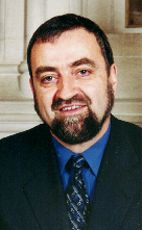
House of Commons photo

Crucial Fact

  • His favourite word was federal.

Last in Parliament May 2004, as Bloc MP for Lévis-Et-Chutes-De-La-Chaudière (Québec)

Lost his last election, in 2015, with 12% of the vote.

Statements in the House

Budget Implementation Act, 1999 May 4th, 1999

Mr. Speaker, I am delighted to support the motion of my colleague from Saint-Hyacinthe—Bagot to delete lines 13 to 43 in clause 4.

In essence, this would re-establish the calculation formula planned at the time when the Minister of Finance announced the Canada social transfer in 1996. I must point out what the Canada social transfer is, or what it was, since it has just been changed again.

The Canada social transfer is a set of transfers to the provinces made by the federal government in the past for health care, post-secondary education and social assistance. I remember that the 1995 reform of the social programs took two years. At that point, I was a member of the Standing Committee on Human Resources Development, which travelled around the country consulting people. I recall the type of consultations we had. There were demonstrations everywhere, because people were concerned about what was going to happen with the cuts to employment insurance and the changes to the social programs.

By putting all that into a single fund, the government seized the opportunity to cut payments to the provinces. Quebec was hit particularly hard. There was nothing to be proud of, but it is a fact. There were more unemployed and poor people in Quebec than the Canadian average. I might point out as well that there is a link between cuts to employment insurance and the transfers to the provinces and today's debate.

The intent of the member for Saint-Hyacinthe—Bagot in his motion is to bring things back to the way they were in the 1996 budget. It must have meant something. It was planned.

I will mention it in conclusion, but we had not just the word of the Minister of Finance but his written word that the government perhaps did not agree to it all, because there were cuts, but there was a formula. This is the commitment the Minister of Finance made to carry out this reform, to bring everything together in the Canada social transfer.

With its 1996 budget, the federal government established a mechanism to reduce current disparities in per capita entitlement between the provinces by half by 2002-03. The mechanism in question would have increased the per capita weighting from 10% in 1998-99 to 50% in 2002-03.

That was what the Minister of Finance promised. But, in the 1999 budget, without a word of warning to Quebec, the federal government is proposing to completely eliminate these disparities in three years. The new increases under the CHST, including the one for this year, will be distributed equally, per capita, in every province and territory.

The budget proposes a weighting of 70% in 1999-2000 and 100% in 2002-03. Because of this unilateral decision by the federal government, Quebec will lose out on more than $350 million annually. This explains why Quebec is getting only 8.3% of the $11.5 billion increase in the CHST over five years, while Ontario will get 47.2% or almost half.

In the circumstances, we should not be surprised to see Ontario MPs take turns applauding this measure, because it is to their advantage.

They have short memories. Now they have harsh words for the member for Saint-Hyacinthe—Bagot, when all he is saying is that this was not what was promised. These were not just idle words from the Minister of Finance. This was a promise made in the budget. That is all the member is saying.

Today, the member for Saint-Hyacinthe—Bagot is being called all sorts of things I would rather not repeat, is accused of being nuts, wrong, unfair, and told that the concept of need took precedence over the concept of per capita distribution. That was the Minister of Finance's plan and philosophy in 1996.

The hon. member for Saint-Hyacinthe—Bagot merely raises this point. Great consternation is stirred up on the other side. They say “My goodness, what he is proposing is insignificant, wrong, and far-fetched”. Is the Liberal side saying that what the Minister of Finance proposed scarcely three years ago was far-fetched and wrong? All those adjectives can be applied, for that is what the commitment by the Minister of Finance was.

Recently, the Minister of Intergovernmental Affairs claimed that the provinces had called for this change on June 15, 1998. There is a connection with the social union, which was accepted by the other provinces, but not Quebec. The others accepted that in future provided there is advance notice of three months, I believe, the federal government can change provincial social programs as it sees fit. Quebec did not accept this, because it is unacceptable to Quebecers, and the premiers of the other provinces accepted so that they would get some money.

I know that there are some words that cannot be said in this House, but when principles are cast aside in favour of money, there is a word that springs to mind: intellectual prostitution, at the very least. This is terrible, scandalous.

The Minister of Intergovernmental Affairs claims the provinces asked for this change. This is no excuse for the government's not giving any advance notice of its intention to modify the transfer formula in its 1999 budget. There was no advance notice. At any rate, had there been one, it would have been only seven months, whereas the social union framework agreement calls for a minimum of one year. The Liberals reneged on their own signature on social union.

That is not all. The Prime Minister said that the premiers' letter of January 23, 1999, concerning the reinvestment of the new transfers in health satisfied him and that he considered it a sort of agreement on health.

The Prime Minister broke his word in the weeks before the budget, since the letter on health care asked the government to totally reverse, within a reasonable timeframe and through existing arrangements under the Canada social transfer for health and social programs, the cuts it had made in its transfers in recent years.

One aspect concerns me increasingly and that is respect for and the promotion of democratic process. One of the conditions of democracy is that information be provided. There is, however, another condition. People who give their word or who agree on a commitment must honour it afterward. Otherwise, it means nothing.

Again yesterday—I would just refer to this matter of particular concern to me, shipbuilding—we debated for an entire day a motion of the Progressive Conservative Party, which, in the end, had used word for word the resolution passed by Liberal Party faithful at their latest convention. Most Liberal members were probably in the hallway, sipping coffee or something, but I asked whether they remembered being at that convention. They did not say yes, of course. They nodded their heads, but did not recall having voted on this resolution. However, they did vote in favour of it.

But in the House, that means nothing. It is like the election promises in the red book. They are meaningless. The Prime Minister said he would scrap the GST. He did not do it. At one point, he also said he would tear up the free trade agreement and change it. He did nothing of the sort.

We could make a long list of such commitments and broken promises. We could talk about promises made during election campaigns and at conventions, but the issue today is a commitment made by the Minister of Finance in his 1996 budget to reform the Canada social transfer.

To put all this together and to make his cuts more palatable, he said “I will tell you in advance how the amounts will be calculated and how much the provinces will be getting”. He said that for two or three years and then, suddenly and unilaterally, in another budget speech, the minister said “This is it. It no longer works that way”.

We must condemn this kind of about-face. People are losing confidence in the Canadian political system because they are increasingly aware that it is plain rubbish.

Supply May 3rd, 1999

Mr. Speaker, since these are probably the last remarks in today's debate, I must thank the member for Saint John and the Progressive Conservative Party for raising this issue on opposition day.

The motion is broad, but at the same time very clever; it is unifying in that it brings together all the opposition parties, but also picks up the text of a resolution adopted by the Liberal Party at its convention, and introduced by the Maritimes Liberal Association. I find this very clever, because it forces Liberal members to ask themselves a very serious question.

There seems to be two different concepts of democracy. In a dictatorship, people are told “Do as you are told and keep quiet. You do not have the right to speak up”. A modern version of this, the Liberal version, highlights the role of the grassroots members at a convention, but it means nothing because their voice is ignored. Would the member agree?

Supply May 3rd, 1999

Mr. Speaker, before I ask the member for Waterloo—Wellington my question, I would like to make the following comment.

I have been here since the beginning of this debate on the motion by the member for Saint John. The motion repeats word for word a resolution adopted at the federal Liberal Party convention in 1998. I am astonished that, so far, Ontario MPs are the ones speaking on behalf of the Liberal government. There have been no representatives of the maritimes, Quebec or the west coast. Yet they are the ones with shipyards in their ridings.

Another thing perhaps worth pointing out is that all the members with shipyards in their ridings are opposition members. In my riding, I defended the Lévis shipyard with everything I had.

I looked at the electoral map and saw that it was not very hard to find a Liberal in Ontario. With one exception, all the members from Ontario are Liberal. Contrary to the promise it made in 1993, this government did not hold a summit on the future of Canada's shipyards in the year following its election to office. After failing to keep their promise, some well meaning members probably want to do well by the Prime Minister and they are all singing from the same song sheet.

I ask the member for Waterloo—Wellington whether he attended the last convention of the federal Liberal Party, whether he recalls the resolution put forward by the New Brunswick Liberal Association, and whether he voted for or against it. And if he voted in favour, will he show some consistency and vote in favour of the motion by the member for Saint John when it is put to a vote?

Supply May 3rd, 1999

Mr. Speaker, the remarks by my NDP colleague lead me to say the following. He is supporting a motion by the member for Saint John, who is a Progressive Conservative and does not usually think like a member of the NDP and vice versa. On this subject, however, be they from the west, British Columbia, the maritimes or Quebec, the members of the opposition parties are in agreement.

It is a rare thing to have a consensus among all the unions of the various regions of Canada and the members of the Canadian shipbuilders association, which represents the nine biggest shipyards in Canada.

As the NDP often takes stands on the number of jobs or employee rights, I have a question for my colleague. Did he notice, as I did, in thoroughly examining the shipyards issue, that none of the unions involved in shipbuilding, for the past four or five years, can be claimed to be protecting its collective agreements at all cost? Did he see the same thing?

The collective agreements are now very flexible. Workers have agreed to make considerable sacrifices, for example the ones in Lévis and the other shipyards I have visited. Studies show that members of the United Auto Workers, who are in the eastern shipyards especially, have pointed out—and the member for Trois-Rivières did too—that salaries and collective agreements are not the issue. In this case, the workers cannot be blamed for the situation.

I want to know whether the member shares this position, whether he has seen what I have in terms of the effort put out by the workers in Canada's shipyards.

Supply May 3rd, 1999

Mr. Speaker, I got to know my colleague across the way better during a trip to Taiwan, where our group visited the giant Kao-hsiung shipyards. We could see that they too were experiencing certain difficulties, which leads me to make a point.

We often compare our shipbuilding facilities to those in Asia, but the ones in Canada, in Saint John, Lévis or elsewhere, have developed different areas of expertise than those of Asia, which were designed mainly for building ships in excess of 300,000 tonnes.

We have to take away some of the mystery. Most ships built in Canada have to use the Panama canal, so our dry docks are made for tonnages of 90,000 or less.

Each of Canada's shipyards has an area of specialization, for instance, aluminum ferries in B.C., military vessels in Halifax. Each, therefore, including St. Catharines and Port Weller, has highly specialized and highly advanced equipment. This is not, therefore, where the problem lies.

The problem is raised by the hon. member for Saint John. In my opinion, Canada's attitude can be considered naïve.

On the one hand, we depend on the OECD treaties, while the European countries, seeing that the Americans are not signing them, are adopting interim measures. These include subsidies.

The hon. member also refers to the EDC. That is all very well, but allow me to cite an example. Just recently, a few weeks ago, two years after the arrival of the Spirit of Columbus platform and after Davie Shipbuilding was at risk of closure because of the lack of funding guarantees, the EDC finally came through. The funding guarantees should have been available right from the start.

There are, therefore, certain possibilities, but the mechanisms for evaluation operate far too slowly.

I would like to have the hon. member's reaction to this.

Supply May 3rd, 1999

Mr. Speaker, since the very articulate member is used to these kinds of debates, I want to ask him some specific questions.

If he remembers attending the last Liberal convention, he must remember that the Liberal Party resolution was approved by a high percentage of supporters. Did he vote in favour of the resolution at the last Liberal convention in 1998?

As a matter of principle, does the hon. member think that it is normal that, six years later, we are still waiting for the summit his party promised, in 1993, to hold within a year? Does he think it is normal for everyone, except the Minister of Industry, to agree that things are not as they should be in the shipbuilding industry, which is only operating at 40% of its capacity? Does he think it is normal to be able to do nothing and to bow down before the American giant, saying nothing can be done? Does he think it is normal?

Supply May 3rd, 1999

Mr. Speaker, I listened very carefully to what the Reform member just said.

I believe his comments reflect what ever member in the House has been saying, that subsidies are out of the question. Everyone agrees on that.

He mentioned tax breaks. This is what people want also. Usually the Reform Party refers to tax breaks as incentives. However a refundable—I stress refundable—tax credit, which is one of the measures Canadian shipyard owners are asking for, is important because it is an incentive that kicks in after the work has been completed. Therefore, it makes it possible to build something that otherwise would not have been built. It brings in tax revenues as well as creating jobs.

I would like to know whether the Reform member agrees with this kind of measure.

Supply May 3rd, 1999

Mr. Speaker, the Minister of Industry said he met with members of the shipbuilding association, to which the management of Canada's nine largest shipyards belong. Their brief, which dates back to 1996—and they still stand by it—mentions a number of considerations the minister or the parliamentary secretary talked about.

There are four points on which they insist, and the minister did not respond, in particular with regard to the implementation of an improved export funding program.

Yes, some assistance is available through the Export Development Corporation, but the minister said himself that Nova Scotia felt the need to implement such a program, and it is nothing new since the minister knows about Title XI in the United States.

Everyone here agrees. We do not have to talk about subsidies. Nobody is asking for that. We want tax measures and loan guarantees just like those available in the United States. We are not talking here about the Jones act. We are talking about Title XI, a program that provides guaranteed loans at lower rates, just like in the aerospace industry.

I will give the minister the opportunity to respond to that.

Shipbuilding May 3rd, 1999

Mr. Speaker, the motion being debated today calling upon the federal government to develop a proper shipbuilding policy is a repetition, word for word, of a motion passed by the Liberal Party faithful in 1998.

How can the Minister of Industry explain to his own party faithful that he is thumbing his nose at their motion and valid concerns relating to the future of shipbuilding in Canada?

Supply May 3rd, 1999

Mr. Speaker, the hon. member for Fundy—Royal is a very staunch defender of shipbuilding. He is very familiar with the whole area.

Could he tell me why the Minister of Industry claims the policy is working fine, and the shipbuilding industry is working fine, when only 40% of shipyard workers are in fact employed, and 60% are unemployed?

If everything is fine, and nothing needs changing, how can it be that things are going so badly?