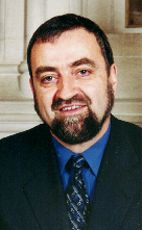
House of Commons photo

Crucial Fact

  • His favourite word was federal.

Last in Parliament May 2004, as Bloc MP for Lévis-Et-Chutes-De-La-Chaudière (Québec)

Lost his last election, in 2015, with 12% of the vote.

Statements in the House

Kosovo April 12th, 1999

Mr. Speaker, I will be sharing my time with the member for Frontenac—Mégantic.

It is with a sense of moral obligation that I rise on this morning of April 13—I should say this night of April 13 since I have been here since around 2 p.m.—to take part in this emergency debate on the situation in Kosovo.

I was not obliged to join in, my whip did not twist my arm, I am doing it out of a sense of moral obligation. After watching what has been going on in Kosovo for several months, and in the former Yugoslavia for several years, I believe that as parliamentarians we have the duty not to stand idly by.

It is our duty not only to rise in the House, but also to listen to our fellow citizens who have something to say on this issue. This is what I have been doing for the past few days knowing this debate might take place today.

Everybody agrees the situation is complex. But we can no longer tolerate ongoing crimes against humanity. We can no longer tolerate massacres such as those in Rwanda a few years ago. One of my constituent comes from Rwanda, my son has several friends whose parents used to live in Rwanda; they escaped and came here as refugees. In the case of Rwanda, the west dragged its feet and failed to prevent the massacre.

For me, it was a lesson. We can no longer let such things occur. Hundreds of thousands of people died needlessly because the west failed to get organized to prevent such a tragedy.

At least in Kosovo, NATO countries were more prepared morally to intervene. This time they were more committed to intervene even though the solution is a very complex one. We could see it coming, it has been going on for years.

First there was the conflict between the Serbs and the Croats, then we all remember what happened in Bosnia. For the people of Kosovo, this has gone on for a number of months, close to a year now. Warnings, negotiations, the Rambouillet summit and threats were used to get President Milosevic to stop his planned campaign of ethnic cleansing, if he did not want to face NATO strikes.

These strikes did follow, because the president of Serbia decided to continue with his plan, which led to the exodus of 600,000 to 800,000 Kosovars out of Kosovo. This, of course, followed upon threats of all sorts against them.

It is in my nature to always try to weight issues as much as possible, and to pay attention to the information received via the various media, while realizing that there are often two sides to a conflict. There are often two sides to any kind of story.

When 600,000 refugees leave the country, there are 600,000 stories for observers to hear at the borders of Albania, Macedonia or Montenegro. And 600,000 to 800,000 people cannot all be lying, especially when we see their columns of misery as they come to the end of a journey of many days without even basic necessities.

We have heard of people whose passports have been seized. Any document that could prove ownership of property was destroyed. Even in the most optimistic of scenarios, they will have trouble getting their property back. Moreover, we have also seen that property going up in smoke. This is a truly deplorable situation.

Dictators' imposition of their will can no longer be tolerated without any reaction. I am no expert in international law but, under the circumstances, it is regrettable that the UN cannot intervene in this conflict. There are countries on the security council, like China and Russia, that have a veto and that are preventing the resolution of situations like the one in Iraq. There was international support for action against Saddam Hussein.

When things are blocked as they are in this case, NATO steps in. This is not the ideal situation. As the previous speaker said, allies are involved. Situations exist in some NATO countries that could be criticized, such as in Turkey and other countries. This is not, however, what today's debate is about. Still, we must not forget our critical eye and our humanitarian feelings for the people suffering cruelty in these countries.

We have an international organization barely 50 years old that is somewhat tied up by rules and the jurisprudence that has guided it in such situations.

This has to stop, because these sorts of situations occur pretty much everywhere. They are happening outside Europe. We need only think of the people of Tibet, whose government is in exile in India. They happen pretty much the world over. We saw what happened in Asia. So, I say, enough.

We speak of globalization in trade terms, but maybe we should think of the globalization of peace. In other words, communities should join together to actively work toward peace. We do not have all the figures, but it currently costs $150 million per day to bomb the former Yugoslavia and the various military or civilian targets, including refineries, to deprive Milosevic of some military power. But do we hear about that kind of money being spent on humanitarian assistance?

When it comes to humanitarian assistance, we must rely on government assistance and all Canadians must be encouraged to make a contribution. But at the same time, we should invest at least as much money as we do in offensive military initiatives. We must be prepared to implement a new Marshall plan following this crisis, otherwise it will make no sense. We will have witnessed a deportation. We must already be thinking about some form of help for those afflicted by the war. This could even include the Serbs, because there is no doubt in my mind that many are good people who are the victims of a dictatorship, of a tyrant who has decided to impose his will.

Some progress has been made regarding international peace. However, the tribunals that judge war crimes and crimes against humanity are frustrated in their efforts. Mrs. Roy was prevented from inquiring about a massacre that took place in Kosovo and in the former Yugoslavia. Everyone supports peace, but I often hear people say that, while they support peace, they do not want us to intervene in these conflicts. What would we do if we saw our neighbour beat his wife and children? We would call the police. In a case like this one, I think we must send in ground troops if that is called for.

Shipbuilding March 25th, 1999

Mr. Speaker, I will provide one example to the minister.

In 1998, the Minister of Finance rammed Bill C-28 through the House, to help shipowners.

When will the Minister of Finance introduce a Bill C-29 to help Canada's shipyard workers?

Shipbuilding March 25th, 1999

Mr. Speaker, when we ask questions of the Minister of Industry on the federal government's shipbuilding policy, he always says that the government is doing enough and that its programs are working.

But surely there must be something wrong, since Canadian shipowners have their ships built abroad.

Instead of telling us that everything is fine when it is not the case, is the Minister of Industry willing to take a closer look at what is not working with his support measures for the shipbuilding industry, and improve his policy, so that it will finally yield results?

Transit Passes March 24th, 1999

Mr. Speaker, on March 4, I asked the Minister of Finance a question about shipbuilding. The Minister of Industry replied to my question. He did not answer satisfactorily in my opinion. On several occasions, I had questioned him in committee.

On October 28, 1997, he replied that it would be better to ask the Minister of Finance, who would perhaps be in a better position to answer my question about shipbuilding and tax credits. Similarly, on April 22, 1998, the Minister of Industry told me that many issues were not the responsibility of his department, but rather that of the Secretary of State for International Financial Institutions or the Minister for International Trade.

On March 4, I directed my question to the Minister of Finance, but the Minister of Industry replied. What can we do? I note that, today, the Parliamentary Secretary to the Minister of Agriculture is likely to be responding, because he is the only member I can see at the moment.

Are we to give up and be content with the government's game of ping-pong and incomplete responses? We can see easily that the Minister of Industry relies on the Minister of Finance. The latter does not want to intervene, because he already has interests in Canada Steamship Lines. The Minister of Transport says he no longer controls the St. Lawrence Seaway following privatization. As for the Minister for International Trade, he has often been unable to answer our questions on the interventions of the Export Development Corporation. When he finally did answer, it was some two years later, on the Spirit of Columbus . In this context, I would like to know who I should speak to in order to get a response, if not action.

The Liberal government has not yet managed to explain why it is refusing to harmonize federal tax measures with those of Quebec. It has yet to explain why, by taxing the tax advantages of the shipbuilding industry, it is obliged to cancel the beneficial effect of the tax deductions offered by Quebec in order to stimulate this industry.

The government has not explained why it does not deign to propose measures of greater benefit to shipbuilding. It has yet to say why it is refusing to establish a real policy on shipbuilding, as all the representatives of the shipping industry have been asking it to do for months.

I plan to continue my campaign in favour of a real shipbuilding policy, which I began a few months ago. I am very pleased to see that more and more business people, union leaders and politicians are taking up the cause.

I am particularly pleased at how this issue has brought people together. Two examples are the coalition of opposition parties I formed on December 8 in Ottawa and the coalition of unions the Davie Industries union managed to get, two groups of stakeholders that are beginning to ask the government serious questions.

I take this opportunity to urge people to send in the postcard calling for a genuine shipbuilding policy in Canada. Since no postage is required on letters to MPs, I particularly urge the residents of Lévis-et-Chutes-de-la-Chaudière and other citizens throughout Canada, in the maritimes and British Columbia, as well as in Quebec, along with the unions, to send it in. We must show that Canadians are not happy with the national shipbuilding policy the Minister of Industry says he has and that he says he knows nothing about. He is forever passing the buck to other ministers, and we never get an answer.

Government Services Act, 1999 March 23rd, 1999

Mr. Speaker, I am pleased to take part in this important debate tonight on the special legislation forcing certain public servants back to work. But before we deal with the actual content of the bill, what we are debating now, and until 11 p.m., is the gag the government is imposing on us. This is an attack on democracy, at least on parliamentary democracy.

The government is in such a rush to get this bill passed that it wants to gag parliamentarians. In my opinion the special legislation is already a breach of democracy, but to deprive parliamentarians of their right to speak is an attack on democracy.

The people in my riding elected me to represent them, not to sit in my seat and passively watch as special legislation is passed constraining much of the population, because it involves public servants. The people want their members of parliament to express their fears. I think many public servants met with their members individually and spoke of their expectations and claims.

I have had the privilege of serving my electors, who are affected by this bill. The union members, including the general labourers with the coast guard working in Quebec City, came to me to say they considered it unfair they were being treated differently according to regions, they did not consider one category of worker should have a different salary because of where they live in Canada.

That is the case. They objected and came to ask me “Do you think your salary should be the same as that of a member of parliament from Vancouver or Newfoundland?” I answered “Naturally, it is a matter of equity”. There is a lot of talk in the House about—and increasingly, Bloc Quebecois members are talking about it—pay equity. We must eliminate the differences in pay for jobs traditionally considered masculine or feminine. We must not only reduce the gap, but eliminate the differences. We consider that an important right.

I heard people in my riding, not only women but also men, say they agreed with that. All this has come up in the negotiations on labour relations.

Yesterday, the government had a knee-jerk reaction. Today, it is resorting to closure to quickly end the matter. Why is the government so anxious that it is using closure?

I am convinced that the majority of Liberal members are not very proud to adopt special legislation. I would even say that some are ashamed of such a measure. They are ashamed, they are not proud of such a measure, but they are forced to support it. As we know, the government imposes the party line when members vote on such issues. Members do not agree with that legislation, but they are forced to follow the party line and support it, because they fear that they will be ejected from the party and perhaps even have to sit as independent members. They prefer to side with the majority and, in some cases, not be present during debate, and certainly not take part in debate.

Many members can vote against their own opinion, but it is quite a bit harder to do so during a vote in the House. I understand why there are very few Liberal members here this evening. We cannot allude to members' absence, but we can talk about their presence. Very few are here this evening to discuss the issue of freedom of speech for parliamentarians. Very few want to enjoy this freedom which is limited, since the debate will come to an end at 11 p.m.

Today, I was at the industry committee. Throughout the day, for hours on end, I had to fight with other members so that the hon. member for Mercier could finish the speech she spent a whole weekend preparing and which summarized the testimony heard in the past two or three weeks.

It was unbelievable the trouble we had getting permission for her to finish her speech. Almost every week lately, this government has been moving time allocation. It is as though our constituents had elected us to sit in our places and do exactly what the majority or the establishment required of us, to keep to ourselves what our constituents tell us and not to make it known in the House.

But is this building, this institution, not called parliament? What is a parliament? The last time I looked in a dictionary, it was a place of speech, the site of democracy.

Mr. Speaker, I am sure your knowledge of history is as good as mine, so I do not need to remind you that not just hundreds of thousands, but millions, of people died fighting for freedom of speech. They died so that their fellow citizens could continue to exercise their democratic rights.

We are in this place, supposedly the very symbol of democracy, and the party in power wants to limit the time spent debating a topic as important as the right to strike.

There is another right and that is the right of association. If we recognize that people have the right to form unions, we should be logical and ensure that they can exercise the other rights that flow from the right to negotiate.

If we look at the history of this government and its predecessor, what do we see with regard to the labour rights of federal public servants? In 1982, a bill was introduced to freeze the salary of some 500,000 workers. In December 1989, back to work legislation was passed. In October 1991, we had legislation saying that the employer's offers would be imposed unilaterally if they were not accepted. There were threats.

In April 1992, we had Bill C-113, which imposed a two year freeze and a unilateral extension of the collective agreement. In June 1993, Bill C-101 gave the government the right to require a vote on its final offers during any negotiations. In June 1994, Bill C-17 extended the freeze for two more years as well as the collective agreement. Salaries were frozen for six consecutive years. Again, this approach was criticized by various stakeholders.

Then, in 1996, we had Bill C-31, through which this Liberal government wanted to start contracting out. In 1992, the federal government closed the Pay Research Bureau, thereby avoiding taking into account facts and figures which contradicted its claims. In 1993, Bill C-26 on public service reform gave a great advantage to the employer by making it judge and jury on issues related to the workplace.

We could go on and on. I want to protect federal public servants. Some people may wonder why a sovereignist would do that. There are federal public servants everywhere, including in Quebec. Since Quebeckers pay federal taxes, part of that money is used to pay public servants. Some of these people do a good job. I am not one of those who think that federal public servants are necessarily bad people. On the contrary, many of them are competent and qualified workers.

What we are dealing with here is the right to strike, to bargain, to organize. This is one of the rights recognized by the United Nations, which makes us a supposedly democratic society.

I have been in this House since 1993 and have had numerous opportunities to note that the Liberal government is not motivated by a very keen sense of democracy. Anytime it runs into a problem, gag orders are used., not just at the end of a session.

At this point in time we are not faced with a huge legislative agenda. I am not the only one to say so; a number of political observers have said the same thing. There are not very many bills. There would probably be enough time. There is no great urgency, yet we are being forced to get the discussions over quickly.

It was the same thing in committee, as I have said.

On top of that, we Quebeckers are dealing with an increasingly centralizing government, which is flouting the Constitution and its various provisions.

Bill C-54 clearly establishes trade as a provincial jurisdiction, yet e-commerce is being used as a pretext for passing a bill aimed at creating federal legislation to protect personal information in the context of commerce. This is a provincial jurisdiction.

We have seen the strategies the government is making use of, for instance the millennium scholarships. The government knows very well that it cannot hand out grants to students in other provinces, in Quebec and elsewhere, directly. What does it do? It creates a foundation that will go over the provinces' heads to give grants to students. This is a way of circumventing democracy, of doing indirectly what it cannot do directly.

When it can take direct action, it is often borderline, a bit dubious, as in the case of the environment, and the member for Jonquière knows what I am referring to.

The environment was not mentioned in the Constitution of 1867. This is a concept that comes up more now. Since it was not specifically mentioned in 1867, much as it did when it patriated the Constitution in 1982, the government is using grey areas to justify invading these jurisdictions.

It sees the provinces as lesser governments and itself as a higher government to which all others are subordinate, a government that wants to set national standards.

There is another point to consider as well. I often meet young people, as all members do in their ridings. Young people often express their opinions of the Bloc Quebecois, but they do not always realize what is going on. They tell us all the parties look the same and ask us how we are different. My reply is that Bloc Quebecois members have always defended democratic values, respect for freedom of speech, respect for the right of association, fundamental freedoms that must be preserved. We constantly have to uphold such rights.

In the present system, questions must be asked. I am not saying this has to be sorted out this evening. In the United States, they hold presidential elections. Here, we hold an election to elect a party and members to represent ridings, but it is the party that gets the most members elected that forms the government and the majority rules.

The Liberal Party did not receive 50% plus one of the votes in the latest federal election. The Liberal Party got the most ridings, which gives it a majority of five seats. Supported in its position, the government is trying to dish that up all the time, in committee and in the House, forcing us to act at its speed and to pass its policies.

They say “Keep talking, you members, it will get you nowhere. We will do the deciding”. For government backbenchers, it is the will of cabinet that counts, and the ministers impose the will of the Prime Minister.

If we look at that, Canada is not the United States. It is not as powerful as the United States, but if we compare the powers of the Prime Minister and of the President of the United States—with a veto in Congress and in the Senate, which is not the case here—the Prime Minister can do what he wants most of the time.

This person who is currently the Prime Minister is imposing the party line on the people in his party. We have special legislation before us, even though many members, men and women, oppose it, because they find it too precipitous and they do not support different pay for different regions.

Let us discuss that a little. I listened to my New Democratic colleague from Acadie—Bathurst. He is quite right. He comes from one of the poorest regions in Canada. Moreover, people there are told “You come from a poor region. You have less benefits. We know that the industrial strategies of the federal government are targeted so as to make Ontario rich”. There is no other way to put it. This is done at the expense of the regions.

People in remote areas are told “In addition to that, the public servants who work in your region will be paid less”. We are talking here about workers who belong to groups such as general labour and trades and ships' crews. Because they work in poor regions, these public servants are paid less.

This increases regional inequalities. If public servants are paid less in these regions, they cannot spend as much as other public servants. They cannot make the same contribution to their region's economic development. This is not fair.

Public servants have come to my constituency office, including people who belong to groups such as general labour and trades, ships' crews, hospital services, general services, and even firefighters. I promised them I would tell my colleagues in the House what they told me, since I was elected to represent them. I promised them I would try to make government members realize that it is not right to force these workers to immediately go back to work by passing special legislation. I must also say on their behalf that it is not right for the government to use closure, so that other citizens cannot hear what we have to say on this issue.

Productivity March 18th, 1999

Mr. Speaker, yesterday the Minister of Finance answered a question I asked by saying that the OECD report predicting our standard of living would be 15% below the average of the other countries dates from the 1980s.

Are we surprised that the Minister of Finance has no real solution to get us out of this mess, given that he is unaware that the OECD report in question is not from the 1980s, but from June 1998?

What does he have to say now?

Productivity March 17th, 1999

Mr. Speaker, I would remind the Minister of Finance that this comes from an OECD report.

With so little federal effort in R&D, and with a devaluated dollar, which makes imported machinery virtually unaffordable, is there not a risk in the medium term that this government's negligence will cost us dearly and will confirm the OECD prediction that the standard of living in Canada will be 15% lower than the average of the other countries?

Productivity March 17th, 1999

Mr. Speaker, the major problem behind the falling Canadian dollar is the low rate of growth of business productivity over the past twenty years or so.

There are two important factors that may influence productivity: R&D investment and equipment purchases.

How can this government compromise the future prosperity of this country by bringing in a budget in which Industry Canada's R&D effort is lower than last year?

Division No. 343 March 16th, 1999

Mr. Speaker, there may have been some confusion earlier because I rose at the same time as the Progressive Conservative members. I made a mistake. I wished to vote the same as the Bloc Quebecois.

Shipbuilding March 11th, 1999

Mr. Speaker, given the inflexibility of the Minister of Industry, will the Secretary of State for Agriculture and Agri-Food go back and tell the men of the Davie shipyard that there is nothing he can do for them?