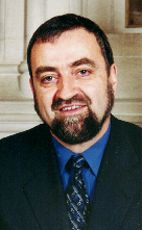
House of Commons photo

Crucial Fact

  • His favourite word was federal.

Last in Parliament May 2004, as Bloc MP for Lévis-Et-Chutes-De-La-Chaudière (Québec)

Lost his last election, in 2015, with 12% of the vote.

Statements in the House

Shipbuilding March 11th, 1999

Mr. Speaker, in an interview with a journalist from the Soleil , the Secretary of State for Agriculture and Agri-Food said that the next budget might contain new measures for shipbuilding.

As we saw nothing along these lines in the last federal budget, are we to understand that the Secretary of State for Agriculture and Agri-Food failed miserably in his attempt to convince his colleagues of the importance of providing assistance for shipbuilding in Quebec?

First Nations Land Management Act March 5th, 1999

Mr. Speaker, at the request of my colleague, the hon. member for Saint-Jean and Bloc Quebecois critic on aboriginal affairs, I am pleased to speak to Bill C-49, an act providing for the ratification and the bringing into effect of the framework agreement on first nation land management.

I would like to draw attention to the excellent work done by our colleague, the hon. member for Saint-Jean, who was unable to be here today. He has done excellent work on aboriginal issues since 1993, first of all by lending an attentive ear to the first nations, and also by raising awareness of the aboriginal reality in Quebec and in the rest of the country.

This framework agreement was signed by 14 chiefs of Canada's first nations, and the federal government, in February 1996. The bill was introduced just before the dissolution of parliament in June 1997, as Bill C-75, dying on the Order Paper when the election was called.

Aboriginal groups concerned by this bill worked very hard to get it back on the legislative agenda as soon as possible. They did an excellent job of lobbying the government and opposition critics.

The Bloc Quebecois lent them a hand in getting the bill back on the legislative agenda as soon as possible. I should point out that the 14 signatory first nations are dispersed throughout British Columbia, Alberta, Saskatchewan, Manitoba, Ontario and New Brunswick.

The British Columbia first nations concerned are the Westbank, the Musqueam, the Squamish, the Lheidli T'enneh and the N'Quatqua.

I ask any aboriginal people listening to excuse my pronunciation. I lack my colleague from St-Jean's familiarity with these names.

The signatory in Alberta is the Siksika, while there are two first nations signatories in Saskatchewan, the Cowessess and the Muskoday.

In Manitoba, they are the Opaskwayak Cree; in Ontario, the Nipissing, the Mississaugas of Scugog Island, the Chippewas of Mnjikaning, and the Chippewas of Georgina Island. Finally, in New Brunswick, it is the first nation of Saint Mary's.

One of the key objectives of this bill for the 14 first nations is to allow them to establish their own system for administering their land and natural resources. It will allow them to manage the land and natural resources on their reserves. Land management will no longer come under the Indian Act. The Minister of Indian Affairs and Northern Development will therefore no longer have discretionary powers in this regard.

The bill makes provision for the 14 first nations to draw up a land code through a process of community approval. This land code will be used to resolve issues such as the use, possession and occupation of lands. Provision should also be made for the division of matrimonial property in the case of marriage breakdown.

The Bloc Quebecois is in agreement with the bill's underlying principles. My colleague, the critic for native affairs, has said in the House and in committee that he supports the spirit of the bill, which gives the 14 first nations the necessary tools to control their lands and thus ensure their economic development.

This bill is therefore one more step towards greater native autonomy. This principle of autonomy is consistent, moreover, with the recommendations of the Royal Commission on Aboriginal Peoples. Bill C-49 will therefore give the 14 first nations greater control over their lands and their economy.

In fact, the Standing Committee on Aboriginal Affairs and Northern Development has been studying the economic development of the first nations since last year. The members of the standing committee are trying to identify the obstacles to aboriginals' economic development, and there are many such obstacles, of which the worst is the Indian Act.

This legislation is paternalistic. It treats aboriginals like children and is a major impediment to their economic participation in their communities. This bill will mean that the 14 first nations can break free of the paternalistic clauses in the Indian Act and finally develop economically. The chiefs who appeared before the Standing Committee on Aboriginal Affairs and Northern Development on December 3 all spoke of this economic impact of Bill C-49 on their communities.

According to Robert Louie, head of the transitional land management commission, Bill C-49 will give first nations control over their resources and lands. They will be able to assume the responsibilities inherent in this control. It is a way of putting an end to the archaic and paternalistic attitude of the Indian Act and the federal government's power to administer their lands.

Chief Austin Bear of the Muskoday first nation of British Columbia told the members of the standing committee at this same session that his community, and many others, had missed out on opportunities for economic development because of the restrictive and paternalistic nature of the Indian Act.

He spoke about an American manufacturing company that had shown an interest in locating in their community. When told of the procedure that had to be followed, obtaining the approval of the Minister of Indian Affairs and going through all manner of red tape, their response was that they did not have time for that; it was too slow.

At the present time, the Muskoday first nation is also seeking to develop its tourism potential in partnership with others. If there is one thing Chief Austin Bear does not want, it is to miss out again on an opportunity to do business with an interested partner because the Indian Act deprives them of control over their resources and land.

We are very much aware that aboriginal people have a different concept than us about community, land and resources. The Bloc Quebecois aboriginal affairs critic has referred to this on more than one occasion here in the House.

Chief William McCue of the Georgina Island first nation in Ontario also touched briefly on the economic issues relating to this bill when he appeared before the standing committee on aboriginal affairs on December 3.

The Georgina Island community is located on three islands in Lake Simcoe, 60 miles north of Toronto. Its main source of revenue is the rental of 500 cottages, and the leases of most of these terminate on March 31, 1999.

This represents $1 million in revenue, which is used to finance various programs, including housing and community maintenance and infrastructures. Cottage rentals are therefore a source of operating income for the community, and create and maintain a number of jobs.

Chief William McCue raised one interesting point about the economic dynamics in his community. Most of those responsible for leases and therefore the management of the cottages on Georgina Island are women.

Despite these positive aspects of the bill, the Bloc Quebecois not only had reservations, it presented amendments. The Bloc Quebecois believes the native women will not have legal protection during the transition period leading to the signing of the land code in the reserve in the case of marriage breakdown.

To better understand the sense of the Bloc Quebecois amendments, we must recall the legal context of native women. Currently, they face a legal void, because the Indian Act contains no provision for distributing matrimonial property in the event of the breakdown of marriages between native men and women.

Native women cannot claim the same rights as Canadian women, who are governed by provincial laws. This situation causes concern to associations of native women in Canada and Quebec.

I refer specifically to the British Columbia Native Women's Society, the Native Women's Association of Canada and the Association des femmes auchtotones du Québec, which have made representations to the native affairs critic and the leader of the Bloc Quebecois expressing their concerns in this regard.

They convinced us to introduce amendments to protect native women legally during the transition period, the 12 months in which the land code comes into effect.

I must say that at the start of Bill C-49's parliamentary journey, the Bloc Quebecois put a lot of stock in the independent inquiry initiated by the minister of Indian affairs at first reading of Bill C-49 last June.

The purpose of this inquiry was to find solutions to the legal vacuum in which native women find themselves. But since the Minister of Indian Affairs and Northern Development has been dragging her feet, the inquiry has not even begun. The Bloc Quebecois had no choice but to move amendments concerning the claims of the native women of Quebec and of Canada.

An inquiry is a good way to examine the problem of the legal status of native women generally, for, in our view, the problem goes well beyond the scope of Bill C-49.

In fact, what is required is a complete overhaul of the Indian Act, an outmoded piece of legislation from the last century, which completely ignores gender dynamics on the reserves. We in the Bloc Quebecois believe that this reform is necessary so that legislation such as Bill C-49 can be enacted quickly, with prejudice to no one. In this case, it is native women who are affected.

I would add, however, that this reform of the Indian Act should not take place unless there is genuine consultation with all native groups in Canada. Only then would the legislation truly reflect native concerns.

Because the inquiry into the legal status of native women is stalled, the Bloc Quebecois has moved four amendments at report stage.

These amendments are necessary because of the foot-dragging of the Minister of Indian Affairs and Northern Development on this issue, for which she was strongly criticized by the native affairs critic at the time the amendments were moved. All these amendments are therefore based on the provision in the bill on environmental protection.

In fact, the Bloc Quebecois wanted to ensure that there are minimal standards for the protection of aboriginal women with respect to matrimonial property in the case of marriage breakdown. This protection is based on the existing legislation in this regard, that is, provincial statutes.

The amendments, which were rejected, amended clauses 17 and 20 in order to establish the minimal protection necessary during the transition period of 12 months following the taking effect of the land code, in which the 14 first nations are asked to include general rules and procedures, and I quote:

—in cases of breakdown of marriage, respecting the use, occupation and possession of first nation land—

This was taken from clause 17.(1).

There is another clause I would like to deal with, if you will allow, Mr. Speaker. I will only need in seconds.

This is clause 7, which was based on British Columbia's family heritage legislation. We hoped it would apply until general rules had been incorporated into the land code. We are very surprised—

Shipbuilding March 5th, 1999

Mr. Speaker, the federal government has harmonized its taxation of the film and television production industry with measures introduced by the Government of Quebec.

Can the Minister of Finance tell us why he does not want to do the same for the shipbuilding industry?

First Nations Land Management Act March 5th, 1999

Mr. Speaker, if time is allowed for questions, it must be of the same length. Let us do as we usually do, so parties other than Reform can have the opportunity to respond.

Five minutes is not, therefore, sufficient. We would need ten minutes or none at all.

First Nations Land Management Act March 5th, 1999

Mr. Speaker, I would be in agreement, on behalf of the Bloc Quebecois, to respect custom and proceed in the usual way, that is speaking for ten minutes. We have already used up five, and I think another five could be allowed, perhaps. We would agree with that, but we would not want the Reform member jumping up each time and having everything go until noon.

Shipbuilding March 4th, 1999

Mr. Speaker, I understand that the question may have taken the minister unawares, but other responses are needed.

How can we explain to Quebec shipbuilders and shipyard workers that federal government decisions cancel out provincial ones?

Shipbuilding March 4th, 1999

Mr. Speaker, Quebec gives tax deductions as a stimulus for shipbuilding, while at the same time Ottawa taxes these benefits, thus cancelling out the positive effect of these measures.

My question is for the Minister of Finance. Is it not absurd for the federal government to cancel out the effect of measures that have been put into place in order to support shipbuilding in Quebec?

Sisters Of Charity Of Quebec February 9th, 1999

Mr. Speaker, our history books often forget or minimize women's contribution to society's development.

For this reason, I would like to honour the very significant contribution to society made by Sister Marcelle Mallet, who, 150 years ago, founded the Congrégation des Soeurs de la Charité de Québec, and 140 years ago, the Couvent de Lévis, now the Marcelle-Mallet school.

The Congrégation's history was marked by all the women who, in Lévis and elsewhere, taught our daughters and, in recent years, our sons. We owe them thanks for that, but they did more. They also visited prisoners, supported victims and helped the sick. They fed the poor, protected orphans and sheltered the aged.

As the member for Lévis-et-Chutes-de-la-Chaudière, I would like to thank the Sisters of Charity for all they have done for us and for what they continue to give us.

Supply February 4th, 1999

Mr. Speaker, I have heard similar comments. In our riding offices, we hear all kinds of horror stories, people talking about personal experiences with regard to that.

I would like to go back to the issue of difference. I still say there are two countries within this country. In our work and in our discussions with members on the other side of the House and from other parties on this subject, we can see how important it is for Quebeckers to maintain jurisdiction over health, education, and so on. We feel this is important. We are always faced with a perception that we can respect because they may not have read the same history books as we have, and vice versa.

They think—and I am also saying this to those who are listening—that the federal government is the superior government, followed by a second level, the provincial governments, and finally by the municipalities. The spirit of Confederation in 1867 put all governments on the same level. They were meant to have different responsibilities and to act together. That is no longer the case today.

The federal government, with its spending power, uses the money. After achieving surpluses, as mentioned by the member for Jonquière, the federal government can now rectify the situation. However, those billions of dollars that were taken away from Quebec and the other provinces have resulted in unthinkable situations, including the one in the Chaudière-Appalaches region. That is the example that always comes to mind.

It is a difference in perception to think, as my colleagues from the other parties do, that the federal government is the superior government, the big government, with the provincial governments being inferior governments.

Supply February 4th, 1999

Mr. Speaker, I am pleased to take part in this debate.

I too would like to say a few words to the member for Chicoutimi, who just spoke, even though the member for Louis-Hébert has responded very well to his comments.

I would like to remind my colleague from Chicoutimi of the words spoken by his former leader, who is now leader of the Quebec Liberal Party. On May 7, 1997, he said, and I quote from Le Devoir “Forget Lucien Bouchard and Jean Rochon; the person who is really responsible for hospital closures and the deterioration of our health care system is—”. I cannot mention his name in this House, but he is the present Prime Minister of Canada. Those were the words of the former leader, of my colleague for Chicoutime, and I think he still has respect for him.

Jean Charest went on to say: “Mr. Bouchard, Mr. Harris, Mr. Filmon, Mr. Klein and all the other premiers are forced to manage the federal government's unilateral cuts”.

What the member said about the Saguenay-Lac-Saint-Jean region may be true. It is true that cuts were made everywhere. He also said that it is a matter of transfers, but I think—and I am sure he will agree—it is an issue that should be discussed in the Quebec National Assembly. I wanted to remind him that the cuts were decided upon there.

Today, the federal government agreed to give back some of the transfer payments, but apparently the amount given back does not even come close to what was taken away. Since 1994, the Liberal government slashed transfer payments to the provinces for health, education and welfare by $6.3 billion a year. If we split that amount among the three areas, it means $1 billion a year for Quebec alone.

We will see the figures within hours or days, but we are far from the final count. One step has, however, been made in the right direction, or in other words a small step back toward the way things used to be.

Transfers to the provinces are at their lowest level—pending adjustment—in 20 years. Cash social transfers from the federal government are today where they were 15 years ago, or in other words $12.5 billion. At the time of the federal election in 1993, the level was $18.8 billion. This means a unilateral reduction of $6.3 billion yearly, or 33% in less than 4 years.

Taking population growth and the cost of living increase into account, social transfers have not been this low for decades. That is why I say that, in 1996, social transfers amounted to $386 per head. That figure is 45% lower than the 1985 record level of $706, and 43% lower than the 1994 level of $678.

An illustration of the concrete meaning of $1 billion to Quebec is necessary here. One billion dollars is 20% of the cost of all Quebec hospitals. It means closure of half the hospitals in the Montreal region. It is the cost of 370,000 hospitalizations. It is the pay of half of the nurses in Quebec. It is the cost of all of Quebec's CLSCs, which is $924 million. It is twice the cost of all services to youth, which is $500 million. It is a sizeable amount.

I know that a number of members are making reference, but I would like to speak of the impact that will have on the Quebec City and Chaudière—Appalaches regions. I may be using the same figures my colleague from Lotbinière will be citing shortly, but, for example, the cuts amount to $103 million for the Robert-Giffard hospital. They represent $76.4 million for Quebec City's Hôtel-Dieu hospital; $12.3 million for the Saint-Joseph-de-la-Malbaie hospital; $72.1 million for the Laval University hospital; $29.5 million for the Charlevoix hospital; $54.2 million for the Saint-Sacrement hospital; $66.4 for the Laval hospital and $71.7 million for the Saint-Fançois-d'Assise hospital.

On the other side of the river, in the beautiful region of Chaudière-Appalaches, there are a few examples. There will be a shortfall of $63.7 million for the Lévis Hôtel-Dieu hospital; $31 million for the Amiante region hospital; $14.7 million for the Montmagny Hôtel-Dieu hospital and $30.1 million for the Beauce-Etchemin hospital. That is a lot.

Often, when billions of dollars are bandied about people do not understand the whole impact, but I know that people currently working in the hospitals—the doctors, nurses, technicians, those looking after the patients—realize what the cuts mean in day to day terms and have known this for a number of years.

On this opposition day, the motion put forward by the Bloc Quebecois is basically asking that transfer payments to the provinces be restored. I take this opportunity to commend the hon. member for Drummond, who has been our health critic since the 1993 election. I am qualified to do so, especially since I worked with her for 18 months before being reassigned to industry and regional development.

Time and time again I witnessed attempts by the federal government and the health department to interfere, not only through the funding cuts we are condemning today, but also with unacceptable bills.

We will recall for example Bill C-47 on new reproductive technologies. We could mention other areas and the broad area of health, with bills like C-14 on drinking water. We all know what happened on the hepatitis C issue. I think it is good to remind the House of the facts. At the insistence of the hon. member for Drummond and Bloc Quebecois members, settlements were made, although they are still incomplete. As we know, those infected before 1986 are not eligible for compensation.

At the health committee, the hon. member for Drummond and myself could see this sort of thing happening almost on a weekly basis. And it went on. There was this foundation that funds health research, to which payments were made directly, but efforts are made to go over the heads of provincial governments and deal directly with universities and even private scholars. As I said, this is still going on.

I have been attending every meeting of the Standing Committee on Industry and, because some proceedings are held in camera, I am not at liberty to mention specific issues; a report is to be tabled on Monday. In recent days, we saw all the attempts made by the federal government to invade the health sector, allegedly to protect the interests and health of all Canadians.

This is why I think the Bloc Quebecois did a good thing today. Its motion came at a most appropriate time, when the premiers and the Prime Minister are negotiating on this issue and others, including social union. Indeed, an agreement was reached regarding the recovery of part of the transfers.

The issue of social union was also discussed. An agreement was reached to recover transfers. It is still acceptable for health, and I know that my colleagues discussed this issue, but attempts have been made to set new standards, new conditions, again in an effort to get involved in what is—as we know—essentially a provincial jurisdiction.

I used to sit on the human resources development committee. This experience makes me say that there are two different mentalities in our country. Today's agreement, the so-called agreeement on social union, was ratified by nine anglophone provinces. It does not bother them to see the federal government get involved in their affairs, as long as they get the money. In Quebec, we think differently.

There is a consensus in our province, and I hope the leader of the opposition in Quebec City will act in a manner consistent with what he said when he was here, and that he will support the position defended today by the Premier of Quebec, Mr. Bouchard.