
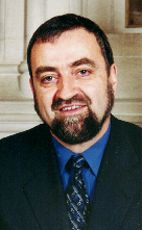
House of Commons photo

Crucial Fact

  • His favourite word was federal.

Last in Parliament May 2004, as Bloc MP for Lévis-Et-Chutes-De-La-Chaudière (Québec)

Lost his last election, in 2015, with 12% of the vote.

Statements in the House

Canada Pension Plan Investment Board Act November 27th, 1997

Mr. Speaker, I was pleased to give up my turn to the member for Saint John earlier, the reason being that there is a shipyard in her riding, as there is in my riding of Lévis. This may strike you as odd, but all parties sometimes have something in common.

When I listen to her, the old saying about not having your cake and eating it too came to mind. Basically, she is deploring the fact that the population is aging and that the CPP can be expected to cost the government more. If one were consistent, one would then admit that more money needs to be put into the fund, but that is not what she is saying.

On the contrary, she is saying that it is an unwarranted and unacceptable tax hike. We in the Bloc Quebecois feel the same way. The population is aging and there will be an increase in the needs of seniors, of those retiring in the future.

But there is worse. We must not forget those to follow, subsequent generations. Earlier, the member for Lac-Saint-Jean spoke of his concerns and fears as a young person for the future.

There must be no mistake about this. The Liberal and Conservative governments should have taken action much sooner. If we look at the demographic patterns, at the statistics, it is obvious that there will a problem to resolve. It could have been foreseen and resolved much earlier, but this was not done.

We therefore find ourselves in a situation where there is a mad rush to build up the fund, to make it more efficient, more productive, as Quebec did several years ago by setting up its Caisse de dépôt et placement. The Caisse is the pride of Quebeckers. Being a staunch sovereignist, I am delighted to see that the federal government wants to copy Quebec. This augurs well because it is also an admission that the Quebec government's solutions are sometimes good ones.

But back to the amendments. Following this line of thought, Motion No. 13 is admittedly a bit special. The New Democratic Party and the Reform Party agree on something. This worries me. What is the explanation when we see people from parties with completely different ideologies agree? Why is it that they agree on that when they are at opposite ends of the political spectrum?

They are also against it. They want to have their cake and eat it too. That is not possible. There comes a time when we have to make a choice, and this choice is now before us. The Bloc Quebecois' position is that the fund for the pension plan absolutely has to be increased. That is why we cannot support amendments designed to limit the assets going into the fund. For us, it stands to reason that it should operate this way.

The other amendments have more or less the same objective, and the motives in the case of Motion No. 14 are the same. I do not have much too say on Motion No. 15. We have to admit at times that we do not understand very well. I hope the NDP members will be providing more information because, as it now stands, this amendment serious questions.

As for Motion No. 16, it calls for the deletion of the section dealing with the new rules for calculating the benefits. These rules state that the pensionable earnings average will be determined by taking the last five years, instead of the last three years as is presently done. We are against this amendment for the reasons outlined before. This would have the effect of not ensuring the long term viability of the plan.

As for Motion No. 17, I do not have any comments. On Motion No. 18, if I understood correctly, the member for Qu'Appelle wishes to increase the contributions, so that the maximum earnings would go from $35,000 to $70,000. If that is what is meant, we can announce right now that we will be against it.

As for Motion No. 19, it calls for the deletion of the clause that provides for stricter requirements on the payment of benefits in the case of combined retirement and disability benefits. There is something I do not understand in all this. When a person is disabled, it is necessarily because he or she is sick or has a disability. I think everyone would agree that a person with a disability has a higher cost of living. Equipment and facilities that generally cost more are required.

It is the same thing in the case of people who have an incurable disease. They need medication, many types of services, and people to help them. So I think we have to accept the principle that people with a disability, when they are retired, need extra support to continue to live under conditions that are as normal as possible.

So these are the main arguments. Other colleagues from my party may also have observations on this, but that is the position of the Bloc Quebecois on Group No. 6.

Canada Pension Plan Investment Board Act November 27th, 1997

Madam Speaker, I am pleased to have this opportunity to speak to this issue, especially to add to these statements we have just heard on Motions Nos. 10 and 12.

These two motions have one thing in common. The present pension plan is inadequate, it has insufficient funds for the long term. If this decision is delayed, it is the future generations that will bear the impacts. This is unacceptable.

The amendment proposed by the Conservative Party attempts to link the reduction in contributions to employment insurance. From the point of view of business, this makes sense to a certain extent, because it would offset any increase in their payroll taxes. However, going as far as the Conservatives would like us to go can perhaps jeopardize the employment insurance program and have an effect on this program and also on the positive aspects of these initiatives.

We already know that the reduction in employment insurance benefits has had an effect. Repeat claimants are affected by seasonal unemployment and have to bear a 1% reduction of their benefits. It is not their fault if there is seasonal unemployment.

We have to be careful with this because it can affect the program. I used to sit on the human resources development committee, and we in the Bloc were opposed to changes in the employment insurance system. Today, we are still constantly reminding the government that it made an error, that it went too far in its cuts to employment insurance.

I would like to come back to the Canada pension plan. The situation is a bit similar, the fund has to be sufficient to provide for the future. A Quebec success story is often mentioned, the Caisse de dépôt et placement. It has been in existence for at least 25 years, and it has had positive results for Quebec.

This bill will allow among other things to manage this money by creating a fund, and this would be more efficient. It would allow an increase in assets and ensure the future of the Canada pension plan for ordinary citizens.

People can talk about payroll taxes, but often these taxes exist for the benefit of the whole population, especially the underprivileged. As you know, it is not everyone that can have access to a pension fund through the workplace. Not everyone works for the government, for a municipality or for large companies that have pension funds. There are people who cannot benefit from these.

There are also people who, because of their family obligations, like single mothers, do not have the opportunity to contribute to RRSPs and to plan for their future, when their children will be grown up and will have finished their studies, etc. Very often these are people who have few assets, and this plan allows many people who are less fortunate to know that they will at least have a basic minimum for their retirement.

We have to be careful when we touch this. The people concerned form a very large part of the population. Very often, they are the less fortunate, the underprivileged in the system. I think that the government acted too slowly in proposing better contributions in this area.

Any amendment that proposes to slow down or reduce rates and to improve the management of this fund to better plan for the future in the interest of future generations is worth considering because such action is urgently needed. However we, in the Bloc Quebecois, oppose Motions Nos. 10 and 12, especially since Motion No. 12 has a connection with the employment insurance.

As I said, we believe that the employment insurance plan is a plan that was considerably thinned down by the Conservatives. We remember the impact of the cuts made by Minister Valcourt, who lost his seat in New Brunswick. The Conservative government was severely criticized for its lack of compassion for the unemployed. In spite of their promises, the Liberals did the same thing during their last mandate. They too got their just reward; in the maritime provinces in particular, where seasonal unemployment is widespread, election results spoke volumes. Voters made it clear first to the Conservative Party, then to the Liberal Party, that they should be careful.

We, in the Bloc Quebecois, will not be counted among those who wish to slow down efforts to improve the pension situation of ordinary people.

Canadian Wheat Board Act November 20th, 1997

Mr. Speaker, the Reform member said that the government party is not listening, and he is right. This government is truly not good at listening.

However, the member who just spoke does not seem to be terribly good at listening himself, because the Bloc Quebecois members who spoke before me all said we were opposed to the bill. For at least two minutes, he got some mileage out of Quebec and the Bloc Quebecois by saying we were in favour of the bill, but that is not the case.

The Bloc Quebecois is opposed to this bill. On initial examination, certain provisions are interesting, but they do not go far enough. There is mention of greater participation by representatives of agricultural producers, of wheat or grain producers sitting on the board of directors.

Here I agree with the Reform Party member that the federal government is retaining too much authority over the administration of the Canadian Wheat Board. In the end, the only opportunity for industry representatives, for producers, to manage the board is symbolic and somewhat meaningless.

I repeat, that is the position of the Reform Party, and on this point we are in agreement. But the members from Quebec represent first and foremost the interests of Quebec and it must be remembered that we do not produce enough grain in Quebec for export purposes, or at least very little. That is why, when it comes to the Canadian Wheat Board, we would not necessarily want to stand in the way of others, but this is not yet an issue that concerns us greatly. We do not produce enough grain crops to be able to export.

What the Reform Party and other parties are saying is that the current situation, even if it remains unchanged in the bill, means we are not creating a large enough contingency fund for the Canadian Wheat Board. When a problem arises, who pays up? The government and thus all Canadian taxpayers.

As we are still in a federal system and as Quebec represents 24% of the population, it means that each time the Canadian Wheat Board has to pay out subsidies, the shortfall will have to be made up. The situation is the same as in the case of the famous harmonized GST in the maritimes, where Quebec has received no compensation and has to pay its share to help the maritimes harmonize their tax. It is the same situation.

I know that the Minister of Human Resources Development, who wants to make known his presence in the House, is trying to question me, but he is also distracting me.

This is why we in the Bloc Quebecois oppose the bill and I have a hard time understanding—and this is my closing point—all the arguments of the Reform members, or at least those of the last one to speak. He gave the House the impression that we support this bill, when we oppose to it. Is it a problem of language? Perhaps, but regardless, I want to dispel the misunderstanding immediately. We oppose the bill.

I would just like to comment on something he said. I found it—I was going to say in poor taste—let us say unpleasant. It is as if he were saying that the Liberal government opposite did not listen to the people in his province or to those in the two other western provinces. He said “Yes, but if I were in Quebec, this government would certainly listen to me”. He is wrong there, because one of the problems Quebeckers face with the federal government and the federal system is they are not paid enough attention.

If he thinks he is not paid as much attention as we are, there is a serious problem, because we have a very hard time getting Quebec's point across in the House. In several the standing committees, we have a hard time getting documents in French. This morning, we spent an hour explaining that the French version of a clause did not say the same thing as the English.

And yet, he, who speaks the same language as most Canadians, is saying that, despite that, he does not feel he is listened to or understood. It is not enough just to be listened to, people have to be understood. Understanding requires two or three mental states: openness, receptiveness and a willingness to be convinced. Without these, a debate becomes a monologue and not a dialogue.

I will have the opportunity to talk about other groups of motions on the subject of this bill, because it covers a variety of aspects. I will draw on my experience as assistant to Jean Garon, who was the Quebec minister of agriculture at one point in time.

Railway Transportation November 20th, 1997

Mr. Speaker, my question is for the Minister of Transport.

When I met with executives of Via Rail on November 10, they confirmed their intention of having the Océan and Chaleur trains back up under the Quebec bridge all the way to Sainte-Foy.

Does the Minister of Transport find this a safe solution, and what does he intend to do with the Lévis station?

Canada Labour Code November 7th, 1997

Mr. Speaker, my question is to the Minister of Labour.

In his reform of the Canada Labour Code, the minister insists on maintaining the possibility of using strike breakers.

Why is the minister so intend on allowing this, since he knows full well, as the Quebec experience has demonstrated, that prohibiting scabs tends to make labour relations more civilized?

Supply November 6th, 1997

Madam Speaker, on a point of order. Is the hon. member speaking on behalf of the Liberal Party or on behalf of the Conservative Party?

Supply November 6th, 1997

Could the member give us the list of those who were present?

Criminal Code November 5th, 1997

Mr. Speaker, on October 24, I put a question in this House to the Minister of Transport. My question dealt with a statement made to the newspaper Le Soleil by the secretary of state for agriculture and agri-food, and fisheries and oceans, who is also the hon. member for Bellechasse, the riding next to mine.

The secretary of state was quoted as saying that the station in Lévis would close on December 1 and that rail service would be transferred to the north shore, in Sainte-Foy. I thought that statement was rather strange, which is why I wanted to ask the Minister of Transport a question. I asked him if the decision had been made at his level, even though there had been a recommendation by the national transportation agency. He said no.

During question period in the House, we do not have much time. I would like to use my time today to get further information on the subject I raised in my question.

I found the answer of the minister very interesting when he said:

We are looking at a number of options for rail service across the country. On the matter of the Lévis station, no decision has yet been made. I will gladly consider any idea or opinion my colleague or anyone else might have on the subject before I make my decision.

Afterwards, I called for public consultations and I tried to find out if the national transportation agency had held public hearings, because it did hold a few public hearings in 1991. But there were no public hearings this time because the NTA decided there would not be any.

Because of public interest, since there had been no agreement between Via Rail and CN, the then Minister of Transport, under the Conservatives, decided, on March 16, 1993, to close Lévis station. It seems that the situation is the same today because, on February 22, 1996, CN got permission to abandon lines along the St. Lawrence River.

However, negotiations between CN and Via Rail have yet to be completed. Since there is still no agreement, Via Rail has let it be known, probably through the member for Bellechasse, that it would be forced to go to Sainte-Foy. In the meantime, two trains stopped at the Charny station every day, but VIA announced in an internal bulletin that they would no longer stop in Charny, which means no more train station on the south shore.

In these circumstances, as a member of Parliament, I decided to hold public consultations on November 11 and 12. I will consult the people, ask who is for and who is against before the irreparable closing of the Lévis and Charny stations so that people who disagree with this decision can express their opinion.

Today, I ask the transport minister's representative to help me by insisting that VIA Rail make all pertinent documents public, which it has refused to do until now, so that people can express an informed opinion.

Railway Transportation October 24th, 1997

Mr. Speaker, I note the minister has not made a decision, but how is it that his colleague, the Secretary of State for Agriculture and Agro-food, and Fisheries and Oceans announced this week with great fanfare in Le Soleil that the Lévis station would close on December 1?

Is the Minister of Transport still in charge of the department or is it his colleague?

Railway Transportation October 24th, 1997

Mr. Speaker, my question is for the Minister of Transport.

The moratorium on railways along the St. Lawrence river to Lévis ends December 1. We learned yesterday that the minister has not yet made a decision in this regard.

Would the minister agree, in light of the importance of this issue to meet with the agencies concerned and to hold public hearings on the subject?