He is an individual.

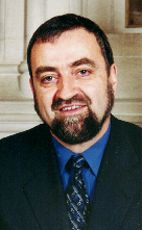 House of Commons photo
Lost his last election, in 2015, with 12% of the vote.
Supply October 9th, 1997
He is an individual.
Canada Pension Plan Investment Board Act October 7th, 1997
Mr. Speaker, the members of the Conservative Party with little to say are interested in points of order.
Two initiatives from groups in the riding of Lévis are similar. While they agree with the principle of a public pension plan, they want people to prepare for retirement as early as they can.
Accordingly, the Association des coopératives d'économie familiale (ACEF) in my riding yesterday invited me to attend the launch of a training course intended to help people of all ages prepare for retirement. They will of course get information to prepare them to save, even a little. I think this applies not only to the people in my riding, but to all ridings, because even if the program is the creation of the south shore ACEF it will be available to all the ACEFs in the various regions of Quebec.
I invite those interested to contact the ACEF. The entire program is aimed at enabling people to come to terms increasingly with the need to prepare for retirement. In 1996, seniors groups met at a summit in my riding. Among other things, they discussed at length the issue of information on retirement and the ACEF responded to their need.
I am concerned about this. Members who sat in the last Parliament will recall that I was the training and youth critic. Since then, I have aged and, since May 15, at 50 years of age, I have been eligible to join seniors clubs. I know many of our colleagues opposite are also in the same position, which means they are able to plan for their own retirement and, more importantly, to help other people do the same, and walk them through the process. As members of Parliament, we have a duty to monitor legislation, and this one in particular.
To conclude, we support this legislation because it is designed to help future generations plan ahead so they are not faced with an empty fund at some point in time. Had the government not introduced this legislation as it did on September 25, action would have been deferred unduly and we would have found ourselves in a situation where the financial security of those coming after us might have been jeopardized. That is why we are in favour of immediately making changes to the plan by, first, increasing premiums because fuller funding is required right away to build a fund out of which pensions can be paid to those who will come after us.
We, members from Quebec, are pleased to note that, from time to time, the federal government imitates the Government of Quebec. As you know, the Caisse de dépôt et placement du Québec is in charge of making sure that the revenue from premiums is invested in businesses to produce the best possible return.
One of the objectives of this bill is to have the board see to it that the amounts collected in the form of premiums are invested in a such a way as to produce the best possible return to ultimately make the retirement fund grow. We, in the Bloc Quebecois, have nothing against that, since, in Quebec, the Caisse de dépôt et placement—which dates back to 1964, I think—has worked wonders and, moreover, fosters economic development.
I will conclude by repeating that we are all in favour of this. At the same time, while being in favour of a public pension system, I think individuals should be encouraged to plan for their retirement, within their means, as early as possible.
Canada Pension Plan Investment Board Act October 7th, 1997
Mr. Speaker, I am pleased to take part in the debate on the act to establish the Canada Pension Plan Investment Board and to amend the Canada pension plan and the Old Age Security Act and to make consequential amendments to other acts.
The bill is now at second reading, the stage at which we deal with the underlying principles of the legislation. Like all Bloc Quebecois members who spoke before me, I fully agree with the principle of the bill, since the overall objective of the reform is to preserve the sustainability of a public pension plan. I insist on the word “public”. The Reform Party would rather have private plans. Yesterday, their leader tabled an amendment which basically says: let us stop considering the bill. The Reform Party is opposed to this legislation. It would prefer a super RRSP.
This is my fifth year here, but I am still surprised at some of the things I see in this House, such as the tabling by the NDP of an amendment to the amendment by the Reform Party. As I understand the rules, the purpose of an amendment to an amendment is to improve the original amendment and it implies that we agree with it. It is quite surprising to suddenly see the NDP agree with the Reform Party to reject a proposal from the Liberal government.
I was among those who congratulated the member for Madawaska—Restigouche, first for defeating the former Minister of Human Resources Development during the last election—which is a praiseworthy accomplishment in itself—but also for his speeches on employment insurance.
While the intention may be good, the means used create confusion, unless the words “women”, “disabled”, etc., are added, because it implies that the two parties agree with the Reform Party's amendment seeking to reject the idea of a public pension plan for Canadians, including a number of Quebeckers.
I should point out for the benefit of those who are listening that less than 1% of Quebeckers are affected by this bill, since the Quebec pension plan is in effect in our province. That figure is made up of Quebec residents who, at one time, worked in another province and came back to live in Quebec, and of people who served in the armed forces or the RCMP.
So, at this stage, the issue is whether or not we support the idea of a public pension plan. As for the Bloc Quebecois, I reaffirm that we are in favour of a public pension plan, because it is not true that everyone has the possibility individually, over his or her lifetime, to prepare for retirement by contributing to an RRSP. This is not the case for low wage earners, and I am also thinking of those who are becoming more and more common, unfortunately, the single mothers—and single fathers too—who have difficulties the whole time they are raising their children, even when the children have reached young adulthood and are still pursuing their studies. It is hard for many people, therefore, to contribute to an RRSP.
We absolutely must have a public pension plan so that opportunities at the time of retirement are as equal as possible. I would therefore invite the new NDP members to reflect on this, for I am sure that it falls in line with their usual values.
When one is in favour of something, and has very little time, there is no point in arguing the point further, but I would like, as the member for Lévis, to—
Speech From The Throne October 3rd, 1997
Mr. Speaker, I listened to the speech made by the hon. member opposite, and remember previous speeches of his. I know that, in his riding, there are tobacco producers, whose interests he tried to defend in the past.
I was critic on tobacco in the last Parliament. A promise was made just before the election campaign regarding the anti-tobacco legislation that did not find its way into the throne speech. We were told that the legislation would be amended as soon as possible with regard to international car races. The Prime Minister said so, but I have read nothing to that effect on the throne speech and, so far, the Minister of Health has not said a word about this commitment.
This is of serious concern to me, not so much for producers as for sport and cultural events. A recent study conducted in the Quebec City area shod that every dollar invested in the Quebec summer festival, for instance, generated $8 in tax revenues and so on for the federal government.
I would like to hear him on that. Will he made representations to the Minister of Health to have the legislation changed?
Speech From The Throne October 2nd, 1997
Mr. Speaker, I listened with great interest to the remarks by the Minister of Indian Affairs and Northern Development. The tone was excellent, the kind of tone that befits the issues she intends to defend. I had the opportunity to hear her speak on other occasions, outside this House, and she displayed on those occasions the same attitude she is displaying today.
I do not know if it comes from being a woman, but her image is completely different from that of the former Minister of Indian Affairs and Northern Development, who came across as very aggressive. This makes for a welcome change. I agree with everything she said, for instance, about poverty among aboriginal people in Canada, about health, suicide and so on.
It is true. I know because, when I was sitting on the human resources development committee in the early part of my former mandate, I saw the problems she is talking about. However, the royal commission, which tabled an extensive report, indicated huge amounts are involved. I think she had better say whether or not she is prepared to go as far as recommended by the royal commission on Indian affairs. Is she prepared to act on the commission's recommendations?
Speaking of understanding and this understanding attitude I welcome—we really need it in this House—is the minister prepared to recognize, in the same positive and open manner, that we are a people?
Speech From The Throne October 2nd, 1997
Mr. Speaker, I listened to the Minister of Human Resources Development, and I noticed the tone he used. It was so melodious, it could almost be compared to a symphony orchestra. But it was not melodious enough to lull me, because it rang false all the way through.
Any observer of the Quebec reality can see that the Minister of Human Resources Development does not visit certain parts of Quebec very often. He carefully avoids those ridings he used to visit with his predecessor at HRDC. We all remember Minister Young—whom I can name since he is no longer a minister. There was also Minister Dingwall. Liberal members from the maritimes were all voted out of office, or almost. Poof, they disappeared just like that.
In Quebec, the member for Bonaventure—Îles-de-la-Madeleine, who played a leadership role in this House in the last Parliament and who backed the Employment Insurance Act, did not get re-elected either.
It takes some gall to come and talk about the future and how Canadian society is the best in the world when there are now 500,000 more children living in poverty than there were when the Liberals took office. It takes some gall on the part of a minister who is from Quebec to talk about the youth strategy and job creation. It takes some gall to talk about an even tighter social union and education, when, like this minister, one has sat in the National Assembly as an assistant to a former education minister.
But knowing all that, he discourses melodiously in both official languages, expecting us to applaud.
I will end on a question that is still topical. In light of the questions that the House heard today on the subject of party fundraising, as a Quebecker, would the minister agree, yes or no, that the federal government should take Quebec's lead and pass legislation limiting the funding of political parties to that provided by individuals? That would save the Liberal Party's skin.
Speech From The Throne September 26th, 1997
Madam Speaker, as always, the member for Matapédia—Matane has spoken right from the heart, from his knowledge of the particular situation of his constituents. He is most eloquent.
Since the members across the way have not answered the question, I would ask my colleague, who cannot have failed to hear the Parliamentary Secretary to the Minister of Intergovernmental Affairs yesterday, when he said in this House: “We cannot recognize you as a people, as the people of Quebec, because that would give you rights”, what he thinks of that remark?
Speech From The Throne September 25th, 1997
Mr. Speaker, I take this opportunity to congratulate you on your appointment as Acting Speaker.
I wish to draw your attention to the speech made by the hon. member, who is an experienced member of this House, and who speaks in English in a certain way and in French in a different way. I heard him speak in English about being firm. When alluding to the issue of national unity in English he advocated the hard line, because he was addressing English Canadians, of course, but he used a much more conciliatory tone in French.
The hon. member for Simcoe North speaks good French since he is a francophone, but he is also the Parliamentary Secretary to the Minister of Intergovernmental Affairs. I want to ask the hon. member if, as the assistant to the Minister of Intergovernmental Affairs, he does recognize the people of Quebec. Is he prepared to say, in this House, that there is a Quebec people? Is the hon. member prepared to do that?
World Maritime Week September 25th, 1997
Mr. Speaker, this week we are celebrating World Maritime Week and I want to take this opportunity to draw to the attention of all members the future of the Lévis shipyard.
I would have preferred to talk about good news this week. Unfortunately, the government's lack of action in the shipbuilding sector is just as bad as it was during the Liberals' first mandate.
Indeed, Davie Industries executives have been waiting for months for a positive reply to a request for financial security from the Export Development Corporation, in order to execute a $125-million contract with Petrobras, a Brazilian crown corporation. The refitting of the Spirit of Columbus platform would immediately create 400 jobs.
We are also still waiting for the implementation of a true shipbuilding policy, as promised by the Liberals four years ago. Let us hope that World Maritime Week will be a wake-up call for the Liberal government.
Parental Leave April 25th, 1997
Mr. Speaker, with its unemployment insurance reform and the new Employment Insurance Act, the federal government has reduced access to benefits for pregnant women and adopting parents. By changing the criteria and introducing a new formula, the government has restricted access to parental leave.
Quebec, however, will establish a broader and more generous parental insurance system. To do so, the Quebec government has to
recover, as provided under the Employment Insurance Act, the amounts budgeted for parental leave so they can be administered by the province. It filed an official request last fall.
When will the Chrétien government act on this urgent request from Quebec? We hope the government will not drag its feet as it did in the case of section 93 of the Constitution Act, 1867. We hope it will deal with this request on a priority basis.
An election is in the air. Voters will remember this in the next election.