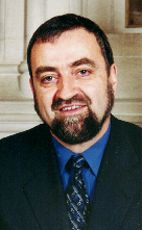
House of Commons photo

Crucial Fact

  • His favourite word was federal.

Last in Parliament May 2004, as Bloc MP for Lévis-Et-Chutes-De-La-Chaudière (Québec)

Lost his last election, in 2015, with 12% of the vote.

Statements in the House

Supply February 13th, 1997

Mr. Speaker, I would like to ask the hon. member to provide more details on the consequences that this will have on Mirabel airport. What happens now with the two airports? Could the hon. member elaborate on this, because we need further information on this?

Sponsorship Of Sporting And Cultural Events February 5th, 1997

Mr. Speaker, I would have liked a fuller response given that, if the minister were to read the papers, he would see that these are his own statements.

Could the minister confirm that he is currently examining the possibility of changing the measures that apply to the sponsorship of cultural and sporting events and of making an announcement before the election?

Sponsorship Of Sporting And Cultural Events February 5th, 1997

Mr. Speaker, my question is for the Minister of Health.

Earlier this week, the Minister of Health intimated that he is currently considering changing his policy on the sponsorship of events by the tobacco industry. It would appear that pressure from all those involved and the members of the Bloc Quebecois finally succeeded in waking up the minister and making him aware of the legitimate concerns of the organizers of sporting and cultural events.

Could the minister confirm that he is seriously considering the possibility of changing the measures that apply to the sponsorship of cultural and sporting events and could he provide more details on the solutions currently being examined?

Canadian Food Inspection Agency Act February 3rd, 1997

After a break of several weeks, Mr. Speaker, the names of the various ridings do not come to us as easily. Mr. Speaker, I would like to take this opportunity to wish you happy New Year.

The three motions made by the Bloc Quebecois regarding this bill, which are part of Group No. 8, are very worthwhile motions. Why is that? Because as the legislation stands at present, all that is required is for the agency to submit a business plan to the minister. That is not enough in our opinion because these provisions have caused considerable controversy within the industry. There is a distinct lack of transparency.

This is why, concerned with improving the bill and making a positive contribution to the legislative process, the Bloc Quebecois asks that everything be submitted to the Standing Committee on Agriculture. This seems to be the thing to do because this is all new: three former federal inspection services amalgamated into a single one coming under the agriculture minister's authority. Granted, that is a good thing. And the opposition did not object to the consolidation of three federal agencies. That is not the problem.

In this whole process, it is clear that the Minister of Agriculture wants to retain as much power as possible. This is a tendency we have been noticing for a few months with this government, a tendency to have responsibility rest with a minister instead of with the governor in council. You know as well as I do that the expression "governor in council" means cabinet.

Now, under Bill C-25, I think, for what had been the normal process so far to be operative, the phrase "by order of the governor in council" will have to be included, for particular matters to be discussed in cabinet from now on. More importantly our motions seek to ensure that they at least be submitted to the members of this House who sit on the agriculture committee so that they can examine whatever changes the minister may want to make from time to time.

We will support the good ones; opposition members do not sit either on the various committees or in this House to object to changes that may be positive, worthwhile. There is a another condition however, and that is the drift of the second motion. The agency should be required to consult both the farming industry or the agri-food sector as a whole and the provinces; in fact, all concerned.

Should this amendment be rejected, there is currently no such guarantee provided in the legislation. We believe such a measure would protect the future of the agri-food industry. It also concerns the health sector, however, since the inspection of food has an impact on health.

I am a now member of the Standing Committee on Health, and I care a lot about public health. It is necessary to inspect food. Just think of what happened in certain countries, Great Britain, for instance, with the whole problem of the mad cow disease. An agency such as this one must be able to protect public health; it must have public health as its main concern. This is why it must operate properly and have credibility. And in order to have credibility, consultation and transparency are required.

We could make other analogies. When it comes to controversial issues relating to health, such as the tainted blood scandal-and I am not only thinking of Canada, but of the western countries-any

process relating to health, including the inspection of food, must be credible and transparent. People must have confidence in it.

We are not trying to be aggressive. We are not proposing things to make a big fuss. We want the public to feel confident about the food it consumes, thanks to the presence of a federal agency. I am from Quebec and I am still a sovereignist, but I care about public health.

Again, we do not oppose the agency, particularly since such a change was made in Quebec in 1978. I know what I am talking about because at the time I was the press secretary of Quebec's agriculture minister, Jean Garon. I can name him, since he does not sit in this House. Jean Garon set out specifically to eliminate duplication.

Before the holiday season, I rose in this House, not to lambast the government, but to express a regret that the proposed change had not yet taken place. As I said, such a cleanup was done almost 20 years ago, by merging responsibilities in the food inspection sector.

This is basically what I had to say to support the amendments proposed by the hon. member for Frontenac who, like the hon. member for Lotbinière, also a member of the Standing Committee on Agriculture and Agri-Food, made an extraordinary and sustained effort. These two members often raise this issue within our caucus and with members from other parties, to make people more aware of the agriculture and agri-food sector, because it is sometimes forgotten. A large number of us live in urban centres. However, the agri-food industry is very important for all of us, since it has to do with our food, with good food and good health.

Mr. Speaker, I thank you and I wish you a long and healthy life.

Canadian Food Inspection Agency Act December 13th, 1996

Mr. Speaker, my colleague from Rimouski-Témiscouata was very eloquent in making the connection between culture and agriculture, as was the Quebec agriculture minister for whom I had the pleasure of working at one point. And she is right. She is right because the federal government's actions as regards culture and agriculture are similar in many respects in that it is trying to eliminate public service jobs for economic reasons to create an agency that will operate outside the public service and that will give more freedom to the governor in council, which, as you know, means cabinet.

The first amendment put forward by the member for Frontenac deals with the new agency, which groups together three agencies that used to belong to three different departments, namely the Department of Fisheries and Oceans, the Department of Agriculture and the Department of Health, into one single agency falling under the jurisdiction of the agriculture department.

However, we can see that people would be appointed by cabinet. If the amendment is not adopted, the agriculture minister, when criticized, could defend himself by saying: "It is a cabinet decision. It is not my fault. I am not responsible. Yes, I am a cabinet minister, but because of ministerial solidarity-"

Finally, it makes the minister of agriculture look good, except that this is a rather special operation. I nearly said "spatial", because there has been so much talk of space today, but no, it is "special". We in Quebec are not all that familiar with this custom. These are measures taken in Quebec in very specific cases, in very specific areas not generally covered by specific departments or sectorial departments.

What is involved here is a food inspection agency, for which at least there is a precedent. At least three agencies have been doing the same thing. As I said yesterday, these various food inspection agencies have been consolidated since 1978 in Quebec. Eighteen years later, we see the federal government developing a desire to do the same thing, moreover in an area of shared jurisdiction, at least where agriculture is concerned. Where health is concerned, however, this would, in principle, be a provincial area of jurisdiction, except where foods from outside the country, or from other provinces, are concerned. But this is not always the case.

We do not, however, have any objection to the principle of consolidating three federal agencies. It is clearer, at least. People will have a clearer idea of whom they are dealing with. But, after grouping the agencies together, they take a diversionary tactic and create one agency which will be able to operate in a different way than the regular sectorial departments.

This leaves a great deal of scope for questions, not that we want to accuse anyone of bad faith, but still. Amendment No. 1 says: "Yes, but why go elsewhere looking for services, when there may be qualified people within the Public Service?" This would be logical, particularly since the fusion may result in early retirement offers or job cuts.

In this context, it seems to me that, before making such changes, thought ought to be given to using the services of people who are already working in the federal public service. That, I would think, would be self-evident. Yet, it seems to me that the government is resisting this amendment.

The other point concerns appointments as legal advisers. Obviously, in Quebec, and I imagine everywhere else as well, there have been appointments following the political trends of the time, and I am not addressing only this present government with this. It seems that the Conservatives also had a considerable appetite for the same thing, which they had had to stifle during the long lean years. It took them nine years to catch up, with a whole series of appointments of lawyers and other professionals, who had all been frustrated during the long Liberal years by not being appointed to legal services.

We in Quebec saw the same thing happen during the Trudeau Liberal years, if not before, and then Mr. Mulroney came along promising change. But the essential change he made was that he appointed different people. When you follow public affairs in Quebec, you see what is going on with federal appointments. With Christmas approaching, I think I could make an analogy with the party game of musical chairs, which it resembles greatly.

Kids like to play musical chairs, but when political appointments are involved, the game is less amusing. The Senate is, of course, the ultimate version of the musical chairs game. When people cannot run around the chairs fast enough, they send them on to the other place. One might call this a kind of compassionate treatment. I do not want to say that everybody in the other Chamber is no good, but this is a costly duplication of an institution.

What we have here is another example, in food inspection. The federal government obviously wants to keep its powers and responsibilities and not delegate to the provinces. It would, however, be much easier to say: "There is an area where duplication could be avoided, because food, fish, products, especially in the context of free trade today, move not only between provinces, but between countries as well". In this context, the government might well want to keep certain responsibilities. In an independent Quebec, in partnership with Canada, mechanisms could likely maintain this situation in cases where products moved between countries.

We have no objection to the mechanism. Our objection is to the way it is set up and to the excessive powers accorded the ministers and the cabinet, because, as we know, the minister can recommend appointments to cabinet. If criticized, however, he will say: "Yes, yes, but it is cabinet. You know, I am only a minister and I must not break ranks with the other ministers". Yes, we understand, but we do not know who is right and who is guilty in this game.

The people of Quebec and Canada want greater transparency and more public involvement in the management of public affairs and political life. It is in this spirit, that the choice of the new leader of the Bloc Quebecois will be by universal suffrage. He will be elected by all members of the Bloc Quebecois. Members of the Bloc wishing to take part will have to wait a few more weeks before the convention.

This is the sort of situation that shows how management of public affairs and political life could be improved.

Why do I say that? Because for a long time, at least in my first years here, I was youth training critic. I was often in contact with young people. What young people do not like about politics-and after being in politics for so long you are aware of this, Mr. Speaker, this will not faze you-is they would like to see some changes, they are tired of the same old ways, especially with regard to patronage appointments. Were the appointees selected because of their hard work for the party, or for their generous contributions to the party? We do not know how it works exactly and people think it is wrong. They would like to see a mechanism such as the one proposed by the member for Frontenac, namely an independent nominating committee.

Mr. Speaker, if I do not have the opportunity to talk to you again, I wish you a Merry Christmas and happy holidays.

Petitions December 13th, 1996

Mr. Speaker, I have a second petition with only 26 names but the petitioners want it to be tabled. They ask the government to get involved in funding the upgrading our national highway system.

Petitions December 13th, 1996

Mr. Speaker, I want to table a petition signed by fewer people than the one tabled by my colleague for Kamouraska-Rivière-du-Loup. Still, people are starting to talk about this. The 77 petitioners want the Senate

abolished, mainly because of its high cost, that is, $43 million. They think we could do without this expenditure.

Canadian Food Inspection Agency Act December 12th, 1996

Mr. Speaker, I am pleased to have another opportunity to speak to this bill because the purpose of this group of motions is to protect the interests of those who will manage this system. The government wants to deny public service employees their vested rights. The other aspect is the one that the member for Richelieu, with his extensive experience, just mentioned so eloquently. He has seen it all, so the government must really have gone too far for him to make this kind of comment.

As the member said, the government, at the end of the session-and that is what Canadians must pay attention to-just before Christmas or just before Saint-Jean-Baptiste day, tries to ram some bills through the House so they will not come up again after the holidays.

The member for Frontenac, with his initiative, and his colleagues in the agriculture committee did wonderful work, and I want to pay tribute to them. Even though they sometimes seem a little too insistent in caucus or in their personal contacts with us, they do make us aware of the reality. They tell us how important agriculture is. But that is of no interest to the members opposite, who are uncharacteristically silent on the subject of agriculture, not only today, but most of the time. This issue concerns not only thousands of Quebecers, but other Canadians as well. Coming from a rural area, even though I now live in a semi-urban area, I know how important agriculture is, as do most Quebecers.

The member for Richelieu is right. Why is it that members opposite do not rise more often to speak to agricultural issues? Would it be because the Liberal government wants to ram his bills through the House? Would it be that it does not want its members to put forward too many arguments because it is afraid of our reaction, so it is trying to avoid debate? But is this democracy? Are we setting a good example? Is that the kind of behaviour we want our young people to see, a government that is acting as if there were no opposition, as if things had to go its way while it is in office? That is almost like a monarchy.

I am surprised that the member for Gander-Grand Falls has not said a word. He usually speaks up when he sees such a flagrant lack of respect for democracy. Without breaking the party line, he usually rises in this House to point out such inappropriate behaviour. He did not do so today, which is rather unfortunate.

However, since we do not have much time left, Mr. Speaker, all members of the Bloc Quebecois who are here today and myself wish to congratulate the member for Frontenac and his two colleagues, the members for Lotbinière and Champlain, for the wonderful work they do to support agriculture in Quebec. My thanks to the member for Frontenac.

Bolo Award December 12th, 1996

Mr. Speaker, La Bande à Gilet , a radio program first aired on CJRP then on CJMP, in Quebec City, have been giving out the BOLO award for five years now. This award goes to an event or a person chosen by popular vote as having been or made the blunder of the week.

I am glad to announce in this House that the winner for this week, whose name will be officially announced only tomorrow at 8.35 a.m., is the federal Minister of Health who earned the title for his anti-tobacco bill. BOLO to the Minister of Health.

Canadian Food Inspection Agency Act December 12th, 1996

There are some remarks that I cannot make in this House and I do not want to be partisan, but I remember very well that, in 1978, Quebec faced the same problem the federal government is now confronted with, that is the multitude of food inspection agencies.

For example, I will tell you what the situation was in Quebec in 1978. At the federal level, there were at least three departments, Agriculture, Health and Fisheries, and the situation was similar in Quebec. In addition, the Montreal area, Quebec City and a number of other major centres in Quebec had their own food inspection agencies.

Therefore, people dealing with food inspection said: "We respect the principles and objectives pursued by food inspection agencies, but enough is enough. It is impossible to work, food inspectors are always on our backs and they contradict one another". There was no consistency.

So, the federal government is now looking for consistency, very late of course, almost 20 years after Quebec. We agree with that objective because, at least, there will be only one federal agency. However, since there is also one agency left in Quebec, there will still be some duplication in respect to slaughterhouses.

I know about it. In my riding, there are slaughterhouses, as there probably are in every riding. These are referred to as type A and type B slaughterhouses. This may not mean anything to the people who are listening and who are not concerned by the issue, but these are the categories. Some categories of meat are approved by the federal government. Others are approved by the provincial govern-

ment. In some cases, this means duplication for the businesses. There is still some duplication left, which is unfortunate.

That is why I agree with the member for Frontenac. He is telling us that one cannot stop the federal government from moving forward, because of some rules involving shared jurisdiction in agricultural matters. But please, do respect provincial jurisdiction in this area, as well as in health. Health is even more of a provincial jurisdiction than agriculture.

Personally, I hope there will be agreement between the provinces, even if the agency is federal. That would be simpler for everybody. It is also possible that we, in Quebec, do not want to control what is happening in British Columbia. If that province is more interested in letting the federal government do the whole thing, so be it. Except that, in Quebec, we have a specific culture. People always equate culture with language, but there is much more.

You know that, Madam Speaker. You come from a region that has a specific culture. That can also be true for food, or gastronomy. Now, this bill is suggesting that one agency could do the work efficiently for all the different regional cuisines.

A while ago, there was a reference to the cuisine of the Lac-Saint-Jean region. That is really good cooking. I know, because I have tasted it. Each region has its own specialties. Even the region of Edmundston, your region, Madam Speaker, has its own specialties. You know that people have different customs in different regions.

I do not want to go into distinctions, but we know that French speaking people do not eat the same food as English speaking people, whether they are in New Brunswick, in Quebec or elsewhere. We must recognize that fact.

In this case, who is in the best position to deal with these problems? The closest level of government. I am from Quebec. In my case, the closest level is the Government of Quebec, and all the more so because Quebec has been a leader since 1978 in matters of food inspection. At that time, I worked in the office of the Minister of Agriculture for Quebec, Jean Garon. I can name him since he does not sit in this House. That is to say that I followed this issue closely. Everybody quoted him as an example.

Incidentally, during our consultations, I met old acquaintances from the Quebec department of agriculture. I was told: "Strangely enough, the federal government is trying to copy us". So much the better if Quebec can influence and try to improve something that will apply somewhere else. I have nothing against that. But I believe the federal government should take into account the fact that Quebec's mindset, culture, way of life, food, and behaviour are quite distinct.

At least, there is some change, some improvement. Instead of three federal agencies there will be only one. It remains to be seen whether this agency will respect areas of provincial jurisdiction.

I want to commend the member for Frontenac for his hard work on this issue. He brought it up time and time again in caucus, at every meeting, to make us realize how important this debate is. He mentioned it to me yesterday, and again today.

He even told me: "My dear colleague from Lévis, I know you have some experience in agriculture, even though it is no longer your field". Finding his exemplary perseverance and tenacity irresistible, I came here to speak in favour of his amendments, to support his views. We will never say it often enough, the member for Frontenac is a staunch supporter of the Quebec farming community. Without sounding like a victim, he has often said that farming was not mentioned enough in speeches in this House. If it were not for the member for Frontenac, the member for Lotbinière, and the member for Champlain, we would not hear much about farmers.

If we were to rely on the Liberal Party, the government, to speak about farming in the House, we would never hear about it. Today is a case in point. It is frightening.

Food inspection is a concern not only for farmers, but also for consumers. How is it that no Liberal members of the health and agriculture committees are speaking on this issue? I am not allowed to criticize them for being absent, but I can criticize them for being silent. This is incredible.

In conclusion, I will congratulate the member for Frontenac. I hope that members opposite will reconsider their position and join us in this extremely important debate on the issue of respecting areas of provincial jurisdiction.