
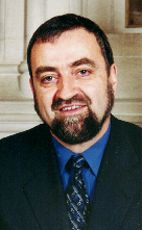
House of Commons photo

Crucial Fact

  • His favourite word was federal.

Last in Parliament May 2004, as Bloc MP for Lévis-Et-Chutes-De-La-Chaudière (Québec)

Lost his last election, in 2015, with 12% of the vote.

Statements in the House

Indian Act Optional Modification Act February 18th, 1997

Mr. Speaker, I am pleased to address Bill C-79, which seeks to amend to the Indian Act. As you know, the Indian Act is over one hundred years old and has often been referred to as a measure which is obsolete, does not reflect the reality and, more importantly, does not meet the needs of aboriginal people themselves.

This act is so flawed that it should be changed, not merely amended, as the Minister of Indian Affairs wants to do. The minister is doing the opposite of what was recently recommended by the Erasmus-Dussault commission, which is to recognize that there is currently an injustice done to aboriginal people.

I sat on two committees of the House. First, I was a member of the Standing Committee on Human Resources Development, and I now sit on the Standing Committee on Health. When I was with the human resources committee, we toured all across Canada and visited a number of aboriginal communities.

Following the testimony heard not only from aboriginal people themselves but also from people working with them, it is obvious to me that aboriginal people have much greater health problems than the rest of Canadians.

Unfortunately, aboriginal people are still the victims of a great deal of prejudice. As the hon. member for Drummond knows, the Standing Committee on Health conducted many studies on the health of aboriginal people. It is rather sad and even disappointing to see that, in spite of these studies, and in spite of the fact that a commission of inquiry released a five-volume report on the condition of aboriginal people, we end up with a bill that only seeks to amend the Indian Act, this in a rather dreadful, embarrassing and nonsensical way.

This bill runs counter to a lot of other legislation. Legislation must apply to everyone. This bill, however, will create two classes of natives: those to whom the old act applies and those to whom the new one applies. It is optional. It will concern only those bands of Indians or aboriginal groups that wish to submit to it, to take the goodies being held out as an enticement to them to give up their ancestral rights. This is something many Indians cannot and will not do.

Despite the opposition of the very great majority of native people in Canada, the minister is deciding to go ahead with this bill. For what purpose? Obviously, to give Canadians the impression, before the election, that he has done something. He dared to

change a statute that has existed for 100 years. What an extraordinary feat. But it is a bill that would not affect everyone, only those who wanted it to.

Has anyone ever seen legislation that is optional like this? It is as though you were told you could not drive faster than 120 kilometres an hour in Quebec; only those who drove under this limit would be affected by this legislation and the rest could decide to have other legislation apply to them.

It is not an acceptable way of doing things. Some people might say that it is interesting, that all legislation should be like that, that people could then take advantage of their freedom of expression, their speed of adaptation we could call it. The law does not work like this. It is not my understanding that the law works like this.

A piece of legislation must apply to everyone. What the minister wants to do is to blind Indians to the facts. He wants to show other Canadians that he has just done something important, when in reality, the proposed legislation, in most cases, would not be applied. It will change nothing. It will only give the impression that he has done something, a bit like the health minister, who boasted about his bill C-71. In the end, he has left himself so many options with this bill that it is not certain if it will be enforceable.

I do not know whether or not it is parliamentary to say so, but I will take the chance. I call this hypocrisy. It is deceptive at the very least, it is misleading. Pretending to do something, when you know in advance that you will do nothing. This is not good government.

It is time the Liberal government held an election, because it seems to be catching. All of the ministers want to do a little something to show that they can get something done before the election, before they change portfolios. If the Liberals do get back in, we know there is a risk of their changing portfolios. They can boast in their c.v. that they have changed a hundred year-old law. But history will say: this law did not change much, because it was obeyed only by those who wanted to. That is extraordinary.

I have made light enough of this serious subject. It is serious: 438,000 status Indians in Canada, and the minister wants to divide them into two categories: those who follow the new act and those who follow the old. There are already two types of Indians: there are the non-status Indians, 112,600 in 1991, and then there are the Metis, 139,491. There are 37,800 Inuit. That makes a total of 720,000 individuals.

In Quebec, the total is 69,300. Now, that represents 1 per cent of the total population of Quebec. A group must not be ignored just because it accounts for only 1 per cent of the total population. At the present time, the Department of Indian Affairs is maintaining a paternalistic system, one which keeps the Indians, the aboriginals of Canada, in a system of dependency. What the aboriginal nations are calling for is the opposite: more autonomy.

You may perhaps reply that they want a bit too much, that this is a negotiation. We in the Bloc Quebecois have always said that they had to be given more.

The day after the commission of inquiry's report was tabled, the Bloc Quebecois even tabled a motion in the House urging the Liberal government to join it in saying that the First Nations are distinct nations. In other words, they should be given the means to promote their distinctiveness, to preserve their culture and especially to obtain the financial resources that will liberate them from this dependency so that at last they will become more autonomous and be able to manage their own health services.

The suicide rate figures, which I will not mention here, are incredible. Which group in Canada has the highest suicide rate? Amerindians. Which group in Canada has the highest rate of alcoholism? Amerindians. Drug addiction? Amerindians. This is also the group that has the lowest life expectancy. Which group has the highest death rate? Amerindians again.

The situation is so bad that Lise Bissonnette wrote the following in the newspaper Le Devoir :

The story we read in the five volumes of this report-and I am referring to the commission of inquiry-is on the whole a story of domestic colonialism that was unique in its brutality and still is, at a time when racism and exploitation should be a thing of the past. The United Nations may have given Canada first prize for being the best place in the world to live, but the fact remains that all social indicators, when applied to the First Nations in this country, are in free fall, indicating a third world in the midst of abundance. From education to health care and employment, the rule is under-development, from coast to coast. According to the commissioners "aboriginal people are 90 times as likely as other Canadians to be without running water. On the reserves, more than 10,000 homes have no inside plumbing". How can we read this and hundreds of other horror stories, in one of the most comfortable places on the planet, and keep on accepting awards?

Or doing what the minister of Indian affairs and the ministers opposite are doing when they tell us that we live in the best country in the world.

It goes on to say that today, one child out of five in Canada lives below the poverty line. We treat aboriginal people this way and would have them believe we are living in the best country in the world, as the situation deteriorates.

This afternoon, the Minister of Finance will tell us how he managed to speed up deficit reduction, either by cutting assistance to the needy, by cutting spending on health care and transfer payments to the provinces and by cutting health care to aboriginal people. Are we supposed to believe that everything is okay, that we

are in good shape? No, Mr. Speaker. The aboriginal people, like the poor in Quebec and Canada, deserve a better deal.

Indian Act Optional Modification Act February 18th, 1997

I am in agreement.

Petitions February 14th, 1997

Mr. Speaker, I also have a second petition signed by 25 people in my riding.

The petitioners ask Parliament to put pressure on the federal government, so that it will join provincial governments and make it possible to improve our national highway system.

Petitions February 14th, 1997

Mr. Speaker, I have the pleasure of submitting two petitions.

The first one is signed by 50 people in my riding, who are asking the government and the Minister of Finance not to increase the excise tax on gasoline in the next federal budget.

Divorce Act February 14th, 1997

We can? I am referring to Mrs. Bacon. She does not live in the riding, but she bought a piece of property in the riding of Lévis to be eligible for an appointment to the Senate. Does anyone ever hear about this senator? This is par for the course in the other place.

Even since the Bloc Quebecois came here, we have said that reforms are necessary. It just does not make sense. First, it costs a lot of money, more than $40 million annually, and second, it is increasingly obvious that this institution tries to delay the legislative process. Occasionally, but such cases are few and far between, we get some new legislation from the other place. But more often, as in this case, people who are opposed to a bill use the other place to delay its implementation, although because of the usual majority in Parliament, the bill is passed in any case, so the delay is only temporary.

So duplication is at work here. I say that right away, because the compromise proposal is to have a joint committee of senators and members of the House of Commons consider the bill's provisions on child custody and visiting rights. I have nothing against the principle. But it is not, in our view, sufficient reason to vote against this bill. Members of the official opposition were among those who supported the bill because of its objectives. One of the main provisions of the bill is to exempt support payments from existing tax provisions.

As we know, this led to a war of almost historical proportions. The spouse who received the support payments was required to pay tax, while the one who made them did not. Often the children were the victims of this war of court orders and legal wranglings.

I would like to call to mind a situation known to everyone, that Canada now has more poor children than when the Liberals came to power, and the numbers are still rising. One child in five is living under the poverty line. In 80 per cent or more of cases, the children living in extreme poverty are in single parent families. In most cases-and this must be said, though as a man I do not want to start a war of the sexes over this-women are the single parents who have to provide for their children. More and more often, unfortunately, these women have to do so under extremely difficult conditions. This is something that cannot be repeated too often.

This bill makes it possible to avoid crises when taxation time comes around, but it does create some rather special situations. The bill is not entirely perfect because, under the Constitution, divorce comes under federal jurisdiction while, under the civil code, marriage in Quebec is a provincial matter under the Napoleonic code. That is one of the dimensions of the distinct society no one wants to recognize.

So, people get married under provincial law and divorced under federal. This is a strange situation, a sort of complicated maze. In today's society, many couples decide not to marry but to live together as common-law couples, and there are various laws recognizing this situation. This is a very good thing, except that, in such cases, the matter of divorce and the guidelines suggested by the bill are under federal jurisdiction. If we take the case of individuals who are living common-law and have children, when problems involving separation arise, application of the guidelines is a purely provincial matter. You can see how things get very complicated at that point.

I have just described the situations of two couples with children, one a married couple for whom the guidelines on support payments apply, the other a case of separation after the divorce, where the federal guidelines apply. In the case of a break up of a common law relationship where children are involved, support is exclusively a provincial matter, in the case of Quebec.

Under an imperfect system like federalism, responsibilities are rather haphazardly distributed. I am not saying this because I am a sovereignist. It is a fact. The Quebec Civil Code governs questions of separation outside marriage.

We could talk at length on this, but an analogy is called for. This is not the only case where this sort of situation prevails. The federal government has the annoying tendency to use the system's ambiguity whenever it can to impose its guidelines in all sorts of areas on the provinces.

By way of example, and only to illustrate the case and not to talk about it, let us consider the bill on tobacco. This bill concerns health, a provincial matter, but the federal government justifies its intervention in the field by pointing to infractions and sentences, which come under the Criminal Code.

Bill C-41 concerns support, family law and other related matters. There is good reason the bill was introduced by the Minister of Justice. Once again the federal government is using the Criminal Code to justify its intervention. The Criminal Code is federal, but the Civil Code is provincial.

It is a bit strange. We must admit that we should never have legislated in the area of support, separation or divorce. Ideally, in a society, there should be no need to legislate people into paying support. They should be able to do so themselves, because, if their children are involved, it is their responsibility.

I will always find it, I would not say abnormal, but strange that, after living a period of time together-years-a couple breaks up and turns to the law to resolve their problems, because they are incapable of doing so themselves. It is too bad, really. It is a real shame to end up in this sort of situation. The ideal would be to have people recognize their responsibilities toward their children.

It is sad for me to see people, mostly women but men also, walk into my riding office and complain about having been treated unfairly by the justice system on suppport issues. Sometimes they cannot afford to pay. It is a shame when, as is often the case, there is hatred where there used to be love and people seek revenge. I always find this unfortunate. The children who are brought into this world did not ask for it, but once there are here, we should provide for them.

While we support the bill, I take this opportunity to deplore how little compassion this government has shown so far for the poor in our society. It is unfortunate that, this week again, the federal Minister of Finance and the Prime Minister commented on how good things are in Canada.

No doubt, on Tuesday, the Minister of Finance will repeat again and again that his government successfully exceeded its federal deficit reduction targets. It has done so at the expense of the disadvantaged and the unemployed, and by cutting transfer payments to the provinces.

When cuts are made in transfer payments, one has to know what that means. The cuts occur mainly in services to the children,

because they reduce transfers for social assistance, health and postsecondary education. In so doing, they are attacking our future.

The Standing Committee on Health spent several weeks this fall reviewing the whole issue of children's health. Experts told us repeatedly that the first three years of a child's life are crucial to the child's mental and physical development. Some even contended with great conviction that, often, juvenile delinquency problems encountered later in life stem from trouble at home in early childhood. Insecurity causes tension which promotes aggressiveness in these young people whose feeling of revolt is often expressed in aggressive ways. So, this is very important.

Repeated cuts in social programs will lead to a grim future. In spite of our concerns about Bill C-41, in spite of the federal government's paternalistic attitude in interfering in areas that should be under the authority of the provinces, in spite of the fact that guidelines were imposed that should normally be under provincial jurisdiction, and because this bill deals with the health of children and bettering their lives, children being the future of Quebec and Canada, this bill is an important bill. For these reasons, we from the Bloc, being the responsible members that we are, will be voting for this helpful bill, as imperfect as it may be.

Divorce Act February 14th, 1997

Mr. Speaker, I welcome this opportunity to speak to Bill C-41, an opportunity we have had several times before. We are having a debate this morning because the Senate or should I say the other place, in parliamentary terms, wanted to introduce amendments. This means discussing the bill again.

For the benefit of the public, I may recall that we went through the usual procedure: first reading, second reading, referral to the justice committee which considered the bill, and then third reading. Now once again, the other place wants to put in its two cents' worth and thus delay the proceedings.

As a result, the Minister of Justice was obliged to suggest a compromise. Why? Because he hopes to see this entirely legitimate bill, which is basically sound and pursues entirely valid objectives, passed and implemented before the next election.

This again raises the question of the usefulness and relevance of the other place. As we know, it is always one step behind. These people are not elected but appointed by the government when vacancies occur. Often at the beginning of a government's mandate, we have a situation where the former government's party has a majority in the other place. In this case, a few months ago the Conservative Party had a majority. And since the other place pursued the interests of the Conservative Party, this tended to delay the parliamentary process.

It has been like this since the beginning of Confederation. When government is replaced, the party that was in power before is still able to delay implementation of legislation by resorting to all kinds of stratagems in the other place.

Mind you, these people are not elected. In my riding, I always ask people the same question: "Do you know the senator who represents you in Ottawa?" I know who it is now. I do not think we can mention names, but she is getting to be known.

Supply February 13th, 1997

Mr. Speaker, the minister had a few good words about the opposition regarding our work on the committee. I must say that the current Minister of Transport is always very kind and courteous.

The fact remains, however, that some situations can be quite dire. As you know, I represent the riding of Lévis. It saddens me to see a shipyard that once employed up to 3,000 workers, a prosperous industry, the leading shipyard in Quebec, stop building ships because of a decline in shipping. This decline is the result of policies that discourage shipbuilding, the building of a Canadian fleet of merchant ships.

I know this also concerns the Minister of Industry, but why was the promise made in the red book not kept? A Canadian shipbuilding summit was to take place in the first year following the election of the Liberal Party. Why did it not take place?

Why does the government not draw inspiration from American policy, the Jones Act for instance, regarding shipping? Why not follow the same policies as those of other countries, particularly Scandinavian countries, on this subject? Why has the Liberal government not done more for shipbuilding? To this day, it has done nothing.

Supply February 13th, 1997

Mr. Speaker, I want to thank the hon. member for Joliette for his interest in the matter. I am appalled to see that the transportation sector does not seem to be very popular. Frankly, it is Thursday afternoon, and many members are in a hurry to leave. Unfortunately, it means that a member of my own party has to ask

the questions. That is a pity. This is a very important subject, and I thank the hon. member for Joliette for his question.

Before the Liberals took office, in the marine sector, under the Conservative government, if we compare spending on marine construction in the maritimes and Quebec, the ratio was 13 to 1, with 1 for Quebec. Of course there was Hibernia. But since the Liberals came to power, not a red cent has been spent by the federal government or the Department of Transport on marine construction. Not one penny.

There is a connection with the defence industry, because marine construction is marine transportation, but also includes ships ordered by the Department of National Defence. One example is the Preserver , a supply ship. Two shipyards submitted tenders: Lévis and Halifax. There was a difference, but since this was for repairs, the difference was in the Halifax shipyard's favour.

We asked to see the tenders. We asked the minister and the government but never received a reply, as usual. We used the Access of Information Act and found that 85 per cent of the 435 pages submitted by the bidder had been blacked out, as we saw in the Somalia affair. There was no way to find out the hourly rate or salary. This is an important point.

When we are talking about refitting a ship, we know that it always costs at least twice as much as expected. There are always some surprises. There is a clause called "open and expect". This clause is variable, and it is very important to know the salary, the hourly rate for overtime and how it will be done. So there was no way to get that information.

The only way to get the information, allowing of course for the lag after the election, is that once the job is finished, the public accounts committee headed by the hon. member for Beauport-Montmorency-Orléans, will be able to have access, but only once the invoices are in, which means in about a year and a half or two years.

Until then, there is a total blackout on any information concerning the Preserver . Other than that, there is nothing on ship construction.

In the area of transportation, let us add the changes to the Coast Guard. This is a plan the government has found to divide its strengths. The Coast Guard, once the responsibility of the Minister of Transport, now reports to the Minister of Fisheries and Oceans.

In the St. Lawrence Seaway, they want to start charging for ice breaking, and they already charge for navigational aids. Step one: $20 million more. These charges apply to ships that put in at Canadian ports. But a ship that travelled all the way down the St. Lawrence Seaway to the United States without ever putting in at a Canadian port would not pay a cent for those same services. Yet we know that the Seaway is operating at a deficit. Because the ship does not put in at either a Quebec port or one on the Great Lakes, it would not pay a cent.

The government's inertia on shipping is scandalous, yet this may be the most economical means of moving freight. What is missing at the moment in Canada is an integrated view of all means of transportation, a national view of transportation.

Supply February 13th, 1997

Mr. Speaker, as you know, we are discussing the motion presented by the hon. member for Kootenay West-Revelstoke, asking the House to condemn the transportation policies adopted by this government. "Condemn"

may be a big word, but we can at least censure or severely criticize the policies of the federal Department of Transport. It is a pleasure to realize I will command the attention of the Minister of Transport himself, who is across the way from me.

Before question period, I touched on two subjects, and I have two left. They specifically concern the people in my riding as well as railway transportation.

I will illustrate the bankruptcy of the Liberal government's transportation policy, using examples that occurred in my riding, and I will start with the loss of jobs. My riding has a major railway centre called Charny. In fact, the name was selected to underline this community's strategic location as a railway crossroads.

Over the past three years, CN's privatization and cuts have meant the loss of 100 out of a total of 500 jobs and the closing of one of the three railroad infrastructure repair shops. After we bombarded the Minister of Transport with questions in the House and he spoke to the media, we showed that the number of rail accidents had increased using statistics provided by the office of railway safety of Transport Canada and the department's own figures. The CN agreed to keep the Joffre shop open, but in a different way: by selling it to an Ontario company, CLN.

Thanks to the concerted action of the people of the community, to the interest generated by the media and to pressure on the government and CN, we kept 30 people employed fixing tracks, which are in ever worse shape because of a lack of resources. And now, the resources to maintain them are being cut.

The rehabilitation of the central Quebec rail line, which could have linked Quebec City with the south, is very important to us and to the member for Mégantic-Compton-Stanstead. The economy flows increasingly north-south, and it would be worthwhile rehabilitating this line. However, without the help of higher levels of government, including the federal government, it will be hard to fix what is broken.

Rail lines are being dismantled and abandoned. I would like to ask the minister some questions, but Oral Question Period is over. In my riding, there is an intermodal station in Lévis, which was renovated in 1986 at a cost of $3 million. Today, CN has sought permission to abandon the line along the St. Lawrence. However, instead of using this line, Via Rail asked for permission to back the train from the maritimes up a distance of three kilometres over the Quebec bridge and then, once the train reaches Charny, it would be backed up again as far as the Ste-Foy station. Meanwhile, they abandon a station that remains in good condition.

I could go on. These are incredible measures since Via Rail, a Crown corporation, is considering abandoning a station on which $3 million was spent in favour of a new one that could cost $800,000 or more, because the figure does not include the land. This decision should have been made two years ago. However, on February 22, when a decision is to be made, Via will recommend to the Minister of Transport this sort of mumbo jumbo of backing up the train.

I know people in Charny who are railroad experts. They have told me this makes no sense. Do you know that, up to a year ago, an employee caught backing a train up more than 300 metres was liable to a warning, which in certain instances could lead to suspension?

And now freight trains, not passenger trains, would be backed up over the Quebec bridge, for which we managed to extract a bit of money from the federal government for renovation work and which remains the symbol of the decrepit state of federalism in the Quebec City region.

Fortunately, after many efforts by the opposition and by the coalition to save the Quebec bridge, we were finally successful. But the energy required to convince this government to do the right thing is unbelievable.

I am very short of time. Ten minutes is not enough. I have two minutes left to speak to marine policy. All the Liberal candidates promised there would be something for the Magdalen Islands ferry built by MIL Davie. Two years later, they are still bandying around the idea of refurbishing the old ferry still in service.

A summit was promised on future marine policy. Nothing has been done. No policy, no summit, nothing. Not a cent has been spent on defence industry conversion, because MIL Davie was a business that primarily handled national defence contracts. The federal government has not spent a cent on this business, on marine construction. It is obscene, and with the election approaching I would not let the Prime Minister or his ministers take credit for the wonderful things they have accomplished in the area of transportation. Yes, the member for Kootenay West-Revelstoke is right to criticize this government for its failure to act in the area of transportation.

Supply February 13th, 1997

Mr. Speaker, I have the impression I will have to continue after question period.

There are four items I would like to discuss in this debate on a motion tabled by the Reform Party which attempts to express the dissatisfaction with the federal government's transportation policies.

The items mentioned include, first of all, Pearson airport. I think this is a subject that has been discussed by a number of members in

this House. I could not agree more with those who thought it was very disturbing and in fact shocking to see the way the government is trying to salvage this mess.

Let me recall the facts of the case. The present Liberal Prime Minister said, when he was in the opposition and also during the election campaign, that he would reverse the former Conservative government's decision to privatize Pearson airport in Toronto, saying it would be far too expensive. They were talking about $600 million.

Not long ago in the newspapers, we read that one hundred million dollars would be needed to pay compensation alone. To salvage what could be salvaged and to try and honour a commitment, the government thinks one hundred million is too much.

Many citizens are talking increasingly about a second subject, the highway system. Many have asked their member of Parliament to table petitions, and I will probably table one myself. They want the government to spend more money on improving or repairing Canada's highway system.

By the way, we deplored the fact that Quebec does not get its fair share. Between 1952 and 1986, only 16.5 per cent of federal spending on highways went to Quebec, although we have more than 24 per cent of the population, as you well know.

From 1986 to 1988, spending dropped to 13 per cent. In 1991-92, spending dropped to its lowest level ever, 4.2 per cent. It went up a little subsequently, but never exceeded 12 per cent. In other words, half of the money the federal government should be spending on the highway system in Quebec is not being spent.

There are two more items, but I think I will have to continue after question period.