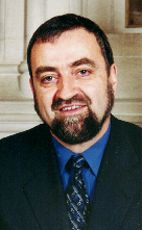
House of Commons photo

Crucial Fact

  • His favourite word was federal.

Last in Parliament May 2004, as Bloc MP for Lévis-Et-Chutes-De-La-Chaudière (Québec)

Lost his last election, in 2015, with 12% of the vote.

Statements in the House

Criminal Code October 2nd, 1996

Madam Speaker, I am pleased to take part in the debate on Bill C-45. Before making my speech, I must say that the way the hon. member for Kingston and the Islands expresses himself is reflective of a situation that we have to put up with in this House.

The hon. member spent a lot of time replying to Reformers to conceal the fact that, in introducing this bill, the Minister of Justice has responded to the comments made by Reformers, particularly regarding the case of Clifford Olson who, as we know, became eligible to apply for parole this spring.

Reformers took advantage of the situation, and the Minister of Justice quickly improvised because, they were speaking up in the west and they still are in this House, even though it is not their turn to do so. The Reform Party made a big fuss over this issue in western Canada.

In some way, this is relatively good for the Liberal Party. When it comes to certain political issues, the Liberals often try to say two different things, depending on whether they are out west or in Quebec. This bill is a good example of that.

So, the reformers often mention that the number of dangerous offenders roaming the streets is increasing. They scare people by referring to all sorts of terrible incidents in their comments, in their questions and in their interventions in debates such as this one. They are very interested in repression, but care little about prevention and the means to avoid a rise in crime.

Once, during the period for questions and comments, I reminded a Reform Party member of a figure, and I told myself that I would bring it up again. What about it? In 1993, Canada had the fourth highest rate of incarceration in the world, 130 prisoners per 100,000 population. The country with the fourth highest rate of prisoners in the world. These figures come from the Department of Justice.

The United States leads the field, with 565 persons for 100,000 population. We are talking here about the land of liberty, where several states have the death penalty. I am speaking about the United States, of course, a country whose judicial system the Reform Party members would like to copy. Let it be noted that the Liberals are very sensitive to the legal concerns of Reform voters. That is why the justice minister introduced this in the month of June.

But what about the crime rate? Canada's homicide rate compares favourably to that of the United States, with 1.98 murders, fewer than 2, for 100,000 population, against 8.5 for 100,000 population in the United States. Internationally, Canada falls within the average of 1.94 for 100,000 population.

Once again, we must look not just at the murder rate, but at who is committing these murders. In Canada, they are committed by members of the victim's immediate family in 36.1 per cent of cases; by immediate acquaintances other than family members in 46.6 per cent of cases; and by strangers-as we keep hearing from the Reform Party-by people unknown to victims, in only 15.9 per cent of cases.

I would like to hear the Reform Party, and the Liberal Party as well, express an interest-as do certain people I know on the health committee-in ways of preventing spouses and former spouses from murdering their partner or former partner, and then attacking and killing their children. I would very much like to hear the Reform Party propose solutions to family situations such as those. As the statistics show, that is the real problem in Canada.

In fact, there is a certain increase in rates, at least in Quebec, because that is where I live. Recently, we have seen many cases of people, men, in particular, it must be admitted, for it is usually men who kill their former spouses and then very often kill themselves. What difference would parole make in these cases?

Why are the Reform and Liberal Party members focusing desperately on one part of the problem, on the 15.9 per cent of crimes that are committed by strangers. And of these strangers-I do not have the figures-a certain number are gangs of criminals, motorcycle gangs. We saw this in Quebec. People were not known to each other, but had a mission. These are senseless murders. Enough of scaring people.

In most cities in Canada, and in Quebec in any event, there are not all that many, but there are some and as long as there are any at all, it is a serious problem. But I am worried. There have been cuts in unemployment insurance, in social programs at all levels. Perhaps it does not come under federal jurisdiction, but there should be more programs so that the provinces can spend more on prevention, assistance to families, to the people going through difficult periods, in order to prevent situations like this from happening.

But no, that is not what they do. There is much fanfare about amending the act, but they are making it up as they go along. They are not consulting the experts in the field, and, without any consultation, they introduced this bill in the House late in June. They waited for the summer to go by and then brought it back. I am well aware that the Liberal majority will impose its point of view and that we will have to live with the result.

I invite my colleagues, those across the way and elsewhere, to take a greater interest in the real problems, the more vital problems affecting families and leading to an increase in domestic violence. That is the real problem.

Divorce Act October 1st, 1996

Mr. Speaker, I am not very familiar with the American system the hon. member is referring to. Frankly, when I do not know a subject very well, I do not usually talk about it because I am not convincing. And when I am not convinced myself, I am even less convincing.

Having said that, I have not closed my mind to this idea. We will consider it together. The hon. member for Québec sitting in front of me is our critic on the status of women. If this is a good idea, she will surely give us some advice after thoroughly reviewing the issue. So we will have to wait for that.

One last thing. I do not know what it is like elsewhere, but in Quebec, for example, CLSCs, local community health centres, or private organizations provide services to attempt reconciliation before a couple separates; they try to help the spouses patch things up while looking after the children's best interest. There is a long tradition associated with this. Things do not always go smoothly because there are unfortunately cases of extreme violence in which people even manage to kill their former spouses, which is deplorable.

Finally, Reformers often talk about criminals on the streets, dangerous offenders who make people feel unsafe, but 85 per cent of crimes are committed by people who are oftentimes very close, like family members, and who are often former spouses. The hon. member talks about prevention. I pay close attention to this and I will support any measure he may propose when-

Divorce Act October 1st, 1996

Mr. Speaker, as the member for Lévis, I am pleased to take part in this debate. As a man, I felt it was my duty to do so, because anything to do with child support is wrongly seen as being a subject that is primarily of interest to women.

This is based on the fact that, in reality, unfortunately, it is women who, as things now stand, more often find themselves responsible for families after a divorce.

I can understand the Reform Party member for Edmonton Southwest, who is one of the more moderate members of his party in many respects, including social issues. Nonetheless, I am not happy to hear him say that it would be better to tough it out than to get divorced. Toughing it out means, in certain cases, for many women and children, and perhaps for men too, putting up with intolerable suffering.

There is one statistic we cannot ignore. In 1990, in Canada, there were 78,152 divorces, and there are undoubtedly more now. Naturally, these divorces involve men and women, so if we multiply this number by two, we see that they affect 150,000 men and women. Furthermore, if we presume an average of two or more children per family, we are looking at 300,000 children affected by these divorces in Canada, and that is just for that particular year. It is not cumulative. Therefore, there were so many instances of divorce that affected 300,000 people in 1990, and probably 300,000 people and up were affected in 1991, and the numbers continue to rise.

We also know that an overwhelming majority, 98 per cent in 1988, of those receiving child support payments were women. The percentage is lower today, but it is still very high. That is why I say that I, as a man, and the men that I represent, should also be concerned about the situation. We can, however, have different points of view, depending on the party line and depending on the objectives of the various parties concerned.

I am a former member of the Standing Committee on Human Resources Development and a current member of the Standing Committee on Health, together with the hon. member for Mississauga-South. We both know how important the first years of life are and how economic and social conditions may have a subsequent effect on health and also create problems, I was going to say with respect to delinquency, but also for a person's social and individual development.

Ideally, and I am sure we all agree, everyone would have a father and mother who stay with their children until they reach the age of majority or even beyond that and who pay for their education. That is the ideal situation we would all wish for.

However, there is one factor we cannot ignore and I am referring to those 78,152 divorces that occurred in 1990. This does not include people living common law, who separate without first having been married and who have children. That is why when last year I saw the Minister of Justice table his plan, and we even saw a glimmer of hope in the last federal budget, something that had changed following the Thibodeau judgment. Basically, the well-known debate on deduction of support payments was no longer about considering one parent or the other, but about what was best for the children.

Twenty per cent of the children in this country live below the poverty line, and the vast majority are in single parent families.

We can say quite confidently that most of the time, in 80 per cent of the cases, these families are headed by women. That is a fact. I must say I am particularly sensitive to the situation of these mothers. In the final instance, children will suffer if we do not deal with the problem in the best possible way. And they will suffer for a long time.

If the economic situation gets worse, with all the psychological and other stress this entails, and this goes on for a number of years, the impact on the children can be catastrophic. Sometimes I hear members of this House, especially members of the Reform Party, say that the rate of juvenile delinquency is terrible, the crime rate is terrible and what is happening in our society is terrible. People often say they do not feel safe any more. I am willing to believe that, but we must try and understand how this happens.

Certain megastudies, which take into account the results of every possible analysis have discovered that these problems are often due to socio-economic problems that affect children when they are young and are not even aware of what is going on in the world. Stress is not always transmitted in an explicit and verbal way. It may be expressed through family tension, bickering, the tension that may exist between spouses, whether they are living together or not.

When spouses take legal action against each other, that affects the children. I am not saying this is so in all cases because some couples divorce amicably. Some men meet their responsibilities properly.

We are not accusing those who are acting properly. But there is one social fact the hon. member for Edmonton Southwest ought to understand: regrettably, a good proportion of people do not meet their responsibilities toward their children properly, and most of these are fathers. Sometimes they may feel that since they did not obtain custody, or joint custody, they are justified in making their ex-wives suffer without realizing that the ones suffering the most are their children. And that is intolerable.

I do not want to sound too critical. Let me take a different approach, since I feel that it is important for this debate to be held. It is important for we men to shoulder our responsibility, just as women responsible for single-parent families must. We must be aware that single parents need our help, be they women or men.

Recently, I attended a function of a single parent association in my riding. It was celebrating its 15th anniversary. There was a time when no men were seen in such associations, but I could see that now there are. Men are also heads of single parent households, and they find that incredibly difficult, as indeed it is.

I do not want to get into details of the private lives of the people here in this House, but I am sure that some here are single parents. Their duties here demand a lot of their time, and they may not have as much time as they would like to devote to their children, who may well have complaints about this.

I know that similar discussions go on in other professions, where there are also heavy responsibilities, where much is demanded of single parents, not just financially, but the financial aspect is a very important one, and ends up being intolerable. As I have already said, 20 per cent of the children in Canada, a country said to have one of the best standards of living in the world, 20 per cent of Canadian or Quebec children, are living below the poverty line.

Among the leading causes of this poverty is the situation of single-parent families and people not fulfilling their responsibilities properly.

While agreeing with the objective pursued by the minister and finding relatively few faults with his bill, I cannot help but notice that the bill shifts away from the strategy announced last spring. We, in the Bloc Quebecois, were afraid there would be discrepancies in the bill or that some of the provisions might be harmful.

Speaking as a former member of the human resources committee, I also notice through all this, good intentions and all, the excessively paternalistic attitude of the federal government in this area. I am also speaking as a Quebecer. Since last year, we have had in Quebec a scheme providing for all the conditions regarding support payments, including provision for support payments to be automatically be collected from spouses who are in default. It is complicated. It is all new and already there are growing pains. The scheme is still in its infancy.

The strange thing is-I can hear you from here, saying: "Here goes the Bloc, the official opposition, again with their line", but spouses who do not fulfil their obligations are in fact not honouring their marriage contract or commitments. And in wanting to interfere in this area, the federal government is interfering in an area of provincial jurisdiction. Let me elaborate.

Marriage comes under the jurisdiction of the provinces, while divorce is a federal matter. There are also those who are not married. When they separate, it is not a divorce. These people form a different group and they are not in any way subject to this bill, which only deals with the issue of divorce. However, the fact is that, in Canada and in Quebec, more and more people are involved in common-law relationships.

Again, the paradox with the current federal system is that people get married under the laws of the province but divorce under federal laws. This is somewhat odd, but such is the situation right now.

In this area, the federal government displays a committed, pervasive and embarrassing paternalistic attitude, as it does in the education and health sectors. In this area, as in the other two which I just mentioned, the federal government introduces guidelines in a bill, presents the whole package to the provinces and tells them: "Sure, you can get involved in this, but provided you do this, that and the other thing. If you do not accept our guidelines, then we are sorry but the federal system will prevail as regards the issue of divorce, because it comes under federal jurisdiction".

This creates a strange situation. For example, if a married couple with two children divorces, the federal legislation will prevail. However, the same situation involving common-law spouses whose children have the same financial needs will be dealt with under provincial law.

Given all the differences in treatment that can take place, I ask you: Is this a fair and balanced situation that will promote consistent social development? This is one of the flaws of the federal system. We have no choice but to say it again: the federal government, the federal "big brother" feels compelled to get involved, with its not so subtle approach, in issues that come under provincial jurisdiction.

When one province does not agree, it is punished, it is not entitled to the benefits of the federal system, or, when there are no benefits, the federal government carries the day.

That, therefore, is the opposition's opinion of this bill. I hope that debate goes well. It is possible that the Liberal government, which has the majority, will decide not to make any concessions or compromises, but that would not be conducive to harmony. At the outset, I hope that government representatives agree to the compromises that will be proposed by official opposition members, who are trying to make a constructive contribution, because these are situations affecting human beings, individuals on whom the decisions made will have important social repercussions, particularly for children, and therefore for everyone's future.

I know that the member for Mississauga South is a sensitive man. He sits with me on the Standing Committee on Health. As I know the influence he has over his colleagues, I challenge him to try to convince them to think about the health of children, given that we want to see more harmonious relations between men and women who have responsibilities with respect to children, and, although there has been a softening of their position, to convince them to be receptive to the compromises we are proposing.

Canada Marine Act September 27th, 1996

Mr. Speaker, I am pleased to take part in this debate because, when we deal with the marine sector, the MIL Davie workers, in my riding of Lévis, immediately come to mind. My goal is to see if this bill includes measures that will be beneficial for these workers.

Why do I think in these terms? Because Bill C-44 is pompously called the Canada Marine Act. However, there is nothing in it about marine construction or the merchant navy. Yet, I saw Liberals, including the Prime Minister, come to meet MIL Davie workers and tell them that a summit would be held and a policy would be developed.

In the end, this bill deals primarily with ports. What is it all about? The member for Blainville-Deux-Montagnes, who spoke before me, stated the Bloc's position. In principle, we cannot oppose this bill, because it theoretically seeks to take politics out of port authorities. However, we are not so sure that this will actually be the case.

For example, in most cases, the federal government will continue to appoint the directors of a port authority. As mentioned in clause 12(1), there will be an official representing the federal government, but, with the exception of those individuals appointed by the municipalities and the provinces, the others, including those representing the users, will be appointed by the federal government.

I happen to come from the region of Lévis, across from Quebec City, which has a major port.

Over the years, I watched what was going on in the port of Quebec, because there are port facilities on both sides of the river. What happened is that, over the ten previous years, the port of Quebec had accumulated profits of $36 million. This prompted the federal Conservative government, and then the Liberals, to grab $33 million out of the $36 million.

Under the circumstances, you will understand why the port authorities had no real incentive to make profits. The member for Blainville-Deux-Montagnes talked about siphoning off profits and he is absolutely right. This best describes what took place. The federal government was siphoning off the profits and, then it says, in the bill, that the previous policy has failed. This is indeed the case, because, wherever it was cost-effective, the federal government moved in and took amounts for its own administration.

The Bloc Quebecois has certain concerns, one being that, although the port of Quebec City was cost-effective, smaller ports, and there are many of them, are not in the same situation. We are still worried about them. Often, ports are in pitiful shape. The federal government has neglected the maintenance of several small ports and now it would like to turn these small ports over to local entrepreneurs, rely on the spirit of economic development and initiative that local people may have.

It is not much of a gift in some cases, unless the necessary money is invested. We will see, during the consultation, because there will be hearings at which the various stakeholders throughout Canada who are interested in the matter may express their views.

The members of the Bloc Quebecois, the official opposition, will be present at each of these hearings to listen to people's concerns.

At first sight, $125 million to refurbish all the ports concerned seems insufficient to us. Sometimes, what is needed is an analogy with what is happening in other areas. This morning, I read in the newspaper about a group of five small regional airports in Quebec that have decided to make representations to the federal government. The representatives say that they would be interested in taking over management of these airports, but that they are in unsatisfactory shape at the moment. For a year, or 18 months now, I believe, we have been seeing, if we look at specific cases, that people are realizing that if an adjustment is not made, it is not as interesting for local authorities to take over the administration of what the federal government leaves behind.

I will give another small example. I personally wonder. Take the Toronto airport, You will tell me it is not the same thing, but it still has a bearing on the ports. The Conservative government had decided to privatize Pearson, but the Liberal government wanted to prevent privatization. Why? Because there was more in it for them that way. It makes me wonder. When something brings in money, the government wants to hang on to it to fill its own coffers, but when it is a losing proposition, and when the government itself has contributed to the deterioration of the infrastructures, it wants to hand it over to the local authorities.

At first sight, this strikes me as a real contradiction. So during these hearings on the ports, people will have a chance to express their concerns. I think that these hearings will provide an opportunity for them to do so.

The only thing I see is that the time limit seems very short. In the human resources development committee I have seen that people have not had enough time to prepare a brief because of the time limits. The democratic process, though generally very good, is not always followed as it should be, because people have not been given the necessary time to prepare. At any rate, we shall see what happens.

This the reason for the Bloc Quebecois' serious reservations, despite our support of the principle.

There is also the matter of pilotage. I have had a lot of representations from people about the St. Lawrence, where I understand it will be implemented in 1998. The St. Lawrence pilots have expressed their concerns to me. They are not sure it is a good thing to move the St. Lawrence pilot administration to Ottawa. In this instance, centralization does not seem attractive at first glance.

Finally, as for privatization and increased commercialization of the St. Lawrence Seaway, I would be in agreement with that. Yet I would point out that, as the member for Lévis, I would certainly like to see this new legislation take into consideration the fact that

vessels plying the St. Lawrence Seaway in future will have to be built with a narrower seaway in mind. We are well aware that it is not all that easy to navigate through all kinds of submerged barriers. As well, environmental protection regulations would be necessary.

If all of this were done, the situation of the workers at MIL Davie, whom I represent here, would also be improved.

Supply September 26th, 1996

Madam Speaker, I would never be ashamed to admit to having been a Conservative Party organizer if I had been, but that is not the case and I would just like to reassure the government whip. I just wanted to clarify that. Moreover, I was a Nationalist Party candidate in Quebec in 1984.

The government whip then goes on to say that I was too critical, that the Bloc Mps have been too critical. Here we have one of the four ratpack members, the one whom, when they were in opposition, the media labelled as the most aggressive, almost harassing,

member of the bunch. In fact he ran after ministers, even trying to break up their press conferences and other such antics.

Now he takes a holier-than-thou tone, speaks quietly, no aggression. He is the House whip now, and adopts this manner because he would like to cool down the emotions of the hon. member for Lévis.

This is the same hon. member who is heavily involved just now in collecting money for the poor souls accused by the director of elections for Quebec. They have been told that they spent money they ought not to have during the Quebec referendum last year. He is assuming that attitude, perhaps, to attract the sympathy of Quebecers, but they will not forget that.

Now, not knowing what more to say on the matter-he is probably tired, and has every reason to be-he starts to read a report that has nothing at all to do with today's question on economic growth. But let us talk about economic growth.

I have had the time to read another report, one that could well have worried the hon. member for Newfoundland just now, one which tends to show that investments are not very high in Quebec, among other things. Some say that the share of investments in Canada is only in the 11 or 12 per cent range, from its previous level of 17 per cent. This report indicates that 59 per cent of private investments are made in Ontario, his province.

The people in the other provinces ought to be really worried about this, since it means that all of the efforts of this government on the economic level are probably linked to the number of Liberal MPs in the province. In Ontario, practically all members are Liberals, so it flaunts the fact but does so discreetly so the other provinces will not notice. We all know this government has a very soft spot for Ontario.

I am from the riding of Lévis. When defence contracts are announced, MIL Davie is asked to tender its bid against another shipyard, but recently, when it was time to order army tanks, there was no call for tenders and the contract was awarded directly. People in other provinces have the right to hear about that.

The Bloc Quebecois, whatever members opposite may think about it, is the official opposition, and as such we condemn the treatment of family trusts. We did so during the last election campaign. We did not wait for the auditor general's report. We said this should be investigated.

At the very beginning, when the auditor general expressed its concerns about $2 billion that were transferred to the United States, all we asked is that the government shed some light on the question. The government whip can say anything he likes, but we in the Bloc Quebecois intend to keep insisting that this government

do everything that is necessary to clarify the situation around the transfer of $2 billion and that it take all necessary steps to ensure this does not happen again. We will not give up.

Supply September 26th, 1996

Me? Never in my life.

Supply September 26th, 1996

Give him a good rating.

Supply September 26th, 1996

Madam Speaker, the member for Gander-Grand Falls, as we have come to know him, has often shown his support for the most disadvantaged, for the people of his riding, of his province. I have the utmost respect for him. His commitment to certain fundamental things with regard to social programs and unemployment insurance, and the fact that, several times, he expressed his disagreement with the government have forced him to remain a backbencher within the Liberal Party.

I know that an election will be called some time soon. One year or maybe less from an election, the member is trying, in the presence of his whip and other colleagues who are listening to him, to improve his image within the party because he wants to run again in the next election, which is perfectly normal.

Even though he likes us and often tells us so, why not pick on the members of the Bloc Quebecois a little. They have not said all they should have said about possible loopholes for rich people.

With respect to family trusts, he tells us that the matter will be resolved in 1999. We will have other arrangements then. What does that say? It tells wealthy families that they have another three years to prepare for the forthcoming changes.

I will tell you that, as in the Pearson deal and many other instances, the bad things that the member says came from the former Conservative government, where some people benefited from certain advantages, are more often than not related to these wealthy families. Oddly enough, in these cases, the friends of the Conservative Party have become the friends of the Liberal Party.

Why is that so? One just has to read the report of the Chief Electoral Officer on political party funding. One can see that large corporations also contributed to the Liberal Party of Canada's funding, equally in most cases. This is less true of the Reform Party, which gets 80 per cent of its funding from private individuals. In the Bloc Quebecois, our funding comes solely from individuals, as is the case for the Parti Quebecois.

Would the member, who supports the have-nots, who seeks political correctness, be in favour of correcting the impression of inequity in this whole issue? That is what the Bloc is asking for. Frankly, I ask the member if he can blame us for supporting the Auditor General of Canada when he says that there is a need to shed some light on what has happened and to inform the public.

How can he blame us for wanting to shed some light on something very obscure? If nothing is found, then so be it. At least the public will be reassured, as well as the 100,000 people that the Government of Canada is suing for unemployment insurance fraud in the amount of $100 or $200. Of course, the member for Gander-Grand Falls is not saying a word about that one year away from an election. Last year, he was talking about it. Why is he not talking about it this year? Is he so eager to improve his image within the Liberal Party? In that case, he will lose my respect.

Prisons And Reformatories Act September 24th, 1996

Mr. Speaker, I always listen to the hon. member for Esquimalt-Jean de Fuca with respect, for normally he uses good judgment. This time, while being less zealous than his Reform colleagues, he is still speaking along the same lines.

I understand what fear is. He speaks of people being afraid to go out in their own neighbourhoods. I do not have the statistics with me, but in Quebec, at least when I looked at the figure for my region, 80 per cent of murders were committed by people known to the victim. More often than not, three out of four times I think, the murderer was a former partner, and in more than half of these cases or something like that, he then took his own life.

I certainly take no pleasure in such statistics. We are seeing the increase of such cases, but at the same time the crime rate in Quebec and in all of Canada is decreasing. Yet the Reform Party is still raising the argument that people are afraid.

I am not all that old. I have not yet turned 50, but I can remember how frightened my grandmother was, how frightened my mother was, how frightened women have always been, both in cities and in the country. If we take fear as a criterion, there is unfortunately no polling company that can do a historical study for us, but I am sure that, if such a study were done, it would be seen that there have always been people who were afraid.

Yes, there are worrisome things going on, particularly where young people are concerned. I say that there are too many violent shows on television, and that could be one explanation.

As I know the member who just spoke to be level headed and usually of good judgement, I would like him to confirm to me, as he is a doctor, that there has been an increase in violent crime, leaving out the crimes committed by ex-spouses, people who know each other and criminals settling scores with other criminals. Is there really an increase where he lives in Vancouver, and is it that serious in this region? If so, he should warn us, because I may have to go to Vancouver next week.

The Senate June 20th, 1996

Mr. Speaker, time is going by rather quickly and I will probably be the last speaker on this topic. When there is discussion, things can change. The Liberal colleague who just spoke was shaken by the arguments of the member for Kamouraska-Rivière-du-Loup, but also by something that took place last night in the other House.

In fact, it is quite strange and unexpected that we should be discussing this today of all days. What happened yesterday was very serious. For lack of one vote, the House has been brought to a halt. As the member just said, if nothing changes and the government wishes to maintain its position, it will have to present a new bill and the same thing may happen all over again.

However, we should perhaps qualify this. It seems that what we saw yesterday was a certain laxity on the Liberal side of the Senate. Apparently a Conservative senator was not present at the start and would not have been able to vote, and that could have made all the difference. There was a lack of vigilance, such that the situation in which we find ourselves was avoidable. The system cannot bear the whole blame, but the situation is nonetheless amusing.

Coming from Quebec, as I do, and having discussed this many times with the member for Kamouraska-Rivière-du-Loup-it is rather the opposite, the member for Bellechasse is right, we often alternate, particularly at the end of session. I think this is the ninetieth time I have risen to speak since the throne speech.

I do not, however, agree with my other colleague, the member for Vaudreuil when he says there is no point in discussing the topic. We cannot accept the comments of the member who just spoke, whose riding I have forgotten, Hamilton-Wentworth I believe. In question period, I saw the Minister of Transport upset at what had happened yesterday, and he was right to be upset.

The member for Vaudreuil spoke about everything under the sun. He seemed to be practising for the campaign trail. If his performance is any indication, we can expect an election this fall. He really seemed to be practicing a campaign speech. He said that it was useless to speak of it, that it cannot be changed, that unanimity would be necessary and cannot be obtained-a fine admission of powerlessness by a member of the House of Commons under the current federal system.

I agree, it is true that it is hard to change. I would even say virtually impossible. It is impossible for us here to abolish the Senate, we cannot. It seems that some sort of stratagem will have to invented somewhere if it is to be done, for it has become frozen in time.

Frozen in time since 1867, and this change cannot be made, although it translates the desires of many, in Quebec and elsewhere. No way of changing it. Talking Constitution or changes in Quebec, no way either, it requires unanimity. For the past 30 years, we have seen constitutional rounds come and go and we always end up in the same dead end. One day, something will have to be done.

We in the Bloc Quebecois think that, as far as Quebec is concerned, what is needed is for the rest of Canada to accept Quebec's becoming sovereign and to discuss with it an offer of economic and, yes, political partnership. I think that would make a huge change and would be along the lines of the formula of Upper Canada and Lower Canada, which was in place before the Union Act. That formula is worth re-examining, not just copying, for times have changed. That could bring about a change.

Along with the hon. member for Bellechasse, I am telling the people of Quebec and elsewhere who agree with us that the Senate should be abolished, because it costs $43 million a year and cannot be touched by the voting public, that they ought to sign a petition asking that the House of Commons abolish the Senate. This is an institution that is no longer of any use. I have nothing against the people individually, some of them are extremely decent people, but that is not the issue. When we do not have to be answerable to the voters for our actions, I think that the exercise of a modern democracy is not possible.

I therefore support the hon. member for Kamouraska-Rivière-du-Loup in his undertaking, which I must say is far from pointless. If a lot of Quebecers and Canadians support this motion, one day it will bear fruit, and we will manage to abolish this system which costs us $43 million.

In closing, Mr. Speaker, let me take my turn in wishing you, and all of my colleagues of all parties, a good vacation.