
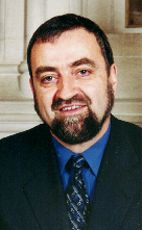
House of Commons photo

Crucial Fact

  • His favourite word was federal.

Last in Parliament May 2004, as Bloc MP for Lévis-Et-Chutes-De-La-Chaudière (Québec)

Lost his last election, in 2015, with 12% of the vote.

Statements in the House

Regulations Act June 12th, 1996

Mr. Speaker, in this House, on May 10, I asked the minister of Transport a question on the federal government's responsibility with regard to the Quebec bridge.

Again, in his answer, the minister of Transport refused to acknowledge that the federal government had any responsibility with regard to repairing the Quebec bridge. Well, his government changed its mind because last week, on Friday, June 7, during a meeting at the Quebec Citadel, Canada's Prime Minister and Quebec's premier entered into an agreement establishing the costs to be assumed by the various parties: 60 per cent for CN, 30 per cent for the provincial government and 10 per cent for the federal government, through its Department of Transport which, until then, had refused to acknowledge its responsibility.

Let me tell you a short story. This afternoon-it is purely a coincidence-I asked a question on another subject, the closure of a CN service shop, and the minister of Transport refused to acknowledge his responsibility in this area. So, in spite of everything, I remain optimistic regarding this matter, because of the minister's flip-flop on the issue of the Quebec bridge.

But this is not the point. Now that the issue has been settled, I would like to ask the Minister of Transport, or his representative, what led him to change his answer, which he had given me on several occasions, including on May 10, and recognize that the federal government did have responsibility, since it is paying 10 per cent.

I would also like to ask him not to change his mind and to stand by this good decision regarding repairs to the Quebec bridge, which is a significant symbol in the Quebec City area. I would like to know the terms of the agreement, and how long the federal government's involvement-the 10 per cent previously mentioned-will last. I would also like to ask the minister if he recognizes that the federal government can pay immediately or as soon as possible, because people believe that the repairs only involve a paint job on the Quebec bridge, when in fact, important girders have to be replaced. It has been estimated that materials represent a third of the costs involved.

I would like to ask the minister why could we not use the services of a company in my own riding, namely Dominion Bridge, which actually built the bridge and recently acquired the MIL Davie shipyard. Since the government has given no money to the MIL Davie shipyard in the last three years, the Transport Department has a good opportunity to influence CN to have the work carried out by Dominion Bridge's workers at MIL Davie, because we know that its president, Mr. Tellier, is a former senior public servant. They say it is private, but we know that he has spent his whole life here.

Oceans Act June 12th, 1996

Madam Speaker, I would like to add that I support the point the hon. member for Chambly made quite eloquently about the major impact this bill will have on Quebec in particular.

Since the rules of this House do not allow us to speak of the absent, I am delighted to see that the minister responsible for Quebec is here. I think that references to someone's presence are allowed. At any rate, he is here and he has been all ears, especially since the remarks made by the last few speakers, including the very significant remarks made by the hon. member for Richelieu, have also attracted another minister from Quebec, I think.

It seems that our efforts to catch the attention of ministers from Quebec through our arguments are starting to pay off. Great. We commend them for being here and for listening to what we have to

say. We must take advantage of their being here to go over the economic considerations coming into play.

Let me remind the House that the Minister of Finance told the Minister of Fisheries and Oceans to come up with savings of $120 million over four or five years.

For this year alone, the finance minister's order is for $20 million. What were the options? The minister first considered implementing a fee structure. I need not elaborate on this subject, as my colleagues discussed it at length, but I feel that there would be room for improvement and, if the Liberals agree to defer consideration of this bill at third reading until the fall, this might be a good time to invite suggestions.

Here is what I have to suggest, in my personal capacity and as a member from the Quebec City area, after wondering if it would not be possible to further streamline coast guard services. Indeed, this is an option the administrator of the port in Trois-Rivières had come up with some time ago. He said: "At present, all of eastern Canada is divided into three areas and administered by three separate regional directorates. Why not consider merging the three into a single regional directorate for the whole region? This would cut costs by at least $17 million, with $2 million in savings coming just from moving icebreakers from the maritimes to bases located closer areas where the Coast Guard operates".

It is surprising indeed that nine icebreakers are currently based in Halifax, when we know that the eastern coast of Nova Scotia is ice free year round. That is incredible. Icebreakers are based in locations where there is no ice. To break the ice in the Gulf of St. Lawrence, they must travel 460 kilometres from their home base. Only four icebreakers are based in Quebec City's harbour. In 1993, there was an incident and it took more than five days for an icebreaker to travel to Lac Saint-Pierre, to break the ice that completely paralysed marine traffic.

Since 85 per cent of the goods transiting through the Cabot Strait are headed for ports in the St. Lawrence, it would make sense to establish the regional centre in Quebec. A journalist recently said I wanted to have the centre in Saint-Romuald, in my riding. I am not asking for that much. I am not trying to convince the minister responsible, but the centre should at least be located in Quebec, in the most appropriate location, since that is where icebreakers are needed, in the St. Lawrence River and in the gulf.

There are other issues which come to mind. The Louis S. Saint-Laurent , an icebreaker, costs $56,500 a day. It is the most costly ship to operate in the whole coast guard fleet. If we stopped using it, we would save $12.4 million. Why are we making this request? It is because the Louis S. Saint-Laurent has not been used to break the ice in the last five years. It was used for all sorts of other tasks. In other words, we were able to do without it.

It comes down to one thing: Why would rescue operations not be taken over by others? The Auditor General of Canada tells us they could be taken over, for instance, by the Canadian Navy, since it already does rescue work. I am not saying the coast guard is not doing a good job in Quebec, quite the contrary. However, since we must streamline operations, we should, instead of increasing fees, better integrate these services.

I know that other members wish to speak on Group No. 13.

Since there is only a half hour left to discuss this group, I will conclude by paying tribute to the hon. member for Vancouver Quadra and by asking the Secretary of State responsible for Quebec to use his influence within the Liberal caucus, so that third reading be postponed until the fall to allow the various stakeholders to make suggestions.

Railway Safety June 12th, 1996

Mr. Speaker, I hope that the Minister of Transport realizes that what is at stake is rail safety in all of eastern Canada.

Given that the minister has the duty, under the existing legislation, to ensure the safety of rail transportation, does he intend to impose a moratorium on the closure of the shop in Charny, pending an impact study by the National Transportation Agency?

Railway Safety June 12th, 1996

Mr. Speaker, my question is for the Minister of Transport.

CN employees responsible for repairing railroad track maintenance equipment at the Joffre station in Charny were told on Monday that their shop will be shut down. This means 100 or so jobs will be lost in Charny while the same number will be created in a shop in Winnipeg. By closing the only track maintenance equipment repair and overhaul facility in eastern Canada, CN could compromise the safety of rail transportation in the region.

How can the minister give the people of Quebec the assurance that railroad tracks will remain safe when these tracks will now be maintained by a shop located in Winnipeg?

Oceans Act June 11th, 1996

Mr. Speaker, the hon. member for Quebec, who made an excellent speech, took away from me many regional arguments regarding the coast guard.

However, since this is an extremely important problem not only for the Quebec City harbour, but also for the South Shore of Quebec City, I only have to mention what this will imply in terms of additional fees to Ultramar, which is a Quebec refinery and which needs the coast guard services not only for de-icing, but also for dredging activities. Ultramar accounts for 25 per cent of transportation services for the port activities in general in the Quebec region.

Before talking about the specific issues and the impact, I asked myself one first question about Bill C-26, which formalizes the transfer of the coast guard and Transport Canada to Fisheries and Oceans Canada.

I was naive enough to ask myself whether or not this kind of transfer was done in order to improve things. There is a need to assess certain criteria to determine the effectiveness of the structure responsible for providing the new service. Did this structure accomplish wonderful things so that it can be entrusted with greater responsibilities?

As far as Fisheries and Oceans is concerned, let us take the example of the cod. What happened to the cod stocks? We could even talk about a real disaster. The cod suddenly disappeared. We could also talk about the reduced quotas for several other species. A quarrel is under way in Acadia regarding crabs and lobsters. This government also restricted access to unemployment insurance. Regions like the Gaspé, Acadia and the maritimes essentially live off fishery resources. If the people in those regions are asked if they think Fisheries and Oceans Canada has been an effective department, they all agree that the opposite is true.

I am a sovereignist; I am an opposition critic who likes to criticize. In the incident involving a hovercraft under repair that occurred in Châteauguay earlier this year, I must say that the coast guard was rather effective. They now want to transfer this service to the minister of Fisheries and Oceans so he can come barging in to put some order into this. To do so, the minister and his officials had the brilliant idea of dividing the country into three regions: the Atlantic, the Central-Laurentian region, and the West.

Distribution must be fair. How can we in Quebec have confidence in this? The Sir Wilfrid Laurier , an icebreaker, also played a major role in the icebreaking operations on the river. About three weeks ago, the Sir Wilfrid Laurier sailed off for a long trip all the way to the west coast. Services are being phased out and hundreds of coast guard related jobs are being cut. Just recently, I heard of one hundred more of these jobs being cut in Quebec City.

That is incredible. They say streamlining is required because the deficit is high, and so is the debt. We agree that streamlining is necessary in some cases, but that is all the minister is doing. Where tariffs did not exist, he imposes tariffs. And this is just the beginning, $20 million just for this year and just for navigation aids. That is $20 million just for buoys. Then, at the next stage, involving icebreakers, similar cuts will be made. This is a five year plan. There one year where we are told that it will progressively add up to approximately $100 million.

Quebec alone will bear 50 per cent of the cuts. I think about the icebreakers and I laugh. The service is still pretty good, for the time being, but there is nevertheless some nonsense that has to be brought to light. For example, half the icebreakers operate between Halifax and Gaspé. They are based in Halifax and in the other harbour. But it is a well known fact that there is no ice in those parts. How bizarre. There are some abominable things happening.

And they want to cut the number of icebreakers. Some winters, the hon. member for Richelieu will recall as I do-he will speak later and I would not want to steal all his material-having to wait four or five days for an icebreaker to come to the rescue and open up the seaway. The seaway is not for the exclusive use of Quebecers. We all know what it is used for and has been used for until now, and that is for freight shipping to the Great Lakes. It is also serving Ontario.

This is a shortsighted government policy which will affect Ontario, but mostly Quebec. Look at the figures. We had a little meeting, organized by our critic, with a senior public servant who gave us a nice chart. It shows that the objective of $20 million for the first phase is divided as follows: $5.8 million for the Atlantic; $4.5 million for the West; and, for the central region-that is us-, $9.7 million only for the first phase of the policy on navigation aids services.

This is the same proportion that will be allocated to us for the icebreakers, again in the first phase. We say: "Enough is enough". Some projects are being taken away from Quebec, and the backbone of our economic development, the St. Lawrence, is being targeted, first by reducing services and, second, by imposing fees.

What is the real motive? Is it because the seaway is in bad shape, because it would cost a lot to modernize it, because the government thinks it might be better to abandon it and let marine traffic go to the eastern United States? If such is the vision of those who currently manage the country and Fisheries and Oceans Canada, we must condemn it and this is what we do. This is unbelievable.

We cannot accept a reduction of services and, at the same time, a fee increase. If this were a private business, such an approach would lead directly to bankruptcy. Those who provide advice to the minister are going to put him in a terrible situation. Why should Quebec should remain silent and be accommodating?

The hon. member for Richelieu was absolutely right when he said it was a shame to see so few members in the House during a debate as important as this one. There is only one member from the other side. We are not supposed to say things like that. We cannot insist too much. We cannot talk about those who are absent, but there is only one member from the other side. I congratulate him for being here and for understanding the importance of this issue for his constituents.

Through our active participation in this debate, we, Bloc members, want to stress the importance of a bill which will have a destabilizing effect on our economy. We have the right to defend our economy and we will do so.

Oceans Act June 11th, 1996

Madam Speaker, I listened with interest to the member for Gander-Grand Falls and the member for Gaspé who are now having an extremely interesting debate that demonstrates their knowledge of fishery resources. This is a refreshing change from constitutional issues.

One thing concerns me when I read Motion No. 65. This is not in the original bill, it is an addition to it, an addition comprising some twenty paragraphs. In the three years I have been here, I have rarely seen such a technical and precise motion. I would like to draw the House's attention to it.

For example, when the motion says: a ) completing a ticket that consists of a summons portion and an information portion;

this is quite precise language on the subject of tickets and the manner in which they must be completed. The motion goes on: b ) delivering the summons portion to the accused or mailing it to the accused at the accused's latest known address; and c ) filing the information portion with a court of competent jurisdiction before the summons portion has been delivered or mailed or as soon as is practicable afterward.

I believe this is obvious. I have rarely seen such wording in a bill.

Subclause (2) then reads:

(2) The summons and information portions of the ticket must

(a) set out a description of the offence and the time and place of its alleged commission; b ) include a statement, signed by the enforcement officer who completes the ticket, that the officer has reasonable grounds to believe that the accused committed the offence.

To me, that seems obvious. When an officer decides to complete a ticket it is because he believes that someone committed an offence. I do not see why that should be included in the bill. That reminds me of the time when someone in the municipal council where I was a councillor proposed a bylaw saying that it was forbidden to steal books from the library. We had to argue for five minutes to have him understand that it was not necessary because everybody already knew it was forbidden to steal.

The motion continues: c ) set out the amount of the fine prescribed by the regulations for the offence and the manner in which and period within which it may be paid; d ) include a statement that if the accused pays the fine within the period set out in the ticket, a conviction will be entered and recorded against the accused.

That too seems obvious to me.

I continue: e )include a statement that if the accused wishes to plead not guilty or for any other reason fails to pay the fine within the period set out in the ticket, the accused must appear in the court on the day and at the time set out in the ticket.

Since when is an accused not required to appear before the court?

Then subclause (3) states:

(3) Where a thing is seized under this Act and proceedings relating to it are commenced by way of the ticketing procedure, the enforcement officer who completes the ticket shall give written notice to the accused that, if the accused pays the fine prescribed by the regulations within the period set out in the ticket, the thing, or any proceeds of its disposition, will be immediately forfeited to Her Majesty.

Namely, the Queen. I do not think this will go as far as England, but it does not matter.

(4) Where an accused to whom the summons portion of a ticket is delivered or mailed pays the prescribed fine within the period set out in the ticket, a ) the payment constitutes a plea of guilty to the offence and a conviction must be entered against the accused and no further action may be taken against the accused in respect of that offence; and b ) notwithstanding section 39.3, any thing seized from the accused under this Act that relates to the offence, or any proceeds of its disposition, are forfeited to (i) Her Majesty in right of Canada, if the thing was seized by an enforcement officer employed in the public service of Canada, or

and this is what concerns the member for Gaspé when he says that when it is time to collect fines, the provinces have a role to play

(ii) Her Majesty in right of a province, if the thing was seized by an enforcement officer employed by the government of that province.

Why would the federal government want to give so many details in a piece of legislation? It is really unusual in an act, as opposed to a regulation, to be so specific, unless the federal government wants to have fines collected by provincial civil servants.

This is the new role the federal government wants to hand over to provincial governments. The federal government is doing its planning from Ottawa and it is having trouble. I listen to the member for Gander-Grand Falls. People think that Ottawa can predict all the migrations the member described just now, and I saw him get the member for Gaspé going all over again. I was saying to myself they even know the exact time, the very week. He even says that today the bluefin tuna are going after mackerel. Obviously they have this level of knowledge because they are close to the resource.

This is the concrete proof that this resource should be administered as close as possible not just to the people, but to the fish, the bluefin tuna and the mackerel. I am amazed at such knowledge. In Ottawa, they want to plan things from their turf, and when it comes to writing up tickets, they tell us exactly how. I do not see in the bill a level of detail as astonishing as what we have just heard from the member for Gander-Grand Falls.

I say to myself that it makes no sense to look at the administration of fish resources like this, to talk about regulations, and I could go on. This is the point I am trying to make. I ask the question. I wonder if this is why the federal government wants to deal with the provinces and does not include them in policy planning and development consultations. However, it wants them to have the role of collecting fines. But where is the concern with saving fish and fish resources, when the sort of thing the members are telling us about goes on while the resource is disappearing? While the bluefin tuna is devouring the mackerel, we are sitting here worrying about the form used for fines.

Oceans Act June 11th, 1996

Madam Speaker, the motions proposed by the member for Gaspé are particularly relevant in this regard. First, I wanted to check the meaning of halieutic resources-I knew what it meant, but I wanted to be sure. Le Petit Robert says that halieutic resources refers to anything involving fisheries.

We can see the concern of the member for Gaspé is the role formerly played by the Department of Fisheries and Oceans, that is,

a concern about fishing. I find that entirely reasonable, because we can see with the new Oceans Act that the jurisdiction of the Minister of Fisheries and Oceans is now much broader.

We could look for example, at Motion No. 69, which concerns clause 41. This clause is very explicit. It talks about Coast Guard services; services for the safe, economical and efficient movement of ships; aids to navigation systems and services; marine communications and traffic management services; ice breaking and ice management services; channel maintenance services and the marine component of the federal search and rescue program.

This really gives us a sense of the aim of the law, which is to significantly change the role of the Department of Fisheries and Oceans. I am not saying we should not try to make changes. As a matter of fact, in my previous speech I was mentioning that I wanted changes and that changes are often a necessity because things evolve.

With regard to the Coast Guard, personally-this is not the Bloc's position as such-I have some trouble seeing how this is going to be transferred from the transport department to the department which, from now on, will be the oceans department, as this will be a new field of jurisdiction.

Speaking of the fields of jurisdiction of various departments, certain colleagues, especially opposite, mentioned environmental concerns, but there is a Department of the Environment, which is called to play a very important role. It seems to me we should have had more time to think this through, more consultation before going ahead with such major changes, because transferring responsibility for the whole thing is like giving responsibility over the ecosystem, the environment; it is giving authority over many fields which used to come under the environment department.

I wonder about this. Of course, I did not follow the committee proceedings as closely as the member for Gaspé, who is on the committee, because I sit on other ones, but the member for Gaspé mentioned them very often and told us about his concerns. Coming from an area where there is a lot of fishing, he has shown on many occasions how well he knows the issue. There is an old saying to the effect that you should not bite more than you can chew.

I am concerned about the minister who will have to play a great many different roles which might be interrelated but could sometimes clash, especially if, for example, he becomes responsible for other departments. This is why it is so important to have a mechanism for the consultation of, and the joint action with, not only other federal departments but also the other partners, the provinces. Consider all the resources associated with oceans; the member for Chambly reminded us yesterday that it can mean such things as the flotilla which ran aground at Pointe-aux-Anglais where the shipwreck now has a definite heritage value.

Clearly the issue is not a simple one. Sometimes, when trying to clarify things, we can complicate them by generating contradictions between the operations of different departments.

My purpose is not to officially oppose that aspect of the bill, but rather to remind the government to consider thoroughly all the possible impacts of such changes in transfers, particularly in the case of the Coast Guard.

Oceans Act June 11th, 1996

Madam Speaker, I was here last night for the first part of the debate, as was the member for Vancouver Quadra, who had several comments on each group of motions presented by my colleague, the member for Gaspé.

I note today that he is no wiser for having slept on it, for he is still singing the same tune.

First, when they talk about co-operation with the provinces, consulting the provinces, the member, whose constitutional expertise is recognized by everyone, takes a very legal approach, while the proposals by the member for Gaspé boil down to this: Why always speak of the Constitution, which was written in 1867, when things have changed, many areas have changed, the fishery has changed? There is something of interest here, which is co-operation by the greatest possible number of partners. Co-operation and consultation.

Approval is not always necessary. It is up to the minister, as recognized by international law, and we accept that. But the member for Gaspé is trying to suggest to the legislators that the minister be placed under a slightly greater obligation to consult, to be more open to those partners wishing to co-operate. Since last night, the member for Gaspé has been holding out his hand in co-operation.

Yesterday, he spoke primarily about the provinces; today, he is adding another aspect. He is a member of the Standing Committee on Fisheries and Oceans, and people reacted to his speeches. People said: "Yes, in fact, the member for Gaspé co-operated very closely with other members of the fisheries and oceans committee". This is recognized by everybody.

But when we get to the House and consider the motions, the reaction is always the same: "No, no, we cannot do that. We cannot consult the Standing Committee on Fisheries and Oceans because it would take powers away from the minister, it is not supposed to happen that way, it is not consistent with parliamentary practices, it is not part of the parliamentary tradition, it is not provided for under current parliamentary rules".

When I hear this, I cannot help but remain stunned and surprised. The Chair and its officers ruled that the motions moved by the member for Gaspé were in order, which means they can be debated. But the member for Vancouver Quadra has a different interpretation, saying: "No, we should not debate these things in here, this is not the right place".

I am not as experienced as the member for Vancouver Quadra, but I would like him to tell me where the right place would be, if this is not it. We are here in the federal Parliament, in the House of Commons, to pass pieces of legislation. Where are we supposed to debate them?

The member for Chambly said: "Are we always supposed to debate constitutional issues in the Chateau Laurier, at night?", thus reminding us of the night of the long knives. Is this the place? If it is not the Chateau Laurier, it might be another hotel, just tell us which one. He never tells us where we can discuss this. Moreover, he tells us that it is not in the standing committee. It is not in the House, it is not in committee, it is not with the provinces. But where on earth can people help the minister carry on his responsibilities, and form partnerships with him?

There has been consultation on the Coast Guard, but we will get back to this later. The minister consults people, but we know full well he only does as he pleases. He can do it, he is the boss.

What we are asking him to do is to mention in the bill that a spirit of consultation and co-operation is needed, but he refuses to do so. I am surprised that such motions do not get more support from the other side of the House.

Then the member for Berthier-Montcalm spoke with his usual eloquence and sincere optimism. And what happened right after his speech? We were told a blunt no, as always, on legal grounds. It is not allowed, it cannot be done here, this is not the proper forum. But we are never told where, when or how.

Those with a long experience in this House should help newcomers and say: "If it cannot be done here, it must be done in this other place". And when I say other place, I am not talking about the "other place", as the Senate is called, because it would seem that is not the place where things are done either. It is not where you find the most dynamic and innovative ideas.

From what I understand, that place is more of an extinguisher, a delaying force. Most of the time, it exercises a power to suspend things. Young and dynamic members, such as the member for Gaspé, make very interesting proposals, but what do they do? They

reply that this is not the right place and these are not the right motions.

In conclusion let me say, as the member for Berthier-Montcalm said earlier, that we will have to think about the meaning of the words written in the Liberal program where they mentioned reforming-maybe not the type of reform the Reform Party wants-the parliamentary system of Canada in order to increase the contribution of members of the federal Parliament, who were duly elected to represent their constituents.

We present motions, considered as admissible by the Chair, but we are told this is not in the Constitution and this is not place to do it. Let me finish with the following thought.

I tried to share the optimism of my colleague, the member for Berthier-Montcalm, but the reaction of the member for Vancouver Quadra brings us back to reality; this federalism is stuck in glue. Stand-pattism is threatening us all, in that area as in others.

Oceans Act June 10th, 1996

I have been listening to the words of the member for Vancouver Quadra. Although rigorously legal, his interpretation is that all of the proposed amendments suggested by the hon. member for Gaspé and supported by myself are constitutional amendments and thus there is nothing that can be done. This is not the proper tribunal for discussing it. We are not, therefore, the right ones to discuss it, for we are in the federal Parliament and here we must speak of laws and not constitutions.

I find that most curious. We have looked at laws here, and I have sat on the Standing Committee on Human Resources Development. I recall the famous debate on occupational training.

That was an area of provincial jurisdiction, and yet in Bill C-96, the act to establish the Department of Human Resources Development, the minister awarded himself powers in this area, by making official those powers he had long recognized as his, having long interfered in that area.

During another session, Bill C-28 dealt with financial assistance to students, another area of provincial jurisdiction, education, under the Constitution. Through legislation, the minister made legal his intruding in this area.

I have been a member of the health committee for some weeks, where there was a bill to make the existence of Health Canada official, reinforcing and clarifying its role. It already existed under another name, but now it is really called the Department of Health. An act has been passed to that end, clarifying the powers of the minister, yet health is a provincial jurisdiction.

At that time, the types of things that have been said just now were not being said, for it was OK, it was for the well-being of all Canadians. Each time there is federal intrusion, it is for the good of the people. I have been interested in politics for a long time, and I can remember Réal Caouette's time here. He used to say: "The government has your good at heart, and it will manage to get its hands on your goods as well". I say he was absolutely right.

There are areas which are not in the Constitution: culture, the environment, communications, to name but a few. Since it is not written down, not specified, when we get into a grey area, we know that the Supreme Court will be called upon to decide and will always say that if not set out otherwise, it is a federal area of jurisdiction.

Without going over every recent event, the Prime Minister recently stated, repeating it last night again on Le Point , that he wants a partnership, and what the hon. member for Gaspé is proposing is precisely the possibility of entering into partnerships, reaching agreement, collaborating with the provinces. Why? Because the Constitution was written in 1867, and things have changed for it, as they have for the catechism.

I will soon be 50 years old, so I am entitled to that analogy. When we were in primary school, we read the catechism. There were questions and answers, and we said: "That is the way it is". I was prepared to believe that things did not change. Today, however, perhaps it depends on religion, but sins are not what they used to be. Things have changed. You do not even have to confess to a priest any more. It is changing. Society is changing, but Canada's Constitution is immutable. It cannot be changed.

Recently we were told that, since there was no provision for a province's sovereignty, it was out of the question. They try to convince us that it is immutable and that if it is not provided for it is out of the question. If we listen-I was going to say religiously-to the member for Vancouver Quadra, nothing can be changed. Nothing whatsoever can be changed.

The question is about the impossibility of changing anything, not a comma of what the opposition suggests. I remember-I have been here for three years. When we manage to get a minor amendment on a minuscule word, it is a real victory, because traditionally with this system proposals from the opposition are not accepted. The party in power runs the show. We see it on the sheet we have. If it is a Liberal government proposal, it is good; if it comes from the opposition, it is not.

The people listening to us must be saying: "What is all this?" What does it all mean. It must be changed. Opposition speeches are intended to try to convince the members opposite that, yes, in theory things can be changed. We said: "We are indeed sovereignists, but it is because the system is immutable, there was never any desire to change it".

So those who must prove us wrong must prove that it is amendable, that there is room for improvement and that the opposition has valid things to say. The fact that it is logical ought to be enough. No. There is the party line, and that is the end of that.

If you do not do that, you are saying, like the member for Vancouver Quadra, that the Constitution does not permit that. Therefore, Mr. Speaker, tonight we are talking about things which we should really not be talking about, and I appreciate your extraordinary tolerance, allowing us to talk about something the member for Vancouver Quadra thinks we should not be talking about. But curiously enough, the Chair and its advisors ruled our amendments, the amendments moved by the member for Gaspé, to be in order, which means that they can be debated and voted on.

The member for Vancouver Quadra says: "It might be in order, we can discuss it, but in any case, it will lead nowhere, the Constitution does not permit changes". This is a strange situation, and since we cannot make further changes, I will spare my voice, but I find this rather bizarre legally speaking. This is quite a lesson in democracy for the young people who are listening to us. Efforts made to get people interested in politics are all for naught when the answer is: "This is not in the constitutional catechism, and when its is not in the constitutional catechism, there is no salvation".

Oceans Act June 10th, 1996

Mr. Speaker, I commend you for doing what you can to stand in for one of your colleagues at a moment's notice. That is quite remarkable.

As far as the Oceans Act is concerned, some may wonder what the hon. member for Lévis is doing in this debate, since the riding of Lévis is far from the Atlantic Ocean and the Arctic Ocean and even farther from the Pacific Ocean. However, according to the legal definition, an ocean is any body of salt water. For the information of my colleagues who appear surprised by this definition, the St. Lawrence carries salt water as far as my riding.

As I was saying earlier about greater federal interference, about the government's effort to extend its reach so it can regulate everyone's life, I see its borrowing the definition of ocean as a body of salt water as an attempt to extend its reach to my region under the Quebec bridge.

This bill also covers the management of the coast guard, which, as it happens, is very important in the St. Lawrence. As you may well understand, we are concerned about the designation of maritime areas. For this reason, I like the amendment put forward by the hon. member for Gaspé, which deals with fishery resources. What are fishery resources?

I spoke on this issue in my riding. Today, again, before I arrived here in Ottawa, someone told me: "I do not have a great deal of education, but it seems the government, the public servants or those who draft the legislation purposely try to confuse us with big words". Take, for example, the French expression "ressources halieutiques", as in halieutics, the art or practice of fishing. This is not the word the person was concerned about, but we must define it.

We, members of Parliament, have a duty to correctly inform the population. So, what does "ressources halieutiques" mean? This expression is more appropriate than marine protected areas, because it refers to the live resource, that is the fish and any other living species in the oceans, whether at the bottom or the surface. Things like this should be specified when drafting legislation.

We are talking here about a large number of species. I did not count them but, in the St. Lawrence River and in the gulf, people still catch eels and sturgeons. The resources are becoming increasingly rare, because they were not adequately protected in Canadian waters located within in the 200 mile limit, since the ocean contour is not always straight.

However, when the notion of ocean extends to the St. Lawrence River, we have a duty to make these specifications. This is why I fully support the amendments proposed by the hon. member for Gaspé, who knows a lot about fisheries and oceans. He was born and raised in a fishing community and, for three years now, he has been active in the committees of our caucus. He constantly keeps us informed, because we, urban dwellers, eat various species of fish now and then.

We are glad to get some once and a while, but we have to ensure it is processed correctly. Also, a lot of people are involved in this industry and some of them have received assistance from their provincial governments.

I had the opportunity to work many years with the former Minister of Agriculture, Fisheries and Food, Jean Garon. I went along with him to the meetings he attended and I heard the fishermen tell him how important the provincial government's involvement in this industry is, since the federal government cannot deal by itself with processing plants.

The provinces can play a key role in many areas, if they so wish. The province of Quebec has tried to do so many, many times. It is still playing a major role, because this is an important resource. I remember when some of today's most popular resources, such as crab for example, were not developed here. Crab was only exported to Japan, to the delight of the Japanese people, but was not very well known here. Nowadays, thanks to all the ad campaigns and the special ways it is processed, Quebecers enjoy crab, too much perhaps, because there are times we run short.

I was talking earlier about another one of our resources, eels. This is a resource found in the St. Lawrence River, in what the bill considers a marine protected area in fact, a resource not well known to Canadians but a pure delight for Europeans, particularly Germans who really enjoy this fish, a resource that we could further develop.

These are all good reasons for the federal government to join with the provinces, even if it has jurisdiction over the fisheries pursuant to the Constitution, and create a partnership to further develop our resources and let the provinces become some of its partners in order to help the people who work in the fishing industry.