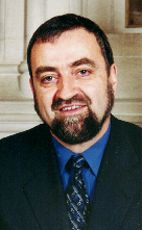
House of Commons photo

Crucial Fact

  • His favourite word was federal.

Last in Parliament May 2004, as Bloc MP for Lévis-Et-Chutes-De-La-Chaudière (Québec)

Lost his last election, in 2015, with 12% of the vote.

Statements in the House

Oceans Act June 10th, 1996

Mr. Speaker, I would like to find out something from the Chair about what has just been done. We have voted on Motion No. 1, one of the four making up Group No. 2. In Group No. 2, then, we still have Motions No. 2, 3 and 4, of course, and I would like to announce our intention to vote on these three in a different way.

Oceans Act June 10th, 1996

Mr. Speaker, we were speaking to motions in Group No. 2, on which the hon. member has already spoken, whereas there are still some speakers left on this side of the House who would like to discuss Group No. 2. I therefore respectfully ask you, Mr. Speaker, to recognize the hon. member for Richelieu, who would like to speak on Group No. 2.

Oceans Act June 10th, 1996

Mr. Speaker, the member who just spoke in this House tried to minimize the importance of our amendments and, before reacting to his remarks, I would like to react to the amendment brought forward by the government. I will remind the House that it is a motion to amend an act intituled An Act respecting the oceans of Canada.

There are, of course, three oceans. Quebec is particularly concerned with the Atlantic and its gulf. We can see that the bill is a new way for the federal government to try to and go even further in its attack on resources at all levels.

As a former member of the human resources development committee, I was surprised when I saw this legislation, when I saw that, even in the area of natural resources, the federal government had the same thing in mind, that is to ignore the provinces, particularly Quebec. Obviously Quebec's interests are our first priority, and we can see in this bill that the provinces are treated like municipalities or any community.

For the federal government, the national strategy is inspired by Captain Canada, the former Minister of Fisheries and Oceans, the one who admonished Spain and all that. It looks like the federal government has all the responsibilities. The government develops this plan and thinks that the opposition will sit idly and watch as this attack is going on on all fronts.

So, what does the Liberal Party's Motion No. 1 contain? Wishful thinking. A lot of it. This is what I would call a hypocritical move to make them look good. It is true that the notion of provincial governments has been included, but it is buried in amongst aboriginal organizations, coastal communities and other persons and bodies.

If the federal government truly wishes to respect provincial governments, let it show it by passing the motions proposed by the Bloc Quebecois, the official opposition, which really involve the provinces. Without some concrete action by the federal government, this motion remains a smoke screen.

What do we hope to accomplish with Motions Nos. 2, 3 and 4? We want it clearly included in the bill that the provinces of Canada must be able to exercise their jurisdiction with respect to oceans and their resources. Limiting the federal government's power by including and respecting the power of the provinces is the whole focus of the official opposition's efforts concerning the amendments to this bill.

Even if the motions are short, I think they should be read. They are being skimmed over as if it made no difference. Motion No. 2 proposes the following:

"WHEREAS the provinces of Canada also exercise legislative jurisdiction with respect to oceans and their resources,".

Motion No. 3 proposes:

That Bill C-26, in the Preamble, be amended by replacing line 15, on page 1, with the following:

"sources in concert with the provinces, taking into account the areas of jurisdiction of each level of government;".

Motion No. 4 proposes that Bill C-26, in the Preamble-we know how important the preamble is in the Constitution, and it is the same in acts-be amended as follows:

"and Oceans, in collaboration with provincial governments, with interested".

bodies.

We are presenting these motions because we know history often repeats itself. Quebecers feel that they have often been tricked by the federal government in the past. I am trying to think of an equivalent ocean image. I have one. Coming from the riding of Lévis, where MIL Davie is located, I would say that we have often watched others sail on by.

This time we will be vigilant, and we are saying that, through its amendments, the federal government is still trying to reinforce its role and steamroller ahead with centralization. All the people from the Gaspé, from the Baie des Chaleurs, from the Gulf and from the North Shore are asking the official opposition to defend them. That is what we intend to do in this House and in committee.

Copyright Act June 4th, 1996

Mr. Speaker, to the astonishment of the whip of the Liberal Party, the Bloc members still have some things to say about this bill, because it deals with culture.

As sovereignist Quebecers, we believe that culture plays an important role in the development of Quebec society. Even if the bill before us was introduced by the federal government, we still find it relevant. As the hon. member for Louis-Hébert reminded us, the time had come to follow up on the demands of the authors, creators, performers, all those who work on the cultural scene, the theatre people, the musicians, the writers.

It is extremely important for us, Quebecers, to have a legislation better suited to today's situation. This is also very important to us because our market is quite small. Quebec's territory may be large, but it is not always densely populated. That is why performers who become professional have the right, I think, to get the most from their high quality work, which is why, as a member of the Bloc Quebecois, I insisted on taking part in this debate.

I also noticed the interest shown by the hon. member for Louis-Hébert and, before him, by the hon. member for Quebec. They all come from the Quebec capital region, which is recognized and renowned for its cultural talents but which often loses its artists to other regions because of a poor standard of living or meagre retribution. We are all proud of Céline Dion, but not all artists are lucky enough to make a break on such a big market.

Therefore, this legislation is welcome. However, it has flaws that were mentioned by those who spoke before me. It must be said, however, that Bill C-32 is the second step of a review of the Copyright Act, which is almost 50 years old and which was amended in 1988. It had its shortcomings then and it still does.

We must remember that this bill provides a way to protect performers' and producers' neighbouring rights. A remuneration regime is also established in relation to the private copying of sound recordings and charges are imposed to manufacturers of blank cassettes. Exclusive distributors of books in Canada will be protected. A number of exceptions are added where no royalties or neighbouring rights can be claimed. And this is an aspect on which we have serious doubts, not enough, however, to vote against the bill, but enough for the Bloc Quebecois to argue in committee in favour of several amendments. We also want to propose amendments to existing legislation for improved collective management and civil remedies.

Neighbouring rights are rights that are recognized for recording artists and producers of sound recordings. Now, when radio stations air the works of these artists, the authors and composers receive royalties, but not the artists and producers.

In this bill, it is also provided that every radio station will benefit from a preferential rate of $100 on the first $1,250,000 of promotional sales. This means that, up to this amount, small radio stations will pay only $100. We think this is not enough.

Now there is the issue of exceptions. It is true that some community organizations made a case and that we cannot remain insensitive to their claims.

But as it is presently written, the bill provides for new exceptions. It does not provides for limitations, it adds exceptions. In this sense, it is not a step in the right direction. We will have to make adjustments here. The Copyright Act already provides for a few exceptions.

At present, there are exceptions concerning the use of any work for the purposes of private study or research; for the purposes of criticism, review or newspaper summary, if the source is mentioned; for the making or publishing of paintings and drawings; for publication in a collection, mainly composed of non-copyright matter, intended for use in schools, of short passages from published literary works in which copyright subsists. Bill C-32 adds many more exceptions for schools, libraries, museums and archive services.

To the exceptions already in existence, the bill adds, among others, the permission to use or make a copy of a work for the purposes of assignments or examinations; to make a copy of a work if its support is not of an adequate quality; to perform in public; to transmit sound recordings, television or radio programs by telecommunications within an educational institution; to make a copy of news programs; to make a copy of different programs and to retransmit them in educational institutions; the reproduction by libraries, museums, archives of works for the purposes of conservation; the permission for museums, archives and libraries to photocopy newspapers and magazines under certain conditions for their clients; the permission for museums, archives and libraries to do the above authorized work for other institutions.

It releases libraries, museums, schools and archives from their responsability for the reproduction of works made by individuals with their photocopiers. This means that a small sign will be put on photocopiers to ask people not to infringe on copyright.

It is like saying to someone in a library: "Please do not steal that bookM". I saw that once in a municipal library, and I was impressed. Well intentioned people, no doubt, had written, as a first rule: "Stealing is strictly forbidden". I found that extraordinary. This measure is similar.

We are saying to people that they can use the books and the photocopier, but that they should not use them in any way that would infringe upon copyright, of writers in this case. This shows how far the law goes. It shows the intent to legislate, but it also shows that we do not have the means to enforce the legislation.

An act can be very good, but if it is unenforceable and comes to rely exclusively on self-discipline, what use is it? That clause appears unbelievable to me. We should really amend it to avoid losing credibility.

What do Quebec writers and artists say? They were very disappointed by the exceptions provided. They say these exceptions are contrary to the spirit of the legislation, which is to protect copyrights and not deprive their owners of what legitimately belongs to them. They think that the legislator should have left users and collective societies negotiate the use of works, as is done with the Quebec Ministry of Education and the Government of Canada.

Since liberalization is pretty much in the air these days-no, dear colleague, not in the partisan meaning of the word-why not let people negotiate according to the market value principle? Those in favour of that principle should apply it to everybody, including artists.

I repeat, the great majority of artists do not earn millions. Sometimes people see Céline Dion or other big international stars and think that all artists are rich. Some have a few good years but like in the National Hockey League, careers are short. It is the same thing with the Liberal federal members-for example the government whip-whose career could very well be short. But that is another story.

In the interest of artists in Quebec and in Canada-I am sometimes told to stir up emotions in this House-we must reiterate our commitment and our sense of responsibility towards artists and writers.

Again, and I will conclude on this note, it is also important for francophones in Ontario. When I worked in that province with the Association canadienne-française de l'Ontario, I met excellent artists who will be very happy with the objectives of this bill. As for the means to achieve these objectives, this bill lacks teeth.

Before somebody breaks my neck, I will stop and make myself available for questions.
The Constitution June 3rd, 1996

Mr. Speaker, I am saying that what my colleague is talking about concerns the people of Newfoundland. It was their decision to make, and that is what they did. Once the referendum results were known, their elected government, supported by the leader of the opposition and the leader of the third party, came to Ottawa to ask the Parliament of Canada to recognize the decision legitimitely made in their province. That is the only possible answer to such a question.

The Constitution June 3rd, 1996

Mr. Speaker, I have two points to make with respect to the hon. member's question. First, she talked about the consultation of the groups affected by the measures. Is there a better consultation than the one in which people old enough to vote are first called upon to take part in the debate and then to vote?

This is not a neighbourhood consultation about a school. It is a consultation about an education systen for the whole province. And it has been done. As for us, we are fully satisfied with the consultation aspect because the province of Newfoundland used, in my opinion, the best consultation tool of all: a referendum.

Newfoundland is concerned with the rights or the claims with regard to the denominational aspect. I believe that this is none of our business and that we should stay out of Newfoundland's affairs. Similarly, Quebecers would not like that Newfoundlanders get involved in the discussions about such arrangements in Quebec.

But since the hon. member is asking me, I will say that I saw in Newfoundland's proposal measures to let the different denominations express themselves. Therefore, any group of people can have access to its religion in its school board or school if it is large enough.

The Constitution June 3rd, 1996

Mr. Speaker, it is my turn to participate in this debate on the motion requesting that the Newfoundland government be authorized to modify its education system through a constitutional amendment, as provided in section 43 of the Constitution.

Members of the Bloc Quebecois support that motion, for two main reasons for this. The first one is very important; it is the fact that we are in a democracy. We believe in democracy and the Newfoundland government presented us with the results of a referendum held democratically and in accordance with recognized rules.

We think that we do not have to agree with the reservations expressed concerning the question. The Newfoundland government, the elected members of the legislature discussed that question. There was a debate, there was a yes side and a no side. Everyone had the opportunity to vote. There was then a result and we, of the Bloc Quebecois, because we are democratic, recognize the result of that vote. The issue is not the final result. When a referendum is recognized, it is the 50 per cent plus one formula, as in the case of the Maastricht treaty, and many referendums held around the world. The democratic rule is 50 per cent plus one.

That is why we, of the Bloc Quebecois, support wholeheartedly the Government of Newfoundland on this issue. Moreover, in the speech he made earlier, the member for Trois-Rivières was reminding us, rightly so, that the Government of Newfoundland is one that can be used as a model with regards to referendums.

First of all, it is the only province that entered the Canadian Confederation after holding a referendum on the issue; I should say two, because there were two. The result was narrow in the first one, so the debate continued the following year, in 1949, and there was another referendum. The people of Newfoundland voted and asked the rest of Canada to accept them in the Confederation. That was done democratically. We have nothing to say on that. That is fine, it was in response to the wishes of the people.

So, this time, the people of Newfoundland decide also democratically to hold a referendum on an issue they consider important, an issue that was causing division within the province; they decide to hold this referendum to change their education system. We support that, of course.

The second reason is that-we sovereignists read the Constitution, we know what it is all about, because we have had to put up with it long enough, we know it by heart-section 93 of the Constitution says: "In and for each province the legislature may exclusively make laws in relation to education". To Quebecers, exclusively means that this is none of our business, it concerns the people of Newfoundland, the men and women of Newfoundland. It is neither for Quebecers nor for the residents of other provinces to tell Newfoundlanders how to manage their school system.

The objectives put forward seem logical to us, Bloc members, and we agree. But it is not because expenditures are being reduced or because a structure is being amended in such and such a way, but because this is exclusively under provincial jurisdiction.

We would not appreciate people from Newfoundland or other provinces telling Quebecers and the Government of Quebec what to do in matters of education. Each time the federal government tries to interfere-and it has no compunction about doing so in this area-we remind it that it does not have jurisdiction, we do. We have a consistent approach to the principle included in the Constitution, which says clearly that it is up to Newfoundlanders to define what they wish to see in their school system. However, we do have some reservations concerning the protection of the French speaking minority's rights.

I want to make it clear right away that, according to statistics, there are 2,680 francophones in Newfoundland, which constitutes 0.5 of the population, spread here and there across the island and also in Labrador. When I hear people say that we must oppose every change, every amendment, it sounds as if all of a sudden we had to protect the major progress the province of Newfoundland has made with regard to protecting the French speaking minority.

I remind hon. members that there is no French school board in Newfoundland. None. Besides, there is only one entirely unilingual French school, only one. Other francophones are distributed among four other bilingual schools. What is it exactly we want to protect? I was about to say next to nothing, but that is the situation such as it is. There is only one school where all the students are French speaking.

When the Leader of the Opposition met with Premier Tobin, he voiced his concerns about the situation and hoped for some improvement. Mr. Tobin said: "Yes, but things are better than they used to be, since we will now have a committee made up of three individuals with a specific mandate to try to improve the situation of French speaking Newfoundlanders in terms of education".

Since the measure respects the Constitution and is to our liking, although we would like it to be more explicit, and since the final legislation to modernize the system has yet to be passed, we are confident that Premier Tobin will protect the rights of the French

speaking minority, just like Quebec did with its English speaking minority. We would like him to go even further and to recognize more than one school. I will not start giving names, but there are 2,680 francophones. So, we would like more schools to be recognized and greater participation of francophones in the school boards. This is what we want.

But there is something else. I have been following the debate for a while and, in fact, the phenomenon goes back to the debate on Bill C-33. All of a sudden, two members were excluded from the Liberal Party, or left of their own will, and became independent. More and more often, the Liberal government lets its members vote freely. This, in my opinion, is the symptom of a routed government, a government that does not know where it is headed and that tries to please all its members. It lets its members speak freely. If we push it a little further-because apparently some 50 Liberal members do not agree with this motion-the government would need the support of members in the two opposition parties to have its motions passed. It does not make sense any more.

The way things are going, one wonders if we still have a government and a prime minister. This Prime Minister says that all referendums are not equal, and his intergovernmental affairs minister agrees and says it depends. This is a double standard. In Newfoundland, any question goes, any result and any level of participation are acceptable. In Quebec, it is a different story. The Prime Minister has to agree with the question. He wants to determine the majority needed to win a referendum. Sometimes he compares our province to a rod and gun club. He noticed that the bylaws of such clubs in Quebec-so he saw back home in Shawinigan, where he goes only in the summertime-provide for a 66.66 per cent majority. He kind of likes that, and he would want to force that on Quebec, but not on Newfoundland.

In Newfoundland, 50 p. 100 is good enough. That is unbelievable. The inconsistency of this government is just unbelievable. But in Quebec, it wants to be tough and object to everything. It goes as far as supporting Guy Bertrand, who wants to take away from Quebecers the right to self-determination. That will never be tolerated.

The Constitution June 3rd, 1996

Better than anywhere else.

Supply May 30th, 1996

Mr. Speaker, we need to remember a few things. The government whip got carried away. He began by talking about numbers, but these same people who tell us about numbers also tell us that, right now in Canada, one child in five is living under the poverty line. One child in five. He spoke to us about the rate of unemployment, which has dropped slightly since the Liberal Party came to power.

However, what he does not say is that the welfare rolls jumped by 40,000 in Quebec because of the UI cuts. This government has cut spending on social programs by $7 billion since coming to power. Seven billion is not negligible.

He boasts that the government has managed to reach its budgetary targets, but how? By slashing social programs, particularly UI.

I would like to ask him the following question: concerning the GST, if the government was so good at keeping its promises, such as those in the red book, we heard the Prime Minister, during the debates and on television, and it was reported in the papers, say that he would scrap the GST, meaning eliminate it. Eliminate does not mean replace or change.

Soon after this promise, the Deputy Prime Minister said that if they did not eliminate the GST, she would resign. And she did. But she is running again, and says she will be re-elected. The Liberal whip is no doubt well aware of what it will cost to clear her reputation and show that she kept her promise to Canadians. We will perhaps see her again in the House, and I hope we do. I am not

opposed to her coming back, of course, that is up to the people in her Ontario riding and has nothing to do with me.

So what does he think of that? That is good enough, you break your promise, you resign, you run again in a byelection, you come back, and there you go, everything is taken care of? I would like to have his comments on that.

Supply May 30th, 1996

There are also one million poor children.
