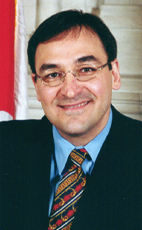
House of Commons photo

Crucial Fact

  • His favourite word was well.

Last in Parliament May 2004, as Liberal MP for Outremont (Québec)

Lost his last election, in 2011, with 24% of the vote.

Statements in the House

Youth Criminal Justice Act February 4th, 2002

Mr. Speaker, the amendment proposed by the Senate is based essentially on the declaration of principle in clause 3 of the bill. It is in accordance with the vision of the legislation. There is a similar provision at this point in time in the criminal code.

Youth Criminal Justice Act February 4th, 2002

Mr. Speaker, again I will be precise. The bill does not come back to the House. It is the amendment that comes back to the House.

Regarding the question of the government listening to people and being open minded about the bill, I remind the House that the process started in 1995 with some amendments to the legislation. We then proceeded with Bill C-68 in March 1999 and Bill C-3 in October 1999. Before those bills were introduced we proceeded with a full hearing across Canada by a standing committee of the House which tabled a report in 1997. After that the bill came before the House. We are talking of course about first reading, report stage and third reading. Altogether we have been discussing the bill in the House for almost 19 hours.

When we compared Bill C-7 to Bill C-3 we went through over 160 amendments. If opposition members have been unable to make their point with all this discussion they will never be able to.

Youth Criminal Justice Act February 4th, 2002

Let us take, for example, the issue concerning 14 to 16 year olds. It is true that for some presumptive offences the age will be lowered to 14 years, although a province may maintain it at 16. This is a good example of flexibility.

Youth Criminal Justice Act February 4th, 2002

Mr. Speaker, again, I understand that the opposition parties would like the bill to come back in its entirety before this House but this is not the case.

What is coming back before the House is a very specific amendment that we have to deal with, an amendment that we support.

With regard to the issue of the flexibility of the legislation, the bill is in its third reincarnation, if I may use this word. It has been the subject of 160 amendments. It includes a declaration of principle that deals first and foremost with the rehabilitation component.

Principles in clause 3 are found throughout the bill. There is flexibility everywhere in the bill.

Youth Criminal Justice Act February 4th, 2002

Mr. Speaker, let us be clear one more time. We are talking about an amendment coming from the Senate.

The point raised by the hon. member is interesting. Some members say the bill is too flexible and soft. Others say it is too rigid. In Bill C-7, which will not come back to the House, we find a balanced approach which focuses mainly on the rehabilitation of young offenders. That is what we believe in.

Youth Criminal Justice Act February 4th, 2002

Mr. Speaker, we must be quite clear about the situation we are facing today. The debate must focus on the amendment coming from the Senate, not on the bill. The bill is not back in the House. It has been voted on.

Yes, I have talked to some of my counterparts, people who have been working in the field at the provincial level and some ministers. Yes, the Canadian government is involved in the funding. Agreements have been signed with the vast majority of provinces across Canada.

Youth Criminal Justice Act February 4th, 2002

Mr. Speaker, I have already said several times before that the procedures developed throughout Canada over the years are derived essentially from the same piece of legislation. It is true that some provinces have developed a more forward looking approach. Quebec has an excellent one and Bill C-7 has borrowed heavily from it. British Columbia is another province that has had good results and meets the goals of Bill C-7.

As to the need to deal with the bill right now, we know that actors in the field are examining the bill and want to proceed with the implementation of this legislation based on rehabilitation. I will get a chance later on to talk about the number of hours opposition members have had to discuss this bill.

Youth Criminal Justice Act February 4th, 2002

Mr. Speaker, as has been mentioned by the hon. colleague, if we look at Bill C-7 and go to the declaration of principles, which is where its foundations are, we will find reference to the question of native people across the land and how we must act with regard to young native people.

The amendment before the House today which was referred by the Senate would ensure we considered the question of native people during sentencing. If we look at paragraph 18.2(e) of the criminal code we find more or less the same principle.

Youth Criminal Justice Act January 30th, 2002

moved the second reading of, and concurrence in, amendment made by the Senate to Bill C-7, an act in respect of criminal justice for young persons and to amend and repeal other acts.

Mr. Speaker, I am pleased to take part in this debate today. I hope that, following the vote on the Senate amendment, we will finally start the implementation phase of the youth criminal justice bill and we will all be able to appreciate the merits of Bill C-7.

As I just noted, after careful study and reflection the Senate adopted one amendment to Bill C-7, the youth criminal justice act, before it passed third reading in the Senate on December 18, 2001.

The House of Commons now has an opportunity to consider and vote on this amendment which relates to the serious problem of the overrepresentation of aboriginal youth in custody. Canada generally incarcerates youth at higher rates than all other western countries and its incarceration rate for aboriginal youth is even worse. The overrepresentation of aboriginal people in custody was an issue identified in the Speech from the Throne and is one that the government is committed to address. I therefore urge members to give serious consideration to voting in favour of the amendment.

The amendment proposed by the Senate adds a sentencing principle that is essentially the same as the one in paragraph 718.2( e ) of the criminal code. The courts will be equired to take into consideration alternatives to incarceration for all young offenders, aboriginals in particular.

This amendment is in line with the current provisions of the bill, which provide that incarceration should only be imposed as a last resort and that measures should be proportionate and appropriate to the needs of young people, in particular those of young aboriginals. The amendment also reflects the content of a provision that is already included in the criminal code in the case of adults.

It is disturbing to see such a large number of young aboriginals in detention centres. While some young aboriginals do commit serious and violent offences that may justify the imposition of stiff penalties, detention is often imposed, even for less serious offences.

Some theorize that the current system uses custody as an alternative means of addressing social or medical problems and not because the seriousness of the offence requires it. If a youth comes from a dysfunctional family or problem community, some may feel that custody will give the youth needed structure and support. If a youth has a medical condition, some may believe that a secure, structured environment is warranted. Using the criminal law power to address social and medical conditions results in a young person being punished because of his or her needs. This is simply not fair. Needs should be addressed when the youth is subject to a youth justice sentence, but they should not be the reason for more intrusive or longer sentences than the offence requires.

The sentencing principles stated in the legislation correct this situation. The principle of proportionate accountability sets the limit of a measure taken under criminal law. Within that limit, every effort will be made to meet the needs of young people. Other responsible authorities, including child protection services and children's mental health services, should be involved in the whole process, on a long term basis if necessary.

The sentencing principles and the amendment proposed by the Senate also promote the imposition of community-based sentences, while reserving incarceration for those who commit the most serious offences. Studies show that the most effective sentences to change a person's behaviour are community-based, particularly when both the family and the community are involved.

The declaration of principle in the Youth Criminal Justice Act already expressly recognizes the needs of young aboriginals. This recognition will impact on how the provisions of the act will be applied to young aboriginals.

Bill C-7 provides the legislative framework to promote constructive approaches to very difficult youth crime problems. For example, the legislation permits key decision makers in the system, like police officers, judges and correctional workers, to hold conferences to support them in making decisions.

Conferences can take many forms, but they often embrace restorative justice concepts and encourage the offender to meet with the victim, family members and community members. The youth is no longer a passive observer but hears first hand how his or her behaviour has harmed others and the community. This helps to teach young people about the consequences of their behaviour. They are participants in determining how to carry out their measure of accountability for their wrong in a way that makes sense to the victim, the community and themselves. Conferencing may have a particular resonance in some aboriginal communities because it is consistent with some traditional practices.

The amendment proposed by the Senate and the new act will provide a framework that will promote a fairer justice system that will be better suited to young aboriginals' needs.

We should accept this amendment and implement Bill C-7.
Young Offenders January 30th, 2002

Please allow me to finish. They are trying to oppose a bill that would make diversion possible. They are trying to oppose a bill whose primary focus is rehabilitation. They are trying to oppose a bill that will now prevent referral to an adult court, which is becoming increasingly frequent in Quebec. I find this quite appalling.

In conclusion, it is not the bill which is before the House but an amendment concerning aboriginal youth. I would like—
