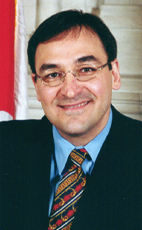
House of Commons photo

Crucial Fact

  • His favourite word was well.

Last in Parliament May 2004, as Liberal MP for Outremont (Québec)

Lost his last election, in 2011, with 24% of the vote.

Statements in the House

Canada-U.S. Border December 13th, 2001

Mr. Speaker, yesterday we signed an agreement with the United States with regard to the shared border. We call it the smart agreement for a smart border. The first concrete action has been the re-opening of Nexus as a pilot project in Ontario. It is a very good concrete step toward helping the free flow of goods and people across the land border. The next step will be waiting for the report on the joint evaluation of the program. Of course we would like to expand the program as soon as we can.

National Security December 13th, 2001

Mr. Speaker, first what the hon. member is talking about is the notion of reverse pre-clearance. He is referring to the question of the commercial relationship between the two countries. I am pleased to report in the House that we have made a lot of progress in reopening exit and access.

He should talk about the first step we have to undertake which is to get involved in a joint project in regard to customs self-assessment with businesses.

We on this side of the House signed the first pilot project last week. We intend to get involved in the pilot project in order to make sure that we keep a good relationship with the United States on the commercial side as well.

National Security December 13th, 2001

Mr. Speaker, first of all I would like to congratulate my colleague from external affairs who signed a wonderful agreement in order to make sure that we will put in place a smart border.

We are making a lot of progress and of course what the member is referring to is the notion of what we call the customs pre-clearance.

I would like to repeat one more time in the House that we have this in place at international airports. We have been able to come to an agreement with the United States in order to make sure that their duty will be fulfilled on Canadian land without having any sidearms. We intend to keep going that way.

National Security December 12th, 2001

Mr. Speaker, the Minister of Foreign Affairs and I are saying the very same thing. This morning we signed an agreement to make sure that we will have, jointly with the United States, what we call a smart border, using more technology.

What the hon. member is referring to is the notion of customs pre-clearance. That exists in Canada. I have said many times that it exists at international airports. The U.S. customs officers are doing their work without sidearms, using local police forces. It works very well.

The Budget December 12th, 2001

Mr. Speaker, this gives me the occasion to remind the House that a wonderful agreement and working plan was signed this morning. It will allow us to keep going and make progress in order to make sure that we keep the border open to trade while offering a very safe society.

Of course the hon. member is referring to the notion of customs pre-clearance. That exists in our country. It has been put in place at the international airports. It works well and U.S. customs officers are working without any sidearms.

Air Transportation December 12th, 2001

Speaking of customs preclearance, I would just like to point out to the House that we already have this in Canada, particularly in the international airports, for preclearance of U.S. customs.

The Americans are doing this in Canada without firearms, essentially by making use of local police forces. This has always worked out well and they have always done an excellent job.

Obviously, we are going to start discussing the matter of preclearance at border crossings. An excellent agreement was signed this morning, one that is in fact an excellent working plan. We are going to continue with a view to improving our border—

Government Grants December 10th, 2001

Mr. Speaker, there are so many questions in the question that I do not know exactly who it is directed to.

As far as Canada customs and revenue is concerned, the question of information about the tax file is confidential. I refer the hon. member to section 241 of the Income Tax Act.

Government Grants December 10th, 2001

Mr. Speaker, with regard to the question that maybe would be directed to the Canada Customs and Revenue Agency, we all know that we cannot comment on any cases with regard to taxes because they are confidential matters. I just refer the hon. member to the Income Tax Act, section 241.

Auditor General's Report December 5th, 2001

Mr. Speaker, that problem was there and has been there for decades. That problem was there when the Conservative government was in power back in the 1980s. It closed its eyes on that problem, which affected our tax base.

We on this side of the government have been able to fix the problem in consultation with the finance department and the whole industry. Actually, those people will have to pay their dues to Canadian society.

Tax Conventions December 5th, 2001

Mr. Speaker, we have more than 70 such conventions, the purpose of which is to prevent double taxation.

What the auditor general basically says in her report is that we did intervene. We were vigilant. She even mentioned certain cases where our intervention produced extremely good results. She also admits that when we had to amend the legislation in the past, we did so.

In this case, if we must intervene to amend the convention or the legislation, we will do so to protect our tax base, as we normally do.