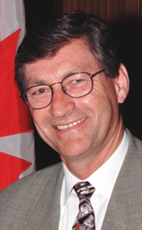
House of Commons photo

Crucial Fact

  • His favourite word was business.

Last in Parliament October 2000, as Reform MP for Edmonton Southwest (Alberta)

Won his last election, in 1997, with 51% of the vote.

Statements in the House

Petitions May 19th, 1995

Mr. Speaker, I have the pleasure to present this petition. It is signed primarily by residents and citizens of the Paradise Valley area of Alberta.

They would draw to the attention of this House the fact that they are very concerned about our streets being made safer for citizens and are opposed to the current practice of early release of violent offenders prior to serving the full extent of their sentences.

Supply May 18th, 1995

Mr. Speaker, if I left the impression with the hon. member that I thought the people of Quebec and the Bloc were here as beggars that certainly was not my intention. I do not think that is the case at all.

Bloc members are hard bargainers. The people of Quebec have been very skilful in using their balance of power and their electoral might for many years in extracting far more than their just rewards from their association with Canada.

The people of Quebec have done very handsomely by their association with Canada. The member speaks of the 50:50 cost sharing in health care. Let us talk about Canada assistance. The province of Quebec gets 70 cents of every dollar spent on welfare. Ontario gets 50 cents and Alberta and B.C. get 50 cents.

How is it that the province of Quebec is considered a have not province when it does not factor in its great and magnificent resource of hydroelectric power? The petrochemical resources of Alberta are factored in. Last year the province of Quebec received $3.5 billion in equalization payments. Alberta has contributed in the last 40 years something in the area of $100 billion toward equalization payments. Quebec has benefited by about that amount.

Therefore, for any member of the Bloc or any other member from Quebec or anywhere else to stand and say that Quebec has done poorly by its association with the rest of Canada is just denying reality.

If Quebec were to decide, in its wisdom, to leave the federation, it would be hurt dramatically because every nickel that has been going to Quebec to subsidize and protect Quebec industry or in direct cash transfers would come to a crashing halt. The people of Quebec have to understand that. They have to be looked square in the eye and told that if they decide to leave this country we are going to leave our cheque book right here at home locked safely in the drawer.

Supply May 18th, 1995

Mr. Speaker, I thank the member opposite for the question. I agree the underlying thought behind the motion is an opportunity to advance the cause of separatism in the House.

It must be extremely frustrating for members of the Bloc to have come to the House resolved to work faithfully to taking themselves out of the House. The more time they spend here, the more at home and comfortable they feel. The more time the Bloc spends here, the more time the members representing the people of Canada in Quebec spend here, the more it is indicative the country is very welcoming to everyone.

I have a great deal of empathy toward the members of the Bloc. Members of the Reform Party came here under much the same cloud as members of the Bloc. We were expected by members of the central Canadian media, by the people of central Canada, to be some sort of monolithic neolists with our knuckles dragging on the ground.

Members of the Bloc and members of the Reform Party were supposed to be fighting in the lobby. Much to everybody's surprise they found out that we probably have far more that unites us than separates us. The members of the Bloc came here and got involved in what they did out of frustration with the way the country is run. They felt left out of the affairs of the nation and the fact that nothing ever changed.

That is precisely the reason I am here today as well. As we have been here for the last year and a half we have come to know more about each other. We are going to be able to ask the big question that is going to come, that is going to be asked in Quebec.

It is my wish, desire, hope and feeling that no matter how the question is posed in Quebec, its people will decide to remain with Canada. Those of us in the House will put it behind us. That is my desire, my wish and everything I do will be to that end.

Supply May 18th, 1995

Mr. Speaker, before question period I was speaking generally about Quebec's financial demands not being a new topic for the House. In the year and half I have been here Quebec's financial demands have been front and centre every day.

It seems odd the Bloc would raise this as an opposition motion in the knowledge that Quebec has done very well by being a member of our great country over many years. It seems passing strange that it would want to leave.

It is also a tragedy that most members of the Bloc seem to think the relationship between Quebec and the rest of the country is primarily financial. To the vast majority of Canadians

the relationship between Quebec and the rest of the country is far more than a financial arrangement; it is spiritual, a relationship among friends, brothers, relatives and family.

I recently introduced my son to Quebec and invited the people of Quebec and in particular members of the Bloc to venture west and east to see for themselves that Canadians are welcome in all parts of the country. Quebecers are welcome in the rest of Canada and the rest of Canada in Quebec.

Whether members of the House liked former President Reagan or not, they will appreciate that President Reagan was widely renowned for his masterful use of the media and his ability to express thoughts and put complicated thoughts into every day simple language. He was a master manipulator of the media. People have to admit that.

It was passing strange that he had a portrait of Calvin Coolidge in the cabinet room. Calvin Coolidge was regarded as the president who had perhaps a most acerbic wit. He would never say in three words what could be said in one word and was generally regarded as a man of very few words.

President Reagan had a portrait of Calvin Coolidge in the cabinet room because of Coolidge's ability to put very pithy comments in very few words. I will deal specifically with what Calvin Coolidge had to say about people, about responsibilities and how we relate together as a society and what the role of government is.

Calvin Coolidge said: "The people cannot look to legislation generally for success; industry, thrift, character are not conferred by act or resolve. Government cannot relieve from toil. It can provide no substitute for the rewards of service. It can, of course, care for those who need care and recognize distinguished merit. The normal must care for themselves. Self-government means self-support".

If we were to extend that the country would benefit greatly if we would start to think in terms of self-reliance and self-support. All provinces, all regions, rather than looking to the federal government and asking what is in it for them should be asking what they can give to the common good of the country after they have looked after their own responsibilities.

Unless we are first able to look after ourselves how can we presume to look after our neighbours? If we cannot first look after our own province how can we presume to look after other provinces? We need to be self-sufficient as individuals, we need to be self-sufficient as communities, we need to be self-sufficient as provinces. This will inevitably lead to self-sufficiency as a nation and to the further strengthening of the nation into the future; in my fondest dreams, desires and wishes, a nation united, with Quebec very much a part of the greater Canada.

Cultural Policy May 18th, 1995

Mr. Speaker, we will try again with perhaps the heritage minister or the Minister of Industry.

Canadians have made it very clear: we support choice and competition. These should be the guiding principles of a cultural policy. Instead, it would appear that the Liberals favour competition when it benefits the Liberal family compact.

Why is the minister sacrificing Canadian artists, Canadian jobs, and consumer choice at the altar of Canadian cultural isolationism?

Cultural Policy May 18th, 1995

Mr. Speaker, the American government is developing a hit list of Canadian communication and entertainment companies in retaliation for Canada's policy of cultural isolationism, a policy that has already denied Canadian country music artists a worldwide audience via country music television. Now Much Music and Teleglobe are among companies who may be sacrificed with this isolationist policy.

My question is for the Minister of Canadian Heritage. Can the minister deny that this government's anti-competitive cultural policies will cost Canadians jobs and Canadian country music artists worldwide exposure?

Supply May 18th, 1995

Madam Speaker, we are speaking today on the opposition motion of the member for Mégantic-Compton-Stanstead regarding Quebec's financial demands. This should not be the greatest surprise we in the House have ever had when speaking to a Bloc supply motion on Quebec's financial demands, especially for those of us who come from Alberta, British Columbia or Ontario who have been well versed in Quebec's financial demands for quite some time.

The motion we are debating is at the core of discussions concerning why the Bloc is in Parliament in the first place. It is a sad situation. The vast majority of Canadians look to Canada as a home and a federation of 10 provinces because we are Canadians. We do not boil the reasons for being Canadian down to the bottom line on a balance sheet asking what is in it for us.

Many times when members of Parliament are debating in committee the Bloc Quebecois-in fairness it is doing exactly what it said it would do-is thinking solely about any policy or law as it directly relates to Quebec. The question for them is always how to protect what we have already while at the same time perhaps getting a little more, wanting complete independence but ensuring we get all the support we have had in the past and what we may want in the future.

To be spending a day of debate in the House on this motion is not a major surprise. The Reform Party came to Parliament with basically one overriding priority, to put the financial affairs of the nation right. The overriding priority of many people who supported the Reform Party and I am sure the government and the Bloc as well was to get our financial affairs in order.

That should still be the number one priority of Parliament. It must be the number one overriding priority of our colleagues from the Bloc.

When I say financial affairs I mean everyone in Canada including in Quebec. Unless we get our financial affairs in order what will we be left with? What is the point of having an independent bankrupt Quebec? There is absolutely no point in it. The whole notion of splitting the country and expecting the haves to have the same critical mass and to be as successful as we are as a combined unit is crazy.

There are areas which would benefit right off the bat, for instance those parts which have through equalization payments been pouring billions of dollars eastward, much of which found a home in Quebec for many years. We are not talking about sovereignty association, we are not talking about splitting up the marriage but retaining bedroom privileges. We are talking about a new house, a new street, the whole shebang. Would the people of Quebec think for one minute that equalization payments or transfer payments from the rest of the country would continue to flow into Quebec? Of course not.

Conversely, all the benefits Quebec brings to the country would also be denied the rest of the country. That is how we would be hurt dramatically by this notion of our colleagues and friends from the Bloc who would want to take Quebec out of Canada.

I have been talking about the financial implications because it is the gist of the Bloc's motion, the financial implications of Quebec in Canada. The bias of the motion, the bias of the Bloc is it wants to make darn sure it will get more out of it and not lose anything even if it splits.

If we go beyond the bottom line on the balance sheet and talk about what will happen to the country if Quebec takes a hike, the costs will be far more than financial. It will cost us a tonne in terms of our own sense of self-worth. It will cost us dramatically in terms of what it means and what it is to be a Canadian, the culture we share together. That we have been able to nurture in an island the French fact in North America in a sea of almost 300 million people, that we have a vibrant, strong, successful, exciting Quebec and French culture here in our midst would be lost.

A separate Quebec would find itself very quickly becoming far more worldly in its outlook and far more accommodating to speak the language of whomever would come in to spend money.

Since I have been living part time in Ottawa I have, as often as possible, taken the occasion to vacation and spend weekends in Quebec, particularly in Montreal. I have come to cherish the time I spend there. A couple of weekends ago one of my sons visited from Vancouver. I am trying to persuade him to go to university in Montreal. I want him to have a sense of what our country is all about. Quebec and the French fact and the Quebecois are so vitally a part of our collectivity as a nation I feel if he did not partake in that he would be losing something in his life.

He lives in Vancouver. We went to Montreal and he had some trepidation because although he has taken French in school for about nine years he cannot speak a word of French. If we do not use it we cannot learn it. He wondered how he would be received as an English speaking Canadian. He is 17 and he was a little nervous about it. Every experience he has had and I have had has been one of complete comfort. People bend over backwards to be accommodating, kind and generous.

That weekend in Quebec turned his mind around. I wonder how many unilingual French speaking people in Quebec who have travelled to other parts of Canada have been treated with the same compassion, understanding, care and politeness. I wonder if we could get more people to look beyond the balance sheet of what it is to be a Canadian and to look at the value of what English Canada and Quebec bring to this united body.

I ask Bloc members to consider what I have said as this great debate unfolds.

Canada Elections Act May 16th, 1995

That would still be 130,000 votes across the country. As an hon. member opposite mentioned, why not higher? If it is the will of this House either in committee or in debate that it should be higher, that could be considered. In my view, 2 per cent was high enough that it was a hurdle but low enough that it was possible to achieve.

I wish to reiterate the intent is not to prevent new parties from getting going. The intent is in keeping with the spirit of the Electoral Reform Commission to ensure hurdles are in place to protect the public purse, to ensure that genuine political parties are able to benefit from the very wise intentions of those that preceded us in this House.

I ask hon. members opposite to give this bill their consideration and support. It may save us somewhere in the region of $1 million, which for most Canadians is quite a lot of money. For the federal budget, it is not that large an amount. However, it is not just the amount, but the principle we are talking about.

Canada Elections Act May 16th, 1995

Madam Speaker, here we were in the middle of the election campaign surrounded by yogic flyers.

That would have been great, except that when the election was over I checked into it. They received a grand total of 84,000 votes in the last election, .6 per cent of the total votes cast. They also received $717,000 from the taxpayers of Canada in reimbursement for their national campaign expenditures. It worked out that the taxpayers of Canada reimbursed them $8.41 for every vote cast. They spent $37.38 for every vote they received, which is their business. It did not make sense to me that the taxpayers of Canada should be subsidizing what really is not a political party.

The intention of having the national campaign party reimbursement was to ensure that national or regional political parties had some income between elections. It was intended to

keep them going. National or regional political parties are necessary for the lifeblood of the country.

In looking at the campaign expenditures, we thought about how we would make sure the hurdle was low enough, so small that parties could get started yet high enough to be real. We came up with the figure of 2 per cent. Federal parties would have to have spent 10 per cent of their total allowable limit and also have garnered 2 per cent of the total votes cast. In the last election that would be something like 270,000 votes across the country.

Some with whom I have discussed this bill have suggested it might be appropriate to have a lower threshold. If that is the case, I would be quite happy to consider amending this bill to have a lower threshold, perhaps 1 per cent.

Canada Elections Act May 16th, 1995

moved that Bill C-319, an act to amend the Canada Elections Act (reimbursement of election expenses) be read the second time and referred to a committee.

Madam Speaker, this is a very straightforward bill. It intends to put one more very small hurdle in the path of registered political parties before they are eligible for reimbursement from the public purse. It would be a hurdle similar to the one that is in the path of individual candidates. When individual candidates run in a particular riding, the candidate is required to have 15 per cent of the total votes cast in that constituency before the candidate is eligible for reimbursement from the public purse.

Reams and volumes of books have been published over the years on election financing in Canada. The stack is quite high. It all has to do with financing elections in Canada and ensuring that financing is straightforward and transparent. It ensures that candidates who are able to run in elections come forward to represent their constituencies without having to be independently well off.

The election financing rules are intended to ensure that candidates are not bought by individuals. That is why there are limits on campaign expenditures. That is why there is full disclosure on funding of individual and national campaigns.

The bill speaks only to the national campaigns. It was motivated during the last election when I found myself, as everyone in the House did, in the situation where there was a cacophony of candidates representing quite a wide variety of platforms.

Perhaps the most outrageous was the platform of the yogic flyers. While the debates were going on I wondered what yogic flying had to do with running our country and what yogic flying could do to get our country out of debt and make our country work better. At first I am sure many people thought it was a joke. We certainly do not want to dissuade anyone from running and getting involved in politics. And perhaps yogic flyers do have the answer to Canada's problems.

I wish to inform the Chair that it is my intention to share my time with my colleague from Okanagan Centre.