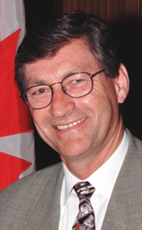
House of Commons photo

Crucial Fact

  • His favourite word was business.

Last in Parliament October 2000, as Reform MP for Edmonton Southwest (Alberta)

Won his last election, in 1997, with 51% of the vote.

Statements in the House

Budget Implementation Act, 1995 March 30th, 1995

Mr. Speaker, as always when the hon. member opposite is speaking the ears in this Chamber perk up. I say this quite sincerely because when my hon. colleague speaks, usually it is about something worthwhile and we can learn something if we listen. I would therefore most sincerely seek the counsel of the hon. member.

If we are looking at special interest groups and the financing of special interest groups via the public purse, certainly we in this House are no different from or worse than anybody else in that donations to political parties or campaigns receive a tax credit. We get beneficial treatment under the Income Tax Act as compared with another charity.

I would ask the member opposite to consider the following. If a private member's motion from the opposition were to come forward which would have the effect of ensuring that donations made to political parties would be subject to the same scrutiny and the same tax advantage as any other charitable donation, would the member opposite be supportive of such a move?

Budget Implementation Act, 1995 March 30th, 1995

Madam Speaker, I listened with interest as the member opposite was going through some Olympian hurdles and patting himself on the back for the marvellous job they did.

Reference to the Olympics would be fair and accurate because the Liberals do have this new Olympic sport. It is called low hurdles. No matter how tough it is, you can only bruise your shins going over the Olympic low hurdles of the Liberals.

We know we have to take some serious hits and Canadians by and large are prepared for it. They are anticipating it and want to do it. We do not want to leave a bankrupt country to our grandchildren. The essence is that it must be fair. If it is not fair, it will not meet with public acceptance on a broad base.

My specific question has to do with the fairness of the budget. It has to do with the Public Utilities Income Tax Transfer Act. How is it that this affects one province disproportionately, the province of Alberta? It affects Nova Scotia and Alberta, no other province in Canada.

The hon. parliamentary secretary said that the reason it is being cut is that it is not being passed along from the province to the individual taxpayer. Does it matter? Is it any business of the federal government what the provincial governments do with that money? It does not belong to the federal government; it belongs to the province.

The idea behind that tax was to ensure that all utilities were treated fairly. An enterprise that establishes itself in Nova Scotia or in Alberta has relatively the same base of taxes for its utility demands.

The hon. member's arm must now be relaxed after all that patting himself on the back. Would he speak to the fairness of two provinces, Nova Scotia and Alberta, being singled out for this punitive tax measure, which is $70 for every single homeowner in either province?

Criminal Code March 30th, 1995

Madam Speaker, I would ask for unanimous consent of the House to withdraw Bill C-303 which was the bill similar to the government's Bill C-72 on self-induced intoxication. Our party is firmly in support of the government's Bill C-72 and we do not need to debate this bill.

Canada Elections Act March 30th, 1995

moved for leave to introduce Bill C-319, an act to amend the Canada Elections Act (reimbursement of election expenses).

Madam Speaker, the intent of this bill is to amend the Canada Elections Act so that registered political parties would not receive reimbursement unless they met two thresholds. At present, the threshold is to have spent 10 per cent of the allowable election expenses. This bill would add another hurdle, that the party would have had to garner 2 per cent of the total votes cast as well as having spent 10 per cent.

(Motions deemed adopted, bill read the first time and printed.)

On the order: Private Members' Business

Second reading and reference to the Standing Committee on Justice and Legal Affairs of Bill C-303, an act to amend the Criminal Code (dangerous intoxication).

Firearms Act March 27th, 1995

Mr. Speaker, if ever evidence was needed that this debate is very highly polarized and charged probably with misinformation on all sides, it is in this debate today.

When I became embroiled in the whole gun control issue it was evident to me that the position a person would take on the debate depended at which end of the barrel that person was going to find themselves. We can see this in the House today not just on this side but on the government side and perhaps on the Bloc side, if they would speak on this.

Very clearly this is a debate on the bill which is charged emotionally and divides the country, as if we needed one more reason to be divided. This divides us on rural-urban issues rather than language issues, cultural issues or some other issue. Anyone who would suggest this is not a rural-urban issue has not been following it because very clearly it is.

Our country, as everyone knows, is thousands of miles across. All areas of the country are different. One rule of law on guns may not make sense in downtown Toronto but perhaps it makes sense somewhere else, either the maritimes or the prairies.

There is wisdom in splitting this bill and I urge the Minister of Justice to carefully consider this. It would be an opportunity for people from both sides of the House and from all over the country to come together on that part of the bill about which everyone agrees, namely those issues aimed directly at crime control, such as mandatory sentencing.

There are other aspects of this bill which concern most Canadians from that part of the country which is less enamoured with the whole notion of gun control. For example, there is the registration of handguns, which is already a fait accompli. We are supposed to be registering them now.

If anyone were to purchase a rifle or a shotgun today, it would be registered. There is nothing wrong with the notion of centralizing the registry of these weapons. Your name and address would be taken. There is no problem with that. It is the notion of a universal registration.

Before I get into the heart of what I want to talk about, I want to say that I am going to be voting against this bill despite the results of a survey I commissioned and which I believe to be accurate. Residents in my constituency, a majority of 69 per cent, would prefer to see universal registration. However, I am prepared to go against that in the full knowledge that this is causing me some grief.

Before I get into that, I would like to spend a couple of minutes to pay a particular vote of respect to two people for whom members may not expect to hear many kind words from this side of the House. They are Wendy Cukier and Heidi Rathjen from the Coalition for Gun Control.

When Heidi's friends and associates she went to school with were killed at the École polytechnique in Montreal, it caused her to do something. She wanted to rid our country of the kinds of weapons that caused that outrage and terrible massacre. We do not need automatic weapons in our country; we just do not need them. Many years ago she set upon this long journey to rid our country of these weapons. She enlisted the aid of Wendy Cukier and between them they formed the Coalition for Gun Control.

I would bet that they did not think they would ever have the sun, the moon and the stars all line up to find themselves with the Liberals in government wanting to address the issues of the people in the vote rich areas of downtown Toronto or Montreal. This decision was made in order to get elected. In my opinion it was not based on what was right for the country. It was a decision on what they could do to get elected. They appealed to people who, for good reason, were afraid of guns. The idea then became a red book commitment.

In some way that is unfair to the intent of Wendy and Heidi. They wanted to rid our country of the dangers posed by weapons and from the crimes involving the use of weapons. They wanted to focus attention on this. I do not think in their wildest dreams they ever expected everyone, no matter where they lived in the country, was going to be forced to register shotguns and rifles. In any event, this is the point we are at now.

By justice department estimates, it is going to cost $85 million to set up the national registry over a five-year period, plus a further $60 million if you accept the fact that there are six million long guns presently in the country. If that is the case, over five years it is going to cost $145 million to register guns. That is a modest estimate. Others say it will cost upward of $500 million or even more, but let us go with the low end at $145 million.

Our country is going into the hole at the rate of $110 million a day. We would be using money to register all of these weapons for which there is not one iota of evidence it will prevent one single, solitary illegal use or crime committed with a gun. The last time I checked, criminals do not get a permit nor do they register their guns. We will be spending $145 million so that some people, particularly those who wrote the Liberal red book can feel warm and fuzzy when they go to bed at night. That is not an honest or prudent way to run the country.

If there were a shred of evidence to prove that registering long guns would in any way prevent crime, then I would be most happy to support this bill. However there is no such evidence. We will then go to the money markets of the world and our children and grandchildren will be borrowing money and paying interest on that money and they will have a standard of living depreciated by the fact that we will be raising this money to spend on registering long guns. Imagine if we used that same money, the same $140 million over five years, for breast cancer research. Would that be a more efficient use of the $145 million?

It is not easy to stand here because I am not a hunter. I do not have a gun. I have not had a gun for years. I originally commissioned a poll in my constituency to buttress my argument within our own caucus. In so far as this is not a moral or ethical issue I am not bound by the poll. It was for guidance. I wanted it to buttress my argument. I wanted to have that argument buttressed within my own caucus so that when I voted against our caucus position I could say clearly this is why, I am representing my constituents.

In evaluating what I was doing here in Parliament over the last year and a half I came very clearly during the Christmas break to understand that I was here for three specific reasons: to restore fiscal responsibility to our nation; to put the rights of victims ahead of the rights of criminals; to restore the bonds of trust between the elected and the electors.

I cannot in conscience spend $140 million to accomplish something clearly not accomplishable through the expenditure of this money, and on one hand spend the money and on the other hand try to save it.

My constituents have very clearly sent me here to bring fiscal sanity to the spending affairs of our country. That is why I will regrettably vote against Bill C-68.

Criminal Code March 27th, 1995

Mr. Speaker, it is a pleasure to rise today to speak to this very important bill. At the outset I remind the House that I will be sharing the time with my hon. colleague from Wild Rose.

The Reform caucus supports the bill 100 per cent, without any question, without any equivocation whatsoever. We are solidly behind both the intent and the desire of the government in the bill.

The Minister of Justice in his comments spoke for quite some time and quite well about the notions of specific intent and general intent. He lost me after about five minutes with the various intents going back and forth. I guarantee that he lost the vast majority of Canadians when the whole issue of intent, specific versus common intent, was raised. That highlights the problem I would like to address in my comments today.

It took 15 minutes for the justice minister to use the words most associated with what should be common law in our country, that is common sense. Without the foundation or without the basis of common sense in law it does not really matter what happens because we lose everybody else.

The basic test our laws must meet is the standard of common sense. Before I get into addressing that I point out that a week before the Minister of Justice introduced the bill I introduced Bill C-303, largely based on Senator Gigantes' bill introduced from the Senate.

My bill is on dangerous intoxication which addresses the issue from the perspective already covered by the Minister of Justice. When the bill was drawn in the lottery I went before the committee of the House of Commons which was to make the decision on whether or not it would become a votable bill. My advice and my suggestion to the committee was that anything which could possibly impair the development of or hinder in any way the application of Bill C-72 should be withdrawn. The decision should be made by people in the Department of Justice who are far more qualified than I am to make such decisions.

As parliamentarians we do not want anything to confuse the issue. Our caucus is solidly behind the Minister of Justice when he says that intoxication is no defence and no reason to slide out from under personal responsibility for the results of one's actions.

The bill rests in kind of a limbo waiting to see what happens. If it is necessary or if there is a problem, there are other ways to address the issue which may not be as efficient or as good as the bill. The reason we have come to this point is that in the first place the Supreme Court of Canada misread the intent and where it is relative to the Canadian population at large.

We do not really have a problem with the common law statutes that existed prior to the Daviault decision. In my view we have a problem with the Supreme Court expanding the envelope of its jurisdiction.

The Supreme Court does not have the responsibility to make laws. The Supreme Court has the responsibility to interpret laws. If this were a single instance where the Supreme Court were seen to lose touch with reality, we could say that perhaps it had a bad day or perhaps it was having tea or sherry in a club and thought: "What can we do? How many angels will dance on the head of a pin? Why don't we get the Minister of Justice to dance around a bit to see how he responds to this bone headed decision?"

If it were in isolation we might be able to say that but the reality is that it is not in isolation. This is a consistent pattern the Supreme Court has laid down over the last few years.

About 10 years ago late Chief Justice of the Supreme Court, Bora Laskin, said: "The Supreme Court is a quiet court in an unquiet land". How things have changed as a direct result of the charter of rights and freedoms. The charter of rights and freedoms essentially says that individual rights in society are paramount. The Supreme Court is kind of between a rock and a hard place, which is why many of its decisions that seem to defy reality are split decisions.

If the Supreme Court does not defend the notion of due process-and by due process I mean dotting the i 's, crossing the t 's and making sure everything is done absolutely correctly-decisions would be overturned based on the charter of rights and freedoms or other considerations.

Meanwhile Parliament and the vast majority of Canadians are concerned with crime control and common sense. We have the Supreme Court on the one hand and the population and by and large parliaments assembled all across the land on the other hand. Somewhere in the middle, I suppose, is justice.

Recently the Supreme Court brought down a decision in which a woman arrested for impaired driving before she blew the breathalyser was allowed to go to the washroom. When she was in the washroom the woman alleged that she consumed more alcohol and that when she blew over the limit it was as a result of having alcohol subsequent to her arrest. Therefore they could not prove that she was driving impaired. The Supreme Court, in a move that defies logic, in a move that defies the last 30 years of trying to get drunks off the road, chose to say that the woman was innocent.

Recently the Supreme Court decided that someone arrested for impaired driving has x amount of time to find a lawyer of choice. If one is nailed for impaired driving, one is nailed for impaired driving. The benefit of the doubt rests with the potential victim: the innocent bystander who gets hit by a drunk. We are trying to stamp out drunk driving. We are not trying to figure out what is legal.

What about ordinary Canadians when laws come down from Parliament that are written for lawyers and not for ordinary people? They should not need law degrees to figure out what is right or wrong.

The Supreme Court may review debate in the House when the time comes to review the law again because it wants to get the judgment of the people. We in the House represent the people of Canada who are upset and disgusted with a Supreme Court that comes out with decisions such as it has recently. I want the Supreme Court to be cognizant of the debate. I want the Supreme Court to hear me speaking about it in the House of Commons, saying that average Canadians have gone beyond the point of being filled with contempt for it. People are just dismissing it.

If the Supreme Court continually comes out with decisions better suited for a faculty club, with no basis of reality, obviously the laws will not connect with people. It is like a municipal police force installing a new sign which says 60 kilometres an when everything is designed for 100 kilometres an hour. People will ignore the law, get tickets and feel resentful.

When the Supreme Court makes decisions that do not make sense it brings discredit and disrepute not only to the Supreme Court but to Parliament as well. That includes all members who were elected to represent the people.

It is the righteousness of law, the essence of law that ordinary people instinctively understand is right, which imparts moral authority to law. If a law does not enjoy moral authority, if it does not enjoy the goodwill of the people, if ordinary people cannot look at it and say that it makes sense and they will obey it, what good is it?

In the absence of a foundation of common sense, laws will be ridiculed and with them the people who write the laws and the people who interpret the laws. That is the bottom line. We do not want to bring discredit to the whole notion of jurisprudence and the law in the way we work as citizens and in the way we relate to one another. Laws keep us civilized and we must respect them.

This brings to mind what we can do about it. We have a charter of rights and freedoms, which in my view would be greatly improved if it were the charter of rights, freedoms and responsibilities. We are not likely to lose the charter of rights and freedoms because people feel that it gives great protection.

Perhaps it is not all bad, but it has changed the way the country works. It has changed our relationship as legislators to the process of making and interpreting laws. As parliamentarians we have to start looking at a new way or another way of confirming people appointed to the bench.

When a person is appointed to the bench historically the procedure has been that the decision will have a host of considerations: where the person lives in the country, what language the person speaks, whether the person has standing in the community, whether the person has standing in the legal community, and whether the person has standing within the community of the political party that makes the appointment.

That might have been okay. By and large Canadians can be very secure in the knowledge that over the years we have had and do have a court that has the most profound respect of people from coast to coast. We have to be careful not to throw the baby out with the bath water.

There has been and is a continuing concern about the wisdom of decisions coming out of courts all across the land and not just the Supreme Court, decisions interpreted by some as decisions to promote or to enhance a particular lifestyle or a particular point of view. There seems to be tremendous inconsistency in the interpretation and the application of law from coast to coast and from court to court.

Perhaps it would not be a bad idea to consider after a person has been appointed to the bench, not just the federal benches but all benches, holding some sort of ratification process. I do not think it would be advisable to have members of the bench or of the Supreme Court in particular fearing for their jobs or being recalled.

I concur the positions should be until retirement because we need consistency and long range thought. We want to make changes slowly, not arbitrarily. We want to ensure that institutions of the country such as the Supreme Court do not reflect a bias that is here today and gone tomorrow. We need it to apply long range thought to decisions.

When the Prime Minister, in consultation with the Minister of Justice, makes a decision to appoint someone to the bench, it would not be a bad idea if the appointment were further ratified, not turned over or dismissed, by a committee of the House, probably the justice committee.

The terms of reference would have to be well defined. I do not think Canadians want or would put up with the confirmation hearings of our friends to the south that we see reported and that become partisan attacks. It would be an extremely important idea at the time of appointment that judges to all courts, particularly the Supreme Court, be very clearly told and understand that their job is to interpret laws and that our job is to write

them. Their job is to push the envelope to ensure that what we do is done correctly and that the checks and balances work.

A confirmation of some description would have far more value not to the judge who has been appointed but to those who are making the appointment to know that if they are making an appointment of someone who does not bear the scrutiny of a carefully crafted confirmation hearing they probably should not be there in the first place.

It would be a check and balance to those of us who are elected and make these appointments to make sure the appointments will stand the test of time, the test of open debate and the test of a little sunshine coming in so people understand these laws and the people who interpret them belong to the people of Canada. Our laws do not belong to the court. They do not belong to the Queen. We live together in society in a social contract because we have confidence and faith in our laws.

When someone commits a crime in all of our courts it is always the Queen, Regina versus the defendant. Perhaps we should expand that and say it is the Queen representing Canada at large and the person affected, the family affected versus the defendant. It is not an abstract third party deal if one has lost a friend or a mother, a father, a brother, children or a spouse either through criminal activity like murder or through violence or second degree offences such as impaired driving where there was no necessary intent.

We have to realize we are not talking about abstract ideas. We are talking about real honest to God people impacted on positively and negatively by the results of our actions, by the results of actions of others.

I put these suggestions on the table. These are the things Canadians from coast to coast want. Whether in British Columbia, the maritimes, Ontario, Alberta, in the north or in the south, whether Canadians are French speaking, English speaking, male, female, black, white, have been here for 10 generations or 10 days, we want security of the person. We want to feel secure when we leave our homes. We want to know that if we have been hurt or injured by someone else, the law of the land is here to protect us, not to protect the guilty, not to protect the perpetrator. The due process should belong to the innocent victim.

Unless we start to put the rights of the victim ahead of the rights of the criminal we will never ensure that people in the social contract between independent citizens who have given of themselves to the state, given their duty and fidelity to the state, get a fair return in exchange.

Supply March 23rd, 1995

Mr. Speaker, it is an interesting question. I posed that question in the media some time ago. It struck an extremely resonant chord in Canada.

The average Canadian sincerely believes it is not all a one way street. The average Canadian intuitively knows that if we see young people hanging around shopping centres, if we see young people with no sense of direction, if we see young people looking at life and are afraid because they see many of their peers not achieving success or not doing anything positive with their lives, they instinctively say there has to be something we can do that is better.

To automatically reject any notion of discipline or military training because it offends the sensibilities of people who think we should be making love and not war is to ignore the fact that people need in their lives discipline. Especially young people need in their lives a sense of strength, a sense of belonging and a sense of self-confidence that comes from that discipline.

Supply March 23rd, 1995

No, Mr. Speaker. This is part of my own personal crusade to add the whole notion of responsibility to being a Canadian citizen. We take for granted the fact that we have rights and privileges. Our Charter of Rights and Freedoms tells us so. Nowhere in the Charter of Rights and Freedoms does it say we have rights and we have freedoms and we have a corresponding responsibility.

I want to move all members of the House to start to think in terms of responsibilities. We should get our young folks to think they have the benefit of being a citizen of this fantastic country. What are their responsibilities to this country? What do they have to give back? What do they have to give before they can take from this wonderful country? We will have achieved something.

If we were to use our military and use the bases we have, the capital cost of one aircraft or one ship could keep a whole lot of young people busy learning about life for a year, half a year, two years, whatever it might be.

Supply March 23rd, 1995

I remind members that Edmonton is the home of the largest freshwater navy in the world, at the West Edmonton mall. We have more submarines there than the Canadian navy. We have it all. We have army, navy and air force in Edmonton in great supply.

Earlier today I had the pleasure to share a few words with the hon. member for Bonavista-Trinity-Conception. Both of us being old salts, sharing this perspective from slightly different vantage points, he as an admiral and me as an ordinary sailor, we were talking about the military, about what has gone on and what the military means to so many people.

The military to a lot of young men and women from the prairies was the first opportunity to see something of our country and to meet people from other parts of the country. The military to many people from the maritimes was the first chance ever to go to the prairies. That is how we got to know each other. In the military was the first time I heard anyone speaking French. I will bet in the military was the first time many people whose first language is French ever spoke English.

The military is the great melting pot of Canada. I do not think it is good for us as a nation to lose sight of the fact that if we are not prepared for the unexpected, if we are honest with ourselves and see others as others see us rather than as we want to see us, we would have to say we are not a world player.

If we are going to ask ourselves what we are, let us ask what we can be with our military and what could be the primary role of our military. It should be something that enhances the country, that is defensive in nature and defends our country.

I read recently that if one comes down from Mars and has a look at Canada's military perspective one would think that our borders are somewhere in Europe. They are not. Our borders are right here in North America.

Why can we not be the very best people ever for search and rescue? God knows we have enough land that we need that capability. We need to be able to protect our sea coasts and we need to be able to help each other in times of distress. Would it not make sense if our military objectives had some semblance to what we need as a nation?

We need as a nation the opportunity to share with each other. We need to be able to protect ourselves and we need to be able to protect ourselves from foreign threats. Would it not make sense to have a highly trained backbone of military and have a very broadly based standing civilian military, a huge reserve?

Imagine if all the military bases across the country were used to provide an opportunity for young people, men and women, when they finished high school and are sitting around watching TV wondering what they are going to do with their lives, feeling that perhaps they need some growing up or some direction.

Would it not be interesting if we could have these people come into the military, spend a couple of years in service for the country, get a sense of self-worth, a sense of confidence, and a sense of our country by going from one part of the country to the other and spend a couple of years in service to the country? That would not cost a whole lot more than it would cost if we had to have these very same people on unemployment insurance or pogey.

If even a portion of these people joined the military and as a result ended up with a sense of discipline, the knowledge of how to get up in the morning and clean your own clothes and look after yourself which not everybody gets, imagine the benefit this would be down the road as people had this foundation of self-assurance and self-respect.

While we are looking at the whole role of the military and while we are investigating the military for its actions in Somalia, we should not lose sight of the fact that historically the military has served our country very well.

While we have a few bad apples, we should not paint everybody with the same brush. We should be very careful that we do not give our military a mandate it cannot carry out. We cannot on one hand say it will not have the funds necessary to do the job, but on the other hand say this is the job. We will have to cut the suit to match the cloth we have. That is the reality of the situation.

Supply March 23rd, 1995

Mr. Speaker, I appreciate the opportunity to say a few words in this interesting debate.

If we are not careful we will end up with a military that we deserve. Perhaps our motto should be talk loudly and carry a small stick. That is really what we have done with our military over the years. We have said to them: "This is your new job, your new mandate. We would like you to do this and if you do not mind, would you do that. At the same time it might be helpful if you did it with a little less".

It is not like dealing with the CBC. It is not as if it is not going to be able to show this program or that program. We are asking our military to put itself into the face of danger and very difficult situations. We are changing the mandate almost every time we get a change in government. We are saying do more but make do with less.

Surely we should start to consider what the long range objectives of our armed forces should be.

I am reminded of a quote by Peter Worthington a few years ago which I believe is quite accurate. He said the military in Canada has always been much more loyal to Canada than Canadians have been to the military. It is quite a profound statement because if we expect our military to be loyal to Canadian parliamentary tradition and to the kinds of objectives that we as civilians would have, we as civilians must have some loyalty reciprocated to the military.

I will bring a few thoughts to this debate little different than many of the comments so far. I would like to put it into a personal perspective. The military has given an awful lot of

young Canadians a start in life, myself included. I joined the navy when I was 17.

In suggesting I joined the military in Edmonton and went to Halifax, I want to remind all members in the House that Edmonton is a great spot for the military to be based, even those military people who will be transferred from Chilliwack and Calgary. It is a great home for those in the military and we welcome them with open arms.