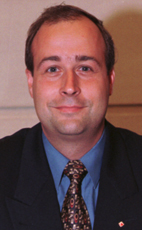
House of Commons photo

Crucial Fact

  • His favourite word was workers.

Last in Parliament October 2000, as Progressive Conservative MP for Madawaska—Restigouche (New Brunswick)

Won his last election, in 1997, with 50% of the vote.

Statements in the House

Employment Insurance June 10th, 1998

Mr. Speaker, there certainly seems to be confusion between Ottawa and the ridings. All local HRDC offices are of the opinion that the reforms are not effective. It is the minister's position to sit back and accept the status quo rather than to examine the shortcomings of his department.

The 1997 employment insurance monitoring assessment report failed to show what we already know, that the EI system is not working properly. Will the minister tell the House today that he will revamp the EI act and give Canadians the assistance they need when they need it?

Employment Insurance June 10th, 1998

Mr. Speaker, unemployed Canadians across the country are continuing to suffer.

When the government introduced EI reforms in 1996, approximately 40% of the unemployed did not qualify for EI. Today as a result of that reform nearly 72% of the unemployed are on welfare because they no longer qualify for EI assistance.

Will the minister tell the House that the act must be restructured to ensure Canadians that when they need EI assistance EI will be there for them?

Business Of The House June 9th, 1998

Mr. Speaker, today in the circus ring we heard the clown speak. He referred to committees and to pride in his party. I would like to point out that we in the Conservative Party number only 20, not 156.

Something happened here yesterday. There was not one member of the government in the House for debate on a motion. That is unbelievable, when there are 156 of them. I am not afraid to bite, and I am not afraid of being bitten back.

The hon. member is proud of his government and of his committees. When I was appointed to the Standing Committee on Human Resources Development, I tabled a motion for examination of the employment insurance reform, which also impacts upon the hon. member's riding. The committee voted it down. Is he proud of that? Just recently, the members of his party voted against compensating some of the victims of hepatitis C. Is he proud of his government for that?

Depository Bills And Notes Act June 8th, 1998

Mr. Speaker, I am pleased to join in the debate to Bill S-9, an act respecting depository bills and notes and to amend the Financial Administration Act.

Departmental officials have indicated that the depository bills and notes act is a technical piece of legislation needed to support improvements in the efficiency of capital markets in Canada. The bill is intended to modernize outdated federal legislation dealing with the transfer of banker's acceptances and commercial bills.

The bill addresses mobilization, meaning a physical instrument will be used but will be held in custody by a clearing house or the like until book entries can be made to show transfer of ownership. With the new technology available today there is no longer a paper transfer during a trade. A simple book entry is made. This bill does not actually spell out which one of these two acts is the case. Instead the transaction is governed by the rules of the depository house.

I would like to know whether this is common with similar legislation in other financial markets. For instance, if two individuals entered into an agreement where one's interest is transferred to the other but the depository is not notified of the transaction until just before maturity, who has the legal right to the interest before the custodian of the bill has been notified? Is it the buyer or the seller?

Furthermore, this legislation deals with electronic transactions and pushes the markets further away from the old system of paper trading and any protection offered against the millennium bug or what is now known as the Y2K risk.

A leading economist from New York, Edward Yardeni, has suggested that the Y2K problem is far worse than the American government likes to admit, partly out of the government's fear over lawsuits.

Questions On The Order Paper June 1st, 1998

Mr. Speaker, I rise on a point of order. I have been up many times over the past several months on Question No. 21.

Question No. 21 was asked on October 3, 1997. It is a long time to wait for an answer to a question. I am sure the parliamentary secretary is doing his best to get the question answered.

I asked the question last week. Will we get the answer before the break? Could the parliamentary secretary answer?

Supply June 1st, 1998

Madam Speaker, it is certainly a pleasure for me to rise today on this very important issue that we have been debating from day one in committee and in the House of Commons.

The motion before the House today is very important for the regions affected. I listened carefully to my colleague from Acadie—Bathurst, who said what people are feeling. It is interesting to see the effect of his speech in the House, because people's feelings are just as he described.

I would also like to comment on the motion moved by the member for Kamouraska—Rivière-du-Loup—Témiscouata—Les Basques.

I moved a motion at the human resources committee's first meeting on October 21, 1997. I moved that the committee review the changes made to the unemployment insurance program to assess their impact on Canadians and make recommendations to the government on how to make the EI program fairer for all workers.

I had the support of every opposition party and even some government members. My motion was defeated by six votes to five. It was very close. On the government side there are also some concerns. People are suffering.

Why I brought this motion so early into committee after elections at the first committee is because it was urgent. People in Atlantic Canada and some other regions of Canada through the reform to the unemployment insurance act are suffering. It is not that we want employment insurance. People want to work.

The Liberal reform to EI has created much hardship among Canadians who are most in need, who are unable to defend themselves. That is why they elected us.

We saw on June 2 what Atlantic Canadians said. I think it was very clear. They elected mostly Tories in New Brunswick. There are not very many Liberals I do not think. I heard comments from the hon. member from P.E.I. a while ago. I am really surprised that it is coming from Atlantic Canada. I am sure that he has citizens in his riding who are suffering from the employment insurance reform. I hope they heard what he said and I hope they remember what he said.

We have to come up with a strategy. Our party has been lobbying from day one to reduce EI premiums. That is a solution for job creation. These people do not want unemployment. They want jobs. One of the problems is that there are barriers to job creation.

EI premiums are a tax on jobs. We have been asking questions of the finance minister since day one. I believe it was my first question in the House of Commons. We called the Liberals pickpockets. It was not considered unparliamentary after it was analysed. This is a way to create jobs and to get people off unemployment and off welfare.

The hon. member said a while ago that if people are not on unemployment they will find jobs. In some regions of Canada they are on welfare. Believe me, that is not too appetising when we consider the fact that in order to get a job in today's economy one must have a good education. In order to get a good education one has to have money. If people do not have money they cannot get a good education and they will not get a job. These people are behind the eight-ball and will be there for a while.

The Progressive Conservative Party of Canada has been calling for the federal government to reduce EI premiums from $2.70 to $2 per $100 of insurable earnings. We have been saying that since day one. Even the government's chief actuary agrees that the EI fund would maintain a sustainable surplus with the kind of EI premium cuts that we are proposing. If the government does not take our word for it, it can at least take the word of the chief actuary.

The Canadian Federation of Independent Business has long opposed the government's tax grab on the EI surplus. The Minister of Finance points smugly to what he likes to describe as a happy economy. In that happy economy is some facts he chooses not to mention. I will mention a few he does not wish to mention.

Per capita personal income is down after inflation and taxes are taken into account. We do not hear anything about that. The number of Canadians living below the poverty line has risen under the Liberals. Those living below the poverty line are in a deeper hole than in 1993. We do not hear the government bragging about that. Canadians are saving less of their take home pay while taking on more debt. Once again, we do not hear the government bragging about that.

We hear government members saying that the Tories were there before and it was over $3. It is a broken record. It is certainly not helping today's citizens. If I were to go back to 1971 when Pierre Trudeau was here, what would it do for today's society? It would not do anything. It is certainly not creative.

Members will be interested to hear that more Canadians went bankrupt last year than ever before. We have not heard about that. We do not hear the Minister of Finance stating that. Some 85,000 Canadians declared personal bankruptcy last year. This is unacceptable.

Canadians want to work. They do not want EI. Until we are able to remove the barriers to job creation we have to protect the people who are going through difficult periods, people with families. It is our responsibility as legislators, as members of parliament, to protect all Canadians. In times of trouble and in difficult times it is up to us to bring the issue to this floor and to protect them. We must treat them equitably and fairly.

When we look at Atlantic Canada, we look at the fisheries and we look at the wood industry. We have seasonal workers in Atlantic Canada. The reform to the Employment Insurance Act is certainly not providing for them. I wonder how government members would feel fishing on top of six feet of ice. They just cannot do it.

These people have to be protected. People cutting wood for the paper we are writing on here certainly cannot cut that wood in the winter with over six feet of snow. These people have to be protected. There seems to be nothing there for them at all but hardship.

Young people also are hurt by the employment insurance and by unemployment. Their jobless rate is twice the national average. It is truly incredible.

I have this to say to young Canadians who are out of work: since youth unemployment is only part of the larger problem of joblessness in Canada, there will be no viable solution to deal with youth unemployment as long as there is no lasting economic growth and development. We have a lot to do before young Canadians can become full members of our society. This is also why I moved that motion then.

Today I am happy to speak to the motion by my colleague from the Bloc Quebecois. In my riding there is an association called Future Street People. Can you believe this, future street people. We asked to meet with the minister. He turned us down.

I strongly believe we can solve this problem, but we have to work together. In the meantime, we must protect people in need.

Questions On The Order Paper May 27th, 1998

Mr. Speaker, as has already been done on numerous occasions, I rise today to ask the parliamentary secretary once again for an answer to Question No. 21, which is still on the order paper.

I am certain that the parliamentary secretary is doing everything he can to comply with the request, but the government does not seem to want to answer this question. Could the parliamentary secretary tell us when we might expect an answer?

Petitions May 27th, 1998

Mr. Speaker, pursuant to Standing Order 36 I am pleased to rise today to present a petition on behalf of my constituents, people from Dalhousie, Campbellton and Eel River Crossing.

They call upon government to give a $12,000 allowance to mothers at home. In order to finance this allowance the Bank of Canada must issue new money that would not be borrowed but issued debt free, interest free and tax free. This new money would be given out free like a dividend to all the mothers who stay at home.

The production of our country is evident enough to correspond to the issuance of new money and this would boost our country's economy.

Supply May 14th, 1998

Mr. Speaker, the Canadian Armed Forces may well be demoralized after comments such as I have heard coming from the government representative this morning.

The hon. member refers to pride, talent and excellence. At least I believe that is what the hon. member said.

He spoke about the flood in Manitoba and he spoke about the ice storm. I was there. During the ice storm I saw the military. I saw what they did. Believe me, I thank them. What the hon. member is doing is certainly not thanking them. He is embarrassing them.

The member keeps saying “The Tories were there before”. This is playing politics with the issue. The problems are here today. The government must demonstrate leadership and it is not doing that. What is it going to do for the problems that the military is facing today?

We could say that Trudeau was there before us. But what is that going to do to rectify the problems of today?

I ask the member if he thinks the military is living below Canadian standards. I heard this morning for the first time that injured soldiers are not getting proper care. We also see that the military is living below Canadian standards. Or are there Canadian standards? We see that members of the Canadian military are getting out of the forces and do not have the proper education to find a post-military job.

Does the member think there should be standards in place for military personnel so that when they leave the military they will be able to get a permanent job? We should have an education system in place to protect these people. I would like the hon. member to comment on that.

Supply May 14th, 1998

Madam Speaker, I rise on a point of order. We are on questions and comments. The hon. member has been giving a speech. I believe there are other members who would like to ask questions. We only have a certain amount of time.