
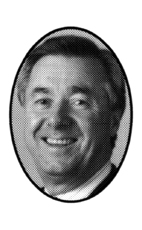
House of Commons photo

Crucial Fact

  • His favourite word was made.

Last in Parliament April 1997, as Liberal MP for Acadie—Bathurst (New Brunswick)

Won his last election, in 1993, with 66% of the vote.

Statements in the House

Guaranteed Income Supplement May 3rd, 1996

Mr. Speaker, I want to give the hon. member every assurance that we have already begun the process. Many of the people who have been affected by this unacceptable technical error have already received their cheques or have been contacted directly.

I give him every assurance we are taking every measure possible to make sure senior citizens who have been upset by this inappropriate kind of situation will receive the money coming to them as quickly as we can do it.

In addition, I repeat to the hon. member that we are doing everything we possibly can to ensure it does not happen again. These people have enough to worry about without having to be concerned about whether they will receive the appropriate amount they are due each month.

I share the hon. member's concerns. I want to say to Canadians who have had to put up with this glitch that it is unacceptable and we will do everything we can to make sure it does not happen again.

Guaranteed Income Supplement May 3rd, 1996

Mr. Speaker, I agree with the minister-my mistake, the member-that this situation is totally unacceptable. We have had bad experiences over the past two months with the delivery of certain programs. There have been flaws in the system which I find utterly deplorable.

You will understand that our department serves hundreds of thousands of people. These people are among the most vulnerable in our society. It is totally unacceptable to cause them concern because of this kind of problem.

I can assure my colleague that I did all that could be done, considering the technology involved which makes these things very complex, to try to prevent this type of situation from occurring again in the future. In the meantime, we took immediate action by calling these people to explain to them what the problem was and to assure them that they would receive their cheques as soon as possible.

I sincerely apologize to these people who did not get good service from my department.

Oral Questions May 3rd, 1996

Mr. Speaker, it is precisely-at least in part-to avoid bringing into the debate all the other well-known elements related to manpower training and the active measures to help create jobs that we want to be certain our proposal will be very easy to understand. In my opinion, we will then have a legitimate hope of reaching an agreement not only with Quebec, but also with all the other provinces.

Once our work is done, and we are almost there-I do not like to set deadlines when we are not certain we can meet them-I am confident that, in the near future, we will be able to sit down at the negotiating table with our colleagues from all the provinces. Of course, there is always the possibility that the Prime Minister will hold a conference with his provincial counterparts from across the country; there are all kinds of timetables that must be considered.

We want to assure the hon. member as well as all those interested in this issue that we will go ahead. We want to make sure that our proposal, when it is presented, will be well thought out and meet the needs not only of government officials but also of the people we really want to help: the men and women working in all kinds of jobs across the country and those looking for work.

Oral Questions May 3rd, 1996

Mr. Speaker, as I understand it, the Quebec consensus is very clear. I agree with the hon. member. It is in this context that I and the Government of Canada want to be sure we do not sit down to another failure at the negotiating table.

But, as the hon. member might agree, dealing with active measures can be very complicated. As far as manpower is concerned, I agree with the hon. member that we have already said we would indeed withdraw.

As for the other elements, commonly referred to as Part II of the Employment Insurance Act, it is a very complex matter because the needs across the country vary widely. We are familiar with Quebec's demands, and that is why we will go much further than simply withdrawing from the area of training. We want to look at all these other elements the hon. member was referring to.

Once we sit down at the negotiating table, I can assure the hon. member that the Government of Canada will put forward a straightforward proposal that, I hope, will meet the demands made by Quebec and all the other provinces.

Oral Questions May 3rd, 1996

Yes, Mr. Speaker, I do think the time has come to see how we can negotiate with all the provinces of Canada in order to meet our commitment with respect to training programs. However, since the consensus the hon. member is referring to was confirmed in Quebec after my meeting with Mrs. Harel in Quebec City, I think it is important-once all the provinces are sitting down at the negotiating table with us-to have an offer reflecting the reality in Canada, in Quebec of course, but also elsewhere.

I hope that, with the co-operation of all our provincial colleagues responsible for manpower and employment, we can come to an agreement. But I can assure the hon. member that, once we are sitting down at the negotiating table, our intention is to have a very legitimate, clear, comprehensive, unambiguous offer so that we can enter into negotiations that will finally lead to the conclusion everyone is hoping for.

Child Care May 2nd, 1996

Mr. Speaker, an attempt was made by the government before Christmas to try to find a way to come to the assistance of people who understand, as the hon. member knows, the need for child care across the country.

The response to that initiative, led by the Government of Canada, was less than warm. Governments across the country, practically without exception, said that although they recognized the need for child care, they wanted to make sure the Government of Canada understood the jurisdictional questions and that whatever the Government of Canada did it would be compatible with what the provinces saw as their needs and based on their capacity to provide resources.

I assure the hon. member we have had conversations with representatives of all governments across the country. We believe there is a very good opportunity to continue to play a national role in the provision of child care.

I look forward to working with individuals and groups, people who are interested in this matter, as well as with provincial governments to ensure the Government of Canada plays a significant but acceptable role in the provision of child care support across the country.

Canada Pension Plan May 2nd, 1996

Mr. Speaker, I keep trying to reassure the hon. member that it is not going to be a unilateral decision of the Government of Canada.

There is another side to the coin. When the hon. member who was involved in the hearing process expressed his views, I have no doubt he was saying that, depending on the need to maintain an appropriate level of support for recipients of the Canada pension plan in the future, there will have to be some hard decisions made. That was his view. As indicated in the quote, it was a personal view. However, his personal views will have to be seen through the prism of all of these hearings, with all of the provinces being involved.

At the end of the process, whatever the recommendations may be of the government and the various provincial governments involved, it will be brought to the House where all members will have an adequate and appropriate opportunity to express their views on the matter.

Canada Pension Plan May 2nd, 1996

Mr. Speaker, the Minister of Finance and I have had many discussion about this to ensure that the process from the federal government's point of view is properly conducted.

To correct the impression left by the hon. member, the member of Parliament who is representing the Government of Canada is the chairman of the industry committee but is certainly no longer the Parliamentary Secretary to the Minister of Finance, and is actually acting our behalf.

Even with the flexible federalism being practised in this country, it would be impossible for one federal member of Parliament to put the fix in with 10 provinces and the territories. This is a co-operative arrangement. It can only be changed, as I recall off the top of my head, with the agreement of seven of the provinces, representing 70 per cent of the Canadian population. Not even the hon. member for Winnipeg North Centre can put that kind of a fix in.

Goods And Services Tax May 2nd, 1996

Four out of seven!

Unemployment Insurance Reform May 1st, 1996

Mr. Speaker, the hon. member raises a very important point in her question and that is this concern with employment. The bill does provide among other things for $300 million to be invested in a transition fund, precisely to create jobs in the most disadvantaged regions of the country.

As an extra benefit, once the program is fully implemented, $800 million will be invested in job creation programs. There is one thing on which we agree with the hon. member, who is her party's critic on the subject. We agree that the solution to the problem facing the unemployed is job creation. And that is what we are working on.