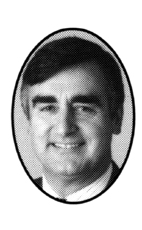
House of Commons photo

Crucial Fact

  • His favourite word was quebec.

Last in Parliament April 1997, as Bloc MP for Lac-Saint-Jean (Québec)

Won his last election, in 1993, with 76% of the vote.

Statements in the House

Quebec Referendum September 19th, 1995

We are all aware the Prime Minister is trying to treat the current referendum as a mere consultation without consequence. I would ask him to confirm, and he also hinted at this yesterday in one of his replies, whether it is true he is preparing to call a federal referendum to put pressure on the Quebec Yes side?

Quebec Referendum September 19th, 1995

Mr. Speaker, the Prime Minister just quoted Mr. René Lévesque. However, I am sure he will remember, the day after the 1980 referendum, that Mr. Lévesque accepted the people's decision. He did not see it as just a consultation, a point of view. He agreed and bowed to the people's wishes, while the Prime Minister reneged on commitments he made to get a No from Quebecers in 1980.

Quebec Referendum September 19th, 1995

Mr. Speaker, the fog thickened yesterday around the Prime Minister's real intentions, following statements he made in this House. When he speaks French, he remains ambiguous about the recognition of a Yes vote, but when he answers in English, he makes it clear he will reject a Yes from Quebecers.

Since the very future of Canada and Quebec is at stake, the public has the right to expect the Prime Minister to be consistent and to be clear about his position.

My question is directed to the Prime Minister. Will he, as the Reform Party did yesterday, respect Canada's democratic traditions and recognize a Yes or a No to the Quebec referendum question as equally valid?

Right Hon. John Diefenbaker September 18th, 1995

Mr. Speaker, John Diefenbaker was a passionate man. Passionate about his vision of his country, passionate in his attachment to his roots, firmly anchored in the dense and fertile soil of the Prairies.

Throughout the career of this resolute man, one would be hard-pressed to find examples of half-measures, grey areas, sidestepping and gobbledygook. He belonged to a generation that spoke and acted unequivocally. After returning from the Great War injured and with the rank of lieutenant, he suffered, a few years later, several defeats at the municipal, provincial and federal levels,

which helped him acquire his legendary determination, before coming to this House to which he was re-elected 12 times.

Cut and dried as he was, it is not surprising that opinions about him are equally passionate on both sides. His career as a people's lawyer and the rejection he was subjected to made him sensitive to the plight of the disadvantaged and the workers. For example, he opened the door to the adoption of the federal health insurance policy.

He showed the same generosity in the promulgation of the Canadian Bill of Rights. In 1961, he condemned apartheid. But francophones will also remember him as a fierce opponent of bilingualism. And who can forget his fight against the adoption of a Canadian flag?

His attachment to England was coupled with an embarrassing coolness toward our American neighbours. But above all, he constantly refused to recognize Quebecers as a founding people, even denying Quebec's distinct character. Unfortunately, we know that his ideas gained widespread acceptance and that, 32 years after his government was defeated, the present government still refuses to recognize Quebec as a nation.

Quebecers now have the ball in their court and they have to express their political will. But, no matter what people may say, nobody can accuse John Diefenbaker of backing away from a fight. He talked about the country, the language and the people that he loved so dearly.

In the upcoming debate, he would not, of course, share the opinion of Quebec sovereignists. He would certainly be a fierce adversary, but I think he would understand that others, like him, feel the need to protect their identity, their language and the right to exercise their choice as a people.

Yes, he was a great fighter. I cannot help thinking that he would enjoy very much to be living now. He certainly would have been very much involved with the debate since its beginning. I think he would certainly fight for Canada as he thought Canada was, but he would understand that many Quebecers would fight for Quebec, for what they think Quebec is.

Quebec Referendum September 18th, 1995

If I understood the Prime Minister's answer correctly, he sees the outcome of this referendum merely as a point of view to be expressed by the people of Quebec. I think we should consider this from the legal point of view, and I may remind the Prime Minister that the National Assembly and the Quebec Gov-

ernment based their referendum strategy on the right of peoples to determine their own future in a peaceful and democratic manner. I want to ask the Prime Minister whether he recognizes the right of Quebecers to do so.

Quebec Referendum September 18th, 1995

Mr. Speaker, with respect, I deplore the fact that at the very beginning of this fundamental debate, we are hearing applause for a prime minister who has just impugned the intellectual honesty of Mr. Jacques Parizeau, who certainly does not need lessons from this prime minister.

Quebec Referendum September 18th, 1995

Mr. Speaker, I think someone put on the wrong record, because the question was about whether the Prime Minister could tell us why he called his minister to order.

I would like to ask him whether we are to understand that taking the same line he took with his minister, he also intends to call to order the chairman of the No Committee, Daniel Johnson, who last Tuesday in Quebec City recognized the right of Quebecers to decide on their future and promised to respect their decision.

Quebec Referendum September 18th, 1995

Mr. Speaker, last year, Quebecers elected a sovereignist government with a mandate to hold a referendum as soon as possible on Quebec's accession to sovereignty.

Acting on its electoral promise, the government presided by Jacques Parizeau triggered the referendum mechanism in the National Assembly.

Recently, the Minister of Labour and federal minister responsible for the Quebec referendum was called to order by the Prime Minister for having said, and I quote: "We have always said that Quebecers had the right to express themselves on the future of Quebec, either within or outside Canada. We live in a democratic country, so we will respect the vote-".

My question is directed to the Prime Minister: What was so wrong about the minister's statement, which reflected the most elementary principles of democracy, that would justify the humiliating retraction he inflicted on her?

Business Of The House June 22nd, 1995

Mr. Speaker, I would like to add my voice to that of the House Leader in thanking the Chair, first, for its excellent mediation and chairing of the sometimes turbulent and very intense debate on vital issues. It succeeded in maintaining the dignity, calm and democratic principles that must prevail in a legislative assembly. My sincere thanks to our elected Speaker and to you, Mr. Speaker, to all those who work with you and to those who work

with the Clerk of the House. I want to thank you for having preserved this institution, which must endure.

I would also like to thank the pages and ask them not to always go by what they have seen here, should they choose a political career, but to keep the best of it. As we well know, there is good and not so good. They should forget the not so good and remember the best.

Chile's Accession To Nafta June 22nd, 1995

Mr. Speaker, the question is not hypothetical, since the treaty exists and the parties felt the need to negotiate clause 2204, a clause of accession that opens membership to all those who wish to join.

I want to ask the Prime Minister whether he would agree that Canada alone does not have the power to prevent Quebec from joining NAFTA and that the only thing Canada can do is get out if Quebec becomes a member.