
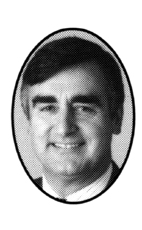
House of Commons photo

Crucial Fact

  • His favourite word was quebec.

Last in Parliament April 1997, as Bloc MP for Lac-Saint-Jean (Québec)

Won his last election, in 1993, with 76% of the vote.

Statements in the House

Matthew Coon-Come November 23rd, 1994

Mr. Speaker, I think that the Prime Minister is minimizing the situation. Keep in mind that in this case a Canadian province and one of Canada's two main language communities are being attacked and accused of a very serious charge of racism. Therefore I think that the Prime Minister should take this matter more seriously.

How does he explain, for example, that the Canadian embassy did not intervene to set the record straight the day after Mr. Coon Come made his remarks, while in the case of clear cutting, for example, the embassy did a very fine job and quite legitimately intervened with the American authorities to correct the information going around Europe on the clear cutting done by Canadian paper companies, and even spent $4.5 million for this purpose? Why did it not show the same vigilance, since this embassy has just demanded the exclusive right to represent Quebec's interests in Washington?

Matthew Coon-Come November 23rd, 1994

Mr. Speaker, last Friday, the Cree chief Matthew Coon Come was in Washington continuing his smear campaign against Quebec in the United States, using insulting terms and accusing the Quebec government of pursuing a racist policy toward the Crees.

My question is for the Prime Minister. After finding out what Cree Chief Matthew Coon Come said, did he instruct the Canadian embassy in Washington to set the record straight with the American authorities?

Collège Militaire Royal De Saint-Jean November 22nd, 1994

Mr. Speaker, I do not think that the minister has made himself look better and convinced anyone by discrediting the present commandant of the college, saying that he knows nothing about the operation, when he is himself appointed by the government to run the college. He is the government's representative to lead the college and the institution and we are being told that he does not know his work. They are hiding behind nameless officials who are under the minister's thumb.

Obviously, the minister still thinks that he alone is right on this issue. Does he share Col. Parisien's opinion that the college in Kingston cannot provide officer cadets with proper support to join the armed forces as French-speaking members and that their dropout rate will be higher?

Collège Militaire Royal De Saint-Jean November 22nd, 1994

Mr. Speaker, the minister quotes anonymous defence department experts for us. He should realize that the expert in this area, who is there on location running the college and knows what it really needs and what it must have in future and who also knows Kingston, is the commandant of the present college, Col. Marcel Parisien. He contradicts the minister.

The minister's attitude could drive one to despair. He is needlessly stubborn. When will he finally listen to reason, since he is practically the only one now who opposes his own commandant of the college in defending the brutal closure of the college in Saint-Jean, which Col. Parisien considers to be irresponsible and unrealistic?

Does he not realize that he is jeopardizing the attempt to reach the goal of 30 per cent French-speaking students in Kingston?

Collège Militaire Royal De Saint-Jean November 22nd, 1994

Mr. Speaker, following the Government of Quebec and the Mayor of Saint-Jean, Col. Marcel Parisien, Commandant of the Royal Military College in Saint-Jean, has proposed to the federal government an alternative to the brutal closure of the college in Saint-Jean.

In a letter addressed to his superiors, Col. Parisien confirms that Kingston does not have enough facilities to house the officer cadets from Saint-Jean and he expresses serious reservations about the ability of the college in Kingston to properly integrate French-speaking officer cadets in their language.

How can the Minister of Intergovernmental Affairs refuse to consider Col. Parisien's proposal, since the colonel knows what he is talking about? Will he finally admit that the college in Kingston does not now have sufficient facilities for the French-speaking officer cadets from Saint-Jean?

Governor General Of Canada November 22nd, 1994

Mr. Speaker, the appointment of the Hon. Roméo LeBlanc as Governor General will no doubt be welcomed as good news. I salute the Prime Minister's decision to name an Acadian to this prestigious position, in fact the first one in Canada's history. This is undoubtedly a gesture of openness to Canada's francophone communities.

The Hon. Mr. LeBlanc will be able to continue the efforts that he has always made in his long and fruitful career for the promotion of minority rights. I wish him good luck and great success in his new duties.

Let me also point out the good, solid work of the present Governor General, the Hon. Ray Hnatyshyn, and thank him and his wife for what they have done for their fellow Canadians.

International Trade November 21st, 1994

Mr. Speaker, we do not need good intentions. We need concrete action on government policies. I would ask the Prime Minister whether he does not consider it essential to maintain the network of Canadian trade commissioners in the United States in order to support the efforts of Canadian businesses, especially SMEs that want to take advantage of new markets that have opened up as a result of NAFTA.

International Trade November 21st, 1994

Mr. Speaker, the Prime Minister knows perfectly well that 80 per cent of Canadian exports, and a little more last month, go to the United States, while the figure for Asia is about 7 or 8 per cent.

That being the case, I would ask him whether he endorses the suggestion made by members of the committee who, now that NAFTA has been ratified, recommend eliminating trade commissioner posts in the United States and Mexico.

International Trade November 21st, 1994

Mr. Speaker, Liberal members have decided to resurrect the third option favoured by the Trudeau government to reduce U.S. influence on the Canadian economy. The majority report's recommendation to make the Asia-Pacific region Canada's export market par excellence is the one that will be debated and that has been submitted to the government.

People will start wondering why the government did not concentrate on developing our trade relations with the United States now that NAFTA has been ratified.

My question is directed to the Prime Minister. Does he endorse the misgivings of his members who see trade relations with the United States as a problem rather than a benefit, and should we see this as lingering Liberal opposition to the free trade agreement?

National Defence November 17th, 1994

Mr. Speaker, given the fact that additional photographic evidence exists in the matter of the torture of Somali civilians by Canadian soldiers, how can the minister claim that justice has been rendered?

What steps will he take to make sure that the evidence relating to the pending case, now in appeal, will be enriched with existing conviction documents which are in the hands of Major Armstrong?