
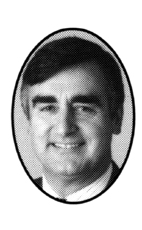
House of Commons photo

Crucial Fact

  • His favourite word was quebec.

Last in Parliament April 1997, as Bloc MP for Lac-Saint-Jean (Québec)

Won his last election, in 1993, with 76% of the vote.

Statements in the House

1992 Referendum September 30th, 1994

Mr. Speaker, beyond the question which has now been settled, the payment of what is owed to Quebec, there is a serious question concerning the proper behaviour of a Prime Minister in telling this House the truth. Nothing should prevent this House from knowing the facts. This House was told by the Prime Minister that he had no answer from Mr. Mulroney, when we know today that he had a complete answer, the same answer which was the basis of his decision yesterday to pay.

Does the Prime Minister realize that his statement that he had received no answer from Mr. Mulroney was likely to mislead the opposition and prevent it from getting to the bottom of this issue as it should?

1992 Referendum September 30th, 1994

Mr. Speaker, I bring the Prime Minister back to the central issue. This Prime Minister said in this House that there was no answer from Mr. Mulroney, although yesterday Mr. Mulroney reported all the facts in a letter to the Prime Minister, saying that these facts were conveyed to the current Prime Minister during Tuesday's telephone conversation. There is a flagrant contradiction.

The least that can be said is that the Prime Minister's memory of his talk with Mr. Mulroney is as bad as his recollection of his recent telephone call to Mr. Parizeau.

Does the Prime Minister not agree that yesterday's letter from Mr. Mulroney formally contradicts what he said Wednesday in this House, namely that there had been no answer from Mr. Mulroney?

1992 Referendum September 30th, 1994

Mr. Speaker, last Tuesday, in an attempt to confirm Robert Bourassa's version of the facts regarding reimbursement to Quebec for the expenses incurred in the referendum on the Charlottetown Accord, the Prime Minister had a telephone conversation with Mr. Mulroney. In the account of this conversation he gave this House on Wednesday, the Prime Minister stated, and I quote: "I called Mr. Mulroney, who did not give me an answer".

How can the Prime Minister reconcile the statement he made before this House on Wednesday with the now established fact that Mr. Mulroney fully briefed him on Tuesday on all that was said between himself and Mr. Bourassa?

1992 Referendum September 29th, 1994

Mr. Speaker, as you know, the Prime Minister was supposed to be in the House today. That is the information we were given. However, at the beginning of the sitting, we were advised he would be late and, with your consent, we agreed to wait with our questions. Since he is not here, I will have to put a question to the Deputy Prime Minister, following the answer she gave the hon. member for Sherbrooke. I realize we do not have enough time, so I will ask only one question. But do not worry, we will get you next time around!

Am I to understand from the Deputy Prime Minister's reply to a question from the hon. member for Sherbrooke that the Prime Minister was aware, as a result of a telephone conversation he had with Mr. Mulroney, that the latter had promised to treat Quebec equitably and compensate it for its referendum expenses, and that the Prime Minister will not take Mr. Mulroney, who is an honourable man, at his word and wants to see this confirmed in writing?

1992 Referendum September 28th, 1994

Mr. Speaker, Robert Bourassa, in the course of his duties as premier and bound by his oath of office, testifies in this letter to the existence of an agreement and a commitment made by his counterpart, the federal Prime Minister. That is the truth.

On September 22 in this House, the Prime Minister challenged the Bloc Quebecois to give him, and I quote: "proof that my predecessor and the previous government made a commitment, and we will gladly pay". Here is the proof. Now, pay.

1992 Referendum September 28th, 1994

Mr. Speaker, I may refer everyone to Hansard for September 22, where the Prime Minister says that no trace of any commitment was found. He knows perfectly well that to prove the existence of a commitment, one needs witnesses, and when the witness is one the parties, the case is clear. The letter dated December 15, 1993, which Mr. Bourassa sent to the Prime Minister, contains clear and irrefutable evidence of an agreement between Mr. Bourassa and Mr. Mulroney.

For the benefit of the Prime Minister, I will read an extract from this letter, in which Mr. Bourassa says: "The Chief Electoral Officer of Quebec has established that the direct cost of the referendum for the Government of Quebec as $47.2

million. That is the basis of our claim for federal compensation, which was transmitted to the federal Minister of Finance by Mr. Gérald-D. Lévesque on May 7, 1993." The letter goes on to say: "Unfortunately, no payment could be made before Mr. Mulroney left." Now for the crucial passage: "although Mr. Mulroney indicated last March that Quebec would be fairly compensated in this respect". How can the Prime Minister deny the existence of an agreement, considering Mr. Bourassa's own very clear testimony which he put down in writing?

1992 Referendum September 28th, 1994

Mr. Speaker, the Prime Minister said in the House last week that, and I quote: "no trace of any commitment was found" to reimburse Quebec for the expenses incurred in the referendum on the Charlottetown Accord. The truth is that there are not just traces but documents, including a letter dated December 15, 1993, from Mr. Bourassa, the Premier of Quebec at the time, to the then Prime Minister of Canada. This letter followed three other letters on the same subject to the federal Minister of Finance.

Why did the Prime Minister hide these letters from the House and the public?

Social Program Reform September 27th, 1994

Mr. Speaker, good government means a government that governs and does not spend its time consulting, publishing white papers and travelling all over the place and making speeches.

I want to ask the Prime Minister whether he realizes that by postponing social program reform indefinitely and restraining his minister's urge to make cuts, he is actually asking the unemployed in Quebec to wait at least another year until the training issue is settled.

Social Program Reform September 27th, 1994

Mr. Speaker, this looks more like hesitation at its best than democracy. I want to ask the Prime Minister whether we are to infer from all this that postponing the reform was motivated by the Prime Minister's reluctance to take unpopular measures before a referendum is held on the sovereignty of Quebec?

Social Program Reform September 27th, 1994

Mr. Speaker, after promising an action plan for social program reform, the Minister of Human Resources Development said yesterday that next week he would only table a discussion paper.

He also made it clear that social program reform would again be postponed, when he said that the government's position would be presented next spring or next fall. In other words, a year from now.

My question to the Prime Minister is this: Should we see these successive delays as an attempt by the Prime Minister to put off the cuts his minister wants to make at the expense of the needy?