
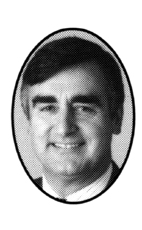
House of Commons photo

Crucial Fact

  • His favourite word was quebec.

Last in Parliament April 1997, as Bloc MP for Lac-Saint-Jean (Québec)

Won his last election, in 1993, with 76% of the vote.

Statements in the House

Manpower Training April 13th, 1994

The Prime Minister is fully aware that the unemployed are the ones who are paying the price for the arm-wrestling match and endless discussions between Quebec and Ottawa.

I wonder if he shares the opinion of his federalist ally, the Leader of the Quebec government, Mr. Johnson, who says that Quebec is in the best position to deal with such matters. If the Prime Minister does agree with this statement, why then is he putting off transferring to Quebec responsibility for a sensitive area such as job creation?

Manpower Training April 13th, 1994

That is right, Mr. Speaker, the perverse power to say no to Quebec, to deny it jurisdiction over pressing matters-

Manpower Training April 13th, 1994

Mr. Speaker, my question is for the Prime Minister. Yesterday, the Minister of Intergovernmental Affairs discounted the possibility of an agreement with Quebec on the transfer of federal responsibility for manpower training prior to any social program reform.

We now know that Ottawa is considering a simple temporary agreement limited to the joint leasing of buildings. This kind of intransigence prompted the Premier of Quebec, Mr. Johnson, inspired no doubt by healthy fear of the eve of the election, to ask the following question: "Who is in charge in Ottawa? The political powers or the bureaucracy?"

Why does the Prime Minister refuse to conclude the agreement that Quebec has been urging its federalist ally to sign? And, following Mr. Johnson's lead, I would also like to ask him this: Who is in charge in Ottawa? The Prime Minister or his bureaucrats?

Manpower Training April 12th, 1994

Mr. Speaker, I think it is easy to interpret the minister's remarks. In any case, the document is correct in that there will be no transfer of officials, authority or resources.

Finally, the bottom line for both ministers is that the same 25 provincial and 27 federal programs will now be administered in the same building, so the client does not have far to go to be utterly confused.

I want to ask the Prime Minister, who must be aware of the contradictions here, whether he realizes that by refusing to transfer federal responsibility for manpower training to Quebec, he is perpetuating an annual waste of $300 million, at the expense of Quebec's unemployed, of whom 20,000 are still

waiting to register for training courses that could help them improve their chances of getting back to work?

Manpower Training April 12th, 1994

Mr. Speaker, this document which appears today on the first page of Montreal's biggest newspaper was prepared by the Minister of Human Resources Development and reflects the minister's position.

The document, and therefore the minister's position, indicates that bilateral agreements on joint use of buildings will be signed immediately with the provinces. However, yesterday the Minister of Intergovernmental Affairs informed the House that there would be no administrative agreements with the provinces on manpower training for the next two years.

I want to ask the Prime Minister who is right in this case?

Manpower Training April 12th, 1994

Mr. Speaker, my question is directed to the Prime Minister. Today, La Presse published sections of a document prepared by the Department of Human Resources Development for the next federal-provincial conference to be held next week, on income security.

According to the document, the government has excluded any possibility of transfers to Quebec of authority, budgets or officials. This position is a direct contradiction of Quebec's demands as reiterated last Friday by Premier Johnson, who is supported by a strong consensus in Quebec on this issue among the parties involved.

Are we to understand that this document represents the government's official policy on manpower training, and that having rejected all transfers requested by Quebec, the Prime Minister will only allow joint use of the same building, where the wasteful practices we have witnessed for a number of years, which have prevented the unemployed from getting the training they need, would be perpetuated, but now under the same roof?

The Budget April 11th, 1994

Mr. Speaker, it is unfortunate to see a government so irresponsible in the way it interprets the negative movements of financial markets.

For instance, Mr. Speaker, the Prime Minister sees an improvement where there has been deterioration. Fewer people are unemployed because more people are on welfare. When people go on welfare, they are no longer included in the unemployment statistics, and so the government is satisfied. This does not make sense. And the few jobs that were created are not durable jobs.

I want to ask the Prime Minister whether he will let his government review its deficit reduction strategy to restore its credibility with the financial markets. Is he prepared to immediately implement measures to cut government spending?

The Budget April 11th, 1994

Mr. Speaker, the Prime Minister forgot to mention that most economists and financial analysts who examined what caused the financial instability of the past few weeks referred to the Budget and the concern shown by financial markets about the govern-

ment's failure to cut where it should cut, in other words, public spending.

Does the Prime Minister agree that the negative assessment of the financial community will add another $3 billion to his deficit and that rising interest rates will compromise economic recovery and job creation as a result of a lack of confidence among consumers and investors?

The Budget April 11th, 1994

Mr. Speaker, my question is directed to the Prime Minister.

Economists and financial analysts are practically unanimous in saying that the falling dollar and the increased spread between American and Canadian interest rates are mainly due to the federal budget's lack of credibility. The government has failed to convince financial markets that it is determined to fight the deficit and put public finances on a sound footing, and taxpayers are paying for this with increased interest rates.

Does the Prime Minister agree that the rise in interest rates as a result of the Bank of Canada's decision to stop the dollar from sliding further is mainly the result of a negative assessment by financial markets which are disappointed in the deficit reduction measures proposed in the budget?

Government's Credit Rating March 23rd, 1994

Mr. Speaker, the financial community does not go in for the florid speeches and noises we sometimes hear in this House, which take the place of monetary and fiscal policies. They spoke very toughly and very eloquently this week by lowering Canada's credit rating. There are also the unemployed and others.

I ask the Minister of Finance whether he is willing to review his inefficient and unfair approach which consists in attacking the unemployed by cutting their benefits to force them to look for non-existent jobs instead of going after the actual causes of unemployment.