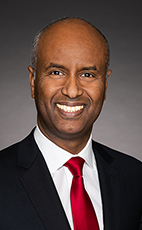
House of Commons photo

Track Ahmed

Your Say

Elsewhere

Crucial Fact

  • His favourite word is development.

Liberal MP for York South—Weston—Etobicoke (Ontario)

Won his last election, in 2025, with 55% of the vote.

Statements in the House

Committees of the House April 15th, 2026

Mr. Speaker, I have the honour to present, in both official languages, the following two reports of the Standing Committee on Foreign Affairs and International Development: the sixth report, entitled “More than a Moment: Investing in Canada's Arctic Security”, and the seventh report, entitled “Securing Ukraine's Future”. Pursuant to Standing Order 109, the committee requests that the government table a comprehensive response to each of these two reports.

Arab Heritage Month Act February 10th, 2026

Madam Speaker, good evening to you, my colleagues and Canadians who are joining us to witness this important moment of parliamentary collaboration.

I rise this evening with a deep sense of honour to speak to Bill S-227, an act respecting Arab heritage month. It is a moment when Parliament once again has the opportunity to rise above partisanship and move forward in celebration of our shared values of inclusion, recognition and belonging. I know that sometimes there are moments when the House truly comes together, and I believe this is one of those moments.

This is not the first time that this bill has reached this place. In the last Parliament, my colleague, the hon. member for Ottawa South, introduced Bill C-232, a forerunner of this very bill. That legislation passed this House unanimously, with the support of every party and every member in this chamber. It was a rare moment of unity that reminded us what Parliament is capable of when we come together in the spirit of national recognition. Before I go any further, I want to thank the member for Ottawa South for all the work that he has done and his leadership in championing this bill in its earlier form in the last Parliament.

Today I am proud to sponsor Bill S-227. I want to sincerely thank Senator Mohammad Al Zaibak for his leadership in reintroducing this legislation in the other place and guiding it all the way through the upper chamber with determination and grace. I also want to recognize the valuable contributions of colleagues from all sides of the House in support of this bill. I would like to thank the Parliamentary Secretary to the Minister of Industry for sharing his personal background, the tremendous highlighting of the economic contributions of Arab Canadians and their role in shaping Canadian prosperity. The words of the hon. Parliamentary Secretary to the Government House Leader on the importance of education and cultural awareness were timely and very important to that first hour of debate. The reflections of the hon. member for Edmonton Manning, my good friend, on the vibrant Arab community from coast to coast to coast, in Alberta but also across the country, have really brought warmth and insight to this important debate.

I thank the member for Jonquière for his perspective on North African and Arab migration to Quebec. I also thank him for highlighting the importance of student mobility, civic inclusion and mutual understanding.

I thank the hon. member for Windsor for his remarks on cross-border connections between Arab Canadians and Arab Americans and the unique contributions that Arab Canadians have made and continue to make, not just to his community but right across the country. I share that sense of pride and of the importance of recognizing this Canadian community. Each of those members built the foundation for today's debate, and I want to thank them.

Thank you, everyone.

This bill proposes that every year the month of April be designated as Arab heritage month in Canada. It is a month that will allow Canadians to learn, reflect and celebrate the contributions of Arab Canadians, their history, culture and heritage. It is an opportunity to recognize the diversity within the Arab Canadian community and to highlight the stories of perseverance, innovation, creativity and resilience.

At its core, this bill is about community and what it means to be part of the Canadian family, to be recognized, to be valued, and to be woven into the larger story of who we are together. Arab heritage month is not only about celebration, though there is much to celebrate. It is also about belonging, to be recognized officially by one's country, to have space in the national calendar that says, “Your story matters, and your identity is part of our collective story.” That is no small thing.

This bill is about more than recognition. It is about education, representation and healing. It is about confronting stereotypes. It is about replacing fear with familiarity. It is about making space for stories long left untold. It is about telling young Arab Canadians, “Your heritage matters, your identity belongs, and your contributions are valued.” As the hon. member for Ottawa South said so eloquently in 2022, “It is high time to move beyond the notion of tolerating anyone. It is now entirely a question of celebrating each other”.

In closing, I want to thank the Speaker for giving me the opportunity to talk about this bill. I ask all members of the House to support the bill and send a message to Arab Canadians that this Parliament sees them, hears them and celebrates them.

Shukran.

Committees of the House December 11th, 2025

Mr. Speaker, I have the honour to present, in both official languages, the following two reports from the House of Commons Standing Committee on Foreign Affairs and International Development: the fourth report, entitled “Haiti's Multi Faceted Crisis and Canada's Response”; and the fifth report, regarding the statement of the Subcommittee on International Human Rights, entitled “Attacks on Christians and Wider Violence in Nigeria”.

Pursuant to Standing Order 109, the committee requests that the government table a comprehensive response to each of these two reports.

Arab Heritage Month Act December 10th, 2025

Mr. Speaker, I am in agreement with my colleague. He is right that diversity is incredible within the Arab Canadian community.

I want to pay particular attention to the fact that, even in Toronto, we will find Francophone Arab communities that originate from Morocco and other French-speaking countries. The diversity is not just limited to the geography; it is also the language and the different customs and celebrations.

Arab Heritage Month Act December 10th, 2025

Mr. Speaker, I want to begin by thanking the hon. member for Edmonton Manning for really supporting this bill. Without his efforts and support, we would not be here today. Again, it showcases what the hon. member from Winnipeg was talking about earlier, which is that we should look for opportunities to work across party lines to advance meaningful work in this place. This bill is an example of that.

I think the Arab Canadian story has not been told enough. When I look at different Arab communities across the country, I am amazed at their diversity, the length of time they have been in Canada and the incredible contributions they have made and continue to make. From some of the smallest towns in southwestern Ontario to the Yukon and everywhere else I have been, I have seen those contributions, particularly from Lebanese Canadians, but also from others from Syria, Jordan, Morocco, Algeria and the Francophonie world.

This bill and this heritage month, if enacted, will help us to educate Canadians about this community, which is now integral to our society, and all the contributions it has made and continues to make.

Arab Heritage Month Act December 10th, 2025

Mr. Speaker, my hon. colleague could not be more right in this instance, because these heritage months allow us an opportunity to reflect on and then celebrate those contributions.

I think of Milman Industries in Sudbury, which was started by a Lebanese Canadian immigrant who came to Canada with nothing and who now has started 10 successful businesses that are employing thousands of people and paying a starting wage of $41 an hour. In the member's own hometown of Winnipeg, Mr. El Tassi, a proud Lebanese Canadian, has done so much for the community, contributing to poverty reduction measures, creating jobs and establishing philanthropic drives every single year. I always make a new discovery about Mr. El Tassi when it comes to Winnipeg.

Yes, this bill is about making sure we recognize and learn about those contributions and teach them to the next generation.

Arab Heritage Month Act December 10th, 2025

Madam Speaker, I am honoured to rise in the House to speak to Bill S-227, an act respecting Arab heritage month, which seeks to formally designate the month of April as Arab heritage month across Canada. It is a bill that speaks of the importance of recognizing not only a vibrant and diverse community in Canada but also the larger principle of what it means to belong, to be seen and to be celebrated in this great country. The bill has already passed in the other place, and I am proud to sponsor it here in the House of Commons as it makes its way through Parliament.

Some members may recall that this is not the first time the House of Commons has seen the bill. In fact, in the 44th Parliament, the hon. member of Parliament for Ottawa South introduced Bill C-232, which carried the very same purpose. That bill was passed unanimously at all stages in the House of Commons in a rare and powerful show of unity. Members from across the political spectrum and from every region and background stood in recognition of the importance of Arab heritage.

I want to particularly acknowledge some of my colleagues for their work on the bill, including of course the hon. member for Ottawa South, who was the first to bring the legislation forward in 2022. Without him, we would not be here today. He said, “in my own family...[my] Syrian Canadian godfather...[was] a man of great intelligence, kindness, and integrity. His origins were humble. In fact, [there was] poverty, and his values instilled in me a deep appreciation for hard work, giving back and public service.”

I would also like to express my gratitude to the member of Parliament for Edmonton Manning, whose steadfast support played a key role in moving the bill forward. He said, “As I said, my story is typical of so many [Arabs Canadians] who have come to this country to seek a better life and to give back to the community. I am proud of my heritage and am happy to see the establishment of Arab heritage month.”

I also want to recognize former members Sylvie Bérubé, Blake Desjarlais and Brian Masse, who all contributed meaningfully to helping the member for Ottawa South bring this important piece of legislation to life. Their collective efforts reflect a shared belief that Arab Canadians deserve formal national recognition for their long-standing and ongoing contributions to the very fabric of our country.

Unfortunately, despite unity and momentum, the bill reached third reading in the Senate but died on the Order Paper following Parliament's dissolution in 2024. Today we have an opportunity and, I would argue, a responsibility to complete that unfinished work, to reaffirm our commitment to diversity and inclusion and to ensure that the contributions Arab Canadians have made and continue to make are formally recognized every April of every year across this country.

Why should it be in April, and why should we do it now? Well, the choice of April is actually very deliberate. It would coincide with several cultural and historic celebrations in Arab communities and provide an annual opportunity to highlight the vast diversity of Arab heritage, culture, language and contributions to Canadian society.

We know that Arab Canadians are not a monolith. The community is very diverse and dynamic. The Arab world spans over 22 countries from North Africa to the Middle East, with a population of over 450 million people. It encompasses a rich mosaic of languages, religions and traditions. Arab Canadians include Christians, Muslims, Jews, Druze and others. They speak Arabic in many dialects, as well as French, English, Armenian, Syriac and more.

Their cultures are as diverse as the regions from which they originate, from the mountains of Lebanon to the deserts of Jordan, and from the cities of Egypt to the coasts of Morocco. Designating April as Arab heritage month would be a way to recognize that diversity and to celebrate the ways in which it has enriched our own social fabric in this country.

Arab Canadians have been building this country alongside others for more than 140 years. Immigrants mainly from what is present-day Lebanon were the first Arab group to come to Canada. The first documented Arab immigrant to Canada was Ibrahim Abu Nadir, a Lebanese Maronite Christian who arrived in Montreal in the 1880s. He worked as a peddler, going from town to town selling goods and eventually becoming a successful merchant. He paved the way for thousands of others from what was then known as Greater Syria, the Levant, which today is Lebanon, Syria, Jordan and Palestine.

These early pioneers helped establish some of Canada's first Arab churches and mosques. I had the opportunity to visit one of those mosques in Edmonton that was started so long ago, a former Ukrainian community church that was turned into a mosque, again another sign of diversity and inclusion in our communities. The new immigrants built businesses, raised families and contributed to the cultural and economic life of their communities, often while facing discrimination, isolation and economic hardship. April would be a time to recognize and celebrate the contributions of these early immigrants.

Fast-forward to today, and Arab Canadians are represented in every field imaginable in Canadian life. Peter Baker, who served as an MLA in the Northwest Territories in the sixties, is believed to have been the first Arab Muslim elected to public office in Canada. Joe Ghiz, of Lebanese descent, served as the premier of Prince Edward Island. He was the first Canadian premier of non-European ancestry. His leadership, especially during constitutional negotiations, left a lasting mark on Canadian federalism.

In the arts, Paul Anka, born in Ottawa to Syrian parents, became one of Canada's greatest musical exports, known worldwide for his songwriting and his timeless voice. In business, Salim Rassy, later known as Rossy, a Syrian Lebanese immigrant, founded a small general store in Montreal in 1910 that would eventually evolve into the national retail chain we know today as Dollarama. In academia, Dr. Bessma Momani, one of Canada's leading voices on analysis of Middle East affairs, has contributed to our understanding of international politics and security issues.

In science, there is Noubar Afeyan, a Canadian Lebanese entrepreneur, inventor and philanthropist, best known for co-founding the biotechnology company Moderna. His family moved to Canada during the Lebanese civil war in 1975. He received his Bachelor of Chemical Engineering from McGill University in 1983. In 2022 Afeyan was awarded an honorary Doctor of Science from his alma mater, McGill University. He points to his immigrant background and mentality as the driving force of his philanthropic, scientific and business work.

A lot of members of this community give back repeatedly because of their appreciation of what Canada has done for them. These stories are not isolated; they reflect thousands of untold contributions from small businesses, artists, teachers, doctors, frontline workers, police officers, firefighters and paramedics who have quietly but powerfully shaped Canadian society and communities.

The bill is not simply a symbolic gesture; it is a practical and timely tool for inclusion, another powerful reminder of the importance of diversity and inclusion. It invites all Canadians to learn about, celebrate and appreciate the cultural richness of Arab Canadians and to recognize the obstacles many continue to face, including racism, Islamophobia, anti-Arab sentiment and misrepresentation. By celebrating the month of April as Arab heritage month, we would make space not just in our calendars but in our conversations, our classrooms, our workplaces and our communities for the voices, stories and contributions of Arab Canadians to be heard and honoured. It is a gesture of recognition, yes, but it is also a commitment to education, equity and dialogue.

The leadership of Senator Mohammad Al Zaibak, the sponsor of the bill, Bill S-227, has been exemplary on this file, and I wish to commend him publicly for championing the bill in the Senate and for his powerful second reading speech earlier in October. I have known him for many years and have seen him contribute so much to life, community life and good causes throughout the GTA and Canada, in fact. He has conducted extensive consultations with stakeholders across Canada on the bill. The bill is non-partisan and has already passed the Senate with broad support.

To conclude, Canada is at its best when we recognize our diversity not as a challenge but actually as a strength, a strength that allows us to understand others and to access other communities, other countries, other regions of the world and other markets and opportunities.

This bill gives us a chance to celebrate what makes us unique while reaffirming what also brings us together: community, faith, freedom, human rights, our commitment to our multicultural heritage, and our shared commitment to respect, fairness and mutual understanding.

Let us seize this opportunity to send a clear and united message that Arab Canadians are an integral part of Canada's past, present and future, that they belong, that their stories matter and that their contributions will never be forgotten. By celebrating and adopting this bill, we will acknowledge those contributions, but we will also celebrate those contributions.

I urge all members, all colleagues from all parties of the House, to support the timely passage of Bill S-227 and join me in ensuring that Arab heritage month becomes a permanent part of our national calendar.

As I said, it is more than just a placeholder in the calendar. It is about an opportunity to learn about our neighbours and their contributions. Let us finish what we began last Parliament, take this meaningful step together and pass this bill.

Committees of the House December 3rd, 2025

Madam Speaker, I have the honour to present, in both official languages, the following two reports of the Standing Committee on Foreign Affairs and International Development: the second report, from the Subcommittee on International Human Rights, entitled “Enduring and Overcoming: The Struggle of the Hazaras in Afghanistan”, and the third report, entitled “Supplementary Estimates (B), 2025-26”.

Pursuant to Standing Order 109, the committee requests that the government table a comprehensive response to the second report.

Canada's International Development Assistance November 24th, 2025

Madam Speaker, Motion No. 14 embodies the simple but powerful idea that Canada's generosity abroad should also help build opportunity at home. That is what it is about. For decades, we have seen Canadians lead with compassion, building schools, strengthening ecosystems and food systems, empowering women and saving lives right around the world. We have done so not because of recognition but because it is simply who we are. However, as the world changes, our development approach must change with it. We can continue to be generous, but we must also be strategic, accountable and mutually beneficial. That is what Motion No. 14 is all about. It aims to make international assistance more accountable, effective and results-driven. It aligns with ongoing efforts to strengthen transparency and ensures that development investments deliver measurable impacts to those who need them.

The motion underlines the link between global development and Canada's own prosperity. Stable, self-reliant partners with strong institutions and the rule of law contribute to a safer, more predictable world, benefit Canadians and support long-term economic security for all of us. By proposing to support the greater involvement of Canadian small and medium-sized enterprises, and innovators and workers in international development, Motion No. 14 highlights how Canada can maximize global impact while also creating jobs, fostering innovation and building expertise right here at home. The motion encourages innovative projects that leverage our unique strengths, such as clean energy, digital technology, education and health, while maintaining a clear focus on poverty reduction and inclusive economic growth. By fostering collaboration among development partners, local actors and the private sector, the motion would promote sustainable outcomes that align with both Canada's international commitments and its domestic economic and social priorities.

Our government has presented a budget of generational investments to empower Canadians, strengthen our economy and secure a stronger, more resilient future for our country. We are living through a time of global change. This means that we must act decisively to ensure that we lay the groundwork for long-term strength and prosperity for our people. Across government, that means making disciplined and sometimes difficult decisions to keep our spending targeted and to make sure that every dollar delivers results, impacts and help for people. As we refocus our international footprint, we remain firmly committed to international assistance and delivering help where it is needed, so the motion is actually in line with the aims of the budget as well.

I have seen first-hand how Canada's international development partnerships change lives, from access to education to providing clean water and enabling people to pursue entrepreneurship and find hope in their lives. Motion No. 14 builds on that proud tradition and propels it into the future. It would ensure that aid remains generous, effective and accountable while also being smart, strategic and sustainable.

When we help others rise, we rise with them. Let us pass Motion No. 14 and make Canada's international development policy a model of shared progress for a changing world.

Canada's International Development Assistance October 22nd, 2025

Mr. Speaker, I agree with my colleague. I accept the amendment.