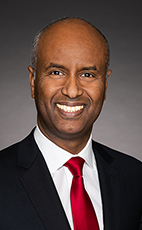
House of Commons photo

Track Ahmed

Your Say

Elsewhere

Crucial Fact

  • His favourite word is development.

Liberal MP for York South—Weston—Etobicoke (Ontario)

Won his last election, in 2025, with 55% of the vote.

Statements in the House

Business of Supply May 24th, 2018

Mr. Chair, we have a six-point plan on irregular migration, with outreach to diaspora communities and non-governmental organizations as well as community media and diplomatic representatives, and making sure that each and every person who crosses our border irregularly is arrested, and like all asylum claimants, is subjected to a thorough security screening.

We respect our international obligations, but those who are found not to need Canada's protection are promptly removed. We are co-operating closely with the provinces on the issue of irregular migration, specifically Quebec and Ontario, through the intergovernmental task force on irregular migration.

Business of Supply May 24th, 2018

Mr. Chair, the Immigration and Refugee Board is responsible for hearing refugee claims. Those claimants who have a legitimate claim for refugee protection are granted refugee status, and they can stay in Canada, and those who are found not to have a legitimate claim for refugee protection are removed from Canada.

Our government has invested $74 million to ensure fast decision-making at the Immigration and Refugee Board so that refugee claimants can get decisions faster. That allows failed claimants to be removed from Canada quickly.

Business of Supply May 24th, 2018

Mr. Chair, the fact of the matter is that asylum seekers are processed separately, in a separate stream, through the Immigration and Refugee Board, whereas all the other immigration processes are done by Immigration, Refugees and Citizenship Canada. I want to keep repeating that point, because the party opposite keeps trying to connect the two and is muddying the waters. The fact of the matter is that the processing in one stream does not affect the other.

On the issue of work permits, it is something that was brought forward by the Province of Quebec. The province asked us to deal with the issue of work permits and to expedite the issue of work permits to allow asylum seekers to support themselves while they await their hearings.

Business of Supply May 24th, 2018

Mr. Chair, on the issue of work permits, the Province of Quebec approached the federal government through the intergovernmental task force on irregular migration and asked us to expedite work permits for asylum seekers as a way to minimize pressure on provincial social services. We responded positively to that request, reducing the processing time for work permits for asylum seekers from three months to three weeks, and we have issued over 13,000 work permits to asylum seekers in Quebec. This is important, because they can then support themselves while they await their hearings and therefore minimize pressure on provincial social services.

Business of Supply May 24th, 2018

Mr. Chair, again I want to correct the record. We are not spending taxpayer money to encourage people to cross the border irregularly. That is simply not true. Even though the member opposite continues to repeat that, it is inaccurate. What we are doing is engaging in a very aggressive and sustained outreach program to educate people in diaspora communities, as well as non-governmental organizations, about the extent of Canada's immigration program and so they have a true understanding of our asylum policies.

Business of Supply May 24th, 2018

Mr. Chair, that is simply inaccurate. We have not spent money to encourage people to cross our border irregularly. That is simply not the case. What we have done is engage in a very aggressive and sustained outreach program to diaspora communities in the United States and beyond to make sure that we engage with diaspora communities, stakeholders, officials, diplomatic representatives, and non-governmental organizations so we can educate people on the extent of our immigration system and our asylum system. Those who are determined to need Canada's protection are allowed to stay in Canada, and those who are not deemed to need Canada's protection are removed from Canada.

Business of Supply May 24th, 2018

Mr. Chair, the fact of the matter is that our outreach program is critical to the work we are doing to address the issue of irregular migration. We have outreached to communities in the United States and beyond, including Nigeria. I am proud of the work we are doing to engage with senior officials and civil society in places like the United States, but also in Nigeria and domestically, to make sure that people understand our immigration system and our asylum system. Senior government officials, including the Minister of Foreign Affairs, have assured me that Nigeria will work closely with Canada to address the issue of irregular migration to Canada in co-operation with our government.

Business of Supply May 24th, 2018

Mr. Chair, the hon. member's question with respect to Yazidis is an important one.

Our government has proven itself to be a world leader in welcoming refugees fleeing war and persecution.

We have now provided a new home to over 1,300 women and their families who endured the brutality of Daesh, 85% of whom are Yazidis. We are not stopping there. We will continue to expedite the privately sponsored applications of survivors of Daesh and support family reunification.

These women and girls have endured and survived unimaginable trauma and face long journeys toward healing and rebuilding their lives right here in Canada. Make no mistake; we will support them every step of the way. We have mobilized settlement organizations and community partners to provide extensive specialized services tailored to their specific needs. These supports include counselling and mental health services provided through the very refugee health care program the Conservatives cut when they were in power.

We made sure that we paced the arrivals of the survivors of Daesh, learning from the German example and advice, to make sure that each group of about 50 survivors would have supports in place before their arrival so they could be assisted in their long journey of restarting their lives in Canada. Second, we have ensured that there are enough translators and community representatives to assist them in their integration. We have ensured that survivors of Daesh atrocities are spread across many communities in Canada, which have more than welcomed them with open arms.

Our government's commitment to supporting vulnerable women and girls is unwavering, and we are continuing down the road with further funding of $20 million, announced in budget 2018, to expand our refugee program to target vulnerable women and girls. In addition to that, we are proud of the fact that our global leadership in resettling women and girls and other survivors of Daesh led to Canada being recognized by the United Nations for this great work. In addition, we will, of course, continue to expedite privately sponsored applications for survivors of Daesh atrocities and facilitate family reunification.

There are no caps on group of five sponsorships. That is why Canadians can continue to exercise their generosity in welcoming these highly vulnerable individuals into our communities so that we can assist them to re-establish their lives in Canada, recover from the unimaginable trauma they have been exposed to, and contribute to Canadian society in the short and long term. In fact, to achieve those outcomes, we have more than quadrupled the number of privately sponsored refugees. This is because we value and support Canadians' generosity and are committed to upholding Canada's humanitarian tradition. We would not have been able to meet these targets had it not been for the overwhelming outpouring of generosity by Canadians.

In keeping with our humanitarian tradition, keeping family members together is very important for our government, and when separation occurs, due to whatever reason, every effort is made by our government to facilitate family reunification as soon as possible. For example, when a family member is released from captivity when the rest of the family has already settled in Canada, we facilitate that reunification. We will continue to facilitate, specifically in this case, family reunification for those whose family members are still in Daesh captivity.

In addition to that, we have ensured that we keep working and engaging with the Kurdish Regional Government, as well as the UNHCR and neighbouring countries that have populations of survivors of Daesh atrocities, including Yazidi women and girls, to highlight their plight, to make sure we prioritize their cases, to refer them from the United Nations High Commission for Refugees, and also to refer them to private sponsors right here in Canada.

The interim federal health program, which we restored as a government, and which we will continue to fund, is exactly the program that is providing mental health and other health care supports to this highly vulnerable group of people, as well as other refugees.

I am most proud, as are all members in the House, of the response Canada had in responding to create a new home for the 1,300 women and their families who endured the brutality of Daesh atrocities, 85% of whom are Yazidis. We learned from the German example, which advised us to make sure we paced the arrivals. We made sure that we expedited family reunification privately sponsored applications, and we made sure that we had the necessary wraparound supports once these individuals got here.

From the lessons we have learned through this experience, we have made sure to provide further funding in our immigration levels planning. As part of budget 2018, the government announced an additional $20 million so we can respond quickly again to make sure that we provide a home for other vulnerable women and girls.

Business of Supply May 24th, 2018

Mr. Chair, the fact of the matter is that it is the long processing times and huge backlogs that frustrate potential immigrants, which is precisely what we inherited from the Harper Conservatives. The fact of the matter is that we have made faster processing of immigration cases our priority and have delivered with respect to the spousal program. I will give an example. The live-in caregiver program went from five to seven years to 12 months under our government.

Business of Supply May 24th, 2018

Mr. Chair, we are proud of the fact that we have an immigration system that welcomes the best and the brightest from around the world. That is why we prioritize client service and faster processing of applications. We have made it a priority to eliminate backlogs. We are proud of having the best record in terms of family reunification. We have doubled the number of resettled refugees and provided a home for the most vulnerable people in the world, including Yazidi women and girls and other survivors of Daesh, something that the party opposite could not do in 10 years in power.