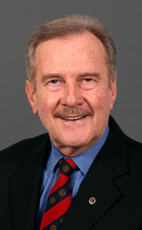
House of Commons photo

Crucial Fact

  • His favourite word was respect.

Last in Parliament March 2011, as Liberal MP for York South—Weston (Ontario)

Lost his last election, in 2011, with 33% of the vote.

Statements in the House

Federal Accountability Act April 27th, 2006

Mr. Speaker, I was impressed with respect to the manner in which my colleague from the Bloc spoke regarding ethics and how it relates to managers and deputy ministers within the context of the workplace.

I note that the government is putting forward its accountability bill and focusing on that area of management and deputy ministers. The proposal would strengthen auditing and accountability within departments thereby bolstering the internal audit function within departments and crown corporations and keep it within the framework of ministerial responsibility.

Inasmuch as she has indicated, and I think quite appropriately, it is not a question of managers not respecting ethics and not knowing how ethics apply, but it is a question of how we, through the mechanisms of government, auditing, committees and how they report through committees, hold the system accountable.

I would like to ask the member if she could expand on whether she believes that this recommendation would in fact achieve what we all wish, which is for ministers and deputy ministers, through the committee structure and audit committees, and through the Auditor General, to be held accountable.

Petitions April 27th, 2006

Mr. Speaker, I have the privilege of presenting a petition from residents of Petawawa and Pembroke, just a little outside of York South--Weston, calling upon the Prime Minister to honour the early learning and childhood agreement for all the reasons entrenched in this petition.

Federal Accountability Act April 25th, 2006

Mr. Speaker, I apologize. I meant no harm when I said that it is nice to be recognized these days. It was an attempt at levity and once again it was a failure. I do congratulate you, Mr. Speaker, on your elevation to the Chair.

The member has given a very comprehensive overview of the legislation and the continuity of the development of legislation which in fact started in previous governments in terms of searching out that ultimate balance that we all desire in terms of open government, transparency and so on.

Perhaps the member would like to pursue one area a little bit further, given his extensive knowledge and background on the access to information component of the bill. In the last Parliament the access to information officer had prepared a report. The report was approved by committee. In fact, there has been extensive consultation on access to information.

Would the member care to comment on the suggestion that that aspect go to committee? Perhaps it could simply be presented as a bill because there has been so much consultation on it.

Federal Accountability Act April 25th, 2006

Mr. Speaker, I would like to congratulate the member for his overview of the accountability bill.

I spoke earlier with respect to the oversight nature of committees, in particular, as it relates to the public accounts and the estimates. I know the member has not had an opportunity to sit on committee but I might tell him that one of the goals of having transparency and accountability was to empower committees to have more oversight.

The proposition put forward in the bill is to create a parliamentary budget authority. Does he believe that, first, committees should have the responsibilities of oversight and, second, would he agree that to give the committees more capacity in the area of budgetary analysis would further reinforce the accountability of members of this Parliament?

Federal Accountability Act April 25th, 2006

Mr. Speaker, it is a very simple answer. The distinction at the present time is that the executive authority has privileged information. If we were more democratic, that privileged information would be less privileged and more generic to the House and to the institutions and structures of this House. If that reform is implemented and that path is taken, then it would naturally follow that there would be no distinction between the executive and legislative parts of the House. The legislation should cover us all as members.

Federal Accountability Act April 25th, 2006

Mr. Speaker, there is no question there is a shortcoming with respect to access to information that is even more extreme when it is applied to committees and members of Parliament. In fact the only mechanism that members of Parliament through committee have is to petition for information, which is the same right that every individual, every taxpayer and every citizen in this country has. In a way it is a fundamental strength that we are all equals.

The point I was trying to make is that we in the House have information that may not be available to the public. We may have a hint of issues that are developing that we should not have to petition. We should be able to simply put it on the record and that information should be supplied to committee in an appropriate manner.

The problem we have is that process and that level of accountability will be delayed because the access to information portion of this legislation will be further referred to committee. My suggestion would be that we should focus on it. It is one way in terms of accountability that we can enable members of Parliament to deliver more on accountability to the taxpayers.

Federal Accountability Act April 25th, 2006

Mr. Speaker, I will be splitting my time with the member for Davenport.

I would also like to take this opportunity to congratulate you on achieving your exalted position and the manner in which you have been adjudicating our proceedings thus far.

I have a comment with respect to the parliamentary secretary's characterization of taxes. I guess he would fundamentally disagree with Edmund Burke who has said that taxes are the price we pay for our passage toward a better world.

However, the subject at hand is accountability. I noted that the parliamentary secretary did not get into the role that members of Parliament could play in terms of heightening accountability, and I will attempt to address those concepts in my comments.

I am pleased to rise today, as the associate critic for democratic reform, to speak on behalf of all Canadians on the issue of accountability in government. I say I speak on behalf of all Canadians because I am certain that there is not one member, regardless of party, opposition side or government side, who does not believe that we all share a moral and ethical responsibility to extract from every dollar of expenditure a dollar's worth of service and value for the Canadian taxpayer. That should go without saying.

My colleague, the critic for our party, has very capably outlined the challenges facing us as parliamentarians to complete the accountability loop that was begun by the previous government. In order to develop some context for our own discussions and those of other speakers, it might be helpful to reiterate what in fact was done as a result of the sordid litany of transgressions, both professional and political, that were investigated by Justice Gomery.

First, as has been mentioned by my colleague and as a result of testimony provided to both the public accounts committee and Judge Gomery, which exposed the weakness in both internal and external audits back as far as 1995, the Liberal government restored the comptroller general's functions for each department and instituted internal audit policies. The role of the comptroller general had in fact been taken out by a previous Liberal government. The order of checks and balances did not recognize any partisanship. If there were weaknesses and mistakes made, they were made equally by both those governments.

That was changed as a result of the experience in 1995 and 1996 of internal and external audits not being followed up. This is important because what occurred was the systemic breakdown in the architecture of checks and balances. This was followed up by the political exploitation of the contract and award system, which is well documented by Judge Gomery.

To be clear, this was perpetuated by a small number of individuals. As Judge Gomery stated, and I quote once again, as my colleague did:

Canadians should not forget that the vast majority of our public officials and politicians do their work honestly, diligently and effectively, and emerge from this Inquiry free of any blame.

The government's accountability legislation picks up in several other areas where the foundation for accountability was laid, such as the continuation of the reform of financing for political parties, strengthening the role of the Ethics Commissioner, making qualified government appointments and cleaning up government polling and advertising. All of these were works in progress and are worthy of support.

Other parts of the bill have implications that warrant further review and should be sent to committee for further deliberation. I speak of two recommendations that both appear to be unduly bureaucratic. In fact, they cloud the historic and well-tried traditions of our parliamentary and justice system in a manner that is contradictory to the objectives of the government.

I am referring to the government's recommendation to create a “director of public prosecutions”. That unnecessarily and even seriously collides with the responsibilities of the Attorney General and even by its definition and characterization implicates on the time-tested principle of natural justice. Those believing in natural justice and human rights and equality before the law should be concerned with respect to the creation of a director of public prosecutions.

The other recommendation that deserves the even-handed treatment of committee is the establishment of a parliamentary budget authority. While the reasons given are laudable, and I quote from the bill, to “ensure truth in budgeting” and “to provide objective analysis to members of Parliament and parliamentary committees concerning the state of the nation's finances, trends in the national economy, and the financial cost of proposals under consideration by either house”, the advantages in creating yet another level of fiscal bureaucracy must be measured against whether the oversight capacity of committees as recommended by Judge Gomery and the Auditor General are in fact being vigorously enhanced by this recommendation to create a parliamentary budget authority.

It is my opinion that members of Parliament cannot and should not delegate away their accountability to what is becoming an ever more complex and intricate array of bureaucratic watchdogs. I believe it was Winston Churchill who said, “Watchdogs? Why yes, but who will watch the dogs?”

I would like to close by reminding Parliament most humbly that there was another work in progress that at least to some extent implicated on those abuses that were uncovered by the Auditor General and Judge Gomery. I am referring to the existence of what was described as a democratic deficit, where it was suggested that parliamentarians were either deliberately shut out or naively shutting themselves out of the process of policy development, evaluation and accountability.

In my short time in the House I have witnessed the efforts of all parties to take back responsibilities from unelected mandarins, lobbyists and the like that had been delegated away. Just one example of this trend was the establishment of the estimates approval process through the standing committee structure. As chairman of the Standing Committee on the Environment and Sustainable Development, I also found myself along with members querying whether the committee was being provided with the necessary investigative tools to carry out this responsibility with the capacity to follow through.

Under the mantra of parliamentary accountability much has been, and through this bill will be, accomplished. Let me make this one observation for the consideration of all hon. members. Let us not in combating the aberration of deceit, corruption and maladministration, pervasively create a culture where we forget that our parliamentary system is the foundation upon which the political, social and economic landscape of our country has been built. By all means let us do all within our power to assure Canadians that those parliamentary institutions and values are dynamic, democratic and flexible enough to reflect and protect the public trust.

This piece of legislation, if addressed in both manner of process and substance as I have tried to outline today, will be yet another step in that direction of accountability that Canadians want to see us take. Most important, it will empower their elected representatives to deliver on their great expectation to protect the public trust.

Federal Accountability Act April 25th, 2006

Mr. Speaker, I followed very carefully the comments made by the hon. member and I respect his knowledge of the process and the way things are done around this place.

One of the recommendations mentioned by the member, which does not have a great deal of content associated with it, is the appointment of returning officers. I think we would all agree that when we are dealing with the machinery of government it is important there is balance and total transparency, not the least of which is anything that is associated with elections and the electoral process.

In order to have that transparency and total objectivity during the electoral process, the recommendation has been made that Mr. Kingsley, the returning officer, should make the appointments. What process is the member suggesting would be in keeping with the kind of responsibility that his party and the government wishes to have in the whole electoral process, that transparency?

Kiyoshi Thomas Tsubouchi November 1st, 2005

Mr. Speaker, I rise today to express condolences on behalf of all members of the House to the family of Mr. Kiyoshi Thomas Tsubouchi whose life was most tragically taken away at the age of 83.

Mr. Tsubouchi was born in Vancouver, raised in Duncan and at an early age left school to help support his family. At the outbreak of World War II, he was sent to an internment camp in northern Ontario where, despite the difficult conditions, he received his high school diploma by correspondence.

After the war, he and his family moved to Thunder Bay where he worked for a logging company, again to help provide for his family. After his marriage to Fumiko in 1951, he moved to Agincourt from downtown Toronto where for 20 years he successfully owned and operated Apex Dry Cleaners.

Kiyoshi was a man of great determination who, along with his wife, sacrificed all for his family. Kiyoshi also loved sports, especially his beloved Maple Leafs, the New York Yankees and, of course, Tiger Woods.

He will be deeply missed by his children, David, Dan and Lynn, his grandchildren and relatives, and remembered as a wonderful father, friend and great Canadian.

Wage Earner Protection Program Act September 29th, 2005

Madam Speaker, I have a huge amount of respect for the member, in particular his experience at the provincial level. The subject matter in terms of the protection of pensions in bankruptcy and so on is extremely important. I congratulate the member for his intense presentation on that.

My question has to do with jurisdiction. I understand how the architecture of Bill C-55 concentrates on the issue of pension protection in bankruptcy, but in terms of the regulators and regulations there is as much a provincial role with respect to this issue. I wonder if there is a two-pronged response that could be made in addition to the contents of this bill.

Could the member please elaborate on what additional initiatives should be taken with respect to provincial jurisdiction? I know he has a great deal of background in that particular area.