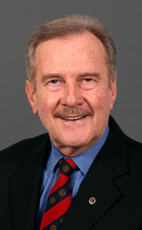
House of Commons photo

Crucial Fact

  • His favourite word was respect.

Last in Parliament March 2011, as Liberal MP for York South—Weston (Ontario)

Lost his last election, in 2011, with 33% of the vote.

Statements in the House

Grants and Contributions September 28th, 2005

Mr. Speaker, the HRSD standing committee recently reviewed the impact of new directives put in place in the awarding of grants and contributions in the Department of Human Resources and Skills Development. The committee heard dramatic testimony expressed by the voluntary sector that was heavily affected by these changes.

Would the Minister of Human Resources and Skills Development please tell the House what her department has done to address the concerns expressed by this most critical non-governmental sector?

Committees of the House June 28th, 2005

Mr. Speaker, I have the honour to present, in both official languages, the seventh report of the Standing Committee on the Environment and Sustainable Development. The report is entitled “Finding the Energy to Act: Reducing Canada's Greenhouse Gas Emissions”.

In accordance with the permanent mandate under Standing Order 108(2) and the motion adopted by the committee on November 23, 2004, the committee undertook a study and heard hearings on the subject matter of Canada's implementation of the Kyoto protocol and agreed to it on Tuesday, June 28.

The committee held nearly 40 meetings with respect to Kyoto. I am very pleased to present this report on behalf of the committee. I would like to thank all members of the committee. This is a report that outlines a strategy for the implementation and the accountability of the committee as part of it.

Civil Marriage Act June 28th, 2005

Mr. Speaker, I rise on a point of order. I seek the unanimous consent of the House to table a committee report.

Civil Marriage Act June 28th, 2005

Mr. Speaker, there would be none if gay and lesbian couples were part of the same civil union institution that was created to be accessible for all people. I suppose it is wrong-headed and I have tried to argue that had we started from that premise, it would not be necessary to fend and prove what values gays and lesbians cherish and value more than couples of the same sex who are married. It would be the blessing and the sacrament of the church that would be part of the freedom that the church enjoyed in granting that benefit. That would be protected equally by the courts.

The question unfortunately sets the stage for what I have tried to say is an unnecessary confrontation between perceived values. The member made a good point, but he also must admit that if it was an acceptable principle that same sex couples and those of opposite sex had the same values, then why would we find ourselves in the position that we are changing one and it has to be at the expense of the principles and values of married couples, of those who have a traditional attitude supported by their religious convictions as a marriage between people of the opposite sex?

My very short answer is that we would not be where we are. We would be talking about the same values, if we were talking about the same thing, which would be a civil union regime.

Civil Marriage Act June 28th, 2005

Mr. Speaker, first, I am a teacher by profession, not a lawyer, and there are many who I think have given very accurate and reasoned analyses with respect to the authorities that Parliament has inherited through its statutory responsibilities and the role that Parliament plays with respect to decisions that are made by the courts. The charter is a living document as part of the Canadian Constitution. We have seen just how alive it is in the most recent decision given by the Supreme Court with respect to health care, with the notion that the charter should not arbitrarily set in place a standard that would make it difficult for Canadians to have reasonable freedom of decision, a different concept of freedom and rights, and one again that we are attempting to fit within the architecture of decision making as established through Parliament.

I believe statutory law is very close to natural law, that there is the finite law and the written law, but it is up to Parliament to look at the overall higher interest and to develop statutory principles within which all Canadians, in fact all human beings within our country, can live. I would think that is the guidance we should be giving to the courts, by setting that higher ground in terms of a law that goes beyond legalistic and judicial law and is really based on traditional values and conventions that have stood the test of time.

Civil Marriage Act June 28th, 2005

Mr. Speaker, I thank the House for this opportunity to speak once again on this subject, Bill C-38, which proposes that the traditional definition of marriage, that which traditionally exists between a man and a woman, be changed to classify marriage as the legal equivalent to a civil marriage, which may be between two men or two women.

The fact is the bill tries to accomplish in one fell swoop what most Canadians would have preferred to have seen their Parliament do in two separate acts, instead of combining marriage and civil union in Bill C-38 and calling it civil marriage. Canadians would have supported the creation of the architecture of civil union, accessible to all Canadians, and separately protect the sanctity and sacrament of marriage as blessed and protected by the faith communities. The government, however, for reasons previously presented, decided not to assert its statutory responsibility to reaffirm the traditional definition of marriage, appeal the decisions of the provincial courts, and then set out to construct a true civil union regime.

For these reasons, Parliament missed the opportunity to interpret and wisely apply the words of the Canadian Supreme Court in describing the Canadian Constitution as a living tree, and root that tree in those same traditional and fundamental values that would serve both religious freedom and modern civil society.

Because we failed to do that, that is, to bring together all of our collective wisdom and parliamentary capacity and construct a bill reflective of the will and the needs of all Canadians, we are now, through Bill C-38, setting the stage for pervasive and divisive change, which up to this point in the discussion has not been given nearly enough consideration.

Time allows me to focus only on two areas as illustrations of practice and institutions that will be profoundly affected by Bill C-38, these being adoption and the public education system.

In some provinces, children's protective services, after decades of advocacy, were judicially granted to faith communities. In Ontario, for example, there exists a public children's aid society, but also both Jewish and Catholic children's aid societies. In this jurisdiction, and I use this as an illustration, when the relevant society is approached through an application for adoption by a couple of the same sex who are married but are at odds with religious and traditional teaching, it will be the courts who will pronounce upon what once again will be a matter of human rights, a confrontation between that same, but we believe erroneously applied, concept of human rights, which is the basis for Bill C-38. This will conflict with traditional spiritual and religious practice and teaching.

The second area is usually referred to as preach and teach, which is more than just protecting the hard-won rights of certain faith communities to develop curriculum in church-affiliated schools consistent with religious and spiritual values. While this is absolutely essential and itself will probably come under judicial assault, we must also be aware that the public school system, presently supported by many faiths, will be faced with contradictory attitudes toward marriage and sex education, compared with values taught in the churches, mosques, synagogues, temples, and homes of this nation. What long-term impact will this have on the institution of public education, which has been a force of cohesiveness across our land?

In both examples, adoption and education, I believe members can see that at a time when more social cohesiveness is needed, Bill C-38 will be taking us in exactly the wrong direction, by weakening these traditional practices and institutions.

To conclude, at a time when the world sees in Canada an example of a caring, tolerant, and compassionate society, and when one reflects on the legacy of institutional strength that generations of Canadians have fought and laboured to build and preserve, on balance, Bill C-38 is just not good enough, either in substance or in the process we have followed in developing it.

The most appropriate course of action, then, would be to defeat this bill and to begin the task of designing and constructing a true civil union that would respect the dignity, tradition, and lifestyle choices of all Canadians, but none at the expense of the others. This has been and should be the Canadian way.

Civil Marriage Act June 27th, 2005

Mr. Speaker, I will be voting no.

An Act to Authorize the Minister of Finance to Make Certain Payments June 21st, 2005

Mr. Speaker, I appreciate very much the opportunity to speak to Bill C-48 this evening. I have been reflecting on what impressions the Canadian people would have through what they are seeing with respect to this debate, particularly the last interchange and the comments made by the last speaker.

Something should be obvious in regard to the rhetoric that has been used in characterizing the government as corrupt and its record with respect to past budgets as abominable. To all of those informed individuals who are taking stock with respect to the impact on the Canadian public, they should be very honest in terms of recognizing that the members of the Canadian public have said two things.

First, they have said clearly that they want this government to establish clear priorities. Second, they want those priorities articulated through the budget and they want the budget dealt with. They will judge the government on the basis of that record of service through the budget to the Canadian public.

As for the polls, we do not do things solely by polls, but they are one of those instruments used to judge how people feel about what we are doing. It is clear from the polls that people want us to get back to basics with respect to reinforcing the institutions that Canadians have depended on, in particular through social programs and programs aimed at improving the environment.

Let us detach ourselves for a moment and talk to the Canadian people about what their priorities are, but not in terms of a continuous finger-pointing exercise with respect to corruption and so on. If we do this, the Canadian people in their collective wisdom will at some particular time take our record of accomplishment and our defence of those areas where we want to do better and we will be judged in totality.

I think that the fear on the opposition side, if I may say so, is the fear that we in fact will be relating better to the Canadian people than the opposition members will be. That will be based on how clearly we have articulated the needs of the Canadian people.

I find it very difficult to accept that these are not the issues the Canadian people want us to talk about when we talk about affordable housing and the impact of affordable housing as it relates to the homeless issues in the great urban communities across this country, or when we talk about post-secondary education and we have young people coming through here and reminding us. We had a lobby day, with the university students' association reminding us about the ever escalating debt that students are having to amass. When we talk about the concerns of post-secondary students, we are talking about the concerns of their parents in terms of being able to manage the aspirations and hopes that those people have.

Is that not getting back to the basics of what Canadians want to hear us talking to them about?

When we talk about the environment, look at Bill C-48 and see the extra $800 million that has been put into it, as that is relating to the ability of cities to manage their transportation and planning agenda in a more sustainable way, is that not what the Canadian people want to see us addressing through every particular instrument that we can mobilize and deliver upon to match the aspirations of those many hundreds of communities? Those are the issues that Canadians want to see us address.

This not just sleight of hand using a political manipulation. This is talking to the Canadian people. I think the opposition is afraid that we are starting to talk the right language to and the same language as Canadians.

Infrastructure June 6th, 2005

Mr. Speaker, St. John's, Newfoundland played host to the Federation of Canadian Municipalities annual conference this weekend, where municipal officials gathered to discuss their policies and priorities.

The new deal is one of those priorities because it means new funding for municipalities: $5 billion in gas tax revenue, $800 million in public transit and $1.6 billion for affordable housing. The mayors of Canada's 22 largest cities have called on Parliament to pass the budget. The new deal means building new partnerships. Would the Minister of State for Infrastructure and Communities please inform the House of what this relationship means in terms of achieving other governmental priorities?

Symbol for the House of Commons May 30th, 2005

Mr. Speaker, I was not going to speak to this but I feel compelled to, following the statement made by the last speaker.

I remember when I was teaching I brought a number of students here, as we have students in the Commons here today. One of the members was standing and speaking about the closure of one of our satellite and military stations upon which the local economy was tremendously implicated.

My students were quite befuddled by the fact that most of the members were either reading their newspapers or carrying on discussions. They were asking their teacher to give an explanation as to why there was this lack of respect, this lack of dignity for a member who was representing the views of constituents, as have been represented so often by members on all sides of this House on agricultural issues and farmers, and the issues we have had with respect to the closing down of postal stations.

I do not find at all the motion that has been put forward as empty symbolism. I do not know what empty symbolism is when it is talking about dignity and about being charitable with respect to the opinions of others and how we deal with them. I do not know what empty symbolism is when it is applied to this House in the context of what our public has a right to demand from us in terms of what they see and what they hear.

Should that be any different than what we expect to see and hear if we were in any classroom in this country, if we were visiting the schools, if we were engaged in local activities with respect to very high opinions and highly charged atmospheres back in our own constituencies? I recently experienced one where we had nearly 2,500 people on a single issue.

What I think is very important to emphasize is that there should be respect for the opinions that are being put forward and that ultimately the community, in its collective wisdom, if the process is transparent, up front and has integrity, would prevail. It seems that is the democratic process. That is what is represented by what we believe should transpire in this place.

I do not know what empty symbols are when they are applied to what we expect from ourselves as individuals from our institutions, be they represented in government at all levels through this House; be they the institutions of law, order and justice; be they the corporate institutions as represented by fiduciary responsibilities and so on.

All too often our public sees institutions that are eroded because the fundamental values that support them are not respected by the individuals who practice them.

Therefore, rather than the member having his motives or intent brought into question, the very process of discussing this motion adds credibility and integrity to this House, regardless of whether we think those symbols are empty or not. It would be my opinion that the symbol of this House is the respect for various opinions, our ability to put those forward, yes, in a partisan manner, but one that is charitable and cognitive of the rights of individuals to put those opinions forward and defend them.