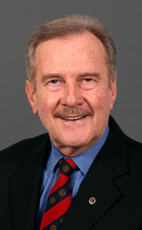
House of Commons photo

Crucial Fact

  • His favourite word was respect.

Last in Parliament March 2011, as Liberal MP for York South—Weston (Ontario)

Lost his last election, in 2011, with 33% of the vote.

Statements in the House

Committees of the House April 15th, 2005

Mr. Speaker, I have the honour to present, in both official languages, the sixth report of the Standing Committee on Environment and Sustainable Development.

In accordance with its permanent mandate under Standing Order 81(4), your committee undertook a study of the main estimates 2005-06, tabled in Parliament on Friday, February 25, 2005, and agreed to reduce vote 25 under Privy Council on Thursday, April 14, 2005.

Committees of the House April 13th, 2005

Mr. Speaker, I have the honour to present, in both official languages, the fifth report of the Standing Committee on Environment and Sustainable Development.

In accordance with its permanent mandate under Standing Order 108(2), your committee undertook a study of a draft report on the subject matter of Bill C-43, an act to implement certain provisions of the budget tabled in Parliament on February 22, 2005, and agreed to it on Tuesday, April 12, 2005.

Petitions April 11th, 2005

Mr. Speaker, it is an honour for me to present petitions signed by 200 Canadians. The petitioners pray that Parliament pass legislation to recognize the institution of marriage in federal law as being the lifelong union of one man and one woman to the exclusion of all others.

Committees of the House April 11th, 2005

Mr. Speaker, I am standing to support the amendment that has been moved, which is to give the committee another opportunity to look at the issues that have been raised here on the floor of the House, and that deal with the whole concept and process of an alternative dispute resolution approach.

I have been following very carefully the comments that have been made by colleagues on both sides. I make the observation that we have had an extremely contentious process in committee. Out of that process has come a report from the opposition. What seems incredulous to me is that this is a report that purports to do the best thing for those who have suffered the tragedy associated with residential schools. Those of course have been represented by our first nations.

We also have a very clear indication that not only does the Assembly of First Nations feel that there is very strong tenets within the alternative dispute resolution that bears further exploration but there also is, as has been pointed out, at least one other opposition party that feels that there are strengths, or at least parts of an alternative dispute resolution process that would help to come to grips with many of those issues that have come out of the committee's deliberations.

Here we are again debating an issue that came out of a process where there was not a clear consensus. This is clearly one of those kinds of issues where we ought not to be seen, nor should we be doing something that in a patronizing or paternalistic way is neither accepted in substance by the first nations people, through this report coming from the opposition, nor on the other hand should we be closing the door to a further consideration of some of the issues that have been raised. That is the reason why the amendment has come through in the manner in which it has.

It would be my position, and I say it with some degree of hesitation, because to the greatest extent my knowledge of those issues related to our first nations people has been through my attendance at the aboriginal affairs committee mainly through the last term. I have been following, though, the debate in this House today.

The report before the House shows that the hearings held by the Standing Committee on Aboriginal Affairs and Northern Development on the effectiveness and the government's alternative dispute resolution process failed to study this complex issue in a truly meaningful way.

I cannot help but bring forward again the observation or the inference that is drawn from that. It seems that the committee for whatever reason did not really explore the alternative dispute resolution to the extent that it should have and could have.

It also seems that some of the members were not as interested in a real understanding of the alternative dispute resolution because many of the stakeholders that came before the committee, I am told, were also interested in working to improve that particular approach which, I might add, is a work in progress.

The committee, with the momentum and the focus provided by mainly the opposition, actually undertook a series of very quick hearings. One could suggest that there was not an absence of bias in those hearings into what is an extremely complex and important issue. It is a very important part of our history, which is the experience that so many of our first nations people, too many, had with the Indian residential schools.

At best, the hearings held by the committee in February were incomplete. That is clear from a simple review of the list of witnesses called to testify at these hearings. At worst, the hearings had the ring of political bias, a bias at the expense, though, of a real understanding or a real study, a genuine attempt to understand not only what happened at so many residential schools but also to understand the work that has been taking place subsequently over the past number of years to address this terrible legacy.

I am told that the committee heard from several former students who were displeased with the process. Let me be clear, we recognize on this side that both criticism and discussion are necessary parts of a developmental and innovative approach to resolving this issue.

For this reason, last year the government provided specific funding support to both the Assembly of First Nations and the Canadian Bar Association, two extremely legitimate organizations, which together would examine the ADR process and offer up their views. If there were no bias, if we were totally objective, would we not have wanted to hear from those two organizations?

It is noteworthy that the analysis and study by both the AFN and CBA was undertaken over the course of several months, in stark contrast to the six hours devoted to hearings by the standing committee. The standing committee also heard from the National Consortium of Residential Schools Survivors Counsel, an association of lawyers with significant investments that they had made in time to litigate against the government. We did not hear from them.

As I said a few moments ago, criticism and discussion are a necessary part of an innovative approach, but are dissenting voices the only voices that merit attention? The government is aware that no process is perfect, but the more than 1,400 applications the ADR process has received to date are surely a sign that this process is taken as a real, viable option for a growing number of former students who have taken it up.

The ADR process continues to receive more and more applications each week. Its adjudicators continue to render decisions, the total of which now stands at almost $5 million. These decisions are made within 30 days of a hearing taking place and the hearings have taken place in private homes, at other locations in communities of former students, and in some cases, in hospital rooms.

I state that because the inference or the implication has been made that the process is very ex parte, that it goes on in confusion and in environments that are not accessible and so on. That is not the case. Health support is available to former students who may be in crisis. The funding is also provided for support persons to attend the hearing with the former student.

That is how the alternative dispute resolution is happening in practical terms. These are clear indications that the ADR process has much merit and the committee would know this if the hon. Ted Hughes, who was the chief adjudicator of the ADR process, would have had the opportunity to address the committee for more than a meagre 10 minutes.

This is really revealing I am afraid. Mr. Hughes had barely started his presentation when the hearing of February 22 was adjourned. He graciously offered to return to complete his testimony at the committee's convenience. The question is: was he taken up on the offer? Unfortunately not. I cannot imagine why because several committee members, including I believe two of our colleagues from the Bloc, made it clear that they wished to hear the rest of the presentation. But it never happened.

As I have stated before and has been stated in the House, the government is working closely with former students, representatives of the churches and other stakeholders, in particular the Assembly of First Nations, to examine ways in which the reconciliation and healing of the terrible residential school experiences of many aboriginal Canadians can begin.

This is difficult and important work. The government and many people are working together to both streamline the existing process as well as to explore other ways to reconcile the legacy of residential schools. It would be an understatement, and I believe that all sides agree in this respect, that far too many aboriginal Canadians and their families in turn suffered as a result of their experiences at residential schools. On this point, I am sure that all colleagues agree.

Therefore, we need to take the time and make the effort in as expeditious way as possible to appropriately and in a fulsome manner address the legacy of Indian residential schools. This means continuing to work with former students and our other partners and stakeholders to find ways to improve the processes that we have in place, and to consider the ways that they may indeed be supplemented.

This does not mean throwing out all of the work that has already been completed. This does not mean abandoning the more than 1,200 former students who have taken the time and the immense effort to complete an application, as has been pointed out, to the alternative dispute resolution process and whose hearings will be taking place over the coming months.

We must not truncate this process and leave these people adrift in terms of what we already have instituted. The government will not abandon these people and it will live up to the commitment to offer a supportive, safe and timely process which is an alternative to the courts. The government will continue to foster debate and discussion. If this amendment is approved, that process will continue in committee and the government will continue to work with partners and other stakeholders.

On behalf of the government, I will state unequivocally that the government will not and cannot support the report that has been put before the House through the opposition.

It is the government's opinion, I think shared by other parties in the House, that the report is the product of a hasty and superficial study by the Standing Committee on Aboriginal Affairs and Northern Development. Accordingly I will be supporting the amendment that would send the report back to the committee for further attention and study.

Canada Labour Code April 7th, 2005

Mr. Speaker, I am pleased and humbled to have the opportunity to speak to Bill C-263.

I appreciate the spirit in which the bill has been presented. Having spent a little over 30 years in municipal government, I have been very close to the negotiating scene in a variety of instances in private and public arbitrations and negotiations. I have seen the impact of labour strife when it occurs within a city or within a constituency and I appreciate very much the issues that have been raised.

The very delicate balance that exists with respect to the environment within which negotiations take place should be taken very seriously. The underpinning of natural justice is that each side in a dispute has an opportunity to have its rights represented.

With respect to the position put forward by my colleague who spoke before me, if we think of that level playing field in which the workers have the right to strike, the counterbalance to that in terms of the rights of the employer would be the right to still operate a business. As has been pointed out, the existing legislation provides for that balance. I would hope that we would not support this bill because it would skew the relationship and balance between employees and the right of employers to have their businesses continue.

First Nations, Métis and Inuit War Veterans April 5th, 2005

Mr. Speaker, I can assure our colleague who just spoke that in the annals of the history of this country there is no more respect that can be paid to any group than to those veterans who have given us the freedoms we enjoy today. There is no question that at any time it is appropriate to reassess where grievances have been made, from any source, with respect to the issues that have been raised on compensation of those who were demobilized, came back and were seeking to be part of the fabric of a country they protected and perpetuated.

I do think that when we are going through that process we should attempt to look at facts and use facts that have been established by a dialogue that was entered into, which really established with clarity what the situation is as it exists with respect to our Métis and our Métis veterans.

I do not want to repeat the remarks about the programs and the accessibility to those programs that my colleague from Halifax West has elucidated. I might remind the House that those were benefits that were available to all Canadians and all Canadian veterans returning from the wars, including aboriginal veterans.

Having said that, let me say there is no denying that for decades many aboriginal veterans, that is to say, first nations, Métis and non-status Indians, have alleged that they were not treated fairly by the Government of Canada after the wars.

In light of that, the government did respond. Four years ago, the government decided to bring all the stakeholders together to the table to investigate those concerns that are the subject of this bill, frankly, and that were expressed by the aboriginal community.

Let me say to my colleagues that in November 2000, and it probably has not been stressed enough, there was an effort to better understand and respond to the concerns of the first nations veterans. The federal government launched the national round table on first nations veterans issues, chaired by Grand Chief Howard Anderson.

The federal government established separate processes with organizations representing Métis and non-status Indian veterans to determine their post-war experience. The federal government provided over $400,000 to support that round table process. A key element of its work included individual file reviews conducted by Veterans Affairs Canada. The research centred on any difference in value between benefits paid to first nations veterans and non-first nations veterans and the value any discrepancy would have today.

While the file reviews, research and national round table discussions found that first nations veterans did receive demobilization benefits after the wars, those first nations veterans who returned to their reserve communities after the wars had to deal with an extra layer of bureaucracy in order to receive their demobilization benefits.

They were unable to deal directly with Veterans Affairs. Rather, they had to go through the Indian agent. For some, this differential treatment may have meant that they did not receive the benefits they should have received, so on June 21, 2002, the government announced its response to the national round table and the grievances of first nations veterans related to their treatment after the wars.

To that end, $39 million was set aside to offer up to $20,000 in tax free payments to first nations veterans who settled on reserves after the wars or to their surviving spouses. The payment was also available to estates where the veteran or surviving spouse passed away after February 1, 2000, the date the national round table process began.

The first nations veterans package was offered as a gesture of goodwill. The Government of Canada believes that it was a fair offer and is comparable to other payments offered to merchant navy veterans, the Hong Kong prisoners of war and so on.

Following the 2002 announcement, Veterans Affairs Canada, with support from the Indian and northern affairs department and the national round table working groups, carried out a comprehensive advertising campaign to ensure that first nations communities were aware of the payment package and the application process. A toll free number was also established to provide information about the payments and application process. To date, 1,195 of these payments have been made.

In order to address current and ongoing issues, Veterans Affairs Canada is developing an aboriginal outreach strategy aimed at facilitating communication and ensuring that eligible aboriginal veterans and their spouses are benefiting from the full range of VAC programs and services.

The Government of Canada, and it should be an understatement to say this, is grateful to aboriginal veterans and indeed to all veterans for their wartime sacrifice and is committed to fairness and equity in providing for all Canadians who serve their country.

As I said at the outset, I believe, in looking at this file, that the government has responded fairly to the concerns raised in the motion. I also would like to add that this is not where the story ends in capturing not only the substance of what the motion is identifying but its spirit.

We wish to advise members of the following. As part of our year of veterans' activities, the government has made a commitment to provide the National Métis Veterans Association with partnership funding to explore the history and the contributions of Métis veterans during and after the wars of the last century.

Veterans Affairs Canada is currently broadening its aboriginal outreach strategy to ensure that Métis veterans and their spouses are benefiting from the full range of VAC programs and services. The government has invited the National Métis Veterans Association to share a list of approximately 2,000 names of Métis veterans so the department can review their files and ensure that they are receiving the benefits to which they are entitled. This will also identify any Métis veterans who did not actually receive a demobilization benefit.

I would like to close by just simply saying that the Minister of Veterans Affairs has assured the Métis that the Government of Canada will follow through on these commitments.

President Chartrand of the Métis National Council said:

We are hopeful this will be Canada's important first step as a partner with the Métis Nation towards ensuring our Veterans will be properly respected for their service to our country and for their personal and family sacrifices.

He went on to say:

After the years of neglect and virtual abandonment of many of our service men and women there is some government action. The government has acknowledged that this issue must be dealt with fairly and quickly....

Because there may be no veterans in the future who will be the beneficiaries.

As for the motion, I think that while it is well-intended and we welcome these kinds of motions in spirit, I hope this debate has satisfied all in this House that the government has followed through on both the spirit and the substance of the motion in terms of the actions it has taken.

Committees of the House March 24th, 2005

Mr. Speaker, I have the honour to present, in both official languages, the fourth report of the Standing Committee on Environment and Sustainable Development.

Civil Marriage Act March 21st, 2005

Mr. Speaker, first, I will be opposing Bill C-38, an act respecting the legal capacity for marriage which was tabled by the Minister of Justice on February 1. However, I have appreciated hearing from and truly respect the opinions of all those who have contacted me over the past year.

This has been an incredibly difficult issue for all parliamentarians. We believe in the principle that the protection of the rights of individuals is in the higher public interest and it is central to our desire for an inclusive civil society. Throughout my many years in public life and in my private life I have applied this principle in decisions affecting both the public good and balancing the needs of individuals and minorities with the collective needs of society as a whole.

That link between individual rights and those of minorities is an exceptional difference in the Canadian democratic tradition, and this aspect is given further expression through the Canadian Charter of Rights and Freedoms. In addition, successive generations of Canadians who seek a society that embraces them and cherishes their customs and culture continue to nurture this principle and the result has been a spectacular Canadian mosaic.

Many then have found it surprising that it is these same people, Canadians who are liberal in nature, who now look for support from their government to reaffirm their values with respect to the definition of marriage. It is not surprising to me, for it is these very same people, many of whom are my constituents, who value the traditional definition of marriage as being consistent with beliefs that spring from the world's major religions.

The good news is, at the same time, most of those same people continue to believe, as I am sure we and most members of the House believe, that a tolerant civil society requires that lifestyle choices such as same sex unions should have legal entitlements consistent with precedents established in courts of common law.

It cannot be overstated that the Canadian experience of respect for individuals and minorities has been made possible because the majority of Canadians throughout our history have given their consent and support. In fact, the charter itself would not have been possible without the consent of the Canadian people through our parliamentary process.

Many Canadians are now telling their member of Parliament that they would prefer a resolution that would respect the traditional definition of marriage while at the same time protect the civil rights of those engaged in same sex unions.

In this high stakes issue I do not believe we have tried hard enough to balance the protection of individuals and minorities while at the same time respecting the values of a large majority of Canadians. If indeed our Constitution is as the court has stated, a living tree, then it must be considered that this tree is rooted in fundamental and historic values, one being the traditional definition of marriage as the basis for family life.

Critical decisions must be made on the basis that a cohesive society can only be maintained when the rights of the majority are at the very least given fair consideration when the government intends to change these fundamental and historic values.

It is my position that the government's legislation is incompatible with the sensibilities of the majority of Canadians in terms of both process and substance and that the bill presented by the government should not be supported.

My fear, as others have said, is that should the bill pass in its present form in the face of reasonable, continuing opposition from across the country, Canadians will emerge as just a little less tolerant and a little more cynical at a time in the history of both our country and our global community when we should be going in exactly the opposite direction.

This forced march toward altering values against the will of the majority is a slippery slope. It will undermine our image and our vision, both at home and abroad, that in such matters Canadians have always been able to achieve a consensus based on the reasonable middle way.

Up to this time, the legitimacy of same sex marriages has been decided on the basis of court rulings. I truly believe that matters of values, such as changing the traditional definition of marriage, are more appropriately the domain of the people. It appears, however, that it will be Parliament through its MPs, who will exercise their delegated responsibility, to grant the consent of the people for changing the traditional definition of marriage.

It is clear to me, and I believe to most Canadians, that we in the House have allowed the issue to pass the point of no return by leaving it to the courts to decide this issue for all of us because of parliamentary obfuscation. I truly regret that it is necessary to characterize the issue as an end run around legitimate and democratic consultation, but that is exactly what many Canadians believe has happened.

A fundamental and widely shared value such as the traditional definition of marriage should not be changed in the manner in which it has been presented to Canadians. As a result, after careful consideration, I will use my voice and vote to reflect what I believe to be the value of the majority of residents in York South--Weston.

Additionally, let me state that this also represents my own view that the protection of the traditional definition of marriage should not be incompatible with the protection of individuals who wish to enter into a civil union relationship.

To conclude, this issue is of such profound importance that those issues raised by all sides deserve, and indeed demand, further exploration. For this reason alone, defeat of this bill would signal to Canadians that for this issue the search for common middle ground is worth trying for.

Justice not only can be done with respect to protecting both minorities and the traditional definition of marriage, but if we are to maintain a continuing tolerant and civil society, justice must be seen to have been done.

The Environment February 24th, 2005

Mr. Speaker, on Tuesday the House Standing Committee on Environment and Sustainable Development had an opportunity to engage in a green dialogue with the Minister of Public Works and Government Services.

Would the minister share with members of the House his comments regarding this committee appearance, particularly the role his department plays with respect to the greening of government operations?

Supply February 17th, 2005

Madam Speaker, I have no problems with plagiarizing because really, plagiarizing is only a sin if one does it and does not admit to it.

In mentioning the plan, I have said that there are many elements of the position that have all-party support. I listed what they were and that should stand on its own.

The second thing is with respect to a plan. We do have a plan. The fact is we had a plan in 2000 and we had a plan in 2002. There really was not the degree of collaboration that should have taken place in establishing that plan.

The environmental and sustainable development committee is having that collaboration now. It is my hope that at the back end of that process and with the budget that will come out very shortly, the committee will use its oversight function. The committee will be able to compare what is being done with many of the suggestions that will be brought forward, including elements of the NDP's plan and those of the other parties to see whether further corrections are required. That is the approach. That is the process.

I tried to give a historical overview of my understanding of how we entered into negotiations in good faith. We have accomplished a great deal with respect to the automotive sector. We should let that play itself out because it has served us well in the past.