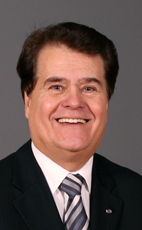
House of Commons photo

Crucial Fact

  • His favourite word was health.

Last in Parliament March 2011, as Liberal MP for Pierrefonds—Dollard (Québec)

Lost his last election, in 2011, with 31% of the vote.

Statements in the House

Norad May 3rd, 2006

Mr. Speaker, the first question is in regard to the extension for 12 months of the current ratification. I disagree with this because it is just going to postpone the maritime security aspect. I think it is very important that the maritime aspect should be included in this Norad agreement.

As for the second question, I am one of the members who totally disagreed with BMD. I will always disagree with Canada's participation in BMD, with a liberal but. The wording may have been included, but I do not think that is what it means. The member may have a different opinion about it, but my party, the one I have been with since 1993, has always disagreed with Canadian participation in BMD.

Norad May 3rd, 2006

Mr. Speaker, this ratification has already been agreed to by the current government and we would have liked, if possible, to discuss it before ratification. It is the first time it is done in this fashion by the present government. In the year 2003 we passed a motion in the House to go ahead with the modernization of Norad in a certain way because it needed to be modernized and there is no doubt that we should be part of Norad.

I really feel that any discussion should be held before a ratification is sought. This treaty is quite easy because both the government and the official opposition agree with the treaty in the sense that we support Norad. It is very important to support it in all its scope including the maritime aspect. However, in the future, I hope the government will come to the House for this discussion prior to ratification.

Norad May 3rd, 2006

Mr. Speaker, I am pleased to take part in the debate tonight about the ratification by the government of the North American Air Defence Command Agreement, Norad. To begin, I will say that I welcome that ratification, particularly because the previous agreement will expire on May 12, in nine days.

Certainly the government can be accused of signing this agreement by stealth, and then afterward having it ratified by Parliament.

Nonetheless, Canada and the United States cannot do without Norad, and our two countries, more than ever, must work hand in hand to provide for our continental defence. That defence must include the maritime component, because since the events of September 11, 2001, no one can predict where, when and how another attack will occur. No matter who is in government, we have a moral duty to protect our country and our continent against all attacks.

Canada has been a party to Norad since it was created in 1958, and because of the cost, but also the exchange of information, it cannot decide to go it alone.

Some members have said that this agreement should first be studied by the defence committees of both Houses, but the members of those defence committees have visited the Norad facilities in Colorado several times in the past. The Liberal members were more than satisfied with the importance of Norad and the role it plays in combating terrorism and protecting our country.

However, it should be said, parenthetically, that Norad’s role must not be confused with the role of antimissile defence.

On August 5, 2004, Canada and the United States amended the Norad agreement to allow the American command units responsible for ballistic missile defence to perform a function that the organization had performed for nearly 30 years.

The Minister of Defence at the time said then that the agreement did not mean that Canada was joining the missile defence program. On the contrary, the Liberal government’s position at that time was that they had agreed to the amendment because the Americans were about to construct an air space defence system that would have made Norad obsolete.

In early 2004, Ottawa discussed Canada’s possible participation in an anti-missile defence program. One of Canada’s conditions for joining such a program was that Norad should play a major role in its implementation. These negotiations followed a motion passed in the House of Commons in 2003 aimed at conferring on Norad the responsibility for creating “any system developed to defend North America against ballistic missiles”. Some Liberal members voted against this motion at the time because the word “any” left the door open to the weaponization of space.

It is important to note that the amendment made to the Norad agreement on August 5, 2004 preserved its function as a missile warning institution that should not be confused with its missile defence functions.

On February 24, 2005, the previous Liberal government informed the United States that Canada would not participate in the American missile defence initiative. The Prime Minister of the day had said that Canada would only join a missile defence program if it served our interests, specifying that he was against the weaponization of space.

The modernization of Norad involves two major changes: first, the agreement will be perpetuated and a four-year evaluation period established, rather than the usual modernization which takes place every five years; then, as I mentioned, the tactical warning and surveillance functions will be expanded to include maritime security.

The Liberal Party supports the expansion of Norad's missions to include the defence of maritime regions. Last year, the previous Minister of National Defence stated before the Maxwell School of Citizenship and Public Affairs in Syracuse, New York:

We believe that it is an appropriate time to consider the possibility of expanding our current defence cooperation to include maritime and land-based elements.

That is why the members of the official opposition will support this ratification.

RESUMPTION OF DEBATE ON ADDRESS IN REPLY April 10th, 2006

Mr. Speaker, I will be sharing my time with the hon. member for Markham—Unionville.

Since this is my first opportunity to address the House in this new Parliament I want to express my gratitude to the people of Pierrefonds—Dollard who gave me their confidence for the fifth time by renewing my mandate. I promise to continue to defend and serve their interests to the fullest. I also want to commend the hon. members from all the parties who were re-elected and those who are sitting here for the first time. Public service is a noble commitment that requires the best of one's self. I want to assure my colleagues of my full cooperation in any matter promoting the general interest of our fellow citizens.

The Conservative government delivered a Speech from the Throne last week that, unfortunately, is sorely lacking in concrete measures to adopt to improve the lives of the citizens of our country. It is nothing but empty words, a list of platitudes—there is absolutely nothing tangible in it. I find it highly regrettable, since Canadians could have expected a lot more from a brand new government that got elected by promising a lot more.

There is nothing new in this throne speech about accountability, for example. It was the Liberal government that took the initiative to issue very clear guidelines to protect federal public servants who blow the whistle on misappropriations and those who commit them. It was also the Liberal government that took the first step to adopt stricter measures for lobbyists who have previously worked in government. The same goes for party financing, since in-depth reforms were initiated by the previous government in order to ensure better transparency and greater integrity.

It was also the Liberal party that undertook to enhance the autonomy of the auditor general, since the government was determined to ensure integrity in public finance management by correcting what needed to be corrected and by prosecuting anyone who broke the law. What concrete measures is the Conservative government proposing in order to go further in this direction? Once again, there is absolutely nothing in the Speech from the Throne on this matter.

The Conservative government gives us only hollow words as if it were afraid to make a real commitment. We must note, of course, the eagerness with which this government took credit for measures that had actually been taken by the previous, Liberal government. Furthermore, this government claims to consider that Canadians pay too much income tax. In fact, it is not at all the interests of the average citizen that the Conservative government wishes to defend but rather those with large fortunes. As evidence, I refer to the GST reduction of 1%. Is anyone going to benefit from this more than those who can buy luxury cars and big new houses for themselves? This measure will have only a microscopic effect on the income of average or low-income citizens. These are the people, though, that a government worthy of its name should be favouring. No major measure was announced in the Speech from the Throne to lighten their burden.

Finally, the government has inherited a very strong economy, which is the result of the economical and responsible management approach assumed by the Liberal government throughout its mandate, and which was clearly beneficial for the vitality of the Canadian economy. It is therefore the economic heritage of the Liberal government that made the accumulation of a large budget surplus possible for the federal government, and this is what enabled the federal government to invest in our social programs, in health and in everything concerning the betterment of citizens.

Even more seriously, there is absolutely nothing in this Speech from the Throne to provide support for middle-class citizens and those most in need, notably where affordable housing is concerned. This government is deliberately forgetting that one of its most essential duties is to act to improve the living conditions of these significant parts of our society. No one should be sidelined in a country as prosperous as Canada. Nowadays the government has the means to do better, notably thanks to the healthy Liberal management of the past decade, but we cannot but conclude that it refuses to do so.

The government has also announced that it plans to fight crime more vigorously, but the directions it is advocating in this regard are retrograde, not to say reactionary, designed basically to please the ultraconservative electoral base that helped elect this government. The government is inspired far too much by measures prevailing in the United States, where we observe that the greater the repression is, the more the number of violent crimes soars. The Liberal government, however, had taken tangible action to reduce crime. Canadians recognize themselves fully in the measured and responsible spirit of the Liberal government’s policies respecting justice, since they reflected a real respect for people and recognized the rights of victims of crime.

The Conservative government should know that Canadians are opposed to the creation of a repressive police state which is a potential source of harmful human rights abuse, and they can count on the official opposition to promote and defend that principle.

With regard to young offenders, the Conservative government is simply promising an approach that will only increase crime, thereby perpetuating if not feeding the cycle of violence.

Instead of its exaggerated and essentially punitive, retrograde approach, the government should instead be making young people truly responsible by giving them a chance to escape the cycle of violence.

But the Conservative government is instead doing the opposite. It is proposing no concrete measures in that direction, not to mention the need to work to improve the living conditions of the most disadvantaged families.

With regard to child care services, the Conservative government is advocating an irresponsible approach, one which first of all destroys the consensus with the provinces established by the Liberal government, in the wake of laborious but judicious consultations.

In addition to making a direct intrusion in a field of provincial jurisdiction, the orientation taken by the government clearly compromises middle-class and more disadvantaged families, for if it is compared with its aborted predecessor, those families are net losers.

With regard to wait times in the health sector, the government is again making claims which violate a provincial field of jurisdiction. The Liberal government had been able to respect provincial jurisdiction, while substantially increasing financial support from the federal government.

Yet the Conservative government is saying nothing about federal funding, even though this is a real priority for Canadians.

In summary, the agenda of this government is a clear disappointment, as it offers no measures to respond to the concrete needs of our fellow citizens.

The government offers nothing concrete to improve federal immigration services, nothing concrete for health and post-secondary education, nothing concrete to improve the standard of living of the middle classes and the most disadvantaged.

Canadians deserve much better, and they can fully rely on the official opposition to remind this government of that fact.

RESUMPTION OF DEBATE ON ADDRESS IN REPLY April 10th, 2006

Mr. Speaker, I thank my colleague from Quebec. I would like to congratulate her on her re-election.

In her speech, she said she supports the integration of Quebec into international institutions, probably based on the model of the Francophonie. In fact, Quebec and New Brunswick can act on their own behalf during Francophonie summits and at other international events.

My question concerns UNESCO. As we all know, this is a UN body in which only countries have the right to vote. What solution does the hon. member propose to help our government, so that Quebec may be fully recognized at UNESCO?

Committees of the House November 23rd, 2005

Mr. Speaker, I have the honour to present, in both official languages, the seventeenth report of the Standing Committee on Foreign Affairs and International Trade. Pursuant to the order of reference of Monday, November 21, 2005, the committee considered Bill S-36, An Act to Amend the Export and Import of Rough Diamonds Act, and agreed on Tuesday, November 22, 2005, to report it without amendment.

Question No. 211 November 4th, 2005

Is the mandate of the Patented Medicines Prices Review Board (PMPRB) to protect Canadian consumers by ensuring that prices charged by manufacturers for patented medicines are not excessive and, if so, is the PMPRB exceeding its mandate by regulating prices of patented medicines that are being sold to non-Canadians outside Canada?

Interparliamentary Delegations October 27th, 2005

Mr. Speaker, pursuant to Standing Order 34(1), I have the honour to present to the House, in both official languages, the report of the Canadian delegation of the Canadian Branch of the Assemblée parlementaire de la Francophonie, or APF, on its participation in the meeting of the Bureau of the AFP, held in Brussels, Belgium, on July 5, 2005, and the 31st annual session of the APF, also held in Brussels, from July 6 to 9, 2005.

Committees of the House June 28th, 2005

Mr. Speaker, I have the honour to table, in both official languages, the 16th report of the Standing Committee on Foreign Affairs and International Trade concerning the participation of the state of Israel in the proceedings of United Nations organizations.

Petitions June 27th, 2005

Mr. Speaker, pursuant to Standing Order 36, I would like to present a petition signed by people from the island of Montreal on respect for the human rights of the Palestinians.