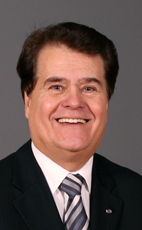
House of Commons photo

Crucial Fact

  • His favourite word was health.

Last in Parliament March 2011, as Liberal MP for Pierrefonds—Dollard (Québec)

Lost his last election, in 2011, with 31% of the vote.

Statements in the House

Jannick Lecavalier-Rodrigue October 18th, 2006

Mr. Speaker, it is with pride that I draw attention today to the merit of a young 15-year-old student from my riding, Jannick Lecavalier-Rodrigue. Jannick is a brilliant and exemplary student who is working hard to succeed in school and to develop all his skills.

He was selected as the only Canadian participant at the 2006 Pacific Rim International Camp that took place in Japan August last. Each of the 11 countries at the camp is represented by a single teenager and Jannick was selected as the representative from Canada.

The purpose of the Pacific Rim International Camp is to promote cultural appreciation and international friendship through mutual understanding, allowing the young participants to experience both traditional and modern Japan.

My congratulations go to Jannick Lecavalier-Rodrigue, whom I commend for preparing himself to become a young Canadian citizen open to the world and able to spread, at home and abroad, the human and social values unique to the citizens of this country.

Interparliamentary Delegations October 4th, 2006

Mr. Speaker, pursuant to Standing Order 34(1), I have the honour of presenting to the House, in both official languages, the report of the interparliamentary delegation of the Canadian section of the Assemblée parlementaire de la Francophonie, which met with officials of the Secrétariat général of the APF in Paris, on May 19, 2006, and which travelled to Amman in Jordan, Jerusalem in Israel, Ramallah on the West Bank and Damascus in Syria, from May 21 to 26, 2006.

Veterans October 3rd, 2006

Mr. Speaker, on June 11 I had the privilege of attending the unveiling of the veterans' wall of remembrance, at the Rideau Memorial Gardens in Dollard-des-Ormeaux, on which are inscribed the names of 1,299 men and women who served our country.

I wish to thank everyone who made this ceremony possible and to express my sincere gratitude to our veterans for the inspiration they provide to our present and future generations.

This wall reminds us of the sacrifices made by our military in order for all of us to live in freedom and dignity. We should always remember that democracy and freedom cannot be taken for granted and that, on the contrary, they require the vigilance and commitment of each and every one of us.

I would like to take this opportunity to thank all members of our military who are presently on duty around the world. We are proud of you.

Petitions September 21st, 2006

Mr. Speaker, pursuant to Standing Order 36, I wish to present a petition signed by residents of my riding of Pierrefonds—Dollard concerning the age under which our children have to be protected.

These petitioners are calling upon the Parliament of Canada to raise the age of sexual consent from 14 to 16 years for our young adolescents, to protect them from sexual exploitation by adult predators.

Development Assistance Accountability Act September 19th, 2006

Mr. Speaker, it is an honour for me to express my full and unconditional support for Bill C-293 introduced by my colleague, the member for Scarborough—Guildwood. This bill fully addresses Canadians' concerns about the international aid Canada provides. That is why we should not only salute the initiative by the member for Scarborough—Guildwood, but also support its implementation.

Because of my various parliamentary duties, especially on the Standing Committee on Foreign Affairs and International Development, I have long had the opportunity to talk with Canadians about this important issue, which concerns our country's commitments and responsibilities in the world.

Whether from members of the public who take the time to express their views individually or from associations involved in international aid and businesspeople, we always hear the same message, stated loud and clear. Our resources must be allocated with greater concern for effectiveness, transparency and good democratic governance.

In practical terms, this means that the vast majority of Canadians not only feel concerned by this major issue, but also demand that our international aid really promote the values that characterize our country. We must work to ensure that Canadian aid initiatives abroad are better targeted so that our country really attacks the poverty that afflicts so many peoples that are part of the human race.

Incidentally, young people strongly support this objective, as evidenced by the large number of international solidarity organizations that are found across the country, even in schools, and that youth intuitively gravitate towards, often very early in their education.

Our youth are therefore sending a very strong message that we as parliamentarians must listen to, because they represent the future of our nation and its role in the world.

In today's world, where so much economic, technological, scientific, cultural and democratic progress has been made, it is scandalous that peoples in whole areas of our planet still suffer such extreme poverty that they do not even have the bare necessities of life.

A long time ago, our government and others, as well as multilateral organizations such as the UN and many more, declared that they would work towards reducing poverty. However, as we have seen, it is not enough to make a declaration. Concrete action is required to achieve real results. In this regard Bill C-293represents a true step forward because it unequivocally states that “all Canadian development assistance abroad is provided with a central focus on poverty reduction”. This is crystal clear.

If passed in its present form, as I dearly hope, this bill will give us a legislative tool enabling parliamentarians to better oversee Canada's efforts to reduce poverty. This bill also seeks to provide better means of assessing the true impact of our international aid, in a context where accountability for management of public resources is increasingly important in the conscience of our citizens, and will lead to greater transparency.

Transparency is required for the Canadian government to provide its citizens with a clearer account of its management of international aid. I mentioned the goal of poverty reduction. However, there are other crucial aspects of this bill which make our support all the more important. These include the requirement to respect international human rights standards. Canadians are very clear on this issue: they do not want international aid to support oppressive political regimes that do not respect human rights, the rights of workers or the duty and obligations of any democratic country with respect to its citizens.

The state must seek to improve the well-being of its citizens. It must have no other purpose. Thus, international aid must never be used to line the pockets of tyrants who are incapable or unwilling to take on such a responsibility and one that we cannot shirk. This bill also requires the government to ensure that the criteria for Canadian foreign aid include respect for the principles of sustainable development.

Concerns regarding responsible management of natural resources and environmental conservation are also an important focus of our fellow world citizens, for today and the future, as well as the responsibilities they demand of their governments in those areas.

This is actually a matter of clarity or common sense. We see it all too often these days: the planet's ecological balance is seriously threatened by the destruction of resources and pollution has crossed our borders, only to now affect us.

In that sense, we Canadians are connected to everyone else on the planet, whether we like it or not. In terms of environmental degradation, the future of our entire species is at risk.

We must therefore take action in this area, as well, or we would be reneging on our responsibilities to future generations, who are just as entitled as we are to live in a healthy ecological environment.

This is why it is so important to include this element in Bill C-293, since we can no longer avoid this aspect of international aid. The issues inherent to human development are becoming increasingly interconnected, and resolving one depends more and more on resolving the other.

In conclusion, this bill contains an essential element of our international aid that not only must become an integral part of the responsibilities of any government in the world today, but that also addresses the concerns and desires expressed by so many of our fellow citizens. Accordingly, it is the duty of this Parliament to pass this bill and we should be privileged to do so.

Afghanistan September 18th, 2006

Mr. Speaker, according to the Prime Minister's office, the problem is that the Minister of National Defence forgot his text that day.

The real problem is that the government has to completely rewrite its text. The government promised that the Minister of Foreign Affairs, the Minister of National Defence and the Minister of International Cooperation would report regularly to this House. Where are these updates? We are waiting. If we do not have these reports, is it because the ministers in question do not know what is happening or is it because the Prime Minister is afraid his ministers will contradict each other?

Afghanistan September 18th, 2006

Mr. Speaker, the Minister of National Defence recently stated that we cannot defeat the Taliban. This is a shocking statement, considering that last May, this same minister stated that the Taliban were losing the battle. The government previously said that it was focussing on the military aspect of the mission, at the expense of diplomacy and development assistance.

Was the Minister of National Defence misleading the House last May by concealing the fact that he felt victory was impossible, or has the situation in the field altered so drastically since May that he has changed his mind?

Aboriginal Affairs June 21st, 2006

Mr. Speaker, if it is a question of $5 billion for aboriginal peoples or $5 billion for the GST, I choose the health of aboriginal peoples.

The infant mortality rate for native communities is 20% higher than for the rest of the Canadian population. The incidence of type 2 diabetes is three times greater and the suicide rate, in certain communities, is ten times higher than in the rest of Canada.

The Kelowna accord was a first step towards addressing these problems as it provided $870 million over five years for the First Nations and Inuit Health Branch, and a further $445 million to increase the system capacity.

Can the current government inform us of its concrete alternative solution—?

Aboriginal Affairs June 21st, 2006

Mr. Speaker, today is National Aboriginal Day. And, yet, this government is providing very little reason for the first nations communities to celebrate.

While age-old diseases are making a comeback within certain aboriginal communities—I am talking about the cases of tuberculosis in Garden Hill, Manitoba—the consequences of the negative actions by this government are worse than if it had done nothing at all.

Why did this government renounce the signature of the previous government at the bottom of the Kelowna accord, which allocated $1.3 billion to prevent situations like the comeback of tuberculosis in Garden Hill?

Governor General's Caring Canadian Award June 15th, 2006

Mr. Speaker, I would like to pay tribute today to William and Marion Grandin, and also Fay Bland, who are all from Dollard-des-Ormeaux and recipients of the Governor General's Caring Canadian Award. All three have carried out some exceptional projects in order to help children and young adults with intellectual disabilities from throughout Quebec.

These projects include the Outdoor Art Show created in 1959, the establishment of the John F. Kennedy school for children requiring special education, the creation of workshops, the creation of the Lakeshore Association for Retarded Citizens and the Lakeshore Vocational Projects Association, which restored hope to families, in addition to Apprentissage à la vie autonome/Towards Independent Living, a project designed for people over 40.

These are their achievements and these people deserve our recognition for never begrudging their time or effort to improve the situation of persons with disabilities.

We thank, Mr. and Mrs. Grandin, and we thank Ms. Bland.