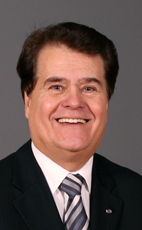
House of Commons photo

Crucial Fact

  • His favourite word was health.

Last in Parliament March 2011, as Liberal MP for Pierrefonds—Dollard (Québec)

Lost his last election, in 2011, with 31% of the vote.

Statements in the House

Foreign Affairs May 10th, 2007

Mr. Speaker, the Minister of Foreign Affairs refused to shed any light on the scandalous situation that occurred in his caucus.

The member for Mount Royal introduced a motion in committee to, first, denounce the Iranian president's explicit call to annihilate Israel and, second, to ask the Canadian government to ensure that the International Criminal Court conducts an inquiry.

Did the Conservative members of the committee vote against the motion at the request of the Minister of Foreign Affairs?

Petitions May 2nd, 2007

Mr. Speaker, pursuant to Standing Order 36, I have the honour of presenting a petition signed by nearly 2,000 Canadians from across the country. These petitioners call on the Parliament of Canada to require Canadian businesses operating abroad to respect the environment and human rights before they can receive any financial assistance from the Canadian government.

Afghanistan April 30th, 2007

Mr. Speaker, this is pathetic. The government knows that over half the NDS personnel are former KHAD fighters from the Soviet era, notorious killers and torturers who were trained by the KGB.

Human Rights Watch has called on the government to work with NATO to develop a common policy and get involved in all stages of the detention process.

Why has this Conservative government covered this up and ignored the recommendations of Human Rights Watch?

Afghanistan April 30th, 2007

Mr. Speaker, we are stunned by revelations that the Conservatives knew five months ago about torture in Afghanistan.

The Minister of Public Safety boasted that there was no need to worry about the 40 detainees in the custody of the NDS, the Afghan secret police. Last November, Human Rights Watch said that the NDS was an irresponsible, abusive institution whose detention centres did not meet international standards. Why did the Minister of Public Safety boast on Friday about turning Canadian prisoners over to the NDS?

National Volunteer Week April 24th, 2007

Mr. Speaker, National Volunteer Week took place from April 15 to 21.

I want to express my sincere appreciation to all the volunteers in my riding who, through their individual efforts and their many associations and organizations, contribute actively to improving the lives of people throughout our community.

This year's theme was “Volunteers grow community”. I feel that this theme is very appropriate and very much appreciated, because volunteers give a great deal of their time and energy to help people with all sorts of needs. Volunteers transform our community into a great place to live. And thanks to their kindness and generosity of spirit, our volunteers truly grow and better our community.

The contributions of these outstanding citizens and their organizations deserve to be fully recognized. Without them, the very soul of our community life would be diminished. We offer them our heartfelt thanks and appreciation.

The Budget March 27th, 2007

Mr. Speaker, as for credentials, if he is talking about professionals such as engineers and doctors, as a doctor myself I agree with him in the sense that we do not do enough. The Liberal government started to do something about it, but in the current budget there is nothing at all about this.

There is a problem concerning this. In my own province of Quebec this is a provincial jurisdiction and it is quite difficult, but if we do not tackle the problem, we are never going to succeed and the government has failed in this budget.

The Budget March 27th, 2007

Mr. Speaker, I want to thank the hon. member for Victoria for her question.

She said that the previous Liberal government did nothing for the least fortunate in society. I simply want to say to her that after curbing the deficit, which had reached $43 billion in 1993, we made the most significant income tax cuts this country has ever seen; $100 billion over five years.

In this budget, there are no tax cuts; there are tax hikes. When the Conservative government was elected in 2005, the tax rate for the first bracket was 15%. It was then increased to 15.25%. This year this figure is 15.5% on the first $35,000 of income. The non-taxable portion for individuals has increased as well. Taxes have therefore increased, which is the complete opposite of what we, the Liberals, did.

As far as the hon. member's question on Bill C-257 is concerned, I would like to tell her that I personally voted against it, but I that I did vote in favour of the bill in principle. I voted against the bill because it was incomplete and the essential services were not clearly defined. If we get a bill with the essential services and it is a complete bill, I will very likely change my vote. In my opinion, it is important for bills to be complete when they are passed in this House.

The Budget March 27th, 2007

Mr. Speaker, like many citizens across the country, I was extremely disappointed when I saw the details of this budget, which does very little, far too little, for the millions of Canadians who have a very hard time making ends meet.

This budget demonstrates once again the Conservative government's blatant lack of sensitivity towards ordinary Canadians, the very people who are working hard to provide for their families and for whom the tax burden is much too heavy. In fact, this budget contains no relief for such people, and that is the sad truth.

Instead, the Conservative government chose to favour those in the wealthier social classes. This should hardly come as a surprise, especially considering the Conservative government's ideological bias in favour of those at the top of the social ladder. Many Canadians were therefore baffled while taking a closer look at what is in the budget. Some of them had believed the Conservative Party promise, when, during the last election campaign, it said it wanted to introduce so-called “real changes” that were supposed to help them in their daily lives. These individuals' bafflement quickly turned to disappointment, because they felt, and rightly so, that they were entitled to receive much more than this budget delivers. The budget does nothing to improve their financial situation, which is already very difficult and tight.

For example, how can this government justify its budget when it allows individuals whose annual revenue is over $300,000 to pocket an additional $930, while there is absolutely nothing in the budget to improve the financial situation of most middle-class Canadians?

How can this government pretend that its budget is in the interests of average Canadians when people living on barely $40,000 for themselves and their families can find nothing in it to help them meet their material needs?

How can this government claim to have considered families at the bottom of the socio-economic ladder when mothers in single-parent families who work long hours for little more than $20,000 a year are not entitled to receive all the tax credits on the fallacious pretext that their incomes are too high? What is the Conservative government doing for mothers in this situation? Absolutely nothing.

How can this government pretend to be helping young couples with unstable jobs who are unable to find permanent employment or working conditions worthy of the name and who, with annual household incomes of barely $25,000 a year, were simply ignored in the Conservative budget, which failed to provide anything at all to help them help themselves and finally look forward to a more stable future?

The so-called universal child care benefit, which is neither universal nor for child care services, is fully taxable. The government will therefore recover an average of $400 per family. The 2006 child care plan was therefore a complete illusion.

These examples of hard-working Canadians who got absolutely nothing in the Conservative government’s budget are far from the only ones. There is a whole array of people who make our society productive and prosperous but were abandoned in this budget. It is clear to everyone that people like them cannot count on this government, which has absolutely no concern for them.

The Conservatives are implementing tax measures that seem helpful at first sight but the advantages they bestow are negated by the tax increases on low- and moderate-income Canadians that were hidden away in last year’s budget and still have not been rescinded. Instead of really dealing with the challenges facing Canadians, the Conservatives stuffed their budget with short-sighted measures aimed at helping them win a quick election that Canadians neither want nor need.

The very purpose of political commitment and, by extension, that of any responsible government, should always be to improve the living conditions of the greatest possible number of people and to use available resources whenever possible. This budget clearly demonstrates that the Conservative government does not share this view of public service and that it is acting only on behalf of one part of the population, and certainly not for the betterment of those experiencing the greatest difficulties or of the middle class which faces the highest tax burden.

Yet, Canadians know very well that the Conservative government inherited some of the healthiest public finances and very significant surpluses—as a result of the rigorous and prudent management of the Liberal governments between 1993 and 2006—that could enable it to do much better and do a great deal more for ordinary people.

Unfortunately, we are faced with a government that is squandering this potentially enormous resource by primarily favouring the wealthiest social classes.

We, the Liberals, have a better understanding of justice and social equity. Canadians will acknowledge this at the next election, when the Conservative government will be accountable to the voters.

As the member for Pierrefonds—Dollard, I am honoured to represent a very large number of immigrants who have become Canadian citizens. Like them, I am very shocked that the Conservative government has not kept its promise by refusing to establish a Canadian agency to evaluate and recognize credentials.

Every week I meet with these people who see their chances for social and economic integration in our country severely curtailed because their qualifications, although real, are not recognized. Many of them belong to professions in high demand in this country. That is an unfair waste of skilled labour. Many lives are ruined in this way.

Why did the Conservative government go back on a solemn promise made in the last election? How can the government renege on such a pressing commitment? Can these people trust the Conservatives another time? Above all, how can these individuals hope to take their rightful place in this country, especially since we need their talents and their skills?

This is tangible proof that the government has little interest in keeping a promise or in building a country that will be genuinely inclusive for those who choose to live here. In addition, this budget offers nothing to rectify the unacceptable delays that are building up for immigration applications.

In terms of family reunification cases, which drag on, naturalization proceedings, which take much too long, or the never-ending wait for asylum seekers, no concrete measures were taken in this budget to make life easier or to alleviate the legitimate concerns of thousands of people whose lives have been put in danger by the mismanagement this government's inaction encourages.

I have only mentioned a few from a very long list of examples which, in this budget, show how little this government cares about the real concerns of a very large category of our population.

I think the Government of Canada has a duty to serve the best interests of all Canadians. It is clear from the budget that the Conservative government holds quite a different view.

Canadians deserve much better from a government that has the resources to take action. For these reasons, I will vote against the budget.

Diabetes March 27th, 2007

Mr. Speaker, I would like to point out the importance of volunteers in the Canadian Diabetes Association, who help improve living conditions for more than two million Canadians affected by diabetes.

It is believed that, by the end of the decade, this number will be over three million. We should also remember that quality of life may deteriorate for these individuals and that they are susceptible to complications, mainly heart disease, stroke, kidney disease, blindness and limb amputation.

It is important to listen to the core messages of the Canadian Diabetes Association activists. People with diabetes should have timely access to medication, supplies and medical devices that can improve their immediate quality of life and that may decrease the likelihood of future interventions, which are often more costly and less effective.

People with diabetes have a right to timely, affordable and ongoing diabetes education and comprehensive treatment services provided by qualified professionals wherever they live in Canada.

All Canadians can learn from the dedicated volunteers of the Canadian Diabetes Association.

Jocelyn Coulon February 22nd, 2007

Mr. Speaker, I would like to highlight the recent appointment of Jocelyn Coulon to the Board of Governors of the International Development Research Centre.

Mr. Coulon is a visiting researcher at the Université de Montréal's centre for international research and study and director of the centre’s French-speaking network on peace operations research.

Mr. Coulon was director of the Montreal campus of the Pearson Peacekeeping Centre from February 1999 to December 2003 and director of international information at the daily newspaper Le Devoir from 1987 to 1989.

He is also well-known for his weekly columns on international politics in the newspaper La Presse, as well as for his frequent appearances as a commentator on television programs.

With his skills and credibility, Mr. Coulon is ideally suited to help the IDRC redefine its orientations and priorities.

Speaking for myself and as Chair of the Assemblée parlementaire de la Francophonie, I would like to offer him my hearty congratulations on taking up this new challenge. I have no doubt that he will be highly successful as he continues to serve our country's best interests.