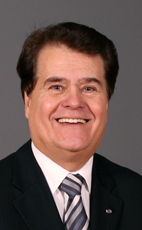
House of Commons photo

Crucial Fact

  • His favourite word was health.

Last in Parliament March 2011, as Liberal MP for Pierrefonds—Dollard (Québec)

Lost his last election, in 2011, with 31% of the vote.

Statements in the House

Interparliamentary Delegations February 14th, 2007

Mr. Speaker, pursuant to Standing Order 34(1), I have the honour to present to the House, in both official languages, the report of the Canadian Branch of the Assemblée parlementaire de la Francophonie, or APF, which participated in the meeting of the Bureau of the APF, held in Châlons-en-Champagne, from January 16 to 19, 2007.

Druide Laboratories January 31st, 2007

Mr. Speaker, I would like to salute the efforts that a company from Pointe-Claire, Quebec, Laboratoires Druide, is making to create sustainable jobs and reduce unemployment in Kabul, Afghanistan.

With financial support from CIDA's industrial cooperation program, Druide and an Afghan partner have set up a new plant to manufacture liquid soaps for personal and household use. And in keeping with Druide's environmentally friendly approach, the plant is producing certified organic products.

The Canadian-Afghan joint venture, called Florance, currently employs eight Afghan women and eight Afghan men and could expand in the short term.

I want to congratulate CIDA and Druide on their social involvement, which may seem minimal compared to the huge needs in Afghanistan, but is nonetheless extremely important.

Beaubois College November 28th, 2006

Mr. Speaker, it gives me great pride to pay tribute to an international youth solidarity initiative by Collège Beaubois, an elementary and secondary school in my riding of Pierrefonds—Dollard.

In March 2005, 16 students from the college took part in a cooperation project in Senegal, and the college is preparing to repeat the experience in March 2007. This initiative has a number of benefits, such as making young people more aware of the reality in a developing country and enabling them to achieve tangible results such as providing learning assistance for Senegalese youth and establishing lasting connections with Senegalese schools. It also provides an opportunity to raise funds for projects initiated by our youth.

The young people at Collège Beaubois deserve to be commended by this House for their sense of solidarity and for what they are doing in Senegal, which is enabling participants to be ambassadors of our country's values and ideals and helping them become responsible citizens committed to improving the lives of those around them.

We need to encourage them to keep up the good work and express our gratitude to them for what they have accomplished.

Health November 21st, 2006

Mr. Speaker, I am very happy to hear the minister himself say that he has no action plan.

The Conservatives have been in power for almost a year and they must take the blame alone. In fact, the only thing they can boast about in terms of health care is that they inherited our plan. Yes, we had signed a 10-year plan to improve health care. We had invested more than $41 billion in that plan, of which $5.5 billion was directed at reducing wait times in cooperation with the provinces and territories.

Why is there this delay? The plan is in place, the money is available and the report by Dr. Postl speaks for itself. Is the minister insensitive to the concerns of Canadians?

Health November 21st, 2006

Mr. Speaker, the Conservatives promised to establish a policy on wait times for heath care. Well, 10 months later, we are still waiting.

The commitment to reduce wait times is no longer among the five little priorities of the government. They have simply crossed it off the list, hoping that Canadians would forget it.

We learned today that wait times for cancer treatment are increasing dramatically.

Will the Minister of Health admit that his promise was nothing but empty words and that he had no intention of implementing a real policy for reducing wait times for cancer treatment?

Interparliamentary Delegations November 21st, 2006

Mr. Speaker, pursuant to Standing Order 34(1), I have the honour to present to the House, in both official languages, the report of the parliamentary delegation of the Canadian branch of the Assemblée parlementaire de la Francophonie that participated in the meeting of the Bureau of the APF in Rabat, Morocco, on June 29, 2006, and in the 32nd annual session of the APF, also held in Rabat, Morocco, from June 30 to July 3, 2006.

International Cooperation November 9th, 2006

Mr. Speaker, today, yet another Conservative minister was the laughingstock of the international community. The Minister of International Cooperation attended the Montreal Millennium Promise Conference. No new announcements were made. We have even taken a step back with respect to malaria.

Can the minister explain why she did not mention this subject during her speech? Why did she cut $18 million from the budget for equipment to fight malaria?

Is she unaware that mosquito nets are very effective at fighting malaria and saving lives, especially in Africa?

Interparliamentary delegations November 8th, 2006

Mr. Speaker, pursuant to Standing Order 34(1), I have the honour to present to the House, in both official languages, the report of the Canadian Section of the Assemblée parlementaire de la Francophonie, respecting its parliamentary mission to Port-au-Prince, Haiti, from September 5 to 8, 2006.

Pursuant to Standing Order 34(1), I have the honour to present to the House, in both official languages, the report of the Canadian Section of the Assemblée parlementaire de la Francophonie, respecting its participation at the Eleventh Meeting of the Heads of State and Government of Countries using French as a Common Language, held in Bucharest, Romania, on September 28 and 29, 2006.

Family Doctor Week October 31st, 2006

Mr. Speaker, I am very pleased to join my colleagues in recognizing Family Doctor Week in Canada from October 30 to November 5.

Every day, family doctors make diagnoses, treat patients, promote health and prevent illness, coordinate care and advocate on behalf of their patents.

They provide not only primary care, but also a great deal of secondary and tertiary care in many places: in their offices, in hospitals, in patients' homes, in seniors' homes and in other community facilities.

The College of Family Physicians will be holding its annual family medicine forum this week in Quebec City. Hundreds of participants and presenters will be in attendance.

I would like to personally thank all family doctors, and I invite all of my colleagues to support Family Doctor Week in Canada.

Canada Labour Code October 18th, 2006

Mr. Speaker, I think it is important for this House to give its full support to Bill C-257 for several reasons, including respect for and consolidation of labour rights, which seem to me to be the most essential elements.

In that respect, this bill is part of Canada's ongoing industrial relations evolution toward guaranteeing fairness and balance between the prosperity of our businesses and the rights of workers.

I would also note that this bill seeks to ensure that labour negotiations take place according to rules that do a better job than we have so far of guaranteeing civility and clarity in the best interests of all parties involved.

Only when all of the parties to a negotiation—or to a labour dispute, if that is the case—are governed by rules that guarantee respect for the rights of each participant can we ensure a process that will mitigate the severity of potential conflicts.

Better yet, clear rules and respect for the rights of the parties are often basic conditions required to avoid worsening the situation and escalating conflict.

That is why this bill deserves the attention and support of the hon. members of the House because it is our primary duty to foster harmonious labour relations, which, in the end, are always good for our prosperity and always benefit our fellow citizens as a whole.

The measures set forth in Bill C-257 establish important standards that will help us achieve these objectives.

We need this bill, or else the rights of workers, which we claim to honour in our legislation, will be ignored and lose all significance or reality.

What would be the purpose of enshrining the right to strike in our legislation if employers could easily keep up the production normally done by the striking workers?

Under these circumstances, the right to strike obviously loses all significance and our laws to protect labour rights would be devoid of any real meaning

As a representative of Quebec in the House, I can attest to the fact that it has been setting a precedent in our country for nearly three decades providing powerful, compelling proof of the benefits of the spirit of this kind of legislation.

Quebec labour law prevents employers from hiring replacement workers, commonly called scabs, when a dispute goes so far as a strike or lockout.

When this Quebec legislation was still at the bill stage, there were very strong and usually negative reactions to it.

There was every reason for this because the spirit of this kind of legislation obviously profoundly altered the labour relations culture that had existed since the beginning of time.

This episode proved that change—especially progress in an area as sensitive as labour relations can be—is never without some conflict and upheavals in the beginning.

However, once the Quebec legislation passed, it did not take all the parties long to find something in it for themselves, to such an extent that there has been a consensus around it for a long time. No one believes anymore that it would be in their best interest to challenge it.

Everyone realizes that when legislation creates unambiguous rules that clearly define and stake out the powers and rights of all parties, negotiations usually benefit, especially because they are a lot more efficient.

What this kind of balance of power does in any industrial bargaining is make it possible for the parties involved to better assess the interests they have in common in any labour dispute.

Employers then become aware of their employees’ interests, and employees are better able to grasp the importance of the company they are working for being able to continue operating profitably and competitively, so that everyone, employers and employees alike, can benefit by ensuring that the company they are working in continues to exist and continues to function.

I would reiterate, however, that to succeed in this scenario, which is based on preserving the commonality of interests and which always benefits both parties at the end of the day, the rules of the game have to be clear and based on the law, and so does the balance of power.

That is where Bill C-257 takes a novel approach, an approach that we must admit is necessary today.

And we have a precedent here in Canada, in the Quebec legislation that bears witness to the wisdom of the legislative action we are being asked to take by supporting the bill we are considering today.

That is why I would like to thank my parliamentary colleagues who have put their efforts into drafting Bill C-257 and introducing it in this House.

In doing this, they have not only done pioneering work at the national level, they have also laid down important benchmarks for the work that must still be done to bring about the kind of prosperity that will provide the greatest possible benefits for Canadians, employers and employees alike.

This is achieved by recognizing and consolidating workers’ rights, in a spirit that also recognizes the interests of our businesses. But we must also not forget the fact that a business is, first and foremost, the sum of everyone who works in it, employers and employees alike.

That is why the more that decisions made by a business are in the common interests of the parties who work there, the greater the guarantees it will have that it will be able to continue operating and that it will have a future.

It is because Bill C-257 reflects that recognition and that spirit that I have the honour of confirming that I will be voting for it.