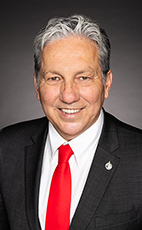
House of Commons photo

Crucial Fact

  • His favourite word was million.

Last in Parliament April 2025, as Liberal MP for Saint Boniface—Saint Vital (Manitoba)

Won his last election, in 2021, with 44% of the vote.

Statements in the House

Indigenous Affairs April 2nd, 2019

Mr. Speaker, members on this side of the House share the outrage of Canadians about allegations of the coerced sterilization of indigenous women. Coerced and forced sterilization is a clear violation of both human rights and reproductive rights.

There is no question the practice is abhorrent and cannot be tolerated. This should never happen to any woman.

As made clear by the Minister of Indigenous Services, the health and safety of indigenous women and girls is one of our government's highest priorities. Action is being taken on multiple fronts to ensure that all indigenous women receive culturally appropriate and safe health services.

For instance, ISC is investing in services such as the maternal child health program to support healthy pregnancies and reproductive health and rights. For the first time, these investments include midwifery.

The department is also strengthening prenatal support and education programs, including changes to the prenatal escort policy. This means that the safety of indigenous women is being improved by ensuring that every mother knows she is entitled to an escort at the time of her child's birth.

The Minister of Indigenous Services has responded to recommendations made in February 2018 at the Inter-American Commission on Human Rights.

The minister is working with indigenous partners to produce information material for health care providers and patients on proper and informed consent and issue guidance on reproductive health options.

In addition, the department has established an advisory committee on indigenous women's well-being to inform ISC of current and emerging issues in health and across the social determinants of health, with a focus on sexual and reproductive health and rights.

The advisory committee held its inaugural meeting in mid-February, with representatives from the Assembly of First Nations, the AFN Women's Council, ITK, NWAC, Pauktuutit, Les Femmes Michif, the National Aboriginal Council of Midwives, the National Aboriginal Circle Against Family Violence and the Society of Obstetricians and Gynaecologists. The next meeting is scheduled for later this spring.

Given that health care is a multi-jurisdictional, indeed, a multi-sectoral responsibility, we must work with other partners to improve access to culturally safe health services and support indigenous-led approaches to health care delivery. Our government is working with provinces and territories to establish a working group on cultural safety and humility in Canada's health care system. The first formal meeting is expected to take place in April.

We hope our provincial and territorial counterparts join us in redoubling our efforts to stop all violations of women's rights. Ensuring health care workers receive cultural competency training was also one of TRC's calls to action. In collaboration with national indigenous organizations, ISC is reaching out to professional bodies such as the Society of Obstetricians and Gynaecologists and the Royal College of Physicians and Surgeons to increase the cultural competency of health professionals.

It is also important to recognize that informed consent policies are administered at the local level within hospitals. This means that hospital administrators and area health authorities are needed in the effort. We all have a part to play in ensuring indigenous patients receive quality health care that is free of prejudice. As the work I have highlighted underscores, there can be no debate about this government's determination to do just that.

Indigenous Affairs April 1st, 2019

Mr. Speaker, I am very proud of the work that we have done as a government. Since being elected in 2015, we have found $17 billion, new dollars, to invest in education, in the environment, in infrastructure. We have removed 81 long-term drinking water advisories.

That party over there committed to balancing the budget at all costs. Thank God that Canadians saw differently and elected us.

Indigenous Affairs April 1st, 2019

Mr. Speaker, our government is steadfast in our commitment to build a new health facility in Grassy Narrows. We continue to work with the community to support its needs.

The minister is looking forward to meeting Chief Turtle to determine how we can continue to move forward on this important issue. It is imperative we all work together, the Government of Canada, the Province of Ontario and the community, to ensure that the people of Grassy Narrows get the supports they need.

International Day of La Francophonie March 20th, 2019

Mr. Speaker, on this International Day of La Francophonie, I would like to acknowledge an important event, namely the 50th anniversary of the Société de la francophonie manitobaine, the SFM. In 1916, the Association d'éducation des Canadiens français du Manitoba, the AECFM, was founded in the wake of the Thornton Act prohibiting French as a language of instruction. This was one of many statutes that were since deemed unconstitutional. The AECFM laid the foundation for our SFM, which was officially founded in 1968 with a mandate that extends beyond education to every sector affecting the lives of francophones.

Today, our community is growing thanks to strong organizations that support our diverse francophonie, which includes francophones, francophiles, Métis and newcomers. I am proud to be one of the 110,000 members of that community.

Long live our Manitoban francophonie!

An Act respecting First Nations, Inuit and Métis Children, Youth and Families March 19th, 2019

Mr. Speaker, to begin with, I admire the hon. member's commitment and his ability to hold the government's feet to the fire on this issue. He said many times that Canada has not earned the respect of indigenous peoples relative to indigenous issues. I agree with him 100%.

However, I am proud to say that we have made progress. Since we have been elected, 650,000 service requests by children for Jordan's principle have been approved. We need to do better than that. Not one request has provided service to Métis children.

The government has doubled its support for indigenous child welfare. We now spend close to $1.2 billion per year on indigenous child welfare. We need to do better. Not one dollar goes to Métis child welfare or Inuit child welfare.

We have been working on the legislation for well over a year. We have consulted. There have been over 70 meetings with thousands of indigenous citizens, leaders and non-leaders. Could the hon. member comment about the co-development process and the importance of getting this right, of consulting with those at the grassroots level and of consulting with the leadership? How important is that for this legislation?

An Act Respecting First Nations, Inuit and Métis Children, Youth and Families March 19th, 2019

Mr. Speaker, I must say I am cautiously optimistic about the potential support from official opposition members for this legislation.

I am glad the member mentioned the co-development process. As the member perhaps mentioned in her speech, this bill has been in the works for approximately a year. There have been unprecedented consultations with the indigenous community. I believe there were upwards of 70 meetings with thousands of individuals who were consulted on the legislation. In fact, Senator Murray Sinclair, former chairman of the Truth and Reconciliation Commission, has said that the consultations that were done for Bill C-92 are a model for implementing the Truth and Reconciliation Commission's calls to action in a meaningful and direct way.

That encourages me, as do the comments that were made. I am wondering if the member could comment on the importance of the consultation for this bill.

Committees of the House March 19th, 2019

Mr. Speaker, I rise on a point of order. As parliamentary secretary to indigenous services, I note that we were here at 10 a.m. to discuss this important bill, Bill C-92, which is about indigenous child welfare. Those on the other side did not want to discuss it. They wanted to discuss the Champlain Bridge. Now the member opposite wants to talk about Bill C-92.

This is completely inappropriate. We should have been talking about Bill C-92 as of 10 a.m., but the Conservatives did not want to do this. The member opposite does not get the opportunity now to discuss Bill C-92, when we have not introduced it.

Committees of the House March 19th, 2019

Mr. Speaker, I have a point of order. We were prepared this morning to discuss indigenous child welfare, which is a topic that is very relevant and that we co-developed with the indigenous community in over 70 meetings with over 3,000 people involved. The Conservatives do not want to talk about indigenous child welfare. They want to talk about the Champlain Bridge. I do not agree with that, but that is where this discussion is going. However, the hon. member is not talking about the Champlain Bridge. He is talking about information that is irrelevant, certainly to indigenous child welfare as well as to the Champlain Bridge.

The member should get back on the subject that we are here to speak on, ideally indigenous child welfare. I understand they do not want to talk about that, but at the very least he could talk about what they were advocating for two hours ago, which is the Champlain Bridge.

Bills of Exchange Act February 28th, 2019

Mr. Speaker, I am very pleased to rise in the House today on behalf of the people of Saint Boniface—Saint Vital to talk about this bill, which is extremely important for our country.

It is a great honour to rise to speak to Bill C-369, a bill very close to my heart. It seeks to create a new federal statutory holiday for truth and reconciliation.

First, it is imperative that we acknowledge and thank the hon. member for Desnethé—Missinippi—Churchill River for bringing the bill to the floor of the House for debate, but, more important, for being an extremely strong advocate for indigenous rights and advocating for indigenous people not only in her riding but across Canada.

I have had the honour to speak in the House many times about our country's path toward reconciliation. It is quite clear to me that reconciliation does not belong to a single political party or an individual. Instead, it is a shared path for all Canadians. The pathway toward reconciliation is one that we must walk together, and this bill exemplifies the journey. It was honour to work with my colleagues from all political parties on the legislation.

I had the privilege to sit in on testimony at the Standing Committee for Heritage, which studied the bill. It was this testimony that we heard that ultimately shaped my views on the bill and solidified my belief on the importance of passing it into law.

In the greater conversation about reconciliation, it would be too easy to dismiss the bill and neglect to see its importance.

First, we must recognize that the act of creating a new statutory holiday is not minor in itself. In fact, this day will be the first new holiday created at the federal level in over 60 years. It joins in ranks of importance with Canada Day and Labour Day, highlighting the significance and importance of this day.

Second, we must consider the importance that this day will have personally for indigenous people. Throughout the witness testimony, we heard from many organizations and groups that highlighted the significance of a day of commemoration, the important need to have a day to reflect on the harm that had been historically inflicted on first nations, Inuit and Métis people. The importance is reflected by its inclusion as a call to action by the Truth and Reconciliation Commission.

I was disappointed to hear my hon. colleague from the Conservative Party, in the House last Tuesday, say that the party would not be supporting the bill. The hon. member argued that rather than creating a new holiday, an existing holiday should be appropriated and transformed. Of course, I disagree with that.

The question would become this. Which other day should be appropriated? Would it be Labour Day, a day to celebrate the hard-won fights of the labour movement in Canada? Would it be Canada Day, a day meant to unite all Canadians in pride of this great nation? Would it be Remembrance Day, when we solemnly commemorate the sacrifices of our veterans, including our honoured first Nations, Inuit and Métis veterans? Which holiday would the Conservatives prefer to see reimagined?

Moreover, none of the existing holidays have any significance to the indigenous community relating to the legacy of residential schools. It is my belief that it is the survivors who should have the ultimate authority over which day should be chosen.

September 30 was a date chosen deliberately for its significance to indigenous people. Currently September 30 is the date of a grassroots movement, started by the formidable Phyllis Webstad, called Orange Shirt Day. It was named for the orange shirt that Ms. Webstad painstakingly selected for her first day of residential school only to have it ripped away from her upon her entrance into the school. Her orange shirt is symbolic of the culture, language and childhoods that were ripped away from the students of residential schools.

We heard at committee that September was a painful time for many indigenous people, as it was the month that their children were taken, year after year, to return to school, leaving their loved ones and communities behind.

It is appropriate to mark this pain with a solemn day of reflection and reconciliation in action. This bill represents that.

It has always been my belief that one of the pillars of reconciliation is education. The creation of a national day for truth and reconciliation is emblematic of education in action. Students still return to school each year in September. Beyond the great symbolic importance of this new date, it would also provide a magnificent opportunity for learning and education within our school systems.

I envisage a day when schools across the country mark the holiday with ceremonies and a day of learning. It is my hope that schools will invite elders to come into classrooms to teach both indigenous and non-indigenous children about the painful history of indigenous people across the country, but also about the hope all indigenous people have for the future.

I think of the way schools across the country use Remembrance Day as a learning tool for children of all ages to learn about the horrors and conflicts Canada has been involved in, and believe this new day for truth and reconciliation would be a perfect opportunity to be a learning tool for another important part of Canada's history.

Unfortunately only half of Canadians are familiar with the residential school system and its long-term effects on the indigenous population. This, frankly, is a devastating and unacceptable statistic. The key, in my opinion, is to fix this statistic through education.

I must emphasize the continued great work of our party and government on reconciliation and the advancement of indigenous rights.

ln my home province of Manitoba, I am extremely proud to celebrate with the community of Shoal Lake 40 on the progress of Freedom Road. After many years, it was our government that stepped up and pledged the necessary funding to ensure this community was finally connected to the mainland, after the construction of Winnipeg's aqueduct in 1919 turned Shoal Lake into an island. The completion of Freedom Road will allow the community to build its own water treatment plant.

On the topic of access to clean water, our government has committed to ending all long-term boil water advisories by 2021, a task previous governments have neglected. Our government recognizes and affirms the right of communities to access clean and safe drinking water. I am proud to say we have been able to lift 80 long-term drinking water advisories since 2015.

It is my honour to serve as the parliamentary secretary for the Minister of Indigenous Services. Today, we tabled important legislation on the welfare of first nations, Métis and Inuit children in care. There is an ongoing crisis in indigenous communities. Too many children are being removed from their homes and communities. This crisis is particularly staggering in Manitoba. This legislation would reaffirm the inherent right of indigenous people over their own children. I look forward to the upcoming debate in the House on this very important legislation.

I have had the privilege to again attend meetings of the Standing Committee on Canadian Heritage as it undertakes a study on an act respecting indigenous languages, which also seeks to implement several important calls to action. My own indigenous language, Michif, is at risk of extinction. The bill would allow for its preservation, but also for more Métis across the country to learn and revitalize it.

There is much more work to be done, but we can be proud of what we have accomplished together in the last three years of government. I look forward to further advancing these files and continuing to work hard for indigenous people across our great country.

Indigenous Affairs February 22nd, 2019

Madam Speaker, our government recognizes the unacceptable gaps in housing on reserve and in indigenous communities.

After decades of neglect and underfunding by the Conservative government, our government is taking action. For first nations housing on reserve alone, we have committed more than $1 billion, with more than 15,000 housing units being built and renovated.

We have also rolled out distinctions-based housing for indigenous communities: $600 million for first nations, $500 million for Métis and $400 million for Inuit.