
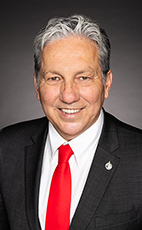
House of Commons photo

Crucial Fact

  • His favourite word was million.

Last in Parliament April 2025, as Liberal MP for Saint Boniface—Saint Vital (Manitoba)

Won his last election, in 2021, with 44% of the vote.

Statements in the House

Questions on the Order Paper November 30th, 2018

Mr. Speaker, with regard to (a), there were 214 first nations that provided a written expression of interest by the July 13, 2018 deadline. As of October 15, 2018, a total of 252 first nations had submitted a written expression of interest.

With regard to (b), the First Nations Financial Management Board has not yet completed its assessment of the first nations who sent in an expression of interest.

With regard to (c), the breakdown of eligible first nations by province or territory is not yet known. The number of first nations who expressed interest in the 10-year grant is distributed by province or territory as follows: Alberta, 17; British Columbia, 88; Manitoba, 30; New Brunswick, 8; Newfoundland and Labrador, 3; Nova Scotia, 11; Northwest Territories, 2; Ontario, 45; Prince Edward Island, 2; Quebec, 14; Saskatchewan, 32.

With regard to (d), under the 10-year grant, measures for accountability to first nation members are codified in the financial administration law, FAL, or financial administration bylaw, FAB, of the first nation and reinforced in the funding agreement. First nations must enact and maintain a FAL or FAB in order to be eligible and to maintain eligibility for a 10-year grant.

Under a FAL/FAB, the first nation must have a policy for first nation information or involvement. The council must establish such a policy and/or procedures or give directions respecting the means by which members of the first nation must be informed about or involved in consideration of the following: the annual budget; the multi-year financial plan; and budget deficits or extraordinary expenditures. Additionally, the council must post a public notice of each council meeting when each of the following is presented for approval: the multi-year financial plan; the annual budget; and amendments to the annual budget. Members of the first nation may attend that part of the council meeting when the matters referred to in the above are being considered.

With regard to (e), under the 10-year grant compliance measures are replaced by practices that strengthen first nations governance and empower first nation citizens to hold their leaders accountable. This includes ongoing monitoring of the co-developed eligibility criteria for 10-year grants by the First Nation Financial Management Board. This monitoring would include an assessment of the adequacy of reporting to band members as per the reporting provisions codified in the first nation’s financial administration law, FAL, or financial administration bylaw, FAB. On an annual basis, the First Nations Financial Management Board will report the results of their assessment of eligibility criteria to ISC. ISC will support the first nations to remediate any issues related to maintaining eligibility for 10-year grant, including the reporting mechanisms for accountability.

With regard to (f), from October 11 to November 20, 2017, Indigenous and Northern Affairs Canada, INAC, and the AFN met on nine occasions with first nations leaders and technical experts around the country to seek their input on options to address predictability of funding, sufficient funding for program delivery, and mutual accountability. The feedback from participants on their priorities and major concerns were considered and reflected in the report entitled, “A new approach: Co-development of a new fiscal relationship between Canada and First Nation”. The Assembly of First Nations presented this report to all first nations chiefs in attendance at Assembly of First Nations’ special chiefs assembly in Ottawa, on December 6, 2017. Department of Indigenous Services Canada officials continue with ongoing co-development work related to the 10-year grant with both the Assembly of First Nations and the First Nations Financial Management Board. Beginning in January 2018, Indigenous Services Canada staff participated in a number of information sessions across many regions to provide first nations participants with more information about the grant.

Questions on the Order Paper November 30th, 2018

Mr. Speaker, as it relates to the office located at 365 Hargrave Street, Winnipeg, Manitoba, no data is available, as there was no appointment process in place for this location while access was provided to the general public. In an effort to balance service standards with the safety of the public and staff, and following the closure of the office at 365 Hargrave Street to the general public, a new appointment process was put in place at the new location to minimize disruptions and to ensure that services continued as efficiently as possible.

The ISC office for secure certificate of Indian status, located at 391 York Street Winnipeg, Manitoba, was opened on November 23, 2016, and continues to provide services to the general public by appointment. The majority of appointments are for secure certificate of Indian status card applications, marriage and death registrations, name changes and amendments. The approximate number of visits from November 2016 to September 2018, broken down by month, are as follows: November 2016: 34; December 2016/January 2017: 235; February 2017: 172; March 2017: 250; April 2017: 141; May 2017: 213; June 2017: 221; July 2017: 253; August 2017: 373; September 2017: 297; October 2017: 331; November 2017: 384; December 2017: 273; January 2018: 331; February 2018: 381; March 2018: 408; April 2018: 349; May 2018: 435; June 2018: 299; July 2018: 624; August 2018: 382; and September 2018: 330.

Indigenous Affairs November 30th, 2018

Mr. Speaker, I would like to thank the hon. member for Pontiac for his question and for the good work he does for his constituents.

Our government is indeed advancing a new fiscal relationship between Canada and the first nations, based on the recognition of rights, co-operation and partnership. We are implementing proposals from first nations, including more flexible and predictable long-term funding for eligible communities, a replacement for the default prevention and management policy, and the establishment of an advisory committee that will guide this work.

We will continue to work with partners to build a strong future together for first nations and all indigenous peoples.

Indigenous Affairs November 30th, 2018

Mr. Speaker, our government is delivering on a new relationship with indigenous peoples that empowers communities and advances self-determination. New investments of $16.8 billion through budgets mean 156 new school projects, 359 new water projects and 165,000 requests from first nations children approved under Jordan's principle.

We know there is more to do, and we are committed to getting the job done.

Indigenous Affairs November 30th, 2018

Mr. Speaker, in support of distinctions-based housing strategies with our first nations, Inuit and Métis partners, budget 2018 invested $600 million over three years for first nations housing, $500 million for Métis nations housing and $400 for Inuit-led housing. This funding is a significant step toward addressing the housing gap in indigenous communities. We will continue working to close the unacceptable housing gap in indigenous communities.

Indigenous Affairs November 29th, 2018

Mr. Speaker, the Minister of Indigenous Services has been very clear in her support for Kashechewan's short-term, medium-term and long-term goals, including its desire to relocate the community. However, a multi-stage process will take time, and in the interim, we must continue to provide quality short-term services for the community, functional housing and infrastructure.

Our government is 100% committed to working closely with Kashechewan First Nation to support a healthy and sustainable community. The plans include working together with federal partners and Ontario ministries to take into account concerns about the annual flood risks at the current site.

Indigenous Affairs November 29th, 2018

Mr. Speaker, as always, it is a pleasure for me to rise in the House to speak on many different subjects. I want to begin by acknowledging that we are on the unceded land of the Algonquin people.

On September 17, 2018, Chief Friday and students from the Kashechewan nation came to Ottawa to ask for a new school and secure the support of the Minister of Indigenous Services for relocating their community.

The minister met with Chief Friday, the community and students, and confirmed that the Government of Canada will support the community's request for a modular school solution. A modular school will provide a safe and healthy place for the students to learn and will better serve the students' needs. It has the immense added benefit that it could be moved to a new site in the future.

I am pleased to advise that progress has been made. Kashechewan issued a request for proposals for the new school on November 21. Our shared goal is to have a contract in place in the coming months so that supplies can be ordered in time for delivery on the winter road. Our top priority is the safety and well-being of the students and their education.

The minister also reiterated the government's support for the community and its larger needs. Indigenous Services Canada has provided funding to the community to undertake a feasibility study to determine the viability of the community preferred site for relocation. The site is located on higher ground a short distance upstream, on the Albany River, which is less prone to flooding during the annual spring breakup. The department has received the final report of the site feasibility study and is working very closely with the community on the next steps in this process.

These measures are consistent with the framework agreement entitled, “Together we Work for Hope”, which was signed by the Government of Canada, the Government of Ontario, and the Kashechewan First Nation on March 31, 2017, in order to support the safety, health and future of the community.

Steady progress has been made since the signing of the framework agreement to address the first nation's long-standing challenges. A tripartite steering committee has been established with representatives from Kashechewan First Nation, the Government of Canada and the Province of Ontario on the implementation of an action plan to address key priority areas. The committee met on September 20, and is meeting again in a few weeks to further discuss progress.

Residents of Kashechewan need reliable access to effective programs and services, functional housing, as well as infrastructure. There is a lot of good news. I am happy to note that upgrades are currently being made to the water treatment plant and repairs have been completed to the secondary school. There have also been investments in health and social programs, including funding for youth mental health.

Our government remains committed to working in close co-operation with the Kashechewan First Nation to ensure the safety, health and future of the community.

Ontario's Francophonie November 29th, 2018

Mr. Speaker, Manitoba's Conseil jeunesse provincial will be holding a rally this Saturday to support Ontario's Francophonie. I am very proud of this important youth-led initiative, because our youth carry the torch for our community, and they are engaged and concerned.

They are concerned about recent events in Ontario, New Brunswick and my province, Manitoba, where the provincial government recently eliminated the position of assistant deputy minister responsible for the Bureau de l'éducation française and other translation jobs. This is a worrisome trend that we must all condemn.

I invite all of those who support our official languages to join us at old St. Boniface City Hall this Saturday morning at 11:45.

At noon, the Franco-Ontarian flag will be raised as a sign of solidarity. From one generation to the next, we will build our future in French together. This has to be done by youth and for youth. We must not give up.

Indigenous Affairs November 23rd, 2018

Mr. Speaker, the loss of life from suicide is a tragedy beyond measure. Our government has increased the number of community-led mental wellness teams by 52 since becoming government in 2015. We also actively support community-based prevention initiatives, such as the choose life program.

With respect to the specific request by the hon. member, I do not have that information, but I will take it under advisement and communicate with the hon. member on where we are on that project.

Louis Riel November 19th, 2018

Mr. Speaker, on November 16, I joined Manitoba's Métis community in commemorating the death of Louis Riel. It is important that all of us, Métis and non-Métis, remember and come together on this important day.

On November 16, 1885, Louis Riel was hanged. Riel fought the government of the newly-formed Canada from taking their Red River lands without consultation. His many sacrifices have secured him an enduring place in our shared history as a leader of the Métis Nation, a founder of Manitoba and a key contributor to Canadian confederation.

His legacy is clear. In Manitoba, a school division, a college, a bridge and an economic development corporation all bear his name.

Across Canada, monuments to Louis Riel are a testament to his lasting legacy. I am a proud member of the Métis Nation.

As a proud Métis, it is a privilege for me to rise today and pay tribute to Louis Riel.