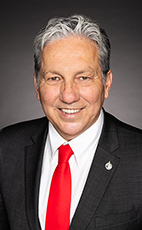
House of Commons photo

Crucial Fact

  • His favourite word was million.

Last in Parliament April 2025, as Liberal MP for Saint Boniface—Saint Vital (Manitoba)

Won his last election, in 2021, with 44% of the vote.

Statements in the House

Saint-Boniface University November 2nd, 2018

Mr. Speaker, western Canada's first educational institution was founded 200 years ago. Known then as Collège de Saint-Boniface, its rich history is a testament to the important role it has played in protecting and promoting the French language in Manitoba.

As a private institution, the college defied the Thornton Act prohibition on French as a language of instruction for over 50 years.

Many eminent members of the Canadian francophonie studied at the college, including Louis Riel.

Now officially known as the Université de Saint-Boniface, USB is still the only French-language university in western Canada, and it welcomes students from around the world.

A big celebration will be held on Thursday, November 8, to honour our francophone institution.

Enjoy the celebration, and long live the Université de Saint-Boniface!

Budget Implementation Act, 2018, No. 2 November 1st, 2018

Mr. Speaker, the hon. member for Winnipeg North is absolutely right. Today, is a wonderful day, not only for Churchill but for the entire province of Manitoba. After being abandoned by the previous railroad owner, the port and the railroad track have been fixed by a private consortium in partnership with the federal government and the Town of Churchill and the railway is back in working order. The community is extremely happy. The port has been rehabilitated and goods and services are going to flow to Churchill once again and jobs will be created. In fact, our Prime Minister was there this morning to announce, in addition to the literally tens of millions of dollars that we have invested to fix the railway, that we are investing close to $40 million on a series of projects in the Churchill area to create jobs and hope and vitality in the town of Churchill once again.

Budget Implementation Act, 2018, No. 2 November 1st, 2018

Mr. Speaker, my speech was about indigenous issues, northern issues and first nations issues. Therefore, I will take the information under advisement and get back to the hon. member.

Budget Implementation Act, 2018, No. 2 November 1st, 2018

Mr. Speaker, having been a city councillor for several years and a candidate in 2015, I can say that one of the policies that was most attractive to the city I come from, Winnipeg, and I imagine many rural areas, was the enhanced infrastructure spending our government was embarking on. Across the country, we are rebuilding cities, we are rebuilding rural areas, we are investing in rural municipalities. I cannot speak precisely to the situation where the hon. member resides, which I believe is northern Alberta, but I can say without a doubt that in Manitoba, in Winnipeg, the money has definitely flowed. Roads are being rebuilt. Water systems are being rebuilt. I think that some of the happiest constituents in Canada today are mayors, city councillors and rural aldermen.

Budget Implementation Act, 2018, No. 2 November 1st, 2018

Mr. Speaker, I welcome this opportunity to participate in today's debate. I want to begin by acknowledging that we are gathered on traditional Algonquin territory.

Our government is committed to renewing the relationship with indigenous peoples based on the principles of the recognition of rights, respect, co-operation and partnership.

We are also committed to growing the middle class by creating opportunities for people that will help them join it. Everyone knows that indigenous peoples have long been faced with some of the most severe economic disadvantages in this country.

This problem has deep roots in the history of colonialism, including in strict measures written into legislation like the Indian Act. Let me give an example. Ed Metatawabin is a residential school survivor from Fort Albany First Nation who attended St. Anne's residential school and became a chief in his community. After he became chief, he started a small sawmill business so that people in his community would have work and the sense of purpose that accompanies work. However, because it was illegal under the Indian Act for him to own the land, he could not get insurance on his business, so he had to keep his business small to minimize any potential liabilities. Any investment he made was a personal risk to him and his family. A lot of Canadians do not understand this. They do not understand the daily barriers first nations people face on reserve.

Today we have an opportunity to rectify some of these measures and to unlock economic growth for indigenous peoples. We have a chance to create an environment that supports self-determination. This will not only be good for indigenous peoples, it will be good for Canada.

The National Indigenous Economic Development Board has estimated that engaging indigenous people in the economy at the same rate as non-indigenous people would boost Canada's GDP by 1.5% and create almost $28 billion in economic growth. Several others have suggested that the number is actually much higher.

Today we are seeing a wellspring of indigenous-led innovation and sound business practices. There are now over 40,000 indigenous-led small and medium-size businesses in Canada. That is why I say we need to build on these successes. Let us remove barriers to further success and self-determination. That is the objective of the new legislative measures set out in the proposed budget implementation act.

I want to clarify that these amendments are not top-down solutions. We developed them in consultation with our first nations partners and by asking for their contribution and their participation from the outset.

The Government of Canada is proposing amendments to the First Nations Fiscal Management Act that would provide greater clarity around language, streamline organizational operational issues, and expand access to the program to complement new budget 2018 funding of $50 million over five years and $11 million per year ongoing. The act is opt-in and enables first nations to implement taxation and financial management systems.

First nations are supported by three fiscal institutions operating under the act: the First Nations Tax Commission, the First Nations Finance Authority, and the First Nations Financial Management Board. These institutions build capacity among first nations and bring them together to access long-term financing, and it has been a very effective approach.

For example, the First Nations Finance Authority fifth debenture of $138 million, issued in September 2018, brought its total bond issuances to $514 million. This bond is being used by first nations across the country to invest in community infrastructure and economic development, such as the new school for Siksika Nation, a power project in Chehalis, and housing for Peter Ballantyne Cree Nation.

The new budget 2018 investments would enable the fiscal institutions to work with nearly twice as many first nations to develop their capacity and have greater access to capital. To date, 239 first nations are scheduled in the act.

Access to funding is one thing, but we can all agree that access to the land is critical for economic empowerment. The Government of Canada is proposing $143 million in budget 2018 to strengthen the First Nation Land Management regime and support 50 additional first nations in becoming signatories to the Framework Agreement on First Nations Land Management over the next five years.

As well, the proposed amendments to the First Nations Land Management Act before us today would ratify changes to the framework agreement, changes that were co-developed with first nations. These fixes address voting thresholds and other administrative improvements that will better support first nations that are signatory members to develop their own land codes, or laws, to exit section 33 land-management-related provisions of the Indian Act. That’s one-third of the Indian Act.

The fixes will also eliminate federal oversight and enable first nations to “move at the speed of business” on investment and development opportunities.

For example, Stz’uminus First Nation, which has been operating under its own land code since 2014, has been able to create Oyster Bay Development—a 65 acre, multi-million dollar site that includes a hotel and a commercial area along the TransCanada Highway—without any need for Indian Act approvals.

Another mechanism to improve the relationship between Canada and first nations and move toward enduring reconciliation is the return of land that is owed to first nations under historical treaties and specific claim settlement agreements. With additions to reserves, ATRs, first nations can also add land to an existing reserve land base or create new reserves for the use and benefit of their members for community and economic development.

The Government of Canada is proposing this legislation to streamline the ATR process, building on the benefits of legislation that is currently only available to some first nations in the prairie provinces. These changes are long overdue. They are part of a number of actions the government committed to take when it adopted a new ATR policy directive in 2016, after several years of engagement and joint work with first nation communities and organizations. The biggest proposed change is that ATRs would now be able to be approved by ministerial order rather than by Governor in Council, which would result in significantly more timely decisions.

The proposed legislation would also speed things up by letting first nations pre-designate land being added to a reserve, similar to zoning in a municipality, and begin to put in place arrangements, such as leases or permits, prior to the land being added, a vital requirement for investment opportunities. This would help create reserve lands that are ready for economic development.

ATRs support economic development opportunities, self-reliance and growth in first nation communities. For example, in September 2018, the Sioux Valley Dakota Nation added 79 acres of land to its reserve. The land is currently home to a gas bar and a convenience store, with future plans for a restaurant, a hotel, commercial space and an outdoor stage.

Collectively, these amendments regarding finances and land support reconciliation with indigenous peoples would result in greater long-term benefits for Canada. I encourage all members to support them.

Churchill, Manitoba November 1st, 2018

Mr. Speaker, last night, for the first time in nearly a year and a half, the sound of a train whistle blew into the town of Churchill.

The Prime Minister joined members of the community this morning to celebrate the return of rail service to Churchill, the gateway to the north. The railway is a lifeline for thousands of Manitobans.

This morning, the Prime Minister announced $3.8 million to help revitalize Churchill and to create long-term economic growth for the people of northern Manitoba. I want to recognize and thank Churchill Mayor Mike Spence for his continued advocacy and partnership throughout this very difficult time. I also want to commend the Herculean effort of the Arctic Gateway Group, which has worked non-stop since September to make this day a reality.

Today is a momentous day for the people of Churchill, the surrounding communities and indeed all of Manitoba and all of Canada.

Canadian Francophone Community October 30th, 2018

Mr. Speaker, unsurprisingly, recent comments once again demonstrate an ignorance of our francophone communities outside Quebec.

I want to assure my colleagues that the Canadian francophonie is quite vast, diverse, proud and thriving. Our government's recent renewing of the official languages regulations is evidence of that.

Our communities are incredibly vibrant. In Manitoba, you will hear all kinds of accents, including Franco-Manitoban, Franco-Métis, Franco-European, Franco-African, Québécois and Acadian.

Our immersion schools are seeing record enrolment, and our francophone communities are welcoming thousands of francophiles who are passionate about the language of Molière.

From generation to generation, we have been here. From generation to generation, we will remain.

Indigenous Affairs October 25th, 2018

Madam Speaker, we are deeply committed to renewing the nation-to-nation, Inuit-Crown and government-to-government relationship with indigenous peoples. We believe all Canadians should have access to safe, adequate and affordable housing. I know my hon. colleague is a strong advocate on this as well.

Indigenous leaders have told us that when it comes to housing in first nations, Inuit and Métis Nation communities, the best approach is one that respects the distinct needs of each group. We will continue to work with our first nation, Métis and Inuit partners to develop and implement distinctions-based housing strategies that are tailored to their needs.

It is never wrong to have hope and I offer that advice for the hon. member.

Indigenous Affairs October 25th, 2018

Madam Speaker, I thank my colleague for her question, and I want to acknowledge that we are on traditional territory of the Algonquin peoples.

Our government is committed to closing the unacceptable housing gap for indigenous peoples. We made a significant investment of $554.3 million early on in budget 2016 to address urgent housing needs on reserve. As a result of these investments, 14,107 total housing units have been or are being built, renovated, retrofitted or lots serviced as of June 30, 2018.

Indigenous Services Canada, in partnership with the Assembly of First Nations and Canada Mortgage and Housing Corporation, will continue to work with first nations to reform on-reserve housing and ensure reliable, sustainable infrastructure for indigenous peoples.

Indigenous leaders have been clear. They do not want a one-size-fits-all approach for improving indigenous housing. The government agrees. This is why, in addition to the national housing strategy funds through investments made in budgets 2017 and 2018, the government has dedicated funding to support the successful implementation of each of the distinctions-based housing strategies, including $600 million over three years to support first nation housing on reserve as part of a 10-year housing strategy that is being developed with first nations; $400 million over 10 years to support an Inuit-led housing plan in Nunavik, Nunatsiavut and Inuvialuit Settlement Region. This is in addition to the $240 million over 10 years announced in budget 2017 to support housing in Nunavut.

A draft Inuit Nunangat housing strategy has been co-developed by Inuit partners, Crown-Indigenous Relations and Northern Affairs Canada, Canada Mortgage and Housing Corporation and Employment and Social Development Canada. It is expected that the strategy will be finalized over the coming months. In addition, there are $500 million over 10 years for the delivery and control of affordable and social housing by the Métis Nation, the first of its kind in Canada.

On July 19, the Minister of Crown-Indigenous Relations, the president of the Métis National Council, Clément Chartier, and the presidents of the MNC governing members signed the Métis Nation housing sub-accord. The Métis Nation housing sub-accord reflects a shared commitment to narrow the core housing gap and further indigenous self-determination in this important area of social policy.

We will continue working with partners to advance indigenous-led approaches to close the housing gap for indigenous peoples. I look forward to working with the member opposite on this critical issue and thank her for her strong advocacy.

Election in Saint-Boniface—Saint-Vital October 25th, 2018

Mr. Speaker, Winnipeg held its municipal and school board elections yesterday.

I want to congratulate Brian Bowman on his re-election for a second term as mayor of the city of Winnipeg. Congratulations also to all new and returning city councillors.

I especially want to congratulate those elected in my riding of Saint-Boniface—Saint-Vital, namely Brian Mayes in Saint-Vital, Matthieu Allard in Saint-Boniface, Markus Chambers in St. Norbert-Seine River, and Shawn Nason in Transcona.

I look forward to working collaboratively with the mayor and all of city council to improve Winnipeg's infrastructure, build new housing, support public and active transportation, and help develop strategies to partner with Winnipeg's growing urban indigenous population.

I also want to congratulate all the school board trustees who were elected to the Commission scolaire franco-manitobaine and the Louis Riel School Division.

We thank all the candidates for presenting their vision for the city of Winnipeg and the province of Manitoba.