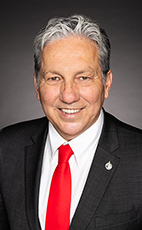
House of Commons photo

Crucial Fact

  • His favourite word was million.

Last in Parliament April 2025, as Liberal MP for Saint Boniface—Saint Vital (Manitoba)

Won his last election, in 2021, with 44% of the vote.

Statements in the House

Indigenous Peoples and Canada's Justice System February 14th, 2018

Mr. Speaker, what is imperative in the Colten Boushie situation is that we learn to understand everything that led to the unfortunate occurrence of Mr. Boushie being shot. I am a firm believer in prevention. We have to put the social systems in place, the supports and assistance to families, so that unfortunate instances like that are prevented.

I know we can do better and I know we can learn from this.

Indigenous Peoples and Canada's Justice System February 14th, 2018

Mr. Speaker, I will repeat that I believe every member in this chamber believes: that education is the key to a better future.

I know that we have been doing some good work on the education front in my home province in Manitoba. The government has recently signed an agreement for a first nations educational authority, representative of, I believe, a dozen first nations in Manitoba, to control their own education and to set the curriculum for the students who are in those schools.

We have to continue talking and negotiating in good faith. We need to listen. One of the hardest things to do in this job is to listen, to really listen without interrupting, and to try to get to a mutual space where there are benefits for all parties. I think that is what “nation-to-nation” means, and we are committed to moving forward in that way.

Indigenous Peoples and Canada's Justice System February 14th, 2018

Mr. Speaker, let me rephrase that. It is fairly obvious the hon. member across the way was not paying attention when the Prime Minister today spoke passionately about our new rights-based framework that we are going to be advancing in partnership with indigenous, Métis, and Inuit populations. It is quite obvious to me that the hon. member across the way was not paying attention when the justice minister, a half hour ago, spoke passionately about leading the way toward better defining the rights that exist in section 35 of Canada's Constitution.

For too long, section 35 has not been defined. We are committed to working with indigenous populations from coast to coast to coast to help define those rights. That is something that is starting immediately, and we are 100% committed to getting the job done.

Indigenous Peoples and Canada's Justice System February 14th, 2018

Mr. Speaker, it is fairly obvious that the member across the way was not present today to hear the important announcement or the important speech this evening by the justice minister on what this—

Indigenous Peoples and Canada's Justice System February 14th, 2018

Mr. Speaker, I firmly believe—and I do not think there is a member in this chamber who would disagree—that education is a way to a better life, education that is respectful and that respects the cultural heritage of indigenous people, education that respects the indigenous languages of the Métis, first nations, and Inuit people of our country.

I am very proud of what our government is doing. We are investing over $2.6 billion in the next five years for indigenous education, first nations education, and we feel that is something that is a concrete first step. However, there is much more work to do, and we are committed to doing the work that is necessary, in partnership with first nations, Métis, and Inuit people.

Indigenous Peoples and Canada's Justice System February 14th, 2018

Mr. Speaker, every time I rise in the House I do so with tremendous pride. I am proud to represent the riding of Saint Boniface—Saint Vital, and I am proud to be a Métis nation member of Parliament.

When I rise, I often think of Louis Riel, who was born in Saint Boniface and currently rests there, because Riel was never granted the same privilege that I am being granted. Louis Riel was democratically elected as a member of Parliament for the constituency of Provencher, not on one or two occasions but on three occasions, yet he was never allowed to rightfully take his seat in the House.

Therefore, today I rise, on the eve of Louis Riel Day in Manitoba, and I reflect on Riel's own treatment by Canada's justice system. Sentenced to death on the charge of treason for defending the rights of the Métis people in Saskatchewan, the jury that sentenced Louis Riel was comprised of six Protestant men of English and Scottish descent.

Over 130 years later, Canada is a much different place, but the colonial legacy of racism and systemic racism remains within our institutions.

The Standing Committee on Canadian Heritage recently presented in the House its report on the forms of systemic racism and religious discrimination. I had the honour of sitting on that committee during its study and I heard academics and indigenous advocates speak in detail about the systemic racism that exists in our country today. There is no doubt that systemic racism is present today.

It was during this testimony for the study on Motion No. 103 that Senator Sinclair, who was a witness, stated that “systemic racism is the racism that's left over after you get rid of the racists.”

The systems, the policies, the procedures in place within our institutions are very often inherently discriminatory as they were built from our colonial heritage and cultures.

It is the systemic nature of this racism that leads to a higher likelihood that bail will be denied for indigenous people. It is the systemic nature of this racism that means indigenous people spend more time in pretrial detention. It is the systemic nature of this racism that leads to indigenous people being more likely to be charged with multiple offences than non-indigenous accused. It is system racism that causes indigenous people to be more than twice as likely to be incarcerated.

The statistics reveal the shocking reality that indigenous people face within the justice system. In my home province of Manitoba, over 70% of the inmates identify as indigenous, yet the indigenous population of Manitoba is 15%.

Indigenous people are not predisposed to violence or criminality, any more than any other population group. Nothing in indigenous culture predisposes this. Nothing in human nature predisposes this. We must face the reality that the long history of colonialism in Canada has led to discrimination and social inequality. The causes of crime must be examined within this context. There are links between poverty, marginalization, and criminal behaviour, but these factors are, again, steeped in systemic racism.

The justice system itself has historically contributed to poverty in indigenous communities in many ways, such as not assisting indigenous communities in enforcing treaty rights, and other rights. The marginalization of indigenous populations is the result of systemic efforts by the government. One needs to look no further than residential schools. Rather than respect the inherent and treaty rights of indigenous people, the government of the day attempted to assimilate the indigenous population.

By continuing to deny indigenous people their inherent and treaty rights, we have perpetuated a cycle of poverty and marginalization throughout many generations.

The scars left by the residential schools are still deeply felt in our indigenous communities. Prime Minister John A. Macdonald said that we needed to “kill the Indian in the child”, in other words, remove the child from his or her culture, language, and traditions. The abuse and trauma that residential school survivors experienced have lasting repercussions in their own lives, as well as in the lives of their descendants and on the health of their communities.

This denial of culture is still happening today. We do not know what the long-term impacts of the current crisis within the child welfare system will be, but we do know that indigenous children across the country are more likely to be apprehended and placed in foster care.

My own province, sadly, has over 12,000 indigenous children in care. Too often they are not placed in culturally appropriate homes. Instead, the history of assimilation of indigenous people is being created within this system. This crisis has often been described as the new sixties scoop, another devastating historical wrong perpetuated by government and colonialism.

I hate to say it, but there are people in Canada who grew up fearing indigenous peoples, and particularly indigenous men. They were taught to fear indigenous people. Hate is learned behaviour.

The number of hate crimes perpetuated against indigenous people across the country is still staggeringly high. Compounding the issue is the inconsistent reporting of hate crimes. Victims are too often reluctant to report hate crimes to law enforcement, and we are not able to have an accurate account of hate crimes and hate-motivated violence in Canada. Under-reporting is an acute issue among the indigenous population, due to lack of trust by indigenous communities toward law enforcement.

It is unacceptable that in Canada indigenous men and women are more likely to face violence and murder. In 2015, 25% of murder victims were indigenous. The rate of violent victimization for indigenous women is double that of non-indigenous women. Too many families have undergone the trauma and pain of losing a loved one to violence. I certainly do not want to pre-empt the work of the missing and murdered indigenous women and girls commission, but I hope its work will lead to concrete actions to end this ongoing tragedy.

One of the most frustrating issues in this debate is that none of these issues is new. It was in 1988 that the Manitoba government launched the Public Inquiry into the Administration of Justice and Aboriginal People, and it issued its report in 1991. Many of the problems we are discussing tonight were addressed in this report, and I encourage all members to seek out this report, which was co-authored by Senator Murray Sinclair from Manitoba.

However, we are moving toward a path of reconciliation, and I must end my speech with hope, because I feel hope. In spite of all the sadness, anger, and frustration, I genuinely feel hope. We are all in this together, whether we are Liberals or Conservatives, indigenous or non-indigenous. We are all in this together and we need to find our way out of this together.

Indigenous people of Canada deserve better, and I truly believe the actions of the government are working to improve the lives of indigenous people throughout Canada. I was very proud to hear the Prime Minister speak today about building a new rights-based framework in collaboration with indigenous people. This comprehensive strategy would work to fully recognize and implement indigenous rights.

Ultimately, we cannot solve the issues of systemic violence within our institutions without moving forward toward self-determination for indigenous people. This strategy is an important step toward this goal. Further, the justice minister has begun a broad review of the criminal justice system, which will include a review of indigenous participation within the justice system.

Finally, before taking questions, I would like to thank the family and the loved ones of Colten Boushie for taking the time to meet me yesterday. I share their grief for the loss of their loved one. No family should have to face the pain of losing a loved one to violence.

Historic Sites and Monuments Act December 13th, 2017

Mr. Speaker, I am pleased to have this opportunity to speak in support of Bill C-374, an act to amend the Historic Sites and Monuments Act. Before I begin, it is important to acknowledge that we are gathered on traditional Algonquin territory.

As my hon. colleagues are aware, acknowledging the traditional territories of Indigenous peoples represents a small but significant step in reconciliation with Canada's first peoples.

My remarks today address another opportunity to advance reconciliation by ensuring indigenous peoples contribute meaningfully and openly to decisions about the designation of historic places, persons, and events.

Bill C-374 proposes to add dedicated first nations, Inuit, and Métis representation on the Historic Sites and Monuments Board of Canada.

There is no doubt that indigenous peoples have played a key role in the history of our country. Indigenous peoples have forged important economic, cultural, and political relationships by opening up a large number of the routes on land and on navigable waters that we continue to use today.

In 1536, Jacques Cartier's crew would have died of scurvy if not for the remedy administered by the Huron people. The alliance of indigenous peoples led by Tecumseh made it possible for Great Britain to drive back the American invaders in the War of 1812.

Some of Canada's designated historic events, persons, and sites are directly linked to indigenous peoples, but we know that we can do more to recognize the full depth and the full breadth of indigenous history and the significant contributions of indigenous peoples.

While relatively few Canadians may be familiar with the Historic Sites and Monuments Board of Canada, almost all Canadians are familiar with at least one event, one person, or one site that carries a national historic significance. Since 1919, the board has served as an expert advisory body to the Government of Canada on historical matters. The board considers whether a person, event, or place has had a nationally significant impact on, or illustrates an important aspect of, Canadian history. Its recommendations have inspired the Government of Canada to formally recognize nearly 1,000 sites, 650 persons, and 400 events. The board's recommendations help to shape our national identity.

National historic designations are of profound importance to Canadians. They enable us to connect with our past and with the people, places, and events that helped shape our country. They encourage us to appreciate and understand our rich and diverse heritage. They tell their own unique history, contributing a sense of time, identity, and place to our understanding of who we are and how we came to be Canada. They are necessary to the greater story of our great country and to our understanding of Canada as a whole.

The sad truth is that indigenous people have left an indelible mark on our culture and our identity, but their contributions are not fully recognized.

Many Canadians canoe and kayak, for example. In winter, we snowshoe and toboggan down hills. Those are indigenous inventions. Many popular sports in Canada, such as lacrosse, hockey, luge, and bobsleigh have indigenous roots.

It is time to truly celebrate the many contributions of indigenous peoples to our heritage. We must recognize the full extent of the history of indigenous peoples who have lived on our land since time immemorial. Our understanding of Canada is linked to our ability to openly discuss the deep historic roots of the peoples who have lived here forever. Inviting indigenous peoples to participate directly in decisions about historic designations would allow us to enrich our collective knowledge of course, but also to foster reconciliation.

In 2015, the Truth and Reconciliation Commission of Canada stated this plainly in its report, “What we have learned: Principles of truth and reconciliation”. The report states:

Too many Canadians still do not know the history of Aboriginal peoples’ contributions to Canada, or understand that by virtue of the historical and modern Treaties negotiated by our government, we are all Treaty people. History plays an important role in reconciliation; to build for the future, Canadians must look to, and learn from, the past.

Bill C-374 responds directly to the Truth and Reconciliation Commission's call to action report. The report called on Canada to amend the Historic Sites and Monuments Act to include first nations, to include Inuit, and to include Métis representation on the Historic Sites and Monuments Board of Canada.

The board works closely with Parks Canada, and Parks Canada already prioritizes reconciliation with indigenous people through a number of strategies. The agency incorporates indigenous knowledge in its conservation and restoration programs, and promotes events and experiences involving indigenous people and cultures across national parks and national historic sites. Through this work, Parks Canada provides Canadians and visitors alike with opportunities to appreciate the role that indigenous peoples have played in our history.

The truth is that indigenous histories and cultures go far beyond canoes and herbal medicines. It is time for Canadians to open their hearts and minds to learn more about the history of this great land. The voices of indigenous peoples must be heard. Canadians take great pride in our heritage programs. They are cornerstones in the promotion of our collective national identity. Furthermore, Canadians are determined to continue on the journey toward reconciliation with indigenous peoples. Surely it is time that indigenous peoples played a more direct and meaningful role in the decisions about historical designations.

Indigenous Affairs December 6th, 2017

Mr. Speaker, this week, the Assembly of First Nations Special Chiefs Assembly is taking place in Ottawa. I had the honour of attending yesterday.

Among their many priorities, first nations leaders across this country are calling for a new fiscal relationship with the Government of Canada that allows them to plan for and invest in long-term growth and development for their communities.

Could the hon. Minister of Indigenous Services please update the House as to the government's commitment to a new fiscal relationship with first nations?

Louis Riel November 20th, 2017

Mr. Speaker, every November 16, Manitoba's Métis community gathers at the Saint Boniface Cathedral cemetery to commemorate the anniversary of Louis Riel's death. One of the great leaders of his day, Louis Riel stood up for the rights of the Métis and francophones when Manitoba joined Confederation.

Indeed, Louis Riel is the father of Manitoba, and we gather to commemorate his death every year in Saint-Boniface.

I stand here today in the House of Commons and remember that Louis Riel was never allowed this privilege. In spite of being elected three times as MP for Provencher, Riel was never granted access to this chamber.

Therefore, it is with great pride that as a Métis member of Parliament, I recognize and honour Louis Riel today. We are a government that will continue to make great progress in reconciling errors of the past with the Métis nation.

Indigenous Veterans November 8th, 2017

Mr. Speaker, during a week in which we humbly honour all veterans who have served Canada, today we also recognize the contributions of first nations, Inuit, and Métis men and women whose sacrifices we can never forget.

This is a day when we take a moment to remember a veteran like Edith Anderson Monture from the Six Nations of the Grand River in Ontario, who, as a nurse in the Great War, tended to the wounded and the sick in an American military hospital in France.

When called to serve, indigenous peoples answered, and to this day, they continue to risk their lives to defend our Canadian values.

As we move forward in our journey of reconciliation, indigenous sacrifices, and accomplishments will never be forgotten.

I call on this House, and indeed I call on all Canadians, to join us in honouring our indigenous veterans today and throughout the week.