
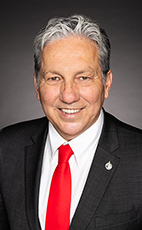
House of Commons photo

Crucial Fact

  • His favourite word was million.

Last in Parliament April 2025, as Liberal MP for Saint Boniface—Saint Vital (Manitoba)

Won his last election, in 2021, with 44% of the vote.

Statements in the House

Paris Agreement October 3rd, 2016

Mr. Speaker, I want to announce that I will be sharing my time with the member for Davenport.

I am honoured to have the opportunity to rise in the House to speak on a matter of great importance to my constituents in Saint Boniface—Saint Vital.

Climate change is the most important environmental issue of our time. The adoption of the Paris agreement last December was a historic accomplishment in the global effort to address climate change. Why is it so important? If we look at my province, we see that the impact of climate change could be dramatic.

Manitoba's location in the middle of the continent means that we will feel climate change sooner, with more severe changes. Scientists have detailed how Manitoba, already known for its extreme weather, will see summers get much drier and much hotter, and winters much warmer. In fact, the average winter temperature in southern Manitoba has increased three degrees over the last 40 years. Our winters are increasingly caught in a freeze-thaw cycle, which is devastating for our already maligned infrastructure.

The impact on our ecosystem could also increase toxic algae blooms in Lake Winnipeg.

This bears repeating: the average winter temperature in southern Manitoba has increased 3 degrees over the last 40 years. Clearly, we must act.

Of the 191 countries that signed the Paris agreement, over 60 have already ratified it. The international will to take action on this is impressive, and Canada must play an active role.

We stood with the rest of the world in Paris to adopt the agreement. We stood with world leaders in New York on April 22, Earth Day, to sign it. Now we must stand with the movers to ratify Paris.

Let us demonstrate that Canada is without a doubt committed to action.

The Paris agreement is not the end of the process. It is only the next step in the efforts to resolve the climate change problem.

More steps will have to be taken. Some of them have already been mentioned in the House. The international community will meet again in Marrakesh, Morocco, for the next round of negotiations with the UN.

Canada must remain a leader in the global fight against climate change and help to ensure a positive outcome.

Marrakech is expected to be a celebration of early entry into force. This will trigger the first meeting of parties to the Paris agreement. Canada has supported efforts to have the agreement enter into force as soon as possible. It is my sincere hope that Canada will ratify the agreement and be part of this important moment.

This meeting, or COP 22, as it is known, is expected to focus on implementation and action. It will continue the world's efforts toward the implementation of the Paris agreement. It will focus attention on the action that all countries and other actors are undertaking to address climate change.

There remain many issues that require significant technical work before the agreement is fully implemented. The Paris agreement provided the framework for global action. Now we must fill that frame with details.

Over the course of the past few months, countries have been writing position papers on those details. The papers, which are now available on the UN website, will inform the technical work in November. We must show the world that this work is progressing well and that implementation will be robust. Canada is contributing to this work in collaboration with our provinces and territories.

Another big part of filling the frame will involve providing details on how countries will support each other as they begin to implement the agreement. This could involve technology transfer, capacity building, knowledge sharing, and so on. Canada is extremely well positioned in this area.

For developing countries, implementing the agreement is often linked to the financial support they will need. To realize the goals of Paris, partners at all levels must work together. Financial support for climate action in developing countries is an essential part of this.

In Morocco, donor countries will provide more clarity and predictability regarding funding. They will achieve their common goal of raising $100 billion U.S. by 2020.

Governments have to make progress on their commitment. It is an essential part of inspiring confidence.

COP 22 will provide countries with a unique opportunity to have a frank dialogue on how to unleash financial flows to ensure transformation to a low-carbon economy. Everyone will be expected to demonstrate progress and action in Morocco. It will be a measure of success as the world seeks to maintain the momentum of Paris. As part of this, Canada will showcase our work under the pan-Canadian framework and the significant new investments we are making in the areas of clean tech and green infrastructure.

How will Canada contribute to the success of COP 22? As we were in Paris, Canada will be constructive. Canada will be active. We will advance our positions, and Canada will engage the world to advance the implementation of the Paris agreement and showcase our climate change efforts at home and abroad.

We will demonstrate our commitment to action through the pan-Canadian framework, as well as our international actions, not just under the UN but through complementary forums such as the Carbon Pricing Leadership Coalition and the Climate and Clean Air Coalition.

This is not just about emission reductions. We also have much to share about our experiences in adapting to the impacts of climate change. For example, Canada will highlight the climate change challenges faced by indigenous and northern communities. We will tell the world how the different levels of government, private companies, and local communities in Canada are working together to address our short- and long-term climate change adaptation and energy-related issues. Our efforts include incorporating indigenous science and traditional knowledge in decision-making, and we have a good story to tell the world there.

To help share Canada's unique perspectives and experiences, we will go to Morocco with an inclusive delegation. That will include provinces, territories, national indigenous organizations, non-government organizations, youth, and individuals from the private sector to join the Minister of Environment and Climate Change.

We invite opposition leaders to join the minister and the Canadian delegation.

However, before COP 22, we first must take the next important step.

We must ratify the Paris agreement.

Let us give Canada a seat the table of COP 22 as a founding partner to the Paris agreement.

Paris Agreement October 3rd, 2016

Mr. Speaker, in Manitoba we take climate change very seriously. We are the home base for an organization called the International Institute of Sustainable Development. It has determined that the average winter temperature has increased 3° over the last 40 years. If the trend continues, and unless we move forward with this plan there is little hope that it will not, we will see winters that are 7° warmer by mid-century.

Is the hon. member aware that the Manitoba Conservative government, which was elected last April in the provincial election, stated in its throne speech that it would adopt a climate action plan that would, “include carbon pricing that fosters emissions reduction, retains investment capital and stimulates new innovation in clean energy, businesses and jobs?” This is the brand new Conservative government in Manitoba, led by a former member of Parliament of this chamber.

Regional Economic Development October 3rd, 2016

Mr. Speaker, my question is for the Minister of Innovation, Science and Economic Development.

Over the past few months, northern Manitoba has been hit hard with recent closures, such as the port in Churchill and the pulp and paper mill in The Pas. What is the federal government doing to boost economic opportunities in this struggling region?

Business of Supply September 29th, 2016

Mr. Speaker, I would like to thank the member for his very intelligent presentation.

The Canadian defence industry is an extremely important sector of our economy. Our Liberal government will introduce a bill to accede to the UN Arms Trade Treaty.

Can my colleague explain why the opposition motion was not required for today's debate?

Canada Labour Code September 23rd, 2016

Mr. Speaker, I congratulate the minister for her hard work and the committee's hard work on Bill C-4 to restore fairness and balance to the collective bargaining process.

I am wondering if the minister can offer some insight or analysis as to how important fairness and balance is, given the Canada Post negotiations over the last few months. I am wondering if the minister would offer some insight into how important fairness and balance is for labour relations in this country.

Income Tax Act June 17th, 2016

Mr. Speaker, that was a very interesting speech. The hon. member spoke about social justice and wealth transfers. The people in the constituency I represent, Saint Boniface—Saint Vital, are very excited about the new Canada child benefit. It is more generous than the previous benefit. It is targeted to income; if people earn less money, they will get more money. Probably most important of all, it is tax free. The Canada child benefit will raise 300,000 children out of poverty. That is what I call a wealth transfer and a champion for social justice.

In addition to the Canada child benefit, we are launching Canada's largest ever infrastructure program, as part of the budget.

In addition, speaking of the middle class, and perhaps it was not this speaker but an earlier speaker who did not like to talk about class but income levels, Canadian citizens making between $40,000 and $90,000 will get a 7% tax cut. That is in the budget.

How can anybody be against a 7% tax cut for income earners between $40,000 and $90,000?

National Aboriginal Day June 17th, 2016

Madam Speaker, I would like to begin by acknowledging that we are in the traditional territories of the Algonquin people.

Next Tuesday is National Aboriginal Day. For 20 years, June 21 has provided an annual opportunity to celebrate the heritage, the diverse cultures, and the outstanding achievements of the first nations, Métis, and Inuit people of Canada.

Over the next week, many activities will take place across the country until June 21, National Aboriginal Day.

This is not just about reflecting on the past, but renewing the relationship between indigenous and non-indigenous people on the basis of respect and genuine partnership.

All my colleagues received an invitation to the sunrise ceremony, which will be held from 4:30 a.m. to 5:30 a.m. at the Canadian Museum of History. There will also be a reception from noon to 2 p.m. at the Sir John A. Macdonald building, in room 200.

I urge all parliamentarians to attend.

Meegwetch.

Budget Implementation Act, 2016, No. 1 June 7th, 2016

Mr. Speaker, what is very clear is that, if a Canadian earns between $44,000 and $90,000 a year, he or she will receive a property-tax cut. That is very clear and this measure will apply to more than nine million Canadians in our great country. This will be a real benefit to nine million Canadians.

Budget Implementation Act, 2016, No. 1 June 7th, 2016

As I have mentioned before, Mr. Speaker, Saint Boniface and the whole of Winnipeg have serious infrastructure problems.

As a former city councillor for several years, I know that several projects are in greater need of assistance than money. The government of Canada must work hand in hand with the City of Winnipeg and provincial authorities on all sorts of projects, from roads to alleys, and bridges to bicycle paths. That is how we will create jobs.

I want to make sure that, as we create jobs to restore our infrastructure, we hire young people from the community so they may gain experience and put food on the table.

Budget Implementation Act, 2016, No. 1 June 7th, 2016

Mr. Speaker, I did have the opportunity to also speak to the hon. member for Elmwood—Transcona about the Louise Bridge earlier in the year and I know he is a big proponent for that, as is the councillor for Elmwood, I believe.

Having been a councillor for many years, I understand the problem is that there are simply too many priorities and not enough funding resources at the city to take care of all the priorities. That is why it is so very important for the federal government to make good on its infrastructure commitments. We have introduced the largest infrastructure program ever, $120 billion over the course of 10 years.

Certainly I know a huge liability in the city of Winnipeg is riverbank protection and I believe that we would be willing to sit down and discuss those options with our provincial government, as well as our municipal government, to see what is achievable and what can be done.