
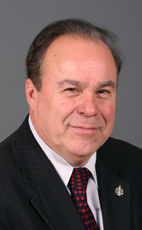
House of Commons photo

Crucial Fact

  • His favourite word was french.

Last in Parliament March 2011, as Conservative MP for Charlesbourg—Haute-Saint-Charles (Québec)

Lost his last election, in 2011, with 30% of the vote.

Statements in the House

Celebration of Love May 17th, 2007

Mr. Speaker, last Saturday, May 12, 2007, I had the pleasure of attending the reception to mark the Fête de l'Amour in Lac-Saint-Charles. The Fête de l'Amour is an event for couples in the Lac-Saint-Charles area who are celebrating their anniversary, in multiples of five years.

During this annual celebration, which was organized again this year by Maurice Cooper and his amazing team of tireless volunteers, I had the pleasure of meeting several couples from my riding of Charlesbourg—Haute-Saint-Charles who have been married for 50 or 55 years. The event is a wonderful celebration of life and love. I offer my congratulations to these extraordinary couples and wish them continued happiness and long life.

I would like to send special congratulations to the two couples attending the reception who celebrated their 55th anniversary this year: Ludger Rhéaume and his wife, Jacqueline Renaud, and Laurent Lepire and his wife, Patricia Lepire.

They are a model of sharing, love and harmony to those around them and an example to us all.

Criminal Code May 17th, 2007

Mr. Speaker, I am pleased to speak today on Bill C-10.

I will point out to my colleague that in the province of Quebec—my province—there is a body, namely the Société de l'assurance automobile du Québec, which has an obligation to protect citizens and in particular to make recommendations to the federal government, since we are responsible for the Criminal Code, on harsher sentences for alcohol-related offences.

My response to my colleague's theory is as follows. When I started practising law, the fine for someone who had consumed alcohol was only $300. We subsequently created three different levels with different penalties for each of the first three offences. This is called the progressive system. If we had heeded my colleague at that time, today there would be but a single $300 offence, and everybody would be fine with that. The criminals would be protected but the victims left out.

I would like to ask a question of my colleague, my fellow committee member, whom I appreciate for his good advice on procedural matters. Even if his party is opposed to the bill, I know very well that his fellow citizens will agree with us, because the people of Canada do want to see victims protected before criminals.

Why does my colleague not agree with imposing progressive penalties for criminal acts, particularly in these specific cases where extremely serious offences are involved? We are not talking about minor situations, but extremely serious ones. We have been doing that same thing for over 20 years, and the most clear example of this is section 259 of the Criminal Code which, as my colleague is well aware, sets progressive sanctions for criminal acts.

Saint-Hubert Airport May 10th, 2007

Mr. Speaker, for several weeks the Bloc members have taken a keen interest in the upgrading of the Saint-Hubert airport. This is nevertheless a very recent interest. Why is the Bloc being opportunistic by suddenly taking an interest in the future of this airport?

Until very recently, the Bloc members only talked about Mirabel airport. In fact, no mention was made of the Saint-Hubert airport in their platform. Even in 2004, the regional platform of Bloc candidates in the Montérégie region, including the member for Saint-Bruno—Saint-Hubert, made no mention of this airport.

Does the Bloc's new position now favour the development of the Saint-Hubert airport over that of Mirabel?

The eternal opposition can ask questions and write press releases but it will never be able to do anything to upgrade a single airport in Quebec, much less ensure the development of the aerospace industry.

Official Languages May 8th, 2007

Mr. Speaker, as you know, our government has shown steadfast support for our linguistic duality. In the last budget, we announced an additional contribution of $30 million over two years.

Today the Minister of International Cooperation and Minister for la Francophonie and Official Languages announced two important contributions for official language minority communities.

Could the minister provide some details about these announcements?

Member for Québec May 3rd, 2007

Mr. Speaker, this week, we learned that the Bloc member for Québec ordered a report recommending that the Bloc support the ADQ in its efforts to achieve independence from Ottawa. However, her leader calls himself a sovereignist and a Parti Québécois ally.

Instead of misleading the people to justify the salary and benefits received by powerless MPs, members of the Bloc would do well to recall what one of their own, who has since left Ottawa, said. In 2003, a former member of the Bloc said, “If the Parti Québécois does not win the next election, do not expect me to run in another federal election. Personally, I am not interested in speaking on behalf of Mario Dumont or Jean Charest here in the federal Parliament”.

I wonder whether the member for Québec agrees with what her former colleague said.

April 30th, 2007

Mr. Speaker, I listened to everything my colleague had to say, and I would like to ask her one very specific question.

Under section 43 of the Official Languages Act, the Province of Quebec is excluded from the application of that Act. How, then, can you justify the right to court challenges for Quebec's anglophone minority, given that we are completely excluded from the application of the Official Languages Act? How can this program help minorities in Quebec when they are excluded from the Official Languages Act under the notwithstanding clause and section 43?

There is one other thing I would like to know. Your party voted against Bill S-3—against the promotion of French in the other provinces. Perhaps the court challenges program can help with social matters, but what can it do to help us linguistically? What good is it?

The Environment April 26th, 2007

Mr. Speaker, the leader of the Bloc Québécois no longer knows what to say to justify the presence of the Bloc in Ottawa. Recently he incorrectly stated that the Conservative members from Quebec were not defending their province's environmental interests. The criticism from the leader of the Bloc is even more surprising and contradictory given that in just 14 months, the Conservative government has given $349.9 million to Quebec to help it meet the goals of its 2006-12 climate change plan.

With this $349.9 million, provided as part of the Canada ecotrust program, Quebec will now be able to meet its Kyoto objectives, which was recently confirmed by Quebec's new environment minister. This is $22 million more than the Bloc was asking for, and $350 million more than what the Bloc could ever get for Quebec.

We, the 10 Conservatives from Quebec, say what we do and do what we say.

Arts and Culture April 25th, 2007

Mr. Speaker, in its last budget, Canada's new government announced that $60 million would be made available over the next two years for events celebrating local arts and heritage.

Could the Minister of Canadian Heritage and Status of Women tell us what progress she has made with the implementation of this program?

Public Safety April 24th, 2007

Mr. Speaker, Clermont Bégin is a dangerous offender who was sentenced to 11 years in prison for sexual assault with a weapon, aggravated assault, attempted murder, kidnapping and forcible confinement. These offences were committed against a 16 year old young woman from the Lac-Mégantic area in Quebec. His sentence began on April 25, 1996. Yesterday, Mr. Bégin was released after serving his entire sentence.

What does the new government intend to do to ensure that these individuals are better supervised once they are released?

Youth Exchanges Canada April 19th, 2007

Mr. Speaker, tomorrow, 18 first-year students and two teachers from Saint-Pierre secondary school in my riding of Charlesbourg—Haute-Saint-Charles are flying to British Columbia as part of the Youth Exchanges Canada program put on by the Society for Educational Visits and Exchanges in Canada.

The exchange is between the Saint-Pierre school in Charlesbourg and the Ross Road school in North Vancouver, where there is a French immersion program. The students are well prepared for their trip and are in contact with their counterparts in British Columbia.

The students from North Vancouver came to Quebec City in the winter and enjoyed the hospitality they received from the Quebeckers, who hosted them for a week during Quebec City's winter carnival period. Now it is time for the students from Charlesbourg to spend a week with them from April 20 to 27.

I want to wish them a very good trip. I am sure the experience will be very rewarding for them because they will get the chance to see another side of life in Canada and to discover just how vast their country is.