
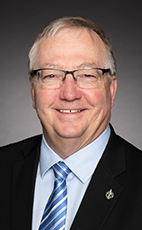
House of Commons photo

Crucial Fact

  • His favourite word was course.

Last in Parliament April 2025, as Conservative MP for Red Deer—Mountain View (Alberta)

Won his last election, in 2021, with 64% of the vote.

Statements in the House

The Budget April 14th, 2016

Mr. Speaker, I proudly rise today on behalf of the people of Red Deer—Mountain View to speak to this Liberal budget for the upcoming fiscal year. I will be sharing my time with my hon. colleague from North Okanagan—Shuswap.

In this budget there is bad news and there is some good news. The bad news is for hard-working Canadians in this country and the good news is for some very sketchy Liberal pet projects.

During the 10 years of Conservative government, there was a critical point that Canadians could count on: a promise made was a promise kept. We can imagine the surprise of Canadians when they realized that when the Liberals made a promise, it was not worth the paper that it was written on. Perhaps they thought they could take the Liberal campaign promises to the bank, but now they have found that the only thing going to the bank is a request to increase the limit on Canadian taxpayers' credit cards. That affects every Canadian.

My constituents come from all walks of life: oil and gas, farmers, teachers, social service workers, protection services, community leaders, small business owners, and so many aspiring entrepreneurs. As Conservatives, we had it right with our economic formula: tax relief, training our future workforce, and supporting trade.

Take, for example, the knowledge infrastructure program, or KIP, which we introduced as part of the Conservative economic action plan. KIP was a two-year, $2-billion economic incentive to encourage infrastructure enhancement at Canadian post-secondary institutions. The program helped to provide economic stimulus, training, and subsequent employment for engineers, architects, tradespersons, and technicians in my community. It was delivered during a time of global economic distress, and it was done in an effective and expedient manner.

KIP also helped to generate the advanced technologies infrastructure needed to keep Canada's research and educational facilities at the forefront of scientific advancement. Both Red Deer College and Olds College received funding under this program, and I have been told many times by people at these institutions how helpful the program was for them. It had a track record of positive results, and Conservatives were able to fund such programs while being financially responsible.

During the past decade, central Alberta enjoyed a reputation of being one of the fastest-growing communities in the country. It was a region renowned for its economic growth, and we saw significant and rapid increases in population.

This entrepreneurial spirit was evident a short time ago when I was honoured to attend the Alberta Chamber of Commerce 2016 Awards of Distinction. I was extremely proud to see many of my constituents and their local businesses recognized on the provincial stage.

Melanie Tuck of Collegiate Sports Medicine took home the award for Woman Entrepreneur of the Year. Melanie and her team saw tremendous growth in both her Red Deer and Olds facilities as she used their expertise to help injured athletes, workers, and community members.

Also, Tannas Conservation Services out of Cremona was nominated in the category for young entrepreneur, while Platinum Homes and Developments from Red Deer was nominated in the small business category. These job creators and community leaders have done an incredible job in growing their businesses to the benefit of our communities.

Sadly, it is the entrepreneurial leaders, future business owners, small businesses, and community job creators that the government is targeting in budget 2016. With this budget, aspiring business owners will be hit with higher taxes, making it harder for them to save up to start a business. Existing small businesses will also be hit with higher payroll taxes through the addition of over $1 billion in new EI expenditures and higher premiums for all future employers.

Additionally, the budget killed the small business hiring tax credit, which was designed to help small businesses grow and create jobs.

Under the Conservatives, Canadians across the country enjoyed the lowest tax rates in 50 years. Low taxes mean more money in the pockets of every Canadian. It is not what we see in this budget.

Today more than 100,000 Canadians from across the country are out of work in the oil and gas industry alone. These Canadians have worked hard to take care of their families and they have paid more than their fair share into the system. For decades they helped pay down debt and they paid their dues. To thank them, the Liberals held a photo op in Calgary, telling struggling oil and gas workers that some of them would be getting a bizarre employment insurance extension plan. This is not the jobs creation plan that Albertans were promised. Unfortunately, this neglect seems to extend past Alberta, with the Liberals failing to identify a solid jobs plan for all Canadians.

The government told us to wait, that when the budget was delivered there would be a clear job plan for everyone. With the budget before us now, we know these were empty words from the Prime Minister.

The Prime Minister's favourite saying seems to be that Canada is back. Well, millions of Canadians are certainly disappointed to see that what is actually back is the old tax-and-spend Liberals, wrecking the economy and the financial well-being of Canadians.

After years of record economic growth and job creation under the Conservatives, the Canadian economy will now be handcuffed, thanks to this reckless Liberal spending.

The Liberals will not tell us this, but the truth is that in the last four months, the Liberals have blown through over a $3 billion surplus as well as an addition $5.4 billion. To pay for their reckless spending, Liberals have already raised taxes and will raise more in the future. With this budget, personal taxes are set to go up by $1.3 billion this year and $2.4 billion the next. Now they need to break their election promise to borrow even more.

The rhetoric does not mask the fact that if the Liberals were the open and transparent government they have claimed to be, they would have allowed us to table the real economic figures and updates in the House.

Financial experts and economists warn us that this irresponsible spending will pile on billions more to the national debt over the next four years. This is reckless spending, with no foreseeable economic boost in the future. There is no clear economic leadership from the Liberals.

This is not the economic environment that will reassure Canadians. When investors and businesses lose confidence, investments start to decline and communities suffer. This is manifesting itself in Alberta at this time.

Budgets should be a source of reassurance to Canadians, assurance that their government is doing its best to encourage a strong economy, good jobs, and uncompromised services. On that note, this budget has failed.

My colleagues and I came back from our ridings sharing the same concerns of our constituents. Canadians are worried.

The government is cutting funds from important sectors. It cut $3.7 billion from our defence budget, and the Liberals have short-changed public safety with a mere $57 million at time when terrorism is a global and national threat.

In terms of provisions for the services we Canadians care about, the Liberals came out empty-handed. They have no clear path in supporting the long-term health of sectors such as home care, palliative care, support for seniors, or a provincial health care and social services scheme.

The leader of the opposition said it well when she said, “Without real economic leadership, there is no means to pay for all of these important social programs that so many Canadians rely on when they need our compassion.”

I sure hope that by the time budget 2017 comes along, the Liberals will stop taking economic lessons from the Prime Minister's government friends from Ontario, who have successfully ransacked local economies, cut essential services, and created mountains of debt for future generations.

Let me again remind everyone that our children, our grandkids, and their children did not sign up for this multi-billion credit extension to which these Liberals feel so entitled. They promised they would be responsible in their quest for change, but with this budget they have abandoned that.

The Liberals have also abandoned our allies when they were needed the most. They abandoned our natural resources industry. They have abandoned our farmers. They have abandoned the champions of religious freedom for persecuted religious minorities around the world. Now they are turning their backs on the future, economic stability, and quality of social services in our country. This budget will short-change Canadians today, tomorrow, and for generations to come.

Canadians and future Canadians, however, can count on the Conservatives to be on their side.

The Economy March 10th, 2016

Mr. Speaker, this week in Washington, the Prime Minister will be hosted by the Center for American Progress. This anti-Canadian organization has spent years lobbying against Canadian energy and the jobs that it creates. Thousands of Canadian jobs depend upon our natural resource industries, which include forestry, agriculture, and oil and gas.

Why is the Prime Minister focused on photo ops and anti-Canadian lobbyists instead of low taxes and better jobs for Canadians?

The Economy March 10th, 2016

Mr. Speaker, a few weeks ago, 10 Canadians had a Q&A with the Prime Minister. One of those Canadians was Danny Strilchuk, a young oilfield worker from Edmonton. When he asked the Prime Minister how he would deal with the struggling oil industry, the Prime Minister responded with a sigh and said, just hang in there.

Telling a struggling young man to hang in there is not enough. When will the Prime Minister stop putting up roadblocks, stop raising taxes, and help struggling workers get back to work?

Interparliamentary Delegations February 18th, 2016

Mr. Speaker, it is an honour for me to be able to present to the House, pursuant to Standing Order 34(1), in both official languages, the report of the Canadian delegation of the Canada-China Legislative Association and Canada-Japan Inter-Parliamentary Group respecting its participation at the 22nd Annual Meeting of the Asia-Pacific Parliamentary Forum in Puerto Vallarta, Mexico, January 12 to 15, 2014.

Red Deer—Mountain View December 11th, 2015

Mr. Speaker, I rise to thank the constituents of my wonderful riding of Red Deer—Mountain View for re-electing me to the House of Commons. I am proud to continue representing Red Deer and Red Deer county, with the addition of the county of Mountain View and the beautiful communities of Olds, Carstairs, Didsbury, Sundre, and Cremona.

Red Deer—Mountain View forms a large of the central Alberta economy. Our riding depends on agriculture, natural resource development, and manufacturing. In recent years, we have faced a number of issues, most notably low oil prices and grain shipment backlogs. This is why I was quite concerned that in the government's throne speech, there was no mention of agriculture or natural resources.

Since these issues are ones that affect our region directly, but do not seem to warrant the Liberals' attention, I have made a commitment to ensure that support for these sectors becomes a priority. It is important that the government respects and does not forget central Alberta or the thousands of Canadians who depend on the agriculture or energy sector to put food on their families' tables.

Petitions June 15th, 2015

Mr. Speaker, it is an honour for me to present five identical petitions today. They have to do with drinking and driving, impaired driving, and many senseless deaths of young people. I am thinking specifically of Krystal Owchar, and the Owchar and Riley families and how they have been devastated, as well as Tyler Isbister, Jeremie LeBlanc, William Harris, Gwen Martin. These are young lives who were taken from us because of this senseless act.

Families For Justice is a group of Canadians who have had loved ones killed by impaired drivers. They believe that Canada's impaired driving laws are much too lenient and want the crime to be called what it is, which is vehicular homicide. It is the number one cause of criminal death in Canada; over 1,200 Canadians are killed every year by drunk drivers. Families For Justice is calling for mandatory sentencing for vehicular homicide and for Parliament to support Bill C-652, Kassandra's law.

Public Safety June 15th, 2015

Mr. Speaker, my constituents believe in justice. They want to know that when a criminal or a terrorist harms a Canadian, their government will work to ensure that justice is delivered and that those responsible will have to answer to the law. Too often crimes go unpunished, and people lose trust in our justice system.

Could the Minister of Public Safety provide an update on the case of the 2008 kidnapping of my former constituent, Amanda Lindhout?

Business of Supply June 4th, 2015

Mr. Speaker, I certainly agree. Even when we go into our own stores, we can look at the price of two litres of pop and compare that to the price of milk or something that is nutritious. It is frustrating when we see that sort of thing happen.

It is one of the reasons we moved away from the food mail program, which also subsidized carburetors and snowmobile parts and so on. It was a case of moving that out of the program so that we could concentrate specifically on what the real needs were, which was as much perishable and nutritious food as possible.

Business of Supply June 4th, 2015

Mr. Speaker, I have spent some time working with public accounts. I understand the process involved, and I realize the difference between some of the statements that are coming in and the proposed expenditures that will take place at other times. I heard one of the other members speak to this as well.

It also looks at results. As I mentioned in my address, it is $137 per month a family is saving because of the program we have in place. It is that type of thing that is important.

I believe that the member opposite spoke about how this program should go to northern communities that are only accessible by air, yet within his own community, and within the list, we have a number of communities that are accessible by ferry or by road. When we look at how the opposition members would try to put input into the program, grabbing things from all different directions, it shows a little inconsistency.

Business of Supply June 4th, 2015

Mr. Speaker, I will be sharing my time with the hon. member for Desnethé—Missinippi—Churchill River.

I am honoured to have the opportunity to clarify why I cannot support the opposition motion. I can assure hon. colleagues that the government is committed to the welfare of northerners. We understand that the north is a fundamental part of our heritage, our future, and our identity as a country. In fact, no other government in history has done as much for the north as our government.

While the motion is motivated by good intentions, the opposition has failed to provide a new solution to what all parliamentarians agree is a real and pressing issue.

I find it somewhat odd that the opposition would even want to provide additional funds to a program that both the member for Northwest Territories and the member for Timmins—James Bay have previously claimed has failed. Northerners are well aware that this is not the case. Nutrition north has provided residents with access to healthy perishable food choices at affordable prices. Unlike past Liberal governments, which endorsed the ineffective food mail program, nutrition north is helping to meet the needs of those living in isolated northern communities.

As other speakers have outlined, the government recognizes that a host of factors drive up the cost of food in northern communities. These include the higher cost of energy, labour, and transportation. Our government is determined to discover how we can overcome these obstacles to increase northerners' food security. Our Conservative government has been unequivocal in its commitment to ensuring that northerners, like all Canadians, have access to perishable nutritious food at a price they can afford.

Thanks to the implementation of nutrition north by our government in 2011, there has been a strong reduction in the cost of nutritious food in remote communities. Between March 2011 and March 2014, the cost of the revised northern food basket for a family of four fell by an average of 7.2% in communities eligible for a full subsidy under nutrition north. That translates into savings of approximately $137 a month for a family of four.

Something else that differentiates members on this side of the House and the opposition is that we do not automatically presume that the government knows best. Instead, we engage directly with the people with the most at stake when it comes to paying for nutritious food, and that is northerners themselves.

Critical to the success of nutrition north is the program's advisory board. The board was created concurrently with the implementation of the subsidy in 2011. Its mandate is to improve program governance and to give northerners a direct voice in the program.

The Nutrition North Canada Advisory Board meets up to three times a year, holding meetings all across the north. When meeting in the north, the board, in public meetings, hears directly from northern residents and communities. Between May 2011 and June 2014, the advisory board held public meetings in Nunavut, Nunavik, Newfoundland and Labrador, and the Northwest Territories. Each meeting provided the board with input from residents and communities on how the program was working.

Members of the board represent a wide range of northern perspectives. Transparency and accountability are ensured by choosing members who are volunteers and who serve as individuals, not as representatives of any particular organization, area, or special interest. Their experience and expertise inform the management and effectiveness of nutrition north. For example, the most recent addition to the board is Tracy Rispin. She is a heritage interpreter from Old Crow, Yukon, who works with the Vuntut Gwitchin First Nation. She has held a variety of positions over the past 30 years pertaining to heritage, natural resources, and finance. She has also served as elected deputy chief of the first nation and has extensive experience as a filmmaker who has worked on projects such as the Vuntut Gwitchin oral history project.

Ms. Rispin has a thorough knowledge of Yukon first nations issues, history, cultures, and protocols. With a strong background and hands-on experience in first nations education, she will provide invaluable input from the community to direct the nutrition north Canada program. One of the many benefits of this approach is that board members often share their region's experiences. This makes nutrition north more effective and representative of the needs of northerners.

Northerners also provide input into the program in many other ways. For example, la Fédération des coopératives du Nouveau-Québec, which operates 14 co-operatives in Nunavik, has voluntarily implemented a point-of-sale in-store system. This system ensures that customers know how and when the nutrition north Canada subsidy is applied to their grocery bills. Consumers can clearly see the amount of the subsidy passed on to them, ensuring greater retailer transparency and accountability.

The advisory board is expected to return soon with an opinion as to whether this point-of-sale receipt system should be applied to all subsidized retailers. Our government believes that this receipt system could be an important step in creating greater transparency across the north. It also demonstrates an innovative way in which communities and retailers can work together to address the concerns of consumers.

The advisory board and local retailer innovation are just two examples of the avenues we have used to collect input from northerners. Our government is making every effort to ensure that northerners have their say about nutrition north and can contribute ideas about how to make the program work even better. Our government has carried out important reviews to assess areas for improvement. The advisory board continues to listen and learn from northern residents.

We are investing additional funds to make sure we increase access to perishable nutritious foods in isolated northern communities. I remind the House that our Conservative government, through budget 2014, added $11.3 million in 2014-15 to increase nutrition north's food subsidy budget. This was over and above the program's existing annual subsidy of $53.9 million. We also committed to a new, ongoing 5% compound annual escalator, beginning this year. Our government believes that this increased financing is a responsible approach to take.

We understand that taxpayers put their trust in parliamentarians to handle their money with great care.

I urge parliamentarians to reject this opposition motion. There is no doubt that subsidies offered by nutrition north have led to impressive results. Let me assure all northerners that this government will continue to act responsibly and in the best interests of northerners, assuring that they will have access to nutritious perishable food.