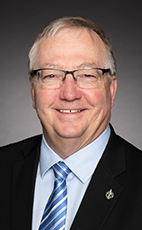
House of Commons photo

Crucial Fact

  • His favourite word was course.

Last in Parliament April 2025, as Conservative MP for Red Deer—Mountain View (Alberta)

Won his last election, in 2021, with 64% of the vote.

Statements in the House

Business of Supply June 1st, 2015

Mr. Speaker, I spent my life as a high school math and physics teacher. For 34 years, I talked about economics and dealing with the ability for individuals to manage their accounts, how to deal with income tax, setting up their Canada pension plans, and managing and understanding EI, as well as concepts of savings and annuities. Those are the sorts of things I have been proud of being able to deal with.

When I saw that our government brought in the national financial literacy, I was extremely proud. I encourage all Canadians to make sure that they can deal with that in a proper manner.

Business of Supply June 1st, 2015

Mr. Speaker, when there is a general discussion about income splitting, we have to look at what has actually occurred. Breaking it down, there would be a maximum amount that could be transferred to minimize the amount of tax. That is part of it.

However, it is also a case of fairness. When we look at the numbers, if an individual is making $20,000 and their spouse is making $60,000, it works out to $80,000. When we compare that to a scenario where two people are making $40,000, much more tax is being paid. I believe it is around $1,100.

Further, it is a case of looking at the potential with different types of families and making that where the fairness comes in. There are caps, which is the other aspect to it, but, again, it is to try to make it fair for all individual families because it had not been to that point in time.

Business of Supply June 1st, 2015

Mr. Speaker, I appreciate the question from the hon. member.

It is absolutely true. When we look at different ways in which small and medium businesses send bills, whether electronically or by mail, there is no intent on their part to add more insult to injury.

That is the frustration we have with mandatory fees. That is why in our economic action plan, we will ensure these changes are done and that consumers will be protected in that area in the same manner as we have protected them in so many other areas.

Business of Supply June 1st, 2015

Mr. Speaker, before I start, I would like you to know that I will be sharing my time with the member for Edmonton Centre.

Our government has a strong record of empowering Canadian consumers. We understand that when Canadians make decisions about how to spend their money, they must be assured their interests come first and that they are given fair treatment. That is why our government is pleased to support this motion. In fact, our government has already addressed the issue raised in the motion at hand. As such, it gives me great pleasure to take a moment to speak about the hard and effective work that our government has done to help middle-class consumers.

We have an actual record to stand on, in contrast to the NDP, which has voted against every consumer protection measure we have introduced.

In November 2014, the Minister of Finance accepted voluntary undertakings from Visa and MasterCard to reduce their average effective interchange fees to 1.5%. In total, the two commitments represent a reduction in credit card fees of approximately 10%. These commitments represent a meaningful, long-term reduction in costs for merchants that should ultimately result in lower prices for consumers.

Furthermore, our government released the enhanced code of conduct for the credit and debit card industry in Canada in April, a move which ensured that merchants and consumers have the information they need to make informed decisions and that they are not gouged by credit and debit card companies. The enhanced code of conduct includes a new measure to ensure that credit card issuers disclose to cardholders that premium credit cards can result in higher fees to merchants.

In economic action plan 2015, we will continue to build on this record by introducing a new and exclusive financial consumer framework for federally regulated banks. This would ensure that banks are more accountable when it comes to consumer protection, such as in advertising and the sale of products. This framework will be good for small businesses and for consumers. Unfortunately, the opposition appears to oppose this measure, along with the rest of the low-tax, pro-job measures that our government has introduced in our most recent budget. Measures such as these would ensure that small businesses benefit from a meaningful reduction in credit card acceptance costs, which would in turn be beneficial for consumers.

As we know, small businesses are the backbone of the Canadian economy. Beyond lowering merchant fees, our government has a record of helping small businesses grow and succeed. Small businesses account for 99% of all businesses in Canada and employ half of the working men and women in the Canadian private sector. Our government believes that small businesses should spend their time growing their businesses and creating jobs. That is why we have cut taxes significantly for small businesses and their owners since 2006. Economic action plan 2015 would go even further.

In the fall of 2014, our government introduced the small business job credit, which will help small businesses save more money. Then, in economic action plan 2015, our government proposed to reduce the small business tax rate to 9% by 2019. This would be the largest tax rate cut for small businesses in more than 25 years. It is estimated that this measure will reduce taxes for small businesses and their owners by $2.7 billion between 2015 and 2020. For example, as a result of this tax cut and other measures since 2006, for a small business with a taxable income of $500,000, the amount of federal tax paid in 2019 will be 46% lower than in 2006. This represents an annual tax reduction of up to $38,600, which can be reinvested in the business to fuel its growth and create jobs for Canadians.

Unfortunately, the opposition parties have chosen to vote against our measures that are designed to help small businesses and consumers. In opposing our current budget bill, the NDP and the Liberals are demonstrating their lack of understanding of the important role that small businesses play in the Canadian economy.

The hon. member prefaces his motion with the notion that the government should take immediate steps to make the cost of living more affordable for the middle class, and we could not agree more. That is why we have cut taxes over 180 times since coming to office. In fact, the overall federal tax burden is currently at its lowest level in 50 years. We believe it is simply the right thing to do. By putting more money in the pockets of Canadians, we are helping them to make ends meet and spend more on what matters to them.

Since 2006, the government has introduced measures to make life more affordable for Canadians. We have cut the GST from 7% to 5%, established tax credits to support working low-income individuals and families, public transit users, first-time home buyers, and families caring for disabled relatives. We have provided additional support for families with children through the children's art and fitness tax credits, and the enhancement of the registered education saving plan and the adoption expense tax credit. We have introduced the new family tax cut, and enhancements to the universal child care benefit and child care expense deduction, measures which will provide support to every single Canadian family with children under the age of 18. Canadians at all income levels are benefiting from the tax relief introduced by the government, with low- and middle-income Canadians receiving proportionately greater relief.

In 2015, a typical two-earner family of four will receive tax relief and increased benefits of up to $6,600 as a result of the measures introduced since 2006. These low-tax measures also build on our pro-consumer record, which includes removing tariffs on baby clothes and certain sporting equipment to help reduce the cost of these goods for Canadian families, banning negative option billing for financial products, requiring all-inclusive airfare advertising to ensure that consumers can clearly see the total price of an airline ticket with no hidden fee, and much, much more.

By keeping taxes low for small businesses and individuals, our Conservative government is demonstrating our commitment to creating jobs and making life more affordable. Moreover, by working with banks and credit card companies, we are ensuring that all Canadian consumers are protected and well educated in order to make informed choices about their financial futures.

Today, Canada stands tall in the world. Over 1.2 million more Canadians are working now than at the end of the recession. The majority of these net new jobs have been full-time positions in high-wage, private-sector industries. Canada has posted one of the strongest job performances in the G7. The International Monetary Fund and the Organisation for Economic Co-operation and Development expect Canada's growth, already ahead of our peers during the recovery, to continue to be solid.

Our government continues to be absolutely committed to job creation and economic growth, objectives that have underpinned our economic action plan since its inception in 2009. By staying the course and sticking to our proven economic action plan, our government will remain committed to helping all Canadian consumers. Let us hope that the NDP will finally start supporting our pro-consumer measures for once.

Agriculture Producers in Alberta May 28th, 2015

Mr. Speaker, this past Saturday I hosted a round table at the Innisfail Auction Mart in my Red Deer riding to address the issues facing local livestock producers.

We had a frank, open discussion about how our government can help central Alberta producers and the agriculture industry as a whole. We were able to discuss the new CETA deal, a deal that would allow unprecedented trading access between Canada and the EU.

One of the many benefits recognized as a result of this deal is that of the EU's more than 9,000 tariff lines, nearly 98% would be duty free for Canadian goods when CETA comes into force.

Optimism was also expressed regarding our recent trade victory at the World Trade Organization regarding U.S. country of origin labelling. We look forward to a quick resolution.

The passion of these participants made me extremely proud of what our central Alberta agriculture producers have done to advance their industry and our goals as a nation. I look forward to hosting many more in the future.

Common Sense Firearms Licensing Act May 25th, 2015

Mr. Speaker, earlier on, one of the NDP speakers said, on bringing back the costly Liberal gun registry, that the party had other plans.

Could the hon. member comment on what the Liberal leader had indicated back on December 3, 2012. He said, “I voted to keep the firearms registry a few months ago and if we had a vote tomorrow I would vote once again to keep the long-gun registry”.

Exactly two years to the day, on December 3, 2014, he said he, “would not reinstate the gun registry, even in a modified form, because it's simply too divisive”. Of course, that would be political suicide. Then he said, “There are other ways to reduce gun violence...including through the classification of restricted and prohibited firearms and through the requirements imposed on the purchase of firearms”, speaking about getting rid of the bullets, taking away property.

Are the New Democrats and the Liberals looking at a joint plan as far as the gun registry?

Common Sense Firearms Licensing Act May 25th, 2015

Mr. Speaker, of course the member was not here in the 40th Parliament when there was a private member's bill designed to get rid of the long gun registry. He did not see the members who had to be thrown under the bus when the numbers were not right as far as that bill being taken to committee. However, a lot of those who did not vote that way are not here because they did not follow the will of their constituents.

The member is from Quebec. There are many people in Quebec who are proud gun owners and might be a little concerned when he says we are simply protecting the minority of owners, where safety is not important. I do not believe that there is anybody who believes that is the case.

I wonder if the member could speak to the fact that there are people in Quebec who believe that we have to continue to respect gun ownership in this country.

Yukon and Nunavut Regulatory Improvement Act May 25th, 2015

Mr. Speaker, of course, as the member knows, the consultations were all consistent with the Umbrella Final Agreement, so all of the discussions were taking place within that framework.

I remember earlier that the parliamentary secretary was speaking of the $100,000 that was there to help the consultations take place. Critical to this, as well, is recognizing that the Government of Canada, as far as policy directives are concerned, has been in support of our aboriginal groups in the north. That is a critical component. Sometimes we hear that we are giving this opportunity for other things and for negative things to occur, because it is easier to talk that way. However, when we look at the practicality and the actual things the government has been doing with the northerners, it has been to protect. Whether it has been environmental issues or aboriginal wishes and concerns to help their communities, there has been great support from our government.

Yukon and Nunavut Regulatory Improvement Act May 25th, 2015

Mr. Speaker, I had the opportunity a number of years ago, when I was first on the aboriginal affairs and northern development committee, to go to the north. We were in Iqaluit, Yellowknife, and Whitehorse. I had a chance to speak to different groups and different organizations.

The study was on barriers to development in the north. While we were there, this was one of the key, important features people were talking about. They said to give them that opportunity. They said that they had great entrepreneurs there and did not want to be held back. They wanted to be able to have the same advantages as the people south of 60. It was so important for them to be able to do that to help their families.

When we were talking to folks about what these barriers were, these were some of the key components that were being brought forward.

Yukon and Nunavut Regulatory Improvement Act May 25th, 2015

Mr. Speaker, it is an honour to speak to this legislation. After years of review and consultation with first nations and other northerners, with the legislation proposed in Bill S-6 we can now move forward with improvements to northern regulatory regimes. These improvements will yield long-term benefits for individuals and businesses in Yukon and Nunavut.

I am a strong believer that northerners should benefit from the tremendous natural resources found in their region. Bill S-6 contains critical amendments to northern regulatory regimes that would ensure that northerners benefit from their resources. These amendments would bring both Yukon and Nunavut's regulatory systems in line with that of the Northwest Territories and the rest of Canada. This would ensure that the territories remained a competitive and attractive place to work, live, and invest for generations to come and that northern families had opportunities to grow and prosper.

I want to focus on several changes in Bill S-6 that would modernize the Yukon Environmental and Socio-economic Assessment Act, called YESAA for short, which would enable us to make progress on both fronts.

The goal of the proposed legislation is to consider the potential effects that proposed development could have on Yukon's environment, people, communities, and economy.

The Honourable Darrell Pasloski, Premier of Yukon, said:

...it is becoming increasingly clear that changes to this legislation before you today are essential in order for Yukon to remain a competitive place to do business.

This work is overseen by the Yukon Environmental and Socio-economic Assessment Board, whose mission is to protect the environmental and social integrity of Yukon while fostering responsible development in the territory, responsible development that reflects the values of Yukoners and respects the contributions of first nations.

I would like to focus my remarks today on one portion of the bill. It is the provision that would allow the Minister of Aboriginal Affairs and Northern Development to issue policy direction to the YESAA board.

The proposed legislation would enable the minister, following consultation with the board, to provide binding policy direction with respect to the exercise or performance of its powers, duties, or functions. This has raised concerns in some quarters that it would give the federal government authority to impose its own policies on projects on first nation settlement land. I can assure members that this is not the intention of the amendment nor the way it has been used in practice. In reality, policy directions have been used to add clarity and to ensure that all parties are on the same page with respect to existing laws.

The reason the change is being proposed is to ensure a common understanding between the Government of Canada and the board. For example, the minister could use policy direction to communicate expectations regarding the use of new technologies to mitigate environmental impacts or expectations regarding roles and responsibilities related to aboriginal consultation. This clarification would reduce uncertainty and delays in environmental assessment decision-making.

In recognition of the board's independence, there would be strict limits on the minister's ability to provide policy direction. To be precise, policy direction would have to be consistent with YESAA and with the Umbrella Final Agreement. In fact, YESAA states that first nations' final agreements will prevail in the event of an inconsistency or conflict. Furthermore, policy direction could not interfere with active or completed reviews, again because the board operates at arm's length from government.

To be clear, policy direction could not change the environmental assessment process itself. In fact, Bill S-6 explicitly states that policy directions do not apply to project proposals that have already been submitted to the board.

It is also important to note that the ability to issue policy direction is not without precedent. In fact, the Minister of Aboriginal Affairs and Northern Development already holds the ability to issue policy direction to the Mackenzie Valley Land and Water Board in the Northwest Territories. With respect to this board, policy direction has only ever been used four times, and each time it was to ensure that the board respected and upheld interim agreements the Government of Canada held with aboriginal groups.

In short, policy direction has only been used to provide additional protection for aboriginals.

Clearly, this is an important amendment to Bill S-6. The ability to ensure a common understanding by the government and the YESAA board, particularly with respect to aboriginal rights, is essential. Unfortunately, the opposition would remove this power from the bill.

This government understands the importance of protecting aboriginal rights, which is why I strongly oppose Motion No. 10, and I would encourage the rest of the House to join me in rejecting it.

A second, related feature of this proposed legislation I want to comment on is the delegation of federal powers to the Government of Yukon. The Umbrella Final Agreement defines government as:

Canada or the Yukon, or both, depending upon which government or governments have responsibility, from time to time, for the matter in question.

The delegation of federal powers to the Government of Yukon is consistent with the final agreements and with the governance regime in Yukon post-devolution. In fact, section 2.11.8 of the Yukon Umbrella Final Agreement states:

Government may determine, from time to time, how and by whom any power or authority of Government or a Minister set out in a Settlement Agreement...shall be exercised.

Moreover, the principle behind this delegation, that decisions about northern governance are best made in the north, is consistent with our government's northern strategy. In fact, just last year, our government brought into force Bill C-15, which devolved all responsibility for lands and resources out of Ottawa and back to the territorial governments.

This, in short, is why I believe that the ability to delegate authority to the Government of Yukon is an integral component of Bill S-6 and why I am so disappointed to see the Green Party oppose this clause. I strongly oppose the passage of that motion, and I hope that all members of the House join me in voting against it.

The opposition actually supported that initiative when it was before the House, but now they are opposing the very same principle when implemented in the Yukon.

I remind my hon. colleagues that the amendments to YESAA proposed in Bill S-6 address agreed upon recommendations from the five-year review or have been directly requested by the Government of Yukon so that the act can better serve all residents of Yukon, aboriginal and non-aboriginal alike. As well, the proposed amendments incorporate suggestions made during the various rounds of review and consultation.

I also want to underline that all parties have improved the legislation before us during the years of consultation and I want to reinforce that the legislation in no way compromises the integrity of YESAA or conflicts with the provisions or nature of the Umbrella Final Agreement.

For these reasons, government members are confident that Bill S-6, including the carefully constructed amendments to introduce policy direction and delegation in YESAA, fully considers the needs and interests of all northerners.

I strongly believe that the ability of the Minister of Aboriginal Affairs and Northern Development to issue policy direction to YESAB and to delegate authority to the Government of Yukon is an essential portion of this bill. Unfortunately, the opposition would like to see both clauses removed. I am asking all hon. colleagues to join me in defeating the motions and moving Bill S-6 forward as it stands.