
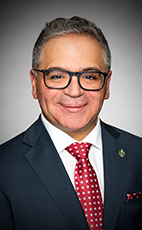
House of Commons photo

Crucial Fact

  • His favourite word was tax.

Last in Parliament April 2025, as Liberal MP for Vaughan—Woodbridge (Ontario)

Lost his last election, in 2025, with 38% of the vote.

Statements in the House

Business of Supply February 27th, 2024

Madam Speaker, it is always wonderful to rise in this most honourable House to speak on various topics, and today, the opposition motion.

If we remember the period of 2021 and the global pandemic, our government undertook a number of measures to both protect Canadians and assist Canadians. We protected Canadians by receiving and contracting for vaccines and getting personal protective equipment, and we assisted Canadians, Canadian workers and Canadian businesses through the Canada emergency wage subsidy, the CERB and a number of other measures. We literally kept a part of the economy going that was basically frozen due to the pandemic, and, working with our provincial colleagues, that allowed us to come out of the pandemic faster and stronger than any other country across the G7, across our developed partners. We see the results today in our employment numbers and our unemployment rate, in our GDP growth and in where the country is going. We had the backs of Canadians during the pandemic; we will always have the backs of Canadians, and we did the right thing.

With regard to today's opposition motion, let me make a few comments.

I want to begin by saying that our government is committed to protecting the integrity of the federal procurement process. The recent allegations related to the procurement of professional services for the ArriveCAN app are simply unacceptable. The Auditor General and the procurement ombud have uncovered inappropriate conduct on the part of some suppliers and some government officials.

While investigations are still under way into what happened in these cases, we are acting now on behalf of Canadians and implementing the recommendations of the Auditor General and the procurement ombud.

I want to reiterate that our government is deeply concerned about the allegations regarding the procurement of IT services for the ArriveCAN app. Furthermore, taxpayers have the right to ask tough questions about how public funds were spent.

While important questions have been raised about the conduct of a handful of public servants during the ArriveCAN procurement process, I want to emphasize that Canada was facing an emergency at the time and that so many others in the public service stepped up to meet the needs.

In the spring of 2020, we were faced with one of the most serious public health crises our country has ever seen. I am proud to say that our government made every effort to protect Canadians by purchasing essential supplies and services. Meeting the needs of Canadians during the COVID-19 pandemic was a monumental task on many fronts, for the government and for the world.

Public servants worked non-stop to support our frontline health care professionals and all those keeping Canadians safe. From the beginning, public servants followed a deliberate, strategic and comprehensive plan that helped Canada get results.

We can all take pride in the fact that our focused approach allowed Canada to secure a supply of vaccines and personal protective equipment when we needed them most and to ultimately get us out of the pandemic. Yes, I do believe in vaccinations; I do believe in science, and I do believe in doctors. We supplied those vaccines to Canadians, and we protected Canadians. Unfortunately, we had about 57,000 Canadians pass away due to COVID and its impact, but we protected millions.

In fact, Canada was a world leader on this front, thanks to the hard work of many Canadians across the country. We acted quickly, because we had to, but that does not excuse the mismanagement that has been uncovered with respect to the ArriveCAN app.

I want to assure the House and all Canadians that the findings of the Auditor General and the procurement ombud are being taken seriously and that we trust our law enforcement agencies, such as the RCMP, to investigate any wrongdoing.

Let me be absolutely clear on the fact that any criminal wrongdoing will lead to consequences. Our government's goal now is to strengthen certain aspects of the federal procurement system, and I know that public servants will use these lessons learned to improve the way they do business with contractors.

Public Services and Procurement Canada, or PSPC, is the central purchasing agent for the government and has an important role to play here. For ArriveCAN, PSPC provided support to the Canada Border Services Agency with contracting tools and lists of suppliers that could be used for the project. It was incumbent on the CBSA to define the requirements for ArriveCAN and to manage the ArriveCAN development and maintenance contracts, based on the policy direction provided by the Public Health Agency of Canada.

Even though greater flexibility in procurement allows us to be more agile, especially in times of crisis, it is clear that the governance and monitoring around procurement needs to be improved. I want the House to know that PSPC has already taken measures to strengthen its processes and review its functions. In November, PSPC informed every government department and agency that it was adopting new, stricter measures, introducing a common set of principles and mandatory procedures that they must abide by to use PSPC's professional services contracting instruments.

These measures will enable PSPC to improve the evaluation requirements to ensure that resources are qualified, to demand more transparency from suppliers regarding their prices and use of subcontractors, to improve documentation when contracts are awarded and task authorizations are issued, to clarify the work requirements and activities, to specify the initiatives and projects being worked on, and to assess the resources just before the work begins to ensure that the services are indeed being provided by the proposed resources.

I would also like to mention the action our government is taking to improve and strengthen the integrity regime. Our government introduced the integrity regime in 2015 to foster ethical business practices, ensure due process and uphold the public trust. The integrity regime is always being improved and strengthened, including when it comes to fraud, and PSPC continually strives to ensure that we hold suppliers accountable for any misconduct.

On an ongoing basis, PSPC proactively uses data analysis to identify any inappropriate conduct and investigate any potential wrongdoing in contracts. If an investigation uncovers any wrongdoing, PSPC informs law enforcement so that a criminal investigation can be conducted. The department also seeks to recover the funds when wrongdoing is discovered.

In conclusion, I must emphasize that we are committed to using an open, fair and transparent procurement process while obtaining the best possible value for Canadian taxpayers. The ArriveCAN app was put in place to protect Canadians. It enabled us to keep Canadians safe by managing public health measures at the border in a time of crisis. It was absolutely necessary. Without that essential tool, Canada's ability to deploy the border measures necessary to protect public health would have been significantly diminished.

I look forward to questions and comments, and I hope everyone is having a great afternoon.

Roman Catholic Episcopal Corporation of Ottawa-Cornwall Act February 14th, 2024

Mr. Speaker, there have been discussions among the parties, and if you seek it, I think you will find unanimous consent to adopt the following motion.

I move:

That, notwithstanding any standing order or usual practice of the House, Bill S-1001, An Act to amalgamate The Roman Catholic Episcopal Corporation of Ottawa and The Roman Catholic Episcopal Corporation for the Diocese of Alexandria-Cornwall, in Ontario, Canada, be deemed read a second time and referred to a committee of the whole, deemed considered in committee of the whole, deemed reported without amendment, deemed concurred in at report stage and deemed read a third time and passed.

Government Business No. 34—Proceedings on Bill C-62 February 13th, 2024

Mr. Speaker, in terms of a timeline of three, five or six years, obviously, a decision was made. As the member identified, we need to work with the provinces and territories as we move forward on this policy. We need to make sure that all provinces, territories, health ministers and individuals working in the various fields are ready for this. We need to make sure that we are ready for this and that it goes through in a manner that is prudent and appropriate.

Government Business No. 34—Proceedings on Bill C-62 February 13th, 2024

Mr. Speaker, I would like to thank my colleague from Quebec for his question and assure him that this is very important to us.

My answer would be yes, of course, as a member of Parliament, I always work in the interests of my constituents, and this is an issue and a law that has been brought forth in the last number of years that people are quite passionate about. I have always grappled with the technical and fine details of the law and the early provisions on a personal level. One term that has been used is “foreseeable death”. Thinking about this must be done with much diligence and judiciousness.

I continue to advocate on our side and within our caucus for a law that is robust, that reflects the individual interests of Canadians and that is obviously compliant with the Charter of Rights and Freedoms.

Government Business No. 34—Proceedings on Bill C-62 February 13th, 2024

Mr. Speaker, I have had much respect and much time for the hon. member in all of our conversations. I am not a lawyer. On having something referenced to the Supreme Court for a decision, I would have to get back to the learned member for Abbotsford on that front.

I would say that it is important for all members in the House to look at the evolving needs of individuals in this country, speak with the pertinent experts and work with the provinces and territories.

I have always believed that we should legislate and not defer to the courts. That is my own personal opinion. I believe in that. I think that is the best way to legislate and govern. We should do so by taking decisions in the House, while making sure they are obviously compliant with the Charter of Rights and Freedoms, which I know all members in the House hold dear.

Government Business No. 34—Proceedings on Bill C-62 February 13th, 2024

Mr. Speaker, it is always an honour and a privilege to rise in the House on behalf of the wonderful residents of my riding of Vaughan—Woodbridge and all of the residents in the city of Vaughan.

I will be sharing my time with my friend and colleague from the wonderful riding of Kitchener Centre.

Before I begin my formal remarks, this is a debate on Bill C-62, medical assistance in dying, which is obviously highly personal to all members in the House. Remarks are being delivered today with much passion, substance and thought. I will add a few words on that front. I have provided my personal beliefs on medical assistance in dying, which I am obviously in favour of. I know many individuals in many families who made tough decisions that were not with regard to mental illness. That gives me great consternation and much thought.

I am glad that a pause will be put in place because mental illness is a complex subject. I am not an expert and will not profess to be an expert, but we all know someone who has struggled with mental illness. We all know family members or friends for whom mental illness continues to be an issue. Unfortunately, many folks have taken their lives, and we need to make sure there is a system in place that is robust, where people can get the help and assistance they need to live their full lives, which God has blessed them with.

I am convinced that our current MAID system is working well. I would like to take the next ten minutes to explain why Canadians should have confidence in our MAID legislation and its application over the past seven years. I also want to describe some of the activities that will help sustain that confidence when eligibility is expanded in March 2027, as proposed in Bill C-62.

When the law authorizing medical assistance in dying was originally passed in 2016, it included a number of mandatory eligibility criteria for anyone requesting MAID. The person must be an adult of at least 18 years of age and capable of making health-related decisions. The request must be voluntary. Their request must be fully informed, and the person must have knowledge of the options available to relieve their suffering. They must have a grievous and irremediable health condition, meaning it cannot be cured, which is defined as follows: They have “a serious and incurable illness, disease or disability; they are in an advanced state of irreversible decline in capability”, and they are experiencing “enduring physical or psychological suffering” that cannot be relieved under conditions that they consider acceptable.

In 2016, the law also required that the person's natural death be reasonably foreseeable. In 2019, the Quebec Superior Court ruled that this criterion violated the Charter of Rights and Freedoms. In March 2021, a revised version of the federal law was passed, extending eligibility for MAID to people whose natural death was not reasonably foreseeable as long as they met other eligibility criteria.

In addition to these eligibility criteria, the law also sets out many procedural safeguards that a clinician must meet before administering medical assistance in dying. Here are a few of them: Two independent practitioners must provide a written confirmation of the person's eligibility. The person who is requesting medical assistance in dying must be informed that they can change their mind at any time and in any way and that their wishes must be respected. Also, the person must reconfirm their desire to receive medical assistance in dying immediately before receiving it.

When a person's natural death is not reasonably foreseeable, a series of enhanced safeguards must be respected. I will talk about some of those critical safeguards.

First, at least one of the two MAID assessors must have expertise in the person's medical condition. If they do not have that expertise, they must consult another practitioner who does. Second, the person must be informed of the means available to alleviate their suffering and be offered meaningful consultations. Third, these means must have been discussed, and both MAID assessors must agree that the person has seriously considered these means. Fourth, at least 90 days must pass between the beginning of the eligibility assessment and the day on which MAID is administered. These are legislated safeguards that all practitioners must abide by.

We know that MAID practitioners across the country exercise considerable professional judgment in providing this service by keeping patients' interests and wishes at the forefront.

Practitioners work hard to ensure that MAID is a last resort. They compile essential information about the person's medical condition, their treatment history and their use of support services. They have the necessary conversations to ensure that their patients are aware of the services available to them that might alleviate their suffering. It is about exploring treatment options, facilitating referrals and following up on the results.

If the person who wants to receive MAID consents to involving family members and loved ones, the practitioners will encourage their involvement and include them in the discussions that are part of the overall assessment process.

Practitioners are also aware that they do not always have the necessary expertise in the patient's condition to conduct a full assessment. In these situations, they have to consult the relevant experts and other health professionals who have the necessary expertise to make an informed decision. Some provinces or regional health care authorities have put in place MAID care coordination services or case consultation mechanisms that rely on a team or network of doctors, nurses and other professionals, such as social workers and spiritual leaders, to support the assessment process.

What does that mean for the future, once we begin allowing MAID requests based on enduring and intolerable suffering resulting solely from mental illness? Are our existing legislative safeguards sufficient? How can we be sure that the same level of care, diligence and consistency in the provision of MAID will be the norm?

In 2021, as mandated by the former Bill C-7, an expert panel reviewed the issue and concluded that the existing legal framework for eligibility criteria and safeguards is sufficient, provided MAID assessors apply the existing framework appropriately, with guidance from MAID standards of practice that have been developed as well as specialized training.

In the time I have left, I would just like to say that we all rise in this most honoured House on many topics. One of these topics, probably one of the most personal ones that we have risen on in the number of years I have been here, is medical assistance in dying. I look forward to questions from the hon. members in the House, who have been sent here by their constituents. This is an important debate for us to have, and it is an important topic to discuss.

Business of Supply February 8th, 2024

Madam Speaker, it is very important for us to help the most vulnerable people in our country.

That includes those people who have come to this country to receive help and apply for asylum. If they receive refugee approval to be here, to stay here and to build a better future, we need to make sure we have the resources in place, not only at the beginning but as we go along.

The whole world is continuing to face a migratory problem because of climate change, war and a number of reasons. We know there are literally millions of people, if not tens of millions, who would love to come to Canada this afternoon if they could, to call this beautiful and blessed country home so we can all build a better future for ourselves and our families.

Business of Supply February 8th, 2024

Madam Speaker, Canada is home to millions of newcomers from all over the world who have come here to build a better future for themselves and add to Canada's future. We always need to maintain the consensus that folks are coming here; they are working, thriving and learning, and their kids are going to have a very bright future. On the immigration policies of not only our government but past governments, we always need to evaluate them and make sure the integrity of the system is robust, that newcomers are coming here on an efficiency basis, that they are being welcomed, that our economic capacity can absorb them and that the supply labour is great. It is not only that, but that we are nation building, and that is what our immigration should always be about. It should be about nation building and making Canada a better and better place to call home.

Business of Supply February 8th, 2024

Madam Speaker, the issue of housing construction is very important, not only for immigrants, but also for every Canadian who wants to be able to buy a home.

We must ensure that our infrastructure here in Canada is robust. We must ensure that builders have those approvals in place, which is what we are doing with the housing accelerator fund, to ensure that they can put shovels in the ground and build the homes that not only newcomers want and need but also Canadians want and need in our communities. We need to make sure we can absorb newcomers and they have a place to call home and so forth.

We know our immigration system is between two different streams, permanent and temporary residents, and we always need to balance the needs of workers and the need to build a better and better country we are all blessed to call home.

Business of Supply February 8th, 2024

Mr. Speaker, a wonderful and good afternoon to all esteemed and learned members in this House.

This new funding will enable the provinces and municipalities that are facing an increased demand for shelter spaces to better respond to that demand. It will also help to prevent asylum seekers from ending up homeless. What is more, as part of “Reaching Home: Canada's Homelessness Strategy”, the federal government has committed nearly $4 billion over nine years to fight homelessness across the country. Do we not all have the fundamental right to a safe place to live?

These are not the only ways the federal government is taking action to respond to the consequences of the increase in asylum claims.

When these claims put increased pressure on Canada's shelter system, we worked with the provinces and municipalities that were most affected to transfer asylum seekers who needed temporary housing from provincial shelters and churches to hotel rooms paid for by Immigration, Refugees and Citizenship Canada, or the IRCC. Since the end of last month, we have approximately 4,000 hotel rooms in six provinces that are safely housing some 7,300 asylum seekers.

In addition to extending the interim housing assistance program, or IHAP, we introduced the interim federal health program so that asylum seekers can receive health care coverage to meet their immediate and essential medical needs.

IRCC has also implemented a temporary public policy that provides asylum seekers with timely access to open work permits, allowing them to enter the Canadian labour market faster and to support themselves while they wait for a decision on their asylum claim.

Finally, the federal government continues to implement innovative immigration measures to address housing shortages, category-based selection and regional immigration programs. These programs are essential to attracting the workers the construction sector needs to start projects and build new housing.

Immigration is one of Canada's defining characteristics. We are a welcoming country, where newcomers can feel as though they are an integral part of the community. We are a country where we understand that immigration contributes to the growth of our economy, to our diversity and to the building of our communities.

In short, the federal government is listening to its provincial and municipal partners and will continue to do so in order to make sure that Canada remains a safe place for the world's most vulnerable people seeking refuge. Canadians expect no less of us.

This opposition motion deals with immigration. My parents were immigrants to this country, this country we are blessed to call home. I will always be proud to rise on behalf of them and the millions of newcomers who have made Canada home as we debate policies that bring newcomers here to Canada and get them working, contributing to our economy, building their family and strengthening, most importantly, our social fabric.