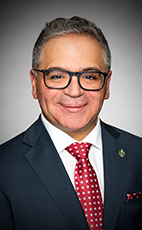
House of Commons photo

Crucial Fact

  • His favourite word was tax.

Last in Parliament April 2025, as Liberal MP for Vaughan—Woodbridge (Ontario)

Lost his last election, in 2025, with 38% of the vote.

Statements in the House

Business of Supply February 8th, 2024

Mr. Speaker, I will be sharing my time with the member for Kings—Hants.

I am pleased to rise today to discuss Canada's immigration system as it relates to asylum claims.

As we are all aware, the world continues to face an unprecedented migration crisis. Canada is not alone in welcoming a significant number of people fleeing violence, war and persecution to seek refuge at our borders.

Canada has made a commitment, grounded in domestic law and international conventions, to provide support to individuals who apply for asylum.

The federal government is meeting its legal and humanitarian obligations, and we are continuing to provide support at a level that reflects the ongoing consequences of asylum claims across the country.

Our government continues to work with our provincial, territorial and municipal partners to determine how we can support them better and support them as effectively as possible. To that end, we have put additional resources at their disposal. While the provinces and municipalities are responsible for housing and support for asylum claimants, we recognize the need for the federal government to play a role and for all levels of government to continue working together on finding solutions. We have been there throughout the entire process and we will continue to be there.

Since its inception in 2017, the federal interim housing assistance program, or IHAP, has been providing funding to provincial and municipal governments on a cost-shared basis to alleviate housing pressures and boost capacity to better respond to the increased volume of asylum claims. IHAP reimburses direct housing costs, such as shelters, hotel rooms and other interim housing arrangements; triage and transportation operations; and indirect costs, such as meals. Amounts per area of jurisdiction are set following the submission of requests for reimbursement and allocated based on the available envelope.

To date, the federal government has provided provinces and municipalities with nearly $750 million in IHAP funds to help alleviate housing pressures related to asylum seekers. Since 2017, nearly half of all federal IHAP funding has gone to Quebec to support the increased need for housing for asylum seekers.

The Government of Canada is committed to working collaboratively with provinces and municipalities to implement permanent housing solutions. That is why, last July, the government contributed an additional $212 million through IHAP and extended the program in response to the higher volume of asylum seekers.

Last week, my colleague, the Minister of Immigration, Refugees and Citizenship, announced an additional $362.4 million for the program. In all, a total of $150 million has been given to Quebec under IHAP during this fiscal year. This new funding will help the provinces and municipalities deal with a surge in demand for places in shelters. This will help stop asylum seekers from becoming homeless.

I wanted to talk about Reaching Home, Canada's homelessness strategy, but I see that I am out of time.

Business of Supply February 6th, 2024

Madam Speaker, it points to a certain level of hypocrisy. When the Conservatives were in power, they did cut over $400 to $500 million for CBSA frontline officers. Recently, on the supplementary estimates, they voted against funding for law enforcement agencies and the brave men and women who keep our communities safe. Whether it is in my hometown of Prince Rupert, where there is an RCMP detachment, or across this country, we hear again and again that the Conservatives are saying no to helping our frontline officers do their job day in and day out.

Business of Supply February 6th, 2024

Madam Speaker, I would like to thank my colleague for his question. It is a very important one. I agree with what he said about the ports of Montreal and Vancouver.

Historically, under any government administration in Canada, we have done a really good job of checking inbound cargo to Canada. We need to do a better job of checking outbound cargo. That has traditionally been the mainstay and the way the CBSA has operated. We also need to provide more resources to CBSA officers to ensure that they have the tools, while we balance the efficiency of our ports to get containers in and out. That is the economic argument.

There is also a security provision; we need to ensure that we are checking enough containers and that we maintain the checking. Also, if individuals put tags in their vehicles, we will know where those vehicles are and we could get them.

Business of Supply February 6th, 2024

Madam Speaker, my family and that of the hon. member for Kamloops—Thompson—Cariboo have known each other for over six decades now in this beautiful country.

Auto theft is a very important and severe issue for Canadians, including the residents of my riding. We are undertaking action. We have invested the resources. We will host a national auto summit this Thursday. I have spoken to many of the participants. I look forward to welcoming the chief of police of York Region, Chief MacSween, who is coming up. I have had many conversations with the deputy chiefs of York Region over the last several months, not just several weeks. We were there last week with the Premier of Ontario investing funds.

As for organized crime, the learned member knows very well that Canada has tough laws on organized crime—

Business of Supply February 6th, 2024

Madam Speaker, I think it applies to our side of the House on that one.

The government is playing a key role in bringing together partners and stakeholders from across Canada to consider new and meaningful solutions. No one level of government can expect to effectively address this issue on its own, nor can one agency or organization.

Later this week, on Thursday, the Minister of Public Safety will host a national summit on auto theft. He will be joined by the Minister of Justice; the Minister of Transport; the Minister of Innovation, Science and Industry; and the President of the Treasury Board, along with numerous provincial counterparts, law enforcement officials and leaders of industry. They will discuss and ensure a coordinated response to this issue. We need all levels of government, including federal, provincial, regional and municipal, as well as partners in industry, auto manufacturers and policing to work together in a coordinated and focused way.

I was at York Regional Police headquarters last week with the Premier of Ontario; Chief MacSween, the police chief of York Region and the presiding president of the Ontario Association of Chiefs of Police; the Minister of Justice; and the Minister of Public Safety to announce the investment of $121 million targeting guns, gangs and auto theft. It is very important that we continue the work and support our frontline officers, which our government has done since day one, instead of and versus the cuts the prior administration brought in across the board, whether it was to border security or directed funding.

This is exactly the approach the federal government is leading on. I am very confident that it will result in meaningful and effective action to address this pernicious activity.

The motion before us proposes we change the law. I expect that this work will comprehensively examine our existing laws, from the investigative tools that police use to the scope of the existing offences and whether they clearly denounce the many ways in which auto theft occurs, including through the use of violence and carjackings, as well as the links between auto theft and organized crime. It is important to remember that our criminal laws in this space are quite broad and far-reaching.

We can take organized crime as an example. We know that the face of auto theft today in Canada involves organized crime. In the GTA, 251 vehicles were taken, put on containers on a ship and brought to the port of Calabria, in southern Italy, with the vehicles destined for the Middle East and Africa. That only happens through transnational organized crime working to do so. We will stamp this activity out. The game is over for these folks. The easy money is done, and we are coming after them.

We see repeated stories of cars being stolen in places such as Ontario, Quebec and my city of Vaughan. Within a matter of days, they are placed on cargo containers and shipped overseas, where they are received and sold. They are then found in destinations in Africa and the Middle East.

Canada's organized crime offences operate independently of underlying criminal conduct, as well as working in tandem with it. This means, for example, that a person is charged with our criminal organization offences independently of being charged with any other underlying offence. To illustrate, a person may be charged with participating in the activities of a criminal organization for scoping out potential cars to steal or committing an indictable offence for the benefit of, at the direction of or in association with a criminal organization. In other words, they can be charged for stealing the car for the benefit of the criminal organization.

As I mentioned, our organized crime laws work in tandem with other criminal offences. This means that, in addition to being charged with an organized crime offence, the person can be charged with the underlying criminal conduct: the actual theft. In cases where convictions are secured for both, the Criminal Code requires that the sentences imposed be served consecutively, back to back. The Criminal Code also makes clear that a conditional sentence is not possible in cases where an auto theft is prosecuted on indictment and linked to organized crime.

It is important for all parliamentarians to recognize that we have a rich legal framework in place that already provides our police forces with strong tools. If more is to be done, I am confident that the work led by the Minister of Justice and his department will identify it.

I started my remarks by talking about the leadership the federal government is showing in this space. This is leadership in pursuing a strategy that will lead to success and meaningful action to prevent and respond to the rise in auto theft. I strongly support this approach, as it is far more likely to produce the results Canadians expect. In fact, through the first part of 2024, auto thefts in the GTA, and specifically in York Region, are down by over 20%. We are seeing a decline in auto thefts, going in the right direction. Ours is a comprehensive approach that starts with prevention and focuses on industry-specific enhancements, on operational improvements and, of course, on our legal responses.

None of these actions can work on its own to address the complex reality of auto theft; it seems to me that the focus of the motion fails to appreciate this. It is not about just throwing away the key and locking people up for years and years and determining laws to be unconstitutional; rather, it is about providing a holistic all-of-government approach working with industry and insurance to come up with the proper solutions, which they are doing. Currently, when a vehicle such as a Range Rover is purchased, insurance companies will require that a tracker be placed in the vehicle before it can be insured, which leads to a 75% reduction in auto thefts.

Leadership is about taking action and working collaboratively. Just last week, I joined the federal Minister of Public Safety, the federal Minister of Justice, the Premier of Ontario and provincial counterparts to announce a new investment of $121 million to prevent gun and gang violence, including as it relates to auto theft. This is exactly what Canadians, including the residents of York Region and of my riding, expect: governments working together to implement real solutions to address these important issues. We are already seeing a double-digit decline in auto theft in the region of York.

Conservatives are offering nothing but unserious slogans that reduce complex criminal issues to childish political games. Their so-called plan includes measures that already exist in the Criminal Code, such as a mandatory minimum penalty for repeat auto thefts. Their suggestions are not rooted in evidence or research but are classic tough-on-crime Conservative scare tactics that do not keep communities safe.

We will continue to focus on solutions while they continue to try to scare Canadians. The government will continue to work with its partners to ensure that all necessary actions can be taken to better address auto theft. I call on all parliamentarians to similarly work in the spirit of collaboration to identify real solutions for the benefit of us all. It is imperative that, as parliamentarians, our number one responsibility be to keep our communities safe and to make sure our residents feel safe in our communities, including the residents of Vaughan—Woodbridge, whom I am proud to represent.

We know that in 2022-23, criminals understood they could make a lot money by stealing fancy vehicles and shipping them overseas post-COVID. We will put a stop to that. We are putting a stop to that. How do we do that? We do it by working with the insurance companies and the auto manufacturers. I am proud to lead the Liberal auto caucus in dealing with the auto manufacturers. I invite all Canadians, especially all the people of Ontario, to visit the auto show in the coming days to see the new vehicles and the new technology there.

We are working with our provincial counterparts and the Premier of Ontario to make key announcements and key investments in our justice system. The Minister of Public Safety and the Minister of Justice will be overseeing where the laws are, where we need improved actions, where to add resources to our ports and so forth.

Finally, in the existing laws, there are mandatory minimums for auto theft that have been there for years, prior to our government. Of course we need to ensure that our residents are kept safe and that they feel safe in their communities, and we have taken action. For the first part of this year so far, car thefts are down over 20% in the region of York. We will see a further decline as the years go by.

I would say to the criminals out there that we know who they are and that we are going to come to get them. Our police resources will be able to do so.

Business of Supply February 6th, 2024

Mr. Speaker, it is great to rise in this House after question period and see so many of my colleagues.

I would like to start my remarks by acknowledging the vote that just took place in the House of Commons in support of our friends and allies in Ukraine, the Ukrainian people and the Ukrainian government. I am very proud to have voted yes on the free trade agreement. We should all be proud, as members of Parliament who voted yes and supported it. We will continue to support the brave men and women fighting against the unjustified, tyrannical Russian government that invaded Ukraine. We will continue to be there, much as the European Union was there for them this week in its €54-billion aid package. We will continue to stand shoulder to shoulder with Ukrainian people in Ukraine and the over 1.5 million Ukrainian Canadians who call Canada home. God bless them all.

I take the floor to discuss the important issue of auto theft, something the Government of Canada is deeply concerned about. Our government is addressing the issue, with over $120 million in additional funding announced last week in the region of York; it is cracking down on repeat violent offenders through Bill C-48 and attacking organized crime through anti-money-laundering measures.

In addition, the government is playing a key role—

Public Safety February 2nd, 2024

Madam Speaker, earlier this week, I had the pleasure of joining the ministers of justice and of public safety in York Region to announce $121 million in funding to combat guns, gangs and organized crime in Ontario. In the city of Vaughan and in many big cities across the country, auto theft is a growing problem and one that is becoming increasingly violent.

Can the Minister of Public Safety please reassure my constituents and all Canadians and tell us how the government plans to tackle this issue?

Black History Month February 2nd, 2024

Madam Speaker, only when we acknowledge that Black Canadian history is Canadian history can we truly understand and celebrate the rich and diverse heritage of our nation. That is why this year's theme for Black History Month is “Black Excellence: A Heritage to Celebrate; a Future to Build”. It reminds us of the contributions, struggles and achievements of Black Canadians, while challenging us to build a more inclusive and equitable Canada.

Canada's history is marked by the contributions of great ones, such as Lincoln Alexander, Viola Desmond and the No. 2 Construction Battalion. They inspire today's change-makers, who are strengthening our social fabric, including Jean Augustine, Rosemary Sadlier, Patricia and Moses Mawa, and Vaughan's very own Shernett Martin.

Our government is working with Black community leaders to ensure that Black voices are heard and reflected in policies. We are delivering initiatives that empower Black Canadians, including the Black entrepreneurship loan fund and the multicultural and anti-racism program. Together, we are removing systemic barriers and ensuring Black Canadians can fulfill their potential.

Happy Black History Month.

Business of Supply February 1st, 2024

Madam Speaker, I thank the member from Vancouver Island for their question.

As we know in this world that we live in, and from economic history and world history, capitalism works. It has lifted billions of people out of poverty and raised standards of living for people across this world on any measure. We know it is a system we are blessed to have. Communism, socialism and all the other forms people want to think and talk about have failed; look at other countries. I do not need to say more.

On the greener homes grant, it is imperative, as a government, that we continue to support Canadians, particularly low- and middle-income Canadians and folks who are on heating sources such as oil. I remember growing up in Prince Rupert, British Columbia. My grandmother's house had an oil tank in the back. We got rid of it in the 1970s and 1980s, but we need to get rid of them all and put heat pumps in and—

Business of Supply February 1st, 2024

Madam Speaker, first, let me say that I support the oil sector across the country.

I fully support the energy sector here in Canada and the over 800,000 workers who work in the sector. They are and will continue to be a crucial part of our economy as the experts of oil and gas, natural gas and so forth. The usage of these fuels will be critical for our economy for years to come, as the world adopts new sources of energy and electricity. It is very important.

On the affordability front, the $10 day care and other benefits for Canadians, such as the child care benefit, are long-lasting measures that are going to be in place well after all of us have gone on to retirement in some shape or form. They will continue to benefit Canadians from coast to coast to coast.