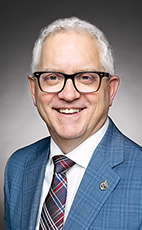
Mr. Speaker, it is indeed an honour to rise virtually to participate in the debate on the budget and to provide the perspective of many Canadians, especially that of my constituents in northern Saskatchewan who feel left out, forgotten and, in some cases, at complete odds with the Liberal government.
It has now been 19 months since I was selected the member of Parliament for Desnethé—Missinippi—Churchill River. During that time, my team and I have done what we could under the current restrictions to meet with as many constituents, local representatives, indigenous representatives, business owners and many others across northern Saskatchewan to keep in touch with their priorities.
For example, in an attempt to reach as many constituents as possible, my office developed an online survey, targeted through social media to the people in my riding. The results show just how out of touch the Liberal government is with the people in northern Saskatchewan. When given a list of 10 issues and asked to choose their top three, the most common issues identified by the people in my riding were: ending and recovering from the COVID-19 pandemic, jobs and the economy, and rural and gang crime.
This budget was an opportunity for the government to chart a clear path forward, to introduce a growth and jobs budget that would provide hope for Canadians that the fight against COVID-19 is nearly over, and that we have a path to recovery. Instead, it is a poorly crafted campaign document that plunges Canada so far into debt that my grandchildren's grandchildren will be paying for the reckless spending of the Prime Minister.
I want to touch briefly on these top three issues that were raised by my constituents for the duration of my time, starting first with ending and recovering from the COVID-19 pandemic. As I am sure members have noticed, several weeks ago Saskatchewan Premier Scott Moe released a reopening Saskatchewan plan. This plan included vaccination targets by age groups and corresponding parts of the economy and social life that would be opened once these targets were met.
The response in Saskatchewan has been very positive. This has not only encouraged people to get vaccinated, but has done what I think is most important: it has given people hope, hope that this will soon be over, hope that there will be a return to normal, hope that we can once again gather with friends and loved ones, and hope for business owners that there is a light at the end of the tunnel.
Unfortunately, we have received no such plan from the Prime Minister or his government. We have been asking for months for a plan, for targets that once achieved would lead us on a path back to life as we know it. Instead, we see Liberal minister after Liberal minister stand in front of cameras and pat themselves on the back, while at the same time attacking premiers from across the country.
Speaking of premiers, premiers across Canada came together and had one ask for this budget. It was an increase in health care transfers to deal with the pandemic, and with the hundreds of billions of dollars the Liberals are spending, they could not even provide a commitment to the provinces on this matter. That is a shame.
Next, my constituents ranked jobs and the economy. Unemployed Canadians hoping to see a plan to create new jobs and economic opportunities for their families have been let down by this budget. Workers who have had their wages cut and their hours slashed hoping to see a plan to reopen the economy have been let down by the budget.
Finally, families who have seen their taxes continually increase over the past six years under the Liberal government and who are struggling to save more money for their children's education or to buy a home have been let down by this budget.
The Prime Minister and the government will tell us over and over again, in fact he did it this week, how the first thing they did was to increase taxes on the top 1% so that they could reduce taxes for the middle class. As someone who has prepared thousands of tax returns over the last 30 years, the vast majority of them for middle-class Canadians, I can assure this House that this is simply not true. I could provide example after example of people whose personal income taxes have in fact increased substantially since 2015.
These are not people who are earning hundreds of thousands of dollars a year. I am talking about people who are earning $50,000 to $80,000 a year in family income and who have seen their taxes increase significantly.
Let me move on to jobs. There are two very important sectors in northern Saskatchewan that have been devastated by the government's poor handling of the pandemic, as well as its weakness at the bargaining table. These sectors are the outfitting and tourism sector and the forestry sector. Believe it or not, many members in this House may be surprised to learn that not all of Saskatchewan is flat prairies where one can see rolling wheatfields for miles at a time.
My riding in northern Saskatchewan is home to many businesses and jobs that depend on the forestry sector. The government's failure to secure a softwood lumber agreement with the United States over the past six years has been very difficult for them, and honestly embarrassing for Canada. Canada has not had a softwood lumber agreement with the United States since the fall of 2015, and the Liberal government failed to negotiate softwood lumber into the Canada-United States-Mexico agreement recently.
My very first question in the House, after I was elected, was on this exact issue. Nearly two years later, Canadians have yet to see any meaningful action on softwood lumber by the government. In fact, we are now seeing a step backward with the United States Department of Commerce's announcement last week of increased duties on softwood lumber imports from Canada.
I do not think the Prime Minister nor his ministers understand the importance of businesses like NorSask Forest Products in my riding. This is a lumber mill. It is owned by nine first nations. As I have stated in the House on previous occasions, dividends paid from this entity provide integral funding for critical programs to the ownership first nations. For this mill and many others that are not owned by first nation entities in my riding, these duties are doubling with the announcement last week. The stakes are too high for the government to continue to fail on this issue.
Let me move on to the outfitting and tourism sectors. The government's total failure when it comes to the border with the United States has continued to leave outfitters and other tourism operators in my riding in the dark. These businesses operate during hunting and fishing seasons. They are seasonal businesses, mostly with customers who travel from the United States to enjoy beautiful northern Saskatchewan. As I said before, the government's lack of a plan is severely hampering these businesses and the many other northern tourism operators.
Many will write this off as partisan, however the Parliamentary Budget Officer has been very clear in his analysis of the budget. Not only will a significant amount of the Liberal spending in this budget not create economic growth or jobs, the Liberals and their budget greatly overestimate their growth prediction. To use a very technical term from my days as an accountant, it seems the Liberals may be fudging the numbers to make themselves look better. I am sure it is not the first time and I am sure it will not be the last.
It is very clear that the Liberal government's stimulus fund was more about spending on Liberal partisan re-election promises than creating jobs or growing the economy. With their uncontrolled spending, the Liberals have made it clear that they have no plan to return to a balanced budget. Once again, this is just another example where the Liberal Party is completely out of touch with Canadians. In fact, a recent poll by Nanos found that 75% of Canadians were worried about the growing deficit.
I realize I have used most of my time on the first two issues, so let me quickly comment on the third priority of my constituents, those in northern Saskatchewan, and that is the rural and gang crime issue. The Liberal government has spent more time and energy going after law-abiding firearm owners like hunters and sport shooters than they have on illegal gun importing and organized crime. Tomorrow and next week, we will have more opportunity to debate the Liberals' disastrous bills, Bill C-21 and Bill C-22, that would decrease penalties for dangerous gun, drug and gang-related crime, while simultaneously criminalizing behaviour like hunting, which many indigenous and non-indigenous people in my riding rely on to provide for their families.
It does not take much to notice how the government has failed Canadians. One need look no further than the current NHL playoffs, games south of the border with fan-filled arenas and life returning to normal, while in Canada, my beloved Toronto Maple Leafs are handily putting a beat down on the Montreal Canadiens in front of empty arenas. It is time for the government to admit its failure and introduce a plan to return to normal, one that focuses on jobs and the economy, and does what it takes to keep Canadians safe.