
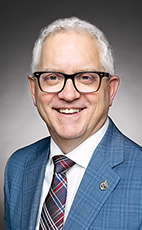
House of Commons photo

Crucial Fact

  • His favourite word was saskatchewan.

Last in Parliament April 2025, as Conservative MP for Desnethé—Missinippi—Churchill River (Saskatchewan)

Won his last election, in 2021, with 49% of the vote.

Statements in the House

Indian Act October 20th, 2023

Mr. Speaker, it is always a pleasure to stand up to speak on behalf of the people who I serve, but one of the things that we do not do in this place is recognize the people who serve us behind the scenes. I want to take a minute today to acknowledge my team, who work tirelessly, without recognition often, to serve not only the people in the House, members of Parliament like myself, but also the people who we represent, in my case specifically those from northern Saskatchewan. I want to take a minute to recognize Linnae and Emalie, who work with me here in Ottawa, and Dion, Hunter and Cindy, who are back in the riding. I want to make sure they know that they are appreciated for the work they do in serving the people that we get to serve.

With those comments out of the way, let us talk about Bill C-38 for a few minutes. I appreciate the opportunity that my colleague has presented to me to speak on this very important bill.

Bill C-38 is an act that amends the Indian Act to address four separate matters, which we have already heard about from the members who spoke already, but I am going to hit on these just for a few minutes.

First, it addresses the gendered inequity issues that were a result of enfranchisement. I am going to speak a little bit more about that in a few minutes. We have already heard as well that it addresses the issue of natal band reaffiliation. If passed, this legislation would allow women to affiliate with their natal band, or the band they came from before having been forced to change to their husband's band if they were married before 1985.

We have heard about the opportunity through application to deregister from the Indian registry. There is a number of reasons why people might want to do that. I am not going to get into the details of that. Finally, we have heard the conversation already today around replacing offensive and outdated language so that no individual under the act is referred to using any kind of discriminatory or offensive language. That, I think we would say, is a very good thing.

As has been mentioned as well, Bill C-38 is the continuation of a series of fixes, fixes that began in 1985 under then prime minister Brian Mulroney, some fixes that carried on in 2011 under then Prime Minister Harper, and finally, Bill S-3, which took from 2017 to 2019 through the Senate bill to make some progress on this.

Each of these pieces of legislation addressed various matters of gender-based discrimination in the act. While it is important to note that we support amendments to ensure that no federal legislation, including the Indian Act, has any discriminatory components to it, we must recognize that these amendments are just that, changes to existing legislation that supports the maintenance of the status quo, a status quo that perpetuates control over first nations people across our country. We cannot simply reverse the damage that these outdated laws have had, but what we can do is to move forward in support of first nations people on their journey to self-determination. Conservatives seek to ensure that we are making positive strides towards truth and reconciliation, and we know how important it is to hold open and honest discussions in doing so.

Since I only have 10 minutes here, I want to spend some time talking about enfranchisement. We have done a bit of that already, but I want to flesh it out a little bit as well.

For those who may not be familiar with the term, enfranchisement was a policy prior to 1985 that terminated an individual's right to be considered as a first nations person or have status under the Indian Act. As the parliamentary secretary, my colleague from Kenora, already identified, this could be done voluntarily or it could be done involuntarily. When we think of involuntary registration, as mentioned, it could be because they received a university degree, joined the medical or legal professions, married a non-Indian man or became a priest or a minister.

We have heard as well that there were a number of reasons for voluntary enfranchisement, although we use the term “voluntary” in this case when it does not seem like it was really of their own free will. Rather, other factors forced it upon them. Some, as already identified, gave up their status for the sole purpose of preventing their children from having to attend residential schools. World War II veterans voluntarily enfranchised to obtain the same essential benefits that other non-status veterans were provided. Some did so just to have the right to vote.

If we look at those examples of voluntary enfranchisement, it does not really seem like it was a matter of personal choice but maybe more a sacrifice of rights, or something that they were forced into, to protect members of their family or others.

Bill C-38 seeks to address some remaining gender-based inequities that were a result of this unequal reinstatement of status in 1985. In short, women who were enfranchised and later reinstated were placed in a different category than men in the same circumstances. Because of this, first nations women could not pass down status or rights to the same number of generations as first nations men could. This is something that this bill addresses. It has a ripple effect because it affects the descendants of these people as well.

I would like to encourage members of the House to talk to people and hear their stories. We have heard a couple already today, but they should talk to the people who have been affected by enfranchisement. I have heard many of these, and I am going to quickly share one story.

My team and I met with a Professor Karl Hele, a member of Garden River First Nation and a professor in Canadian indigenous studies. His personal experience with enfranchisement is not unfamiliar to many others. His mother and many other women in their community were targeted and coerced by an Indian agent to voluntarily enfranchise. This resulted in an unfair exclusion of their rights and those of her descendants.

To access his child's rights, Professor Hele had no other choice but to pursue legal action, which came at a hefty cost, both in time and resources, which is an option that many people do not have. This case highlights how the Indian Act gatekeepers have historically been, and continue to be, much of the problem.

It is little wonder that first nations people in Canada feel there is an Ottawa-led system, which feels broken. We need to fix it. I believe we need to acknowledge, despite amending the act, there still needs to be a change in how first nations issues are approached. This means acknowledging the failure in the cumbersome bureaucracy that is meant to support first nations, but instead often creates significant barriers.

The population of my riding is over 70% indigenous, and my team deals with the endless frustrations of individuals trying to either access their right to status, respond to other requests of maybe a financial nature or even access appropriate health services. Our office has been dealing with one individual who has been denied status time and time again. However, the bigger issue is not the denial of status, but that this individual has been given a variety of excuses for the denial, which contrast with their family story, and where other members of the family have been granted status under the same circumstances.

It seems as though this case has been passed around the department without a care or concern for the provision of an honest answer. That is unacceptable. In one of the calls with my office, this gentleman finally expressed his frustration and disappointment, and that he is going to give up because he believes he is going to die before this ever gets resolved. That is a very sad story.

What this story tells us is that we cannot accept simple amendments to the Indian Act as a means to an end. We can reshape the tool as many times as we like, but if we do not fix the mechanism, there will never be a fix for the problem.

Our Conservative team is determined to address this problem. In fact, we are proposing steps to do that. My friend from Kenora has already addressed one of those, in relation to our leader proposing the first nations resource charge and our plan for that.

The goal of the federal government should be to work with indigenous leadership to put the control of their communities back into their hands. While the hope for Bill C-38 is to address this to some degree and to respond to a constitutional challenge on enfranchisement, it is merely a small step in the long journey to self-determination.

We have a lot of work to do, and as Canada moves forward on eliminating the Indian Act, the “Ottawa knows best” mentality has got to go.

It is imperative that we recognize the rights and freedoms of first nations people across our country. They know what is good for them. They know what needs to be done. They have already taken many of the steps necessary by investing in projects and businesses, and creating prosperity and employment. They are focused on increasing capacity, and they are generating opportunities that will pay dividends for generations to come.

It is important that the government no longer stands in their way, and that we ensure that first nations are the decision-makers controlling their own destiny. We recognize that this is the only way forward, and although it will have its challenges, Conservatives are not afraid of a challenge.

In closing, let me simply say, under the leadership of a Conservative government, I would be very hopeful for the future of our first nations people across this country. I am personally very eager to see meaningful change.

Indian Act October 20th, 2023

Mr. Speaker, as has been part of the interaction of the members so far today, people tried to take credit for whatever and said that things were accomplished under certain governments. However, with the indigenous stakeholders that I talked to, they very clearly indicated to me that there has been more achieved for indigenous people in our country under Conservative governments than any other government in history. Does the member think it is time for a Conservative government to step up and effect the change that we need to improve the lives of indigenous people across the country?

Indian Act October 20th, 2023

Mr. Speaker, it is an important piece of legislation.

I would like to identify some of the time frames we see around indigenous legislation. Let us go back a couple of years to when Bill C-29 was introduced on June 22, the second-last day of the parliamentary session in 2022. Bill C-38, which we are talking about today, was introduced on December 14. We are now 11 months down the road and are finally starting to debate this very important piece of legislation. Bill C-53 was introduced on June 21, 2023, the very last day of the parliamentary session. In our office, we have a running comment about how we address indigenous legislation from the government: It is the “last-minute Liberals”. They are doing it at the last minute all the time.

The parliamentary secretary identified that there are some issues that still need to be dealt with. She identified the second-generation cut. There are several others that are identified in the engagement kit presented by this bill. If it was going to take 11 months to actually get this bill to the floor to debate, can she identify why we did not solve some of the other issues at the same time so we could speed up this process and solve some of the challenges she identified?

Leader of the Conservative Party of Canada October 3rd, 2023

Mr. Speaker, everything in Canada feels broken.

Canadians do not feel safe in their communities and life is now unaffordable for many. On my recent travels in northern Saskatchewan, I was reminded of this again when I found a $17 jug of milk, a $41 bag of flour and a four-dollar can of mushroom soup. Everything on every shelf everywhere has a huge freight cost.

What will these basic necessities cost if the NDP-Liberal government gets to its 61¢-a-litre tax on fuel? I will tell members. The lives of people in northern Saskatchewan and of all Canadians will not be better off.

However, there is hope on the horizon. Under the direction of the Conservative leader, we can put the pieces back together. He will lead a government that lives within its means, leaves more in one's pockets, protects its citizens and lets us feel safe again in the Canada we know and love.

For all Canadians, let us bring it home.

Budget Implementation Act, 2023, No. 1 June 5th, 2023

Madam Speaker, I would respond to my colleague's question by saying there are many things that we find missing in this budget and that are not included, one of them being the ability to control the inflationary spending and the huge deficits. Just six months ago, the finance minister talked about having to end the inflationary deficits because she acknowledged that they were fuelling the flames of inflation.

There are a lot of things missing in this budget. We have made it very clear that there are some requirements that are missing for us to support the budget. They would include a move toward a balanced budget and something to control the inflationary spending and the increasing cost of living. Those are the things that are missing in this budget that we feel are very important.

Budget Implementation Act, 2023, No. 1 June 5th, 2023

Madam Speaker, I agree with my hon. colleague. We have done some work on a number of different committees together and much of it around our first nations and other indigenous populations.

I would say this to the member. We sat at committee together the other day when we talked about the Parliamentary Budget Officer's report on the ability of the departments of CIRNAC and ISC to meet the goals and the targets they set for themselves, including the targets for things that he referenced. I would suggest that one of the things we need to do, as a House of Commons, is to find a way to create accountability to ensure that the bureaucrats in the departments, who are out there serving people, set good targets and are able to meet the targets they set for themselves so that we do not see huge investments in departments across government without the required outcomes to improve the lives of people.

Budget Implementation Act, 2023, No. 1 June 5th, 2023

Madam Speaker, Conservatives will talk about improving the lives of people. We will talk about the war on work from increasing taxes. We will talk about stopping the rising cost of living, the rising costs of food, fuel and housing. We will talk about making people more accountable to the people who elected them so that we can improve the lives of people all across this country.

Budget Implementation Act, 2023, No. 1 June 5th, 2023

Madam Speaker, it is always a privilege to rise to speak on behalf of the people of northern Saskatchewan. Debates such as this on Bill C-47 are good opportunities for members of Parliament to bring their own unique backgrounds and perspectives to the House. As a former accountant and mayor, members can imagine that I have dealt with a few budgets and many numbers in my day. I want to spend the first few minutes tonight talking about a few of these numbers, some very big numbers.

In 2015, when the Liberals were first elected, Canada's national debt was $612 billion. This budget projects Canada's debt to be $1.22 trillion by next March, which is $81,000 per Canadian household, and it will reach $1.3 trillion by 2028. A simple fact is that the Prime Minister has accumulated more debt in eight years than all of Canada's previous prime ministers combined.

How did we get here? In 2015, the total expenditures of the government were $280 billion. This budget again calls for billions of dollars in new spending. The Prime Minister simply cannot help himself. This past year, total expenditures were $480 billion, and this budget projects to start at $497 billion and rise to $557 billion by 2027-28. That is an average of $526 billion in each of the next five years. That is also $246 billion per year or 88% greater than expenditures were in 2015.

If this is what the finance minister meant when she said, “we will review and reduce government spending, because that is the responsible thing to do”, I would hate to see what the irresponsible thing looks like.

I have a couple more numbers. Canada will have accumulated over $700 billion of new debt under the Prime Minister by 2028. As projected, the cost of interest on that debt will rise to over $50 billion per year. That is more than a 100% increase over 2021 and 2022, and it would then become about 10% of the total expenditures of the government. If I had run my accounting practice for the little City of Meadow Lake the way the Liberal government has run Canada's finances, I would have been out of business and run out of office.

Let us consider some promises made in 2015. First, the Liberal Party said it would run small deficits and return Canada's finances back to balance in 2019. I hate to break it to the members opposite, but not only did the Prime Minister overspend this promise by about $700 billion, but the budget was never balanced and there is no plan to ever balance it. It is no wonder that record numbers of Canadians no longer trust their government institutions.

Second, the finance minister talked a lot about the declining debt-to-GDP ratio. This was her fiscal anchor. She said, “This is a line we shall not cross. It will ensure that our finances remain sustainable.” That sounds like another promise. I hate to once again break it to colleagues opposite, but the debt-to-GDP ratio has risen every year since the government was first elected in 2015 and is projected to rise again in the coming year. When the Prime Minister and finance minister make promises about debt and deficits, forgive me if I do not hold my breath.

Sometimes one must invest in things to be successful, so it is important to measure what one gets in return for choosing debt and increasing spending. Let us consider the state of Canada after eight years of out-of-control Liberal spending and inflationary deficits. Food price inflation is at a 40-year high. Nearly half of Canadians feel they are less than $200 from insolvency. One in five Canadians is skipping meals to reduce the cost of food, and 1.5 million people used food banks in a single month. The average cost of housing, both to rent and purchase, has doubled since 2015. This is the record of the Liberal government and the measures it is proposing in budget 2023 will, in fact, make the situation worse for Canadians by pouring another $67 billion of new deficit spending fuel on the flames of inflation.

I am very proud of coming from northern Saskatchewan. I believe it is an area that is a very good benchmark to measure how Canada's economy is performing. It is a region that has many important sectors of our economy: mining, forestry, agriculture, oil and gas, tourism, etc. It is also home to a unique cross-section of communities and people, communities and people that, frankly, should be thriving. Instead, everywhere I visit when I go home, people speak about how frustrated and desperate they are with the current economic situation.

Municipalities are struggling. The cost of much-needed infrastructure projects has ballooned over the last few years. Whether it be upgrading a sewer line, building a recreation complex or improving a street, community leaders are being tasked to do more with less. The result is that not only do they have to do the heavy lifting for their people, but the conditions under which they are operating keep getting worse due to the economic policies of the NDP-Liberal coalition.

These same policies are negatively impacting small businesses in northern Saskatchewan. This winter, I was talking to a business owner. He supplies people living in remote and rural communities with home heating fuel. He described to me the difficult position he was in due to the rising cost of this home heating fuel. His customers were either being forced to buy very small amounts, or they were pleading with him to extend credit until they could pay. They were having to choose between feeding their families or living without heat in the middle of a northern Saskatchewan winter, and he was having to choose between possibly losing money or seeing these families live without heat. That is the choice that this small business owner was facing because of the NDP-Liberal coalition nightmare.

Small business owners are also continually telling me how the carbon tax disproportionately affects rural and remote areas like northern Saskatchewan. This is becoming a very serious situation for them. Not only are they dealing with a labour shortage crisis, but due to the rising carbon tax they are forced to increase prices. Now the costly coalition is adding a second carbon tax that will ultimately add 61¢ per litre to the cost of fuel.

Everything, everywhere in northern Saskatchewan must be trucked. There is no other option. According to the Parliamentary Budget Officer, this will cost the average household in Saskatchewan $2,840 per year. Increasing taxes at a time when people are struggling to get by is not a recipe for economic success. Is it any wonder that the people I talk to are fed up?

That anger can also be felt when I talk to farmers back home. The government members seem to forget that agriculture is the economic backbone of Canada. A stabilizing sector and one that provides the food we all rely on deserves better from its government. Let us imagine being the Minister of Agriculture in Canada and voting against Bill C-234, a bill that would give farmers carbon tax exemptions to produce the food we need. If the minister will not stand up at the cabinet table for farmers, who will?

Let us face it. When it comes to agriculture, these Liberals have become the living definition of biting the hand that feeds them. In a country that feeds the world, Canada is now a place where people cannot afford food. For many people in northern Saskatchewan who were already struggling with the increased cost of living, the skyrocketing price of food has become a crisis.

“This isn't working” are the words of a food bank chair from northern Saskatchewan, who adds, “Everything is increasing—gas, rent, food, heat.... I just don’t know how people are supposed to manage.” The food bank's monthly food budget is $5,000, and it now provides half the number of food hampers that it did just three years ago. The Liberals' mismanagement of the economy, assisted by their NDP enablers, has created conditions that directly harm the most vulnerable in our communities the most.

All of this is while the people from northern Saskatchewan and Canada have a Prime Minister who spends $6,000 a night on a hotel in London, but would not admit to it for months and still takes no responsibility; a Prime Minister who vacations in Jamaica at a luxurious estate of Trudeau Foundation donors; a Prime Minister who spends $8,000 a month on groceries; a Prime Minister who is embroiled in a foreign election interference scandal and uses Trudeau Foundation members and friends to investigate; a Prime Minister who named an interim Ethics Commissioner who is the sister-in-law to a cabinet minister, who is also a long-time family friend, to replace the former commissioner who grew so frustrated by the continued Liberal ethical lapses that he finally walked away. This is not leadership by any measure at any time in our history.

Budget 2023 is not an economic document. It is the political document of a government led by a Prime Minister who has chosen power over principle.

New Democratic Party of Canada May 31st, 2023

Mr. Speaker, we know that Beijing interfered in the last two federal elections. The Liberals' response was to use their Trudeau Foundation friends to cover it up. The NDP's appearance of standing up to foreign interference is like a bad group-work partner: They arrive late, do nothing, copy others and then boast that the best ideas were their own. I guess the NDP is just an empty “bewoke” suit.

Just yesterday, after the bark and bluster of an NDP motion calling for the resignation of the special rapporteur, the NDP leader walked out of the House right into a media scrum, and dismissed calls to end this Canadian coalition nightmare.

If the New Democrats were serious about wanting to restore confidence in our electoral system, they would do what Canadians are asking: get out of the way and let Conservatives fix what the Liberals have broken.

Moose Hide Campaign May 11th, 2023

Madam Speaker, with Red Dress Day having just passed, it is important to continue our commitment to end violence against all women and children.

The Moose Hide Campaign is an indigenous-led, nationwide movement started along Canada's infamous Highway of Tears. It calls on men, boys and all Canadians to stand up against gender-based violence. The co-founders, Paul and his daughter Raven, started this campaign to honour women and children and to challenge men and boys to stand with women and children, to speak out against gender-based violence, to support each other, to hold each other accountable, and to be positive role models for one another.

By wearing a moose hide pin and participating in Moose Hide Campaign Day, Canadians are making measurable and meaningful progress towards reconciliation and the creation of a country where violence against women and children can no longer flourish in the shadows. I encourage all members of the House to show their support by wearing and sharing a moose hide pin today.