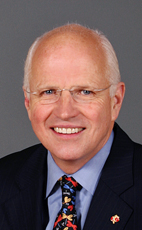
House of Commons photo

Crucial Fact

  • His favourite word was veterans.

Last in Parliament March 2011, as Conservative MP for New Brunswick Southwest (New Brunswick)

Won his last election, in 2008, with 58% of the vote.

Statements in the House

Petitions May 18th, 2005

Mr. Speaker, I have another petition which I know that you would be interested in because the petitioners are from Saint Andrews, New Brunswick, and I know you are familiar with that area as well as Bayside and St. Stephen.

The petitioners are calling upon Parliament to enact legislation that would prohibit the transport of LNG tankers through Head Harbour Passage bound for a refinery or an LNG terminal in Eastport, Maine.

I know the House wants clarification on this. Basically those LNG tankers can only get to the United States if they pass through this very dangerous Canadian passage. The petitioners are asking the Government of Canada to say no to the passage of those ships. I know, Mr. Speaker, that you would like to see that happen.

Petitions May 18th, 2005

Mr. Speaker, I have two petitions from my riding of New Brunswick Southwest, mainly the citizens of the Grand Bay-Westfield area, Nerepis area and that section of the riding.

The petitioners are calling on Parliament to pass legislation defining marriage as the union between one man and one woman to the exclusion of all others.

Petitions May 5th, 2005

Mr. Speaker, I have yet another petition to present from the citizens of Grand Manan Island, New Brunswick. They are opposed to the construction of an LNG terminal in Eastport, Maine.

One could argue or question why we would have a petition against a project outside of our jurisdiction. The LNG project in Eastport, Maine can only proceed if LNG tankers are allowed to navigate through Head Harbour passage, which is Canadian sovereign territory.

Our petitioners are asking the Government of Canada to say no to the transport of LNG tankers through that very dangerous passage. In fact it is rated as one of the most dangerous shipping passages in all of Canada. They are saying that we should exercise our sovereignty rights and not allow this to happen.

To conclude, they are saying that we should protect the fisheries, protect tourism and the natural wonders that make their area special.

Petitions May 4th, 2005

Mr. Speaker, I have a petition from the citizens of Deer Island, New Brunswick. The petitioners ask the Government of Canada to say no to the passage of LNG tankers through Head Harbour Passage, the most dangerous passage in all of Canada. In the words of the petitioners, please protect our fisheries, our tourism and the natural wonders that make our area special.

They call upon the Government of Canada to say no to the passage of the tankers.

Interparliamentary Delegations May 4th, 2005

Mr. Speaker, pursuant to Standing Order 34 I have the honour to present to the House, in both official languages, the report of the Canadian delegation of the Canada-U.S. Interparliamentary Group respecting its participation at the Canada-U.S. Partnership Day and meetings with U.S. legislators in Washington, D.C. on March 1 and March 2, 2005.

Civil Marriage Act May 3rd, 2005

Mr. Speaker, it is an honour to take part in the debate. I want to thank my colleague from Okanagan, British Columbia for allowing me to speak now and he will speak a little later.

From the outset I simply want to put on the record that I support the traditional definition of marriage as a union between one man and one woman to the exclusion of all others.

The debate is about the Government of Canada changing the definition of marriage; it is as simple as that. The federal justice minister suggested that we change the traditional definition of marriage from the union of one man and one woman to the union of two persons, which is the change that we are actually debating in the House today. I am fundamentally opposed to that and a number of my constituents are as well.

I want to mention at the outset that our party is the only party in the House of Commons that is actually having a free vote on this issue. We can talk about a democratic deficit in the House, as the Prime Minister used to do a long time ago and that he would do something about it, but the fact is we are the only party that will have a free vote in the House of Commons on this issue.

The NDP will not have a free vote. In fact, Mr. Speaker, if you have been observing, which you often do from the chair during votes, some of the members of the NDP have had to leave the chamber during the vote. They are not allowed the intellectual freedom to cast a vote according to the wishes of their constituents and their own conscience, which is a good word and a fair word to use. Of course it is the same for the Liberals. As for the Bloc members, we know how they are voting on the issue.

The Liberals do not have a free vote. It is disturbing to a lot of Canadians that if there were a free vote in the House of Commons, the bill simply would not pass. The Prime Minister has the largest cabinet in the history of Canadian government. All of those people will be forced to vote. They are whipped by the Prime Minister. They hold their positions only because of the wishes of the Prime Minister. In addition, there are the parliamentary secretaries. Three-quarters of the Liberal Party will be forced to vote according to the Prime Minister. There is no free vote in the House of Commons. So much for the democratic deficit and so much for the words of the Prime Minister. They mean just about as much in this issue as any of the other issues we have dealt with in the House.

The sad part of the whole debate is that the Prime Minister is attempting to pit Canadian against Canadian. The Liberals do not want a debate. I want to quote from some comments made yesterday by my colleague from Dufferin—Caledon because they focus on the level of debate the government wants to take us down to.

The government does not want to debate the question of traditional marriage versus same sex marriage. It would rather focus on attacking its opponents as opposing human rights and the charter. This debate is not about human rights. It is a political, social policy decision and should be treated in that light.

That fits in with what we have heard from so many speakers in the House. The previous speaker mentioned the same thing in terms of human rights. He quoted the United Nations charter as it relates to human rights and the whole marriage issue.

We are the only party that will have a free vote. We are the only party that introduced amendments to the legislation which, by the way, were voted down by the government. Again, the government members were whipped by the House leader and the Prime Minister.

We said that we would propose amendments, which we did and which were voted down by the House--Mr. Speaker, you were here for that vote--which amendments would provide clear recognition of the traditional definition of marriage. It is something that the courts were saying that Parliament should do, that Parliament should lead on this issue.

The Supreme Court is acting in a legislative vacuum. The leadership on this issue should have been exercised by the Government of Canada. The Supreme Court would take its message from the Parliament of Canada.

In addition to the recognition of the traditional definition of marriage, we were also proposing to provide full recognition of same sex relationships as possessing equivalent rights and privileges. In addition to that, we would provide substantive protections for religious institutions in the context of federal law, none of which exists under the present legislation.

The churches are afraid of prosecution under the act because the government has not taken the time to provide them with adequate protection. That is an argument that we are hearing from all religions and all denominations. We have seen those cards, letters and presentations from Catholic bishops, Baptist ministers, and the list goes on. Basically every religious group and every denomination in the country has concerns about the direction in which the federal Liberal government is pushing us.

There is an article written by Barbara Kay in the National Post . I want to read it because children are the one group of people missing in this debate. Other members have mentioned this as well. The title of Barbara Kay's article is “It's time to think about the children”. This is the point that Ms. Kay made:

Canadian researchers have made no effort to harvest the views of those who have the most invested in the gay marriage debate--children. Nobody has asked the children if they “strongly prefer, strongly reject or don't care” whether they have a single mom, single dad, mother and father, or two moms or two dads.

She said that “children are by nature social conservatives and will, by nature, respond that they prefer a mom and a dad”. She concludee by saying, “Canada is one of only three places on earth poised to endorse the use of children as social guinea pigs without their consent. And all because our intellectual and political elites haven't ever really thought about it”. They have not thought about the children.

That pretty well lays it on the line. That journalist is speaking for a lot of moms and dads and a lot of individual Canadians.

This is not about voting the wishes of our constituents. It is all about voting our conscience. There are members in our own party with whom we disagree on this issue. We respectfully disagree with each other on this issue.

This is an issue that does not have to come before Parliament. It does not have to be dividing Canadians. The track record of the government is always about dividing. It is never about uniting and bringing us together. This is a debate that should not happen.

The Conservative Party is asking the government to reconsider this legislation. It should reconsider this legislation in light of the impact it will have on our families and our institutions. We ask the government to simply stand back for a minute and listen to individual Canadians.

Petitions April 6th, 2005

Madam Speaker, there is one more petition and which is a very important one. I have risen many times in this House on this petition. This petition is completely different from the ones I have just tabled.

The petition is on the proposed LNG terminal in Eastport, Maine. This is a very controversial proposal to build an LNG terminal in Eastport, Pleasant Point, Maine.

Members may ask why would petitioners be petitioning the Parliament of Canada on a proposal in the United States. The reason is that this proposal to build this plant has been turned down in the United States in a number of areas up and down the New England coast. They have now identified an area in Maine which can only be accessed, believe it or not, by going through Canadian waters. These waters are very dangerous and include the very narrow Head Harbour Passage.

The petitioners want the Government of Canada to say no to the transport of LNG tankers through that passage simply because of the dangers that Canada would be exposed to.

The petitioners are asking the Government of Canada to do the very same thing it did approximately 30 years ago when it said no to the passage of tankers through Head Harbour Passage for at that time the construction of an oil terminal.

The petitioners ask the Government of Canada to say no to the passage of LNG tankers through--

Petitions April 6th, 2005

Madam Speaker, I have six petitions to present. Five of my petitions are on the traditional definition of marriage.

The petitioners are calling upon Parliament to protect the traditional definition of marriage as being in their opinion the lifelong union of one man and one woman to the exclusion of all others.

I would like to identify these five petitions by area. They are from a wide ranging area in my constituency. Most of them are from Fredericton Junction and Tracy. There is another group that has been signed by people in that same area of Tracy, Fredericton Junction and Hoyt. Another one is from the Grand Bay, Westfield, Nerepis area. There is another group of people from Grand Manan Island, an island of 3,600 people in the Bay of Fundy. Many of those citizens have signed this petition. There is another one from the area of Fredericton Junction, New Brunswick and Mazerolle Settlement.

Committees of the House April 4th, 2005

Madam Speaker, the question is very fundamental, but given the fact that we have a surplus today in the fund, that the fund is still generating revenues and in fact there is $60 million more in the fund this year than there was last year, why is the government so hesitant to do the right thing? Why does it not just simply compensate all victims, admit it was wrong, and carry on with doing what most Canadians would believe is the right thing to do?

Committees of the House April 4th, 2005

Madam Speaker, I have a question that I do not think I or anyone else in the House can answer but it is a fundamental question that one of my colleagues asked me and I want the member's sense of where he thinks the government is on this whole issue.

In his opinion, what prevents the government from doing the right thing, knowing full well there is enough money in the fund to do it, that any actuary outside of that fund would say yes, there is enough money there as evidenced by the $60 million in revenue that the fund generated last year, despite the fact that it paid moneys out? In other words, there is $60 million more in it than there was a year ago.

I would like the member to respond to that in terms of where the government's head would be on this. Why would it not do the right thing? Is it political stubbornness? What would prevent the government from doing the right thing?