Mr. Speaker, I rise on a point of order. With your permission I would seek unanimous consent to revert to presenting interparliamentary reports. I was late getting into the House and I was hoping I could do that today.

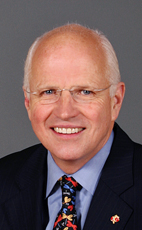 House of Commons photo
Won his last election, in 2008, with 58% of the vote.
Petitions December 14th, 2004
Mr. Speaker, I rise on a point of order. With your permission I would seek unanimous consent to revert to presenting interparliamentary reports. I was late getting into the House and I was hoping I could do that today.
Federal-Provincial Fiscal Arrangements Act November 29th, 2004
Madam Speaker, equalization is one of those arcane debates where not only members' but the listening public's eyes tend to glaze over because it tends to get very complicated and controversial. However, it is worthwhile to lay out what equalization is for our listening audience, if we have one, which I think we do, and maybe for some of our members to remind them what equalization is all about.
Equalization is a constitutionally entrenched program which allows all provinces to offer “reasonably comparable levels of public services at reasonably comparable levels of taxation”. Its goals are “to promote equal opportunities for the well-being of Canadians, furthering economic development to reduce disparity in opportunities, and to provide essential public services of reasonable quality to all Canadians”.
It is a fancier way of saying sharing the wealth with other areas, which is truly one of the unique features of Canada. We cannot say that for all countries. We cannot even say that for our neighbours to the south of the border despite the fact that they do a number of things well. Equalization is unique to Canada. We have to be very proud of it, but obviously it is ridden with its problems and difficulties. We are always trying to strike a balance that works at both the federal and provincial levels.
I want to point out what some of the premiers are saying, and then I will go on to our position as a federal party. The province of P.E.I. is an example. We have heard from Nova Scotia and Newfoundland today in the House, but I wanted to point this out because Newfoundland is obviously missing members of Parliament on the Conservative side. I guess we will have to work on that problem in the next election.
The treasurer from P.E.I., Mitch Murphy, is suggesting that cuts to equalization payments may be unconstitutional. He suggests that those cuts to equalization, what we are hearing now and his up to date figures, would indicate an additional $25 million loss, which would bring the total loss in revenue to P.E.I. in the next year to something like $78 million, a substantial amount of money. In my home province of New Brunswick, the premier is looking at a loss of about $100 million this fiscal year if the current formula holds.
What we are discussing now is Bill C-24. Bill C-24 is a bill that would bring in some changes to the arrangement, but I want to put on the record where we stand on it as a party, the Conservative Party of Canada. The Conservative Party of Canada views the equalization program as an essential component of Canada's nation-building efforts. In short, we support it in order for Canada's provinces to grow and prosper. It is important that a strong and effective equalization program be in place.
We accept some of what is in Bill C-24 because in fact the government accepted some of the ideas that we have thrown out during the election period and right here on the floor of the House of Commons. Bill C-24 addresses some of the concerns shared by the Conservative Party of Canada, the provinces and territories, notably the provisions for additional federal equalization and TFF, territorial funding formula, and a structure that sets the total level of funding going forward, not backward. These changes are an admission by the Liberals that their methods are flawed, were flawed in the past, and that the Conservative Party and the provinces have been right in calling for changes. Some of those changes again are inherent in this bill.
Unfortunately, Bill C-24 does not address how the equalization and TFF will be allocated among the provinces and territories from 2006-07 forward. We have to look into the future. One of the things we are suggesting, which again is in this bill, is that it examine the report or the future funding levels through a panel of experts. The government is doing that and it has bowed to some of the pressure we have put upon it to do that very thing. At the end of the day, the federal Liberals will retain the ultimate decision-making in the equalization formula. Although the panel of experts is a step in the right direction, at the end of the day the government will basically call the shots.
Again what I am suggesting is that the government is putting its own political agenda ahead of the provinces and the need for a fair and sound formula. Then there is the other point I want to make about what it does not address. This is a point that the members from Newfoundland and Labrador point out every time they are on their feet on this side of the House, although there is an absence of that on the other side of the House in terms of debate.
Our members from Newfoundland and Labrador and Nova Scotia consistently have talked about the inclusion of non-renewable resource revenue in the current equalization formula. Under the current formula, provinces that benefit from non-renewable resource revenues are subject to a clawback that results in lower equalization payments. We are saying that this should be included in the bill. We support the ending of that clawback so there can be no disagreement.
As you know, Madam Speaker, although your riding is far removed from Newfoundland and if I am not mistaken is in the heart of Ontario, during the election the Prime Minister made that promise in Atlantic Canada. He did that when the bottom was falling out of his campaign and he did it for one reason only: votes. It is very simple.
In the middle of the election he made a promise to the Canadian people, particularly those in Newfoundland and Nova Scotia, for votes. As some members have already mentioned, we probably should have had the Prime Minister put that in writing and sign it. But he is on the record. He was on national television. He went over there and made that promise to resurrect Liberal fortunes on the Island, in Nova Scotia and in Atlantic Canada in general, and he has reneged on those promises. That is wrong.
In terms of the Conservative Party policy, we have four recommendations.
The first is to allow reforms in the 2004 budget to take effect.
The second is to provide a formula driven approach. We have always been in favour of a formula driven approach that works and is consistent.
The third is to provide incentives for sustainability by carving out resource revenue from the equalization formula. I have spoken on that previously.
The fourth is to remain committed to the five year renewal schedule.
I believe that we can do better, as I have pointed out. I will leave my arguments at that and look forward to questions and comments from my colleagues.
Privilege November 29th, 2004
Mr. Speaker, I bring to your attention the notice of question of privilege, which obviously I had in your hands prior to question period. It has to do with an article that appeared on page 6 of the November 26 edition of the Fredericton Daily Gleaner , one of New Brunswick's three provincial English-language newspapers.
The article was written by Jorge Barrera. He reports on my election as chairman of the Canadian section of the Canada-U.S. Parliamentary Group, which is a recognized group within Parliament, with a long and very proud history. Those elections were held on November 24. Many positions were hotly contested. You, Mr. Speaker, and other members could back me up on this that it was probably the most hotly contested election for one of the positions in the history of this place.
As honorary chairman of that association, you out of courtesy visited that meeting on the Wednesday evening of November 24. The presiding officer at the election for co-chairman on the House side also conducted the vote on the Senate side. Under co-chairmanship, we have a chairman from the Senate side and one from the House side. The Deputy Speaker of this House, an officer of this place, presided over the election. That was not by accident. Knowing full well that there was at least 200 to 250 members registered to vote that evening, we knew the procedure would have to be ironclad and it would have to be done properly. If I am correct, you, Mr. Speaker, were originally approached to do that. However, because you were busy that evening, it was delegated to your Deputy Speaker to conduct the vote.
Knowing full well that it was hotly contested, the Deputy Speaker wanted to ensure that the membership knew clearly how the rules would be laid out and how they would be applied. He wanted to ensure that they were consistent with the constitution of that body, which they were. There was clarification sought from the floor. There was unanimous agreement among all members, including the member from Saint John, New Brunswick, who I am questioning as to why he would say what did. I will quote that in a minute.
There was unanimous agreement, including agreement from the member from Saint John, New Brunswick, who I beat in that chairmanship race in a vote recorded that evening. I will quote from the newspaper article in question, the November 26 edition of the Fredericton Daily Gleaner . The member from Saint John, New Brunswick, said, “Everyone assumed (vice-chair) was the position [the member for New Brunswick Southwest] wanted and he had applied for co-chair”. He said that it was unfortunate. This is where it becomes very problematic for the member for Saint John, Mr. Speaker, because he is questioning the integrity of your position. I point out that in Marleau and Montpetit, at page 298, it talks about the authority of the Speaker. It says:
Every action of the Deputy Speaker, when acting in the Speaker's place, has the same effect and validity as if the Speaker had acted; or, in the terms of the Parliament of Canada Act:
Every act done and warrant, order or other document issued, signed or published by a Deputy Speaker...that relates to any proceedings of the House of Commons--
We know full well that its a body that the House of Commons recognizes. It continues:
--or that, under any statute, would be done, issued, signed or published by the Speaker, if then able to act, has the same effect and validity as if it had been done, issued, signed or published by the Speaker.
He is calling into question the integrity of the Deputy Speaker of this place and the integrity of that committee. He said, “Unfortunately the committee”, which reflects on all of us, Liberals, Conservatives, NDP and Bloc, “decided not to follow the rules, leaving the Liberals following the rules”. That is not accurate and it is not true. The member himself was in that room when the Speaker sought clarification of how the rules were to be interpreted and applied, and he gave his consent. That is disingenuous at the least.
I believe there is a prima facie case of the integrity of the House and every member in it, the Speaker, the Deputy Speaker and the Senate. I believe it is contempt. At the very minimum, I believe you, Mr. Speaker, the Deputy Speaker, this place, including the Senate, deserve an apology from the member for Saint John for acting in that very callous, disrespectful, irresponsible way toward you, the House and all members.
At the minimum, I believe all members deserve an apology. I hope that other members will take part in this in an attempt to lay out clearly before the Chair what happened the night of November 24 when the member for Saint John lost a very hotly contested election. It is sour grapes at the best.
Petitions November 29th, 2004
Mr. Speaker, I have in my hand a petition signed by the residents of Deer Island, New Brunswick.
The petitioners are calling upon Parliament to protect the waters of Passamaquoddy Bay and the citizens of the area by saying no to the construction of an LNG terminal in Eastport, Maine, U.S.A.
The way in which we can say no is simply by not allowing the passage of those tankers through Canadian waters. We cannot control what happens in the United States but if those tankers do not go through Canadian waters, through a very dangerous passage called head harbour passage, that project will die a natural death.
The petitioners do not support the construction of that terminal and therefore are asking Parliament to say no to the transport of LNG tankers through head harbour passage.
The citizens of Campobello and Deer Island, New Brunswick would urge that we do that in a timely fashion.
Canada-U.S. Relations November 29th, 2004
Mr. Speaker, we are old and proud neighbours, and that view is confirmed by a survey just released on the eve of U.S. President George W. Bush's first state visit to Canada. Seventy-one per cent of all Canadians consider the United States our closest friend despite lingering trade disputes.
The presidential visit is a great opportunity to reaffirm that relationship and focus on the challenges facing the world's largest trading partners. For that relationship to thrive and grow, we need open borders and a commitment from the U.S. President that open borders will prevail.
This partnership in trade has been the single largest contributor to the relative wealth and prosperity that both nations enjoy. Let that prosperity continue.
Petitions November 24th, 2004
Mr. Speaker, I have a petition from the people of Campobello Island, New Brunswick and surrounding area. The petitioners call upon the Government of Canada to say no to the construction of an LNG terminal in Eastport, Maine, U.S.A. The key to this is that terminal can only go ahead if we allow the passage of tankers through internal Canadian waters.
The petitioners are asking the Government of Canada to do what it did 30 years ago in similar circumstances when a proposal of that nature was being considered in the United States of America. We said no to the passage of those tankers through internal Canadian water.
These people understand the risk to the environment, to our citizens, and are asking the Government of Canada to say no to the transport of LNG tankers through Head Harbour Passage, Canada.
Supply November 23rd, 2004
Mr. Chair, that is absolutely unfair and untrue. The minister should be completely ashamed of himself for making remarks like that. We know what the government has done on this issue. It has stonewalled the House. Compassion is simply not part of the equation. The Liberals made a calculation. They miscalculated. They were told from 1998 forward, even by Justice Krever, that they were making a mistake not to compensate all victims. For the minister to suggest otherwise is not even reasonable. It is completely unfair.
The onus, the responsibility for this fund is clearly at the doorstep of the government. In my opinion, the minister should divorce himself from those kinds of partisan remarks. It is the responsibility of the opposition in the House to keep the government responsible, make it responsible and force it to do the right thing.
Why will the minister not stand in his place and simply do the right thing, admit his mistake, and admit the mistake that the government made in 1998 with the original package in compensating only some victims and not all the victims, completely ignoring Justice Krever?
Supply November 23rd, 2004
Mr. Chair, the government of the day appoints that council. The minister should look at some of those political appointments that were made, because truly they do not reflect the wishes of Atlantic Canada. There is a level of unfairness in that funding, aside from what the minister has pointed out.
There is one other point I want to bring up tonight. It was spelled out in today's Ottawa Citizen . Our health critic, the member for Charleswood--St. James--Assiniboia, really went after the minister a couple of days ago on the hep C payment issue. The government has been very negligent on that, in fixing those dates where many of the victims were obviously left outside of the original package, the only package that we know. When the minister responded he basically suggested that our health critic lacked compassion and was trying to use the victims of hepatitis C to score political points. That is way over the line.
I believe that the House and the member, particularly this side of the House, is entitled to an apology from the minister for making those kinds of callous remarks, especially to an individual and a party that have worked so hard for some fairness and sensibility on that whole funding issue.
If members recall, I was the first member of Parliament in the House in 1998 who suggested full compensation, followed by the critic for the Reform Party at that time, Grant Hill. We have a record of standing in the House and demanding fair and compassionate treatment. Why would the minister use that kind of language when referring to our health critic yesterday in this place?
Supply November 23rd, 2004
Mr. Chair, I noted that earlier this month the Canadian Institutes of Health Research announced its funding. I think it totalled around $187.5 million this year. Of that $187.5 million, Atlantic Canada only received $4.8 million and the province of New Brunswick, my home province, received only $243,000. If we do the percentages, that is less than one-tenth of one per cent. Why the dismal amount for the province of New Brunswick?
The Environment November 23rd, 2004
Mr. Speaker, 30 years ago the Government of Canada said no to the transport of tankers through Head Harbour Passage to a proposed oil refinery in Eastport, Maine, U.S.A. The government of the day took the strong position to protect Canada's environment by refusing the passage of tankers through internal Canadian waters, the only route possible. The project died.
Today a similar project is being considered in the United States. This time it is a liquefied natural gas project. Canada has everything to lose and nothing to gain from this proposal.
I urge the Government of Canada to once again stand up and protect our citizens and our environment, and say no to the transport of LNG tankers through Head Harbour Passage.