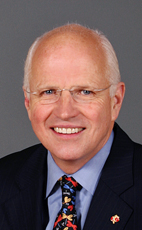
House of Commons photo

Crucial Fact

  • His favourite word was veterans.

Last in Parliament March 2011, as Conservative MP for New Brunswick Southwest (New Brunswick)

Won his last election, in 2008, with 58% of the vote.

Statements in the House

The Budget February 18th, 1999

Mr. Speaker, it is cold outside today and I do not want to sit outside, so I do apologize for that unkindly word.

I think Diane Francis can say it better than most of us in this House. In an article in yesterday's Financial Post she calls it “fiscal fairy tales”. Is that better, Mr. Speaker? She wrote, “the minister is a master at devising fiscal fairy tales”. This is his sixth in a row, fiscal fairy tale.

The Budget February 18th, 1999

Mr. Speaker, I apologize to Mark Twain.

The Budget February 18th, 1999

Mr. Speaker, it is nice to respond to the budget. In all fairness, there has been a lot of good publicity on the budget and most of us would accept that fact although we may disagree with some of the headlines. There has been some analytical appraisal of the budget and not all of it has been favourable. Despite the optics, this budget is going to have a very short shelf life and the reason has been articulated in the House more than once this morning.

When I look at the budget, at the numbers and at how it was presented by the finance minister, I cannot help but think of Mark Twain who coined the expression “lies, damned lies and statistics”. I am much too polite to use the word “lie” in this House when it comes to the budget but I would suggest that the minister is using a lot of creative accounting to come up with the numbers. No one here knows what the real numbers are.

Not one member on either side of the House can tell us how the surplus in the EI account works into the budget numbers. No one knows and if they do know they are not going to tell us. If they did, I think it would expose the finance minister for what he is, someone who is capable of balancing the budget on the backs of the unemployed. The number we often hear is $20 billion which has been taken out of the hides of the employers and the employees and used to help creatively balance his books.

There is a lot of doubt in the minds of ordinary Canadians as to what the minister has really done in the last six budgets he has brought into this House. I agree with the member next to me that a lot of the policies this very government fought against are the ones that are delivering the numbers the Liberals brag about.

We mentioned specifically the free trade agreement. We mention the GST from time to time on this side of the House. It is rolling in revenues of about $20 billion this year compared with about $12 billion the day it was brought in. That is about $20 billion the minister would not have to play with if he had lived up to the 1993 red book promise to rid this country of that hated GST. He can roll around in the luxury of having it there but he has not had to pay the political price for introducing it.

Is that not the Liberal way? Mr. Speaker, I see you nodding in agreement. There is at least one person in this House who is agreeing with me. You were there and you fought that election. You know on the basis of how you fought. That is even a bigger nod, Mr. Speaker. Thank you for that honesty.

This has been called the health budget. We have to be careful what the Liberals call it. I think this same minister called a budget he introduced a couple of years ago the youth budget. Immediately after he introduced the so-called youth budget, 12,000 young Canadians filed for bankruptcy because of their inability to pay off their student loans. Thousands are leaving this country to seek employment.

I do not think the minister can take too much satisfaction from the thematic approach to budget making. Goodness knows what is going to happen to those people who depend on health care services, given the track record of this minister.

The theme is health care. The Liberals are bragging about putting $11.5 billion in. You are right, Mr. Speaker, they are putting it in or we are being led to believe they are. But the timing is the thing, is it not?

The first chunk of change to go in is going into what is called a third party fund. Mr. Speaker, have you ever heard of that type of fund before? It is a clever word game, a third party fund is being created. It will be a $3.5 billion fund but no one is going to draw down any money this year. It will be next year and the year after.

I agree with the member from Manitoba in that I think it is going to coincide with the finance minister's leadership bid. I should not mention the dirty word leadership in here but that is exactly what he has done. He is very clever. The timing will work out perfectly for the finance minister.

Sadly, this is like giving the arsonist credit for burning down your house and then building you a one room shanty. That is exactly what the finance minister has done. He took the torch to health care five years ago. And torched it he did. He immediately extracted almost $6 billion out of health care. He put back $11.5 billion after extracting $6 billion in health care alone and he took $17 billion from the social transfers. If we follow his scenario to its logical conclusion, in the year 2004, we will be into the next millennium if we make it that far, and health care spending will be back to the very same level that we had in 1995.

In Atlantic Canada we call that backward speaking. That is absolutely bizarre. He is taking credit for inventing health care when he is the man who single-handedly wrecked health care. Now the Liberals are standing up and bragging about it.

Back in all the provinces where the hurt was really inflicted, back in New Brunswick and every other province, including his friend Roy's whom he likes to brag about in the House, they are questioning what they are going to do with this money. The feeling is that this infusion of $11.5 billion is going to be used by the provinces to eradicate debt that this character imposed upon them. There will be no change in patient care.

I am speaking about the shelf life of this budget. There will be no changes in terms of rural doctors and services for rural Canadians for years to come. There will be no change in waiting lines or in emergency wards. People are still going to be waiting. They still will not receive the care they should be receiving.

In fact, when money is taken out at the rate the minister has taken it out of health care, it takes more to bring it back to where it was. An analogy would be a house with a leaking roof. If we let the roof leak, the problem gets worse and instead of just having to fix the roof, we would have to fix the rafters, the floor joists and the floors. We are talking about maintenance. They have not had the money to sustain the system over the years. Now we are going to have to wait until the year 2004 before we are back to the level we had in 1995.

Would it take a rocket scientist to figure this guy out? No it would not. It would take an ordinary citizen to look at the numbers, if they were provided. Unfortunately the minister does not disclose the real numbers because he is devious. He is the Houdini of finance. I suggest that he go back to the provinces and teach those finance ministers the magic in his numbers. I go back to the old Mark Twain expression “lies, damned lies and statistics”. This minister fits into the very first category mentioned.

Canadian Human Rights Act February 9th, 1999

Madam Speaker, I am up on the same topic and the same question to the minister. I hope that I do not get the same reply from the parliamentary secretary. He is dodging the real question of what happened to that federal money when the agreement was broken by the province of New Brunswick. That is the big unanswered question in this House.

The only thing I can agree with in terms of what the parliamentary secretary said is that the federal government is examining future agreements. It has admitted that this agreement was violated. It goes beyond the violation of the agreement that upsets me.

The agreement was made by the former Minister of Transport in this House, a man by the name of Doug Young. He now happens to be the chairman of the Maritime Road Development Corporation, MRDC. His company is taking control of what is truly a provincial constitutional issue. His company will determine the weights on that highway, the tolls on that highway and the maintenance on that highway. Basically, the province of New Brunswick has abrogated its responsibilities. The feds are sitting back here nodding their heads in agreement, protecting their old friend, Doug Young.

That is wrong because at the end of the day it is going to cost the citizens, the taxpayers of the province of New Brunswick more money than if they had built the highway themselves. This is ridiculous.

There is also another difficulty in terms of transportation. It now costs one single truck $20,000 a year to use that highway if it is used 365 days a year. That is a $20,000 increase in the operation of just one vehicle.

They have sat back and allowed them to set those tolls which is absolutely indisputably wrong. We are asking for a correction. We are also asking for leadership in this House from the Minister of Transport to renege on that type of an agreement and to take the province of New Brunswick to task on that type of agreement.

It is double jeopardy for taxpayers. The toll payers and the taxpayers are one and the same person. Why should they pay twice for the same piece of highway? The only reason they are going to pay twice is because it is going into the hind pocket of their friend, Doug Young, the former Minister of Transport, who set the deal in motion right here in this House. They reneged on their own signature.

The premier of New Brunswick is finally admitting that there is going to be money coming off this deal. Where is it going? It is going into what they consider their own little fund but it has nothing to do with paying off that highway and kicking Doug Young and the rest of them out of the deal.

That is what we want to see happen: leadership at the federal level. Anyone who can stand in the House to defend Doug Young does not understand how this toll highway works.

We are asking again for leadership from the federal level to make sure deals like this one do not happen in the future. Taxpayers can only stand so much punishment and this is extraordinary punishment brought on by a Minister of Transport who does not dare to stand up to his old friend.

Railway Safety Act February 1st, 1999

Madam Speaker, I am pleased for the opportunity to take part in third reading of Bill C-58, an act to amend the Railway Safety Act and to make a consequential amendment to another act. This act is basically the same as the previous Bill C-43 introduced during the last parliament. Unfortunately it died on the order paper at the call of the last election.

The bill proposes amendments to the Railway Safety Act which came into effect in January 1998. The statutory review took place after five years. The result was the previous Bill C-43 and now the bill that has replaced it, the one before us, Bill C-58.

The bill will provide the necessary authority to require railways to implement safety management systems. This is a preventive measure that will work to enhance the procedures of railway companies. The bill will also provide greater involvement of the affected organizations in rule making. It will allow communities to become involved in the issue of train whistles.

It does not sound very important but it is. For one living in a community next to a railway track it becomes a disruption. I am being told that this will ensure local communities will have their say on how that is handled, not at the expense of safety but by attempting to eliminate that disruption in certain communities because of rail lines and their crossings. The community and the railway will be able to work together under the legislation to provide for minimal disruption of the community and, as I said earlier, to provide the highest level of safety at crossings.

The bill will now clarify and strengthen the federal powers at road crossings which will allow for safer crossings at a time as speeds and volumes are increasing, which makes safe crossings that much more important. Particularly with the increase of car and truck volumes using our road system and the rail industry competing globally with increased volumes, it is much more important that we become vigilant to support or provide for the safest possible system when these two modes of transportation meet.

Increased crossing safety is the utmost importance considering the circumstances when there is an unfortunate incident at a crossing. Railway crossing safety will become even more critical as volumes increase. The Maersk-Sea Land's post-panamax strategy for North America may and most likely will include Halifax. We are hoping Halifax will be the container port of choice by huge new vessels which will increase traffic volumes immensely. Nova Scotia's economy, indeed the Canadian economy, will benefit greatly if Halifax is chosen.

I take this opportunity to impress upon the federal government the importance of the Halifax bid. My seatmate from Nova Scotia and our transport critic from Cumberland—Colchester have been working very hard to make sure that the bid is given some recognition by the government. Unfortunately the government has been what we call shamefully silent on the issue. It has to be a little more aggressive in that bid if Halifax is to be successful.

I am getting off topic a bit but the Halifax terminal is up against some pretty stiff competitors. It all fits into the safety implications of the bill. The container line coming into Halifax and the super port would increase volumes dramatically on the railways and on the highways simply because of the loads super carriers would be bringing into the port of Halifax if it were successful.

One thing that annoys me about the federal government is its lack of support of the Halifax bid for the super port. I have before me an article that was carried in the Halifax Chronicle Herald in September 1998 wherein the federal international trade minister was urging New England business leaders to back the bid of Halifax for super port status.

It is interesting that Halifax is looking for $50 million from the federal government to help with the bid to become the named port in competition with ports along the American seacoast. Yet here we have the Minister for International Trade urging New Englanders or New England business to support our bid but not coming up to the line on behalf of the Government of Canada to support Nova Scotia in that bid.

Halifax is on the short list and it is coming down to a choice between Baltimore, New York, New Jersey and Halifax. It is up against some pretty stiff competition. The federal government has to be a little more active on that file if Halifax is to be successful. We can be sure that the Americans will use everything at their disposal to make sure they are successful.

Just a week or two ago I was listening to a New York radio station and I know hundreds of millions are now being spent to dredge the New York-New Jersey harbour in anticipation of receiving the go ahead; in other words that it will be the favoured port.

The Americans are doing everything they can to secure that bid, and we are sitting in Ottawa doing absolutely nothing. I urge the federal government to talk to the industry minister and the finance minister. It is time we did what our American competitors are doing to ensure success by investing in the future of Nova Scotia, the east coast of Canada and the Canadian economy. This is a big money maker, a big job maker. It is time the government at least acknowledges the writing on the wall and plays hardball with our American counterparts. Otherwise it is like rolling over and playing dead to the elephant. I do not think that we can afford to do that any more.

The transport minister's parliamentary secretary is here. He is a very capable individual. I hope he impresses upon his minister the importance of the bid so that we can move on with it.

Another measures contained in the bill is the authority to regulate railway emissions. Our environment is a valuable asset, one that we cannot replace. It is not as if it is a renewable resource. We have one and we have to take care of it. We support any measures to protect it, and that is included in the bill.

The last feature to which I will speak is the security of the railway system. Bill C-58 will improve safety, not only for the travelling public who uses the rail system through VIA Rail but also the vital link which has a major impact on the success of the Canadian economy.

The Railway Safety Act which passed in 1988 was a significant change in the way we regulate railways and how railways interact with government. This has proven to be a very good approach, and with the legislation before us today I hope it will become that much better. I might add that I was a member of the government that passed the legislation in 1988.

The member for Cumberland—Colchester examined the bill in detail at the committee stage and was glad to hear the witnesses who appeared before the committee, including CP Rail, Canadian National, the Railway Association of Canada and three groups representing labour. We are also pleased with the exhaustive consultations that took place with the stakeholders involved and their valuable input.

I emphasize that it is a top priority of our party to ensure safe railway operation. In conclusion, I am glad to say that we will be supporting Bill C-58, the Railway Safety Act, as we look forward to the safer railway system which will be a result of the bill.

Privilege December 8th, 1998

Mr. Speaker, this question of privilege arises from a situation that occurred on December 3 following question period. It was the same situation that occurred with the member next to me with regard to a question put through you to the Minister of Transport that involved a former member of the House, Doug Young, who is involved in a very controversial highway deal back in New Brunswick.

Yesterday I rose on a point of order, not on a question of privilege. I do not have to get into as much detail as the member from Nova Scotia who sits next to me did, but it was the same force of intimidation and innuendo that the member for Kenora—Rainy River used against the member from Nova Scotia. That same tactic was employed against me outside the Chamber in the parliamentary precincts.

It has gone beyond that. Not only has it happened to me and the member next to me from Nova Scotia, but it has happened to a number of members of parliament on the same issue through the same member and his staff.

This is where it becomes confusing. Yesterday I rose on a point of order and not a point of privilege. The issue is very serious. I will go through specific citations in Beauchesne's. Citation 92 reads:

A valid claim of privilege in respect to interference with a Member must relate to the Member's parliamentary duties—

It did. It related to a very sensitive question in the House to which the member opposite took offence. He used threats and intimidation to shut me up but it did not work. I will now read citation 93. I want the House to listen very carefully. It states:

It is generally accepted that any threat, or attempt to influence the vote of, or actions of a Member, is breach of privilege.

Reading on in Beauchesne's sixth edition, citation 99, which is the important one for you to hear, Mr. Speaker, reads:

Direct threats which attempt to influence Members' actions in the House are undoubtedly breaches of privilege. They do, however, provide serious problems for the House. They are often made anonymously and it is rarely possible for the House to examine them satisfactorily.

This was not made anonymously. It was made in the flesh by the member for Kenora—Rainy River. Citation 99 concludes with the following:

The common practice today is to turn the responsibility for investigating them over to the ordinary forces of the law.

In his apology yesterday to one of the other members, which is inferring I guess an apology to me, the member was quoted as saying “if I really meant this threat, if it was a pure and honest threat and I carried through with the threat”, to quote the hon. member for Kenora—Rainy River from yesterday's Hansard at page 10986, “I can assure you, he would not be sitting over there today”, pointing to our seats.

That is a threat. It is not ambiguous. It is direct and is not in any way made anonymously. It was made by that member sitting over there. I think this goes beyond an apology. It is a prima facie case of breach of privilege.

Points Of Order December 7th, 1998

Mr. Speaker, it is a point of order in the sense that the same situation happened to me as another member of parliament. That is the point I want to make.

Further to that, it was the same language and the same tone as used by the member for Kenora—Rainy River to me as a member of parliament based on a question that I had for the Minister of Transport on the same individual, Mr. Doug Young. I think it is out of character for the member to do that, but the same language and the same inference was used.

The point I want to make is simply that in the apology he said that if he were serious I would not be standing here today. In other words, how do we know when he is serious and when he is not?

Points Of Order December 7th, 1998

You didn't hear the whole conversation, Mr. Speaker. That is the point I am trying to make.

Points Of Order December 7th, 1998

If you can't get up on a point of order, what is the sense of being here?

Points Of Order December 7th, 1998

Mr. Speaker, I think I was part—