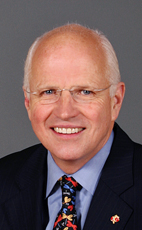
House of Commons photo

Crucial Fact

  • His favourite word was veterans.

Last in Parliament March 2011, as Conservative MP for New Brunswick Southwest (New Brunswick)

Won his last election, in 2008, with 58% of the vote.

Statements in the House

Tobacco Act November 25th, 1998

Madam Speaker, I rise on a point of order. I am not prepared to give unanimous consent to that motion, simply because the government rammed this through clause by clause at committee stage. Basically it boils down to the government making a major mistake.

Hepatitis C November 23rd, 1998

Mr. Speaker, before I get to my question, I want to recognize the hon. member for Moncton—Riverview—Dieppe, the latest addition to the cabinet from New Brunswick. It is nice to see her.

I want to ask the Minister of Health if there is any possible way that the funding of $1.1 billion for compensation to hepatitis C victims from 1986 to 1990, which has been agreed on, can be moved along through co-operation with the provinces. Many of these people are hurting badly.

Hepatitis C November 23rd, 1998

Mr. Speaker, today the Government of Ontario followed through with its promise to compensate unilaterally pre-1986 and post-1990 hepatitis C victims. Recognizing the federal government's failure to do the same, will the minister provide us with an update on the unacceptable slow delivery of the compensation package several months ago? What is the status of that package? What is the minister doing to expedite the delivery?

Supply November 19th, 1998

Mr. Speaker, both myself and the member for Winnipeg North Centre have been on our feet probably more than anyone in the House this week in terms of government legislation and what is coming down, including this opposition motion today.

She is right.

The government had a chance yesterday to do something about health care which at the end of the day would have saved the Canadian public $3 billion a year. I am talking about Bill S-13, Senator Kenny's bill, which would help to reduce smoking among teens. That is costing us 40,000 lives a year in Canada at a great cost to the health care system. I do support what the member is saying.

Supply November 19th, 1998

Mr. Speaker, there is nothing like a lynching in the morning to focus the mind.

These people are obviously playing politics with health care because of the upcoming election in Quebec. They sat here in the House between 1993 and 1997 and never said a word about the cuts to health care back in their home province.

It was a slash and burn policy and they sat here in silent agreement and did not open their traps when it came to health care.

Now they find that their own premier is in deep trouble on health care, right up to his eyebrows, because he mismanaged health care from day one, starting right here in the House of Commons when he was sitting in the front row.

Bloc members are trying to salvage his career—

Supply November 19th, 1998

Mr. Speaker, the member has selective memory, because we did not add a nickel to the debt. The deficit was caused by the compound interest on the debt that his party left us. That is a fact. When Pierre Trudeau became Prime Minister of Canada in 1967-68 Canada was debt free. But that is an old argument and I will not get into it.

I have given the government credit in terms of deficit reduction. Unfortunately, it has done it on the backs of the provinces, hence the $7 billion extracted out of the system. Now it is balancing its books on the backs of the unemployed.

Supply November 19th, 1998

Mr. Speaker, the person I was talking about, whose initials are JC, would be the Prime Minister of Canada, often referred to as JC by the solicitor general in conversation.

The Prime Minister was allowed to do it. The provincial premiers silently nodded in agreement as the Liberals extracted $7 billion from the health care system. There is no government on the face of this earth that could get away with that in a parliamentary democracy.

I endorse exactly what the member for Winnipeg North Centre has articulated. It is correct. Every major medical association in Canada has told us the same thing. To be precise, the Canadian Medical Association has said that there has to be an immediate injection of $2.5 billion in the system. The nurses' associations are telling us the same thing, within degrees of dollars here and there.

Health care is delivered by human beings. That is what the minister forgets. At the end of the day, human care has to be there. That has been articulated well by the nurses' associations and the doctors across the country. Sadly, because of these draconian cuts in health care, some of our brightest, most highly educated, most dedicated workers are having to go elsewhere to seek their profession.

I support an injection of funds in health care. It is purely and truly consistent with our position as a party. I look forward to questions and answers from my colleagues.

Supply November 19th, 1998

We will talk about that as well. I was a member of the finance committee and I will talk about any of those issues. I will stand to defend everything that we did.

They slashed $7 billion from the health care system. How did they get away with it? It was simply because they did not have any opposition here in the House of Commons. There was none.

There has to be someone in the House with a social conscience. In the last parliament the official opposition was the Bloc. Bloc members were focused and are still focused on one issue and one issue only. They did not fight for health care in the House of Commons between 1993 and 1997. Never. They are only using it today as a political ploy.

The other major party in the House of Commons at that time was the Reform Party. In terms of its strategic position, the Reform Party was somewhere to the far right of Attila the Hun. There is nothing the government could do to health care that would concern it. Its position was to scrap the Canada Health Act. The only time in the House when I actually have a smile on my face when I hear the Minister of Health speak is when he reminds the Reform Party of what its policy is in regards to health care.

They get away with it here on the floor of the House of Commons.

The other thing that is interesting is that the Liberals' provincial cousins back home were nodding in silent agreement as they cut the $7 billion. They were saying “What more can we do for you?” Premier Frank McKenna did not open his mouth when these cuts were coming down. Why? Because it was his friend Jean Chrétien who was doing it. He did not open his mouth. So they got away with it.

Supply November 19th, 1998

A member opposite says that it is good literature. That is exactly what it is. It is just literature and words. It has nothing to do with reality and implementation. It is a corporate plan. Corporate Americans are going to take over our health care system in Canada. Give them time and they probably will.

I am quoting from page 77 of the infamous red book of 1993. It describes how a Liberal government will face the challenges of health care:

A Liberal government will face these challenges squarely, thoughtfully, and with confidence. Our approach will be based on our values. Our solutions will be predicated on our commitment to the five fundamental principles of our medicare system, and on our commitment to the continuing role, in financing and in other aspects, of the federal government in health care.

It worked. They were successful in winning the election of 1993. But what did they do? They came in with sort of a scorched earth policy in terms of health care. That is exactly what they did. Immediately they slashed $7 billion from the system.

The question is: How could they get away with it? Name one government in the history of this country that could ever get away with slashing $7 billion unilaterally from the health care system. The Conservative government, despite all of its faults between 1984 and 1993, could never have gotten away with that. It did not even try.

Supply November 19th, 1998

Mr. Speaker, I do not think too many people know who the health minister is because it is not the first time this has happened.

More important is the fact that the parliamentary secretary to the finance minister is the person leading the debate today. Does that not tell us something about the government, where its head is at in terms of health care and what is important? Obviously the most important thing to the government is the finance minister's position as it relates to health care. It has nothing to do with the health minister. This health minister has to be the weakest health minister we have had in parliament for many years.

Given the fact that the parliamentary secretary to the finance minister is carrying the debate on behalf of the government, and understanding that the health minister is not doing it, nor is the parliamentary secretary to the health minister doing it, and given the fact that the finance department is handling this debate today, I want to go back to 1993. This will give us an understanding as to why the finance department is leading the debate and not the Minister of Health, although I cannot obviously allude to his absence in the House, as you pointed out so clearly in your ruling, Mr. Speaker.

I am quoting from the red book of 1993. This was the book which helped the Liberals get elected in 1993. It basically outlined what they were going to do.